Skip to content
Dabour HubLEARN · PRACTICE · EXPLORESign inStudent

19.1Electric Current and Circuits

Electric Current, Potential Difference and Power — American System Physics Revision Notes & Topical Questions
10 min read 7 parts Lesson 3 of 5 1 quiz

🩺
100% Curriculum Specification Match Lesson Doctor Verified
The only platform with 100% curriculum specification match and verified interactive question banks.
0%read
Lesson summary

Define current, charge, e.m.f.

  • Charge = current × time
  • Current = charge ÷ time
  • Power = current × potential difference
  • Power = energy ÷ time
  • A charge of 180 C passes through a lamp in 2.0 minutes. Calculate the current
  • Electric charge

Section 1 of 7Electric Current, Potential Difference and Power

1
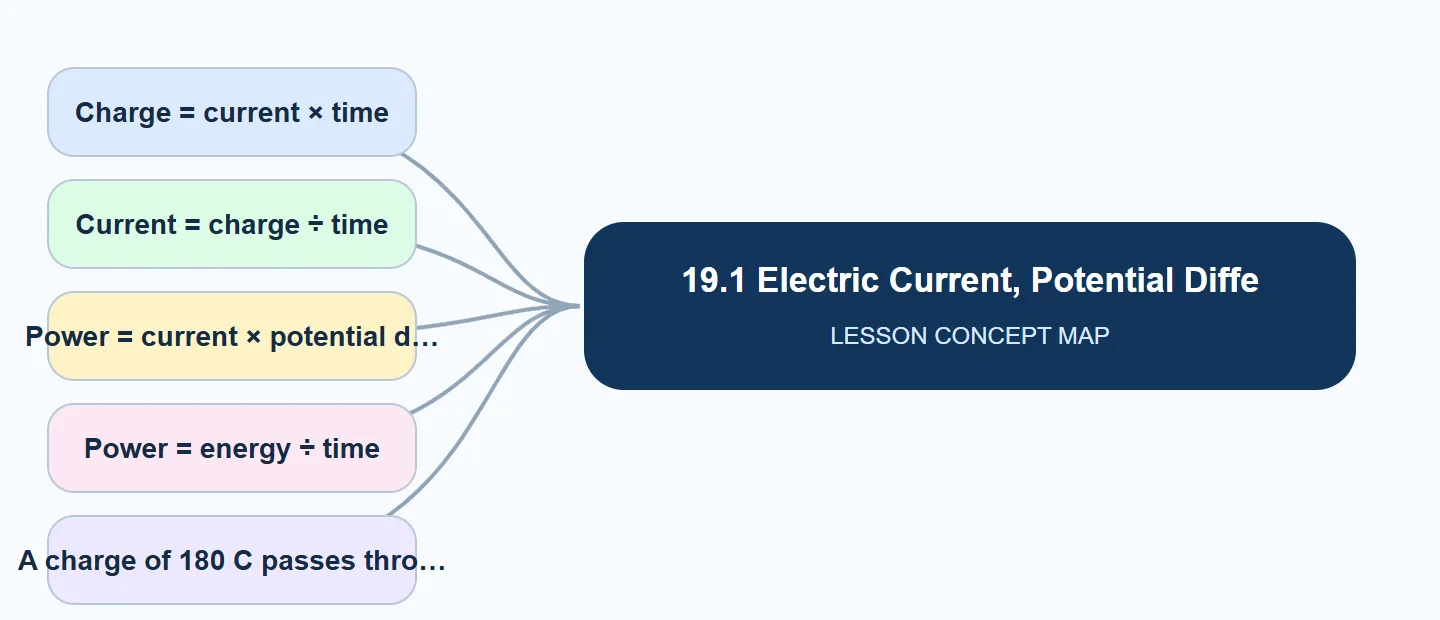
19.1 Electric Current, Potential Differen… concept map: Charge = current × time, Current = charge ÷ time, Power = current × potential d, Power = energy ÷ time, A charge of 180 C passes thro
Visual guide to the key ideas explained in this lesson.
2
Metals contain free electrons that move randomly. When a source is connected, an electric field is set up in the wire and the electrons drift towards the positive terminal. This drift of charge is the current.
3
Conventional current was defined before electrons were discovered, as flowing from + to −. Circuit diagrams and rules (like the right-hand rules) use conventional current. Electron flow is from − to +.
4
Current is measured by an ammeter placed in series. Because the same charge must pass through every part of a single loop, the ammeter reading is the current in that loop. An ideal ammeter has zero resistance so it does not change the current.
5
The charge on one electron is 1.6 × 10⁻¹⁹ C, so 1 C is the charge of about 6.25 × 10¹⁸ electrons. A current of 1 A means 1 C passes a point each second.
6
A source (cell, battery, power supply) does work on charges, giving them electrical potential energy. The e.m.f. of the source is the energy given to each coulomb that is pushed around the complete circuit.
7
In components, charges transfer this energy to other stores (thermal energy in a resistor, light and thermal energy in a lamp, kinetic energy in a motor). The p.d. across a component is the energy transferred per coulomb passing through it.
8
Voltmeters are connected across (in parallel with) a component and ideally have infinite resistance so they draw negligible current. The p.d. across a plain wire is almost zero because almost no energy is transferred in it.
9
Power is the rate of energy transfer. Since V = energy per charge and I = charge per second, V × I = energy per second, so P = IV. Combining with t gives E = IVt.
10
Energy companies charge by the kilowatt-hour. Convert watts to kilowatts (÷1000) and minutes to hours (÷60) before multiplying.
11
Cells in a battery add their e.m.f.s if connected in series in the same direction (e.g. three 1.5 V cells give 4.5 V).
12
Direct current (d.c.) flows one way only; alternating current (a.c.) reverses direction many times per second. Mains a.c. in the USA is 120 V, 60 Hz.
13
Current is not 'used up' in a component; the charge flows through and returns to the source. It is the energy carried by the charge that is transferred.

Section 2 of 7Process & sequence

1
Set up a series circuit: cell, switch, lamp and ammeter in one loop.
2
Check the ammeter is in series and its positive (red) terminal is connected towards the positive side of the cell.
3
Connect the voltmeter in parallel across the lamp, positive terminal towards the positive side.
4
Close the switch and record the current I (A) and the p.d. V (V); zero-check both meters first.
5
Time how long the lamp is on, t (s), with a stopwatch.
6
Calculate charge Q = It, power P = IV and energy E = IVt.
7
Open the switch between readings so the lamp and wires do not heat up and change the readings.

How energy flows around a simple circuitwrite these steps in this order; each step is a marking point.

1
Chemical energy in the cell does work on charges (e.m.f.).
2
Charges gain electrical potential energy at the source.
3
Charges drift through connecting wires with almost no energy transferred.
4
In the lamp, the energy per coulomb (p.d.) is transferred to thermal and light energy.
5
Charges return to the cell to be given energy again; the charge is not used up.

Section 3 of 7Compare

Comparing the key circuit quantities
QuantitySymbolUnitDefining equationMeter / connection
CurrentIampere, AI = Q/tAmmeter, in series
ChargeQcoulomb, CQ = It—
Potential differenceVvolt, VV = W/QVoltmeter, in parallel
e.m.f.Evolt, VE = W/Q (for the source)Voltmeter across source terminals (no current)
PowerPwatt, WP = IVJoulemeter or calculated
EnergyEjoule, J (or kWh)E = IVtJoulemeter / electricity meter

e.m.f. describes energy given to charge by a source; p.d. describes energy transferred from charge in a component.

e.m.f. versus p.d.
Featuree.m.f.p.d.
Where measuredAcross a source (cell, battery, generator)Across a component (lamp, resistor, motor)
Energy changeChemical/other energy → electrical energy of chargesElectrical energy of charges → thermal, light, etc.
UnitV (J/C)V (J/C)

Section 4 of 7Worked examples

Worked examples
A charge of 180 C passes through a lamp in 2.0 minutes. Calculate the current.
  • t = 2.0 × 60 = 120 s. I = Q/t = 180 C ÷ 120 s = 1.5 A.
    What the symbols mean: Q = charge (C) · I = current (A) · t = time (s)
1440 W ≈ 1.4 kW
A kettle is connected to a 120 V supply and draws a current of 12 A. (a) Find its power. (b) Find the energy transferred in 3.0 minutes.
  • (a) P = IV = 12 A × 120 V = 1440 W ≈ 1.4 kW.
    • (b) t = 180 s; E = IVt = 12 × 120 × 180 = 259 200 J ≈ 2.6 × 10⁵ J.
      What the symbols mean: P = power (W) · I = current (A) · V = potential difference (V)
$45
A 2.5 kW heater runs for 4.0 hours each day for 30 days. Electricity costs 15 cents per kWh. Find the cost.
  • Energy = 2.5 kW × (4.0 h × 30) = 2.5 × 120 = 300 kWh. Cost = 300 × 15 = 4500 cents = $45.

Section 5 of 7Key terms

Section 6 of 7Command terms

Command terms
Identify / Describe (FRQ)
A short, specific statement; describing requires relevant characteristics, not a single word.
Explain / Justify (FRQ)
Give the cause-and-effect reasoning or evidence; a restated fact does not score.
Calculate
Show setup, substitution and the answer with units.
Predict
State the expected outcome; add a reason only if asked to justify.
MCQ technique
Read every option; eliminate distractors that are true statements but do not answer the question; watch for NOT/EXCEPT.

Section 7 of 7Exam technique

Keywords the mark scheme looks for in this lesson

Keywords the mark scheme looks for in this lesson
Electric charge · Electric current · Conventional current · Ammeter · Electromotive force (e.m.f.) · Potential difference (p.d.) · Voltmeter · Electric power · Electrical energy · Kilowatt-hour (kWh) · Direct current (d.c.) · Alternating current (a.c.) · Complete circuit
Learn each definition in the Key words tab exactly; a missing keyword in a definition usually loses the mark.

How to get full marks (examiner guidance)

1
Answer exactly what is asked; extra correct material does not earn credit, and contradictory statements can cancel credit (AP FRQ).
2
Use precise vocabulary, never “it/stuff/things”.
3
Show units and working in calculations.
4
In MCQs, predict the answer before reading the options, then eliminate.

Words to avoid

1
current is used up by the lampthe current is the same before and after the lamp; energy is transferred, not current.
2
voltage flows through the circuitcurrent flows through a component; potential difference is across it.
3
current is the flow of chargecurrent is the rate of flow of charge.
4
p.d. is the energy in the circuitp.d. is the energy transferred per unit charge between two points.
5
the ammeter is put across the lampthe ammeter is connected in series with the lamp.
6
1 kWh = 1000 J1 kWh = 1000 W × 3600 s = 3.6 × 10⁶ J.

Last updated: