19.3Electric Current and Circuits
Series and Parallel Circuits — American System Physics Revision Notes & Topical Questions
10 min read 7 parts Lesson 5 of 5 1 quiz
State the rules for current, p.d.
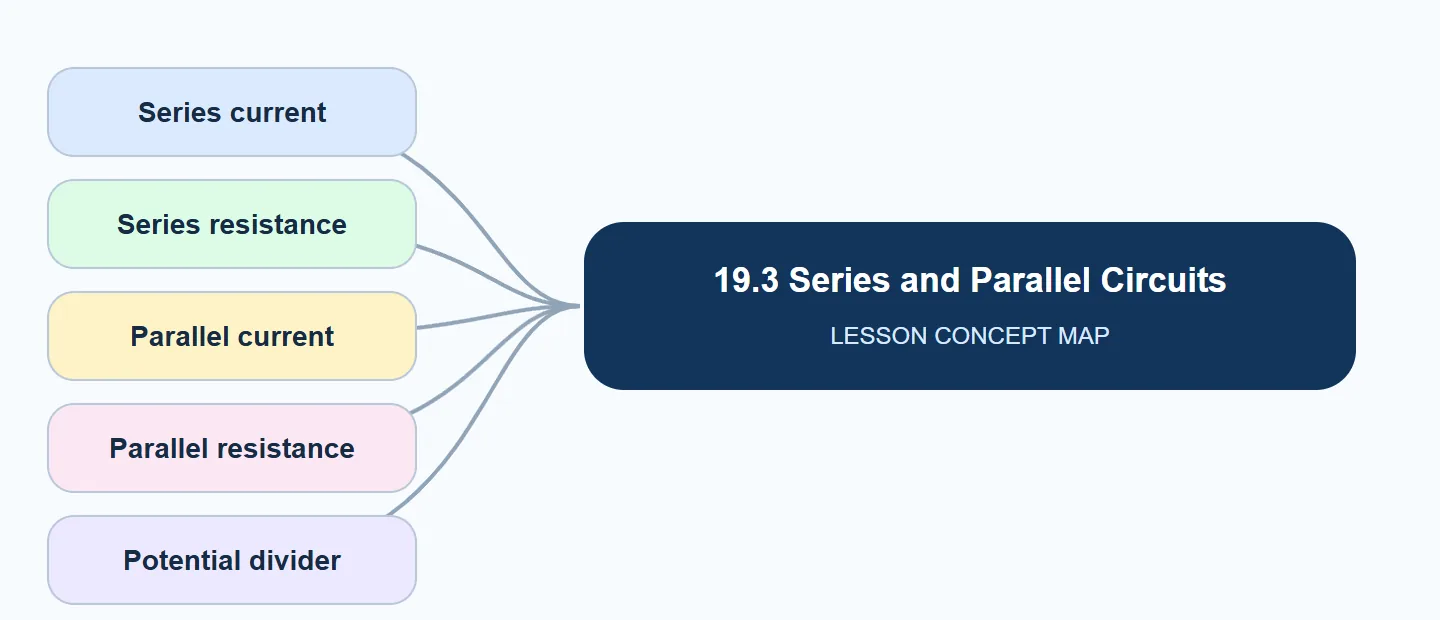
- Series current
- Series resistance
- Parallel current
- Parallel resistance
- Potential divider
- Fuse rating
Part 1 of 7Key ideas
Part 2 of 7Learning objectives
Part 3 of 7Essential knowledge
Part 4 of 7Process & sequence
How the earth wire and fuse prevent electric shockwrite these steps in this order; each step is a marking point.
Part 5 of 7Worked examples
- (a) R = (4.0 × 12)/(4.0 + 12) = 48/16 = 3.0 Ω.
- (b) I = V/R = 6.0/3.0 = 2.0 A.
- (c) I1 = 6.0/4.0 = 1.5 A .
- (the 12 Ω carries 0.50 A; 1.5 + 0.50 = 2.0 A ✓)
- RT = 10 + 20 = 30 Ω.
- I = 9.0/30 = 0.30 A.
- V10 = 0.30 × 10 = 3.0 V;
- V20 = 0.30 × 20 = 6.0 V;
- 3.0 + 6.0 = 9.0 V ✓.
- I = P/V = 2000/230 = 8.7 A. The fuse must be just above this: 13 A.
Part 6 of 7Summary
Part 7 of 7Compare: Compare
| Property | Series | Parallel |
|---|---|---|
| Current | Same at every point: I = I1 = I2 | Splits between branches: I = I1 + I2 |
| p.d. | Shared: V = V1 + V2 | Same across each branch: V = V1 = V2 |
| Combined resistance | R = R1 + R2 (larger than any one) | 1/R = 1/R1 + 1/R2 (smaller than the smallest) |
| If one lamp fails | All lamps go out | Other lamps stay on |
| Uses | Fairy lights, potential dividers | House wiring; each appliance gets full p.d. and its own switch |
| Feature | What it does | Protects |
|---|---|---|
| Fuse | Melts if current too high | Wiring/appliance from overheating and fire |
| Circuit breaker | Trips if current too high; resettable | Wiring from overheating |
| Earth wire | Gives low-resistance path from casing to ground | User from electric shock |
| Double insulation | Plastic casing that cannot become live | User from electric shock |
Choose a fuse rating slightly above the normal operating current (I = P/V).
Key terms
Command terms
Exam technique
Keywords the mark scheme looks for in this lesson
How to get full marks (examiner guidance)
Words to avoid
Instant feedbackCheck yourself
Q1. Three 6.0 Ω resistors are connected in series. What is the combined resistance?
- A. 2.0 Ω
- B. 6.0 Ω
- C. 18 Ω
- D. 0.50 Ω
Show answer
C. Series resistances add: 6 + 6 + 6 = 18 Ω.
Q2. Two 10 Ω resistors are connected in parallel. What is the combined resistance?
- A. 20 Ω
- B. 5.0 Ω
- C. 10 Ω
- D. 0.20 Ω
Show answer
B. For identical resistors in parallel, R = R/n = 10/2 = 5.0 Ω.
Q3. In a parallel circuit, which quantity is the same for every branch?
- A. Current
- B. Resistance
- C. Power
- D. Potential difference
Show answer
D. Each branch is connected across the same two points, so the p.d. is the same.
Q4. Why is house lighting wired in parallel?
Show answer
B. Parallel branches all have the supply p.d. and independent switching; one failure does not affect others.
Q5. A potential divider has R1 = 3.0 kΩ and R2 = 1.0 kΩ across 12 V. What is the p.d. across R2?
- A. 3.0 V
- B. 9.0 V
- C. 4.0 V
- D. 12 V
Show answer
A. V2 = 12 × 1.0/(3.0 + 1.0) = 3.0 V.
Q6. A current of 3.0 A enters a junction. One branch carries 1.2 A. What is the current in the other branch?
- A. 4.2 A
- B. 3.0 A
- C. 2.5 A
- D. 1.8 A
Show answer
D. Current in = current out: 3.0 − 1.2 = 1.8 A.
Marked practiceQuizzes for this lesson
Last updated: