Skip to content
Dabour HubLEARN · PRACTICE · EXPLORESign inStudent

22.1Quantum Theory and the Atom

A Particle Model of Waves — American System Physics Revision Notes & Topical Questions

10 min read 7 parts Lesson 3 of 5 1 quiz

🩺
100% Curriculum Specification Match Lesson Doctor Verified
The only platform with 100% curriculum specification match and verified interactive question banks.
0%read
Lesson summary

Describe the spectrum of a hot (blackbody) object and how it changes with temperature.Photon energy = Planck constant × frequencyE = hf (E in J, h = 6.63 × 10⁻³⁴ J s, f in Hz).Using c = fλ: photon energy E = hc/λ (λ in m, c = 3.00 × 10⁸ m/s).Useful shortcutE (in eV) ≈ 1240 / λ (i…

  • Einstein's photoelectric equation
  • Converting
  • Photon momentum = Planck constant ÷ wavelength
  • Planck's quantisation
  • Einstein extended the idea
  • Light therefore shows wave-particle duality

Section 1 of 7A Particle Model of Waves
Essential knowledge
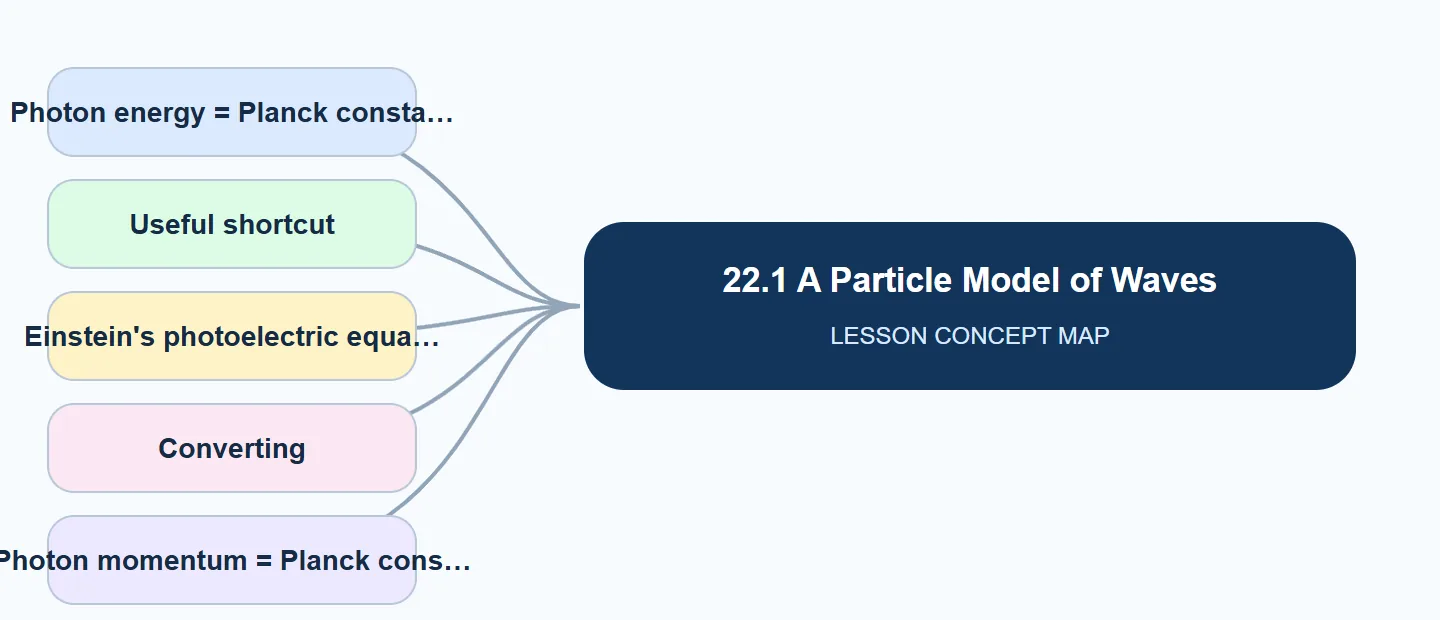
22.1 A Particle Model of Waves concept map: Photon energy = Planck consta, Useful shortcut, Einstein's photoelectric equa, Converting, Photon momentum = Planck cons
Visual guide to the key ideas explained in this lesson.
Every object above absolute zero emits electromagnetic radiation. A heated metal first glows dull red, then orange, yellow and finally bluish-white: as temperature rises, total emitted power increases steeply and the peak of the spectrum moves to shorter (higher-frequency) wavelengths.
Classical wave theory predicted that a hot body should emit enormous (unlimited) amounts of ultraviolet radiation, which does not happen.
  • Max Planck solved this in 1900 by assuming the energy of vibrating atoms is quantised: it can only take values nhf,
  • and energy is emitted or absorbed only in jumps of hf.
Einstein extended the idea
Einstein extended the idea light itself travels as photons. A photon has no rest mass, travels at c in a vacuum and carries energy hf. Higher frequency (shorter wavelength) means more energetic photons, which is why ultraviolet and X-rays can damage cells but radio waves cannot.
In the photoelectric effect, each photon interacts with a single electron and gives up all of its energy.
  • Part of this energy (the work function W) is used to free the electron from the metal surface;
    • the rest becomes kinetic energy.
  • Electrons from deeper inside lose extra energy, so hf − W is the MAXIMUM kinetic energy.
If hf < W, no electrons are emitted at all, however intense the light, because electrons cannot collect energy from several photons. This is why red light may not eject electrons from zinc while weak ultraviolet does.
Increasing intensity (at a fixed frequency above threshold) increases the number of photons per second, so the photocurrent increases, but KEmax and the stopping potential stay the same.
A graph of KEmax against f is a straight line of gradient h for every metal; different metals give parallel lines with different x-intercepts (f0) because they have different work functions.
The electron-volt is a convenient energy unit at atomic scale: 1 eV = 1.60 × 10⁻¹⁹ J. Visible photons have energies of roughly 1.6 eV (red) to 3.1 eV (violet).
Arthur Compton fired X-rays at graphite and found the scattered X-rays had longer wavelengths.
  • Treating the X-ray as a particle with momentum h/λ colliding elastically with an electron explains this: the electron recoils, gaining energy and momentum,
  • so the photon loses energy and its wavelength increases.
Light therefore shows wave-particle duality
Light therefore shows wave-particle duality interference and diffraction need the wave model, while the photoelectric and Compton effects need the photon model. Neither model alone describes all behaviour.

Section 2 of 7Process & sequence

1
Shine monochromatic light of known frequency onto a clean metal plate (the emitter) inside an evacuated photocell.
2
Connect the collector electrode to a variable power supply so that it is made negative relative to the emitter (reverse potential difference), with a sensitive ammeter in series.
3
Slowly increase the reverse potential difference until the photocurrent just falls to zero; record this stopping potential V0.
4
Calculate KEmax = qV0 (in eV this is numerically equal to V0).
5
Repeat with several different frequencies (use filters or LEDs) and plot KEmax (y-axis) against frequency f (x-axis).
6
The gradient of the straight line equals the Planck constant h; the x-intercept is the threshold frequency f0; the y-intercept is −W.

How a photon releases a photoelectronwrite these steps in this order; each step is a marking point.

1
A photon of energy hf reaches the metal surface.
2
The photon is absorbed by one electron and gives it all its energy.
3
Energy equal to the work function W is used to escape the surface.
4
If hf > W, the electron leaves with kinetic energy up to hf − W.
5
A reverse voltage V0 can just stop the fastest electrons: qV0 = KEmax.

Section 3 of 7Compare

Wave model vs photon model for the photoelectric effect
ObservationWave model predictsPhoton model explains
No emission below f0, however brightBright enough light of any frequency should eventually eject electronsOne photon gives all its energy to one electron; if hf < W no electron escapes
Emission is instantA time delay while energy builds upA single photon delivers its energy at once
Brighter light (above f0) gives more electrons, not faster onesBrighter light should give faster electronsBrighter = more photons per second, so more electrons per second; each photon still has energy hf
KEmax increases linearly with frequencyNo link with frequencyKEmax = hf − W

Intensity controls the NUMBER of photoelectrons; frequency controls their maximum ENERGY.

Photon energies across the EM spectrum (approximate)
RadiationTypical wavelengthPhoton energy
Radio1 mabout 1 × 10⁻⁶ eV
Infrared10 µmabout 0.1 eV
Visible (green)500 nmabout 2.5 eV
Ultraviolet100 nmabout 12 eV
X-ray0.1 nmabout 12 000 eV

Section 4 of 7Worked examples

What the symbols mean:
Calculate the energy of a photon of wavelength 450 nm in (a) joules and (b) electron-volts.
  • (a) E = hc/λ = (6.63 × 10−34 × 3.00 × 108) / (450 × 10−9) = 4.42 × 10⁻¹⁹ J.
    What the symbols mean: E = photon energy (J) · h = 6.63 × 10⁻³⁴ J s · c = 3.00 × 10⁸ m s−1 · λ = wavelength (m)
    • (b) E = 4.42 × 10⁻¹⁹ / 1.60 × 10−19 = 2.76 eV (check: 1240/450 = 2.76 eV).
0.83 eV
Sodium has a work function of 2.28 eV. Light of frequency 7.50 × 10¹⁴ Hz falls on it. Find (a) the threshold frequency, (b) the maximum kinetic energy of the photoelectrons in eV and (c) the stopping potential.
  • (a) W = 2.28 × 1.60 × 10−19 = 3.65 × 10⁻¹⁹ J; f0 = W/h = 3.65 × 10⁻¹⁹ / 6.63 × 10−34 = 5.50 × 10¹⁴ Hz.
    • (b) hf = 6.63 × 10−34 × 7.50 × 1014 = 4.97 × 10⁻¹⁹ J = 3.11 eV;
      • KEmax = 3.11 − 2.28 = 0.83 eV (1.3 × 10⁻¹⁹ J).
    • (c) V0 = KEmax/q = 0.83 V.
A lamp emits 5.0 W of light of wavelength 600 nm. How many photons does it emit each second?
  • Energy per photon E = hc/λ = (6.63 × 10−34 × 3.00 × 108)/(600 × 10−9) = 3.32 × 10⁻¹⁹ J.
    • Number per second = power / energy per photon = 5.0 / 3.32 × 10−19 = 1.5 × 10¹⁹ photons per second.

Section 5 of 7Key terms

Section 6 of 7Command terms

Command terms
Identify / Describe (FRQ)
A short, specific statement; describing requires relevant characteristics, not a single word.
Explain / Justify (FRQ)
Give the cause-and-effect reasoning or evidence; a restated fact does not score.
Calculate
Show setup, substitution and the answer with units.
Predict
State the expected outcome; add a reason only if asked to justify.
MCQ technique
Read every option; eliminate distractors that are true statements but do not answer the question; watch for NOT/EXCEPT.

Section 7 of 7Exam technique

Keywords the mark scheme looks for in this lesson

Keywords the mark scheme looks for in this lesson
Blackbody · Thermal (blackbody) radiation · Quantum · Photon · Planck constant (h) · Photoelectric effect · Threshold frequency (f0) · Work function (W or φ) · Electron-volt (eV) · Maximum kinetic energy of photoelectrons (KEmax) · Stopping potential (V0) · Compton effect · Wave-particle duality
Learn each definition in the Key words tab exactly; a missing keyword in a definition usually loses the mark.

How to get full marks (examiner guidance)

1
Answer exactly what is asked; extra correct material does not earn credit, and contradictory statements can cancel credit (AP FRQ).
2
Use precise vocabulary, never “it/stuff/things”.
3
Show units and working in calculations.
4
In MCQs, predict the answer before reading the options, then eliminate.

Words to avoid

1
brighter light makes the electrons fasterbrighter light gives more photons per second, so more electrons are emitted per second, but their maximum kinetic energy is unchanged.
2
the work function is the energy of the electronthe work function is the minimum energy needed to remove an electron from the surface of the metal.
3
KE = hf − W for all electronshf − W is the MAXIMUM kinetic energy of the photoelectrons.
4
electrons store up energy from the light until they escapeeach electron absorbs the energy of a single photon, all at once.
5
Don't mix units: never subtract a work function in eV from a photon energy in J — convert both to the same unit first.

Last updated: