22.1Quantum Theory and the Atom
A Particle Model of Waves — American System Physics Revision Notes & Topical Questions
10 min read 7 parts Lesson 3 of 5 1 quiz
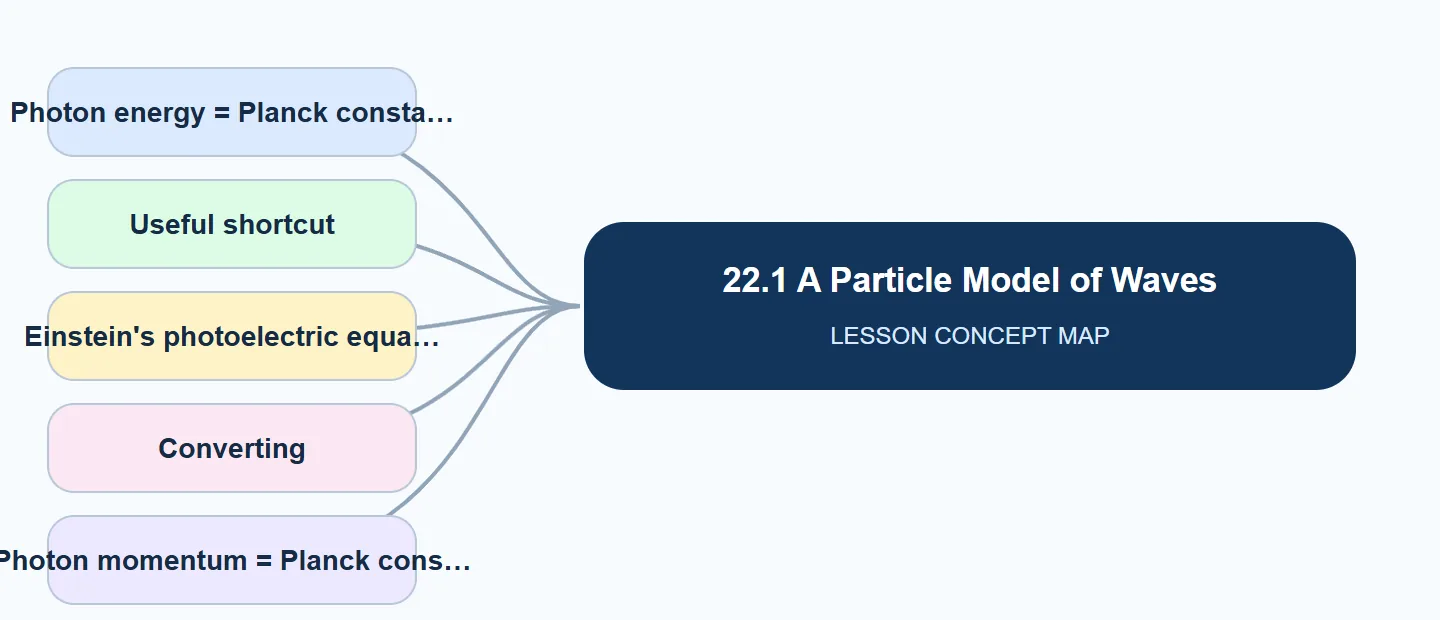
Describe the spectrum of a hot (blackbody) object and how it changes with temperature.Photon energy = Planck constant × frequencyE = hf (E in J, h = 6.63 × 10⁻³⁴ J s, f in Hz).Using c = fλ: photon energy E = hc/λ (λ in m, c = 3.00 × 10⁸ m/s).Useful shortcutE (in eV) ≈ 1240 / λ (i…
- Einstein's photoelectric equation
- Converting
- Photon momentum = Planck constant ÷ wavelength
- Planck's quantisation
- Einstein extended the idea
- Light therefore shows wave-particle duality
Section 1 of 7A Particle Model of Waves
- Max Planck solved this in 1900 by assuming the energy of vibrating atoms is quantised: it can only take values nhf,
- and energy is emitted or absorbed only in jumps of hf.
- Part of this energy (the work function W) is used to free the electron from the metal surface;
- the rest becomes kinetic energy.
- Electrons from deeper inside lose extra energy, so hf − W is the MAXIMUM kinetic energy.
- Treating the X-ray as a particle with momentum h/λ colliding elastically with an electron explains this: the electron recoils, gaining energy and momentum,
- so the photon loses energy and its wavelength increases.
Section 2 of 7Process & sequence
How a photon releases a photoelectronwrite these steps in this order; each step is a marking point.
Section 3 of 7Compare
| Observation | Wave model predicts | Photon model explains |
|---|---|---|
| No emission below f0, however bright | Bright enough light of any frequency should eventually eject electrons | One photon gives all its energy to one electron; if hf < W no electron escapes |
| Emission is instant | A time delay while energy builds up | A single photon delivers its energy at once |
| Brighter light (above f0) gives more electrons, not faster ones | Brighter light should give faster electrons | Brighter = more photons per second, so more electrons per second; each photon still has energy hf |
| KEmax increases linearly with frequency | No link with frequency | KEmax = hf − W |
Intensity controls the NUMBER of photoelectrons; frequency controls their maximum ENERGY.
| Radiation | Typical wavelength | Photon energy |
|---|---|---|
| Radio | 1 m | about 1 × 10⁻⁶ eV |
| Infrared | 10 µm | about 0.1 eV |
| Visible (green) | 500 nm | about 2.5 eV |
| Ultraviolet | 100 nm | about 12 eV |
| X-ray | 0.1 nm | about 12 000 eV |
Section 4 of 7Worked examples
- (a) E = hc/λ = (6.63 × 10−34 × 3.00 × 108) / (450 × 10−9) = 4.42 × 10⁻¹⁹ J.What the symbols mean: E = photon energy (J) · h = 6.63 × 10⁻³⁴ J s · c = 3.00 × 10⁸ m s−1 · λ = wavelength (m)
- (b) E = 4.42 × 10⁻¹⁹ / 1.60 × 10−19 = 2.76 eV (check: 1240/450 = 2.76 eV).
- (a) W = 2.28 × 1.60 × 10−19 = 3.65 × 10⁻¹⁹ J; f0 = W/h = 3.65 × 10⁻¹⁹ / 6.63 × 10−34 = 5.50 × 10¹⁴ Hz.
- (b) hf = 6.63 × 10−34 × 7.50 × 1014 = 4.97 × 10⁻¹⁹ J = 3.11 eV;
- KEmax = 3.11 − 2.28 = 0.83 eV (1.3 × 10⁻¹⁹ J).
- (c) V0 = KEmax/q = 0.83 V.
- (b) hf = 6.63 × 10−34 × 7.50 × 1014 = 4.97 × 10⁻¹⁹ J = 3.11 eV;
- Energy per photon E = hc/λ = (6.63 × 10−34 × 3.00 × 108)/(600 × 10−9) = 3.32 × 10⁻¹⁹ J.
- Number per second = power / energy per photon = 5.0 / 3.32 × 10−19 = 1.5 × 10¹⁹ photons per second.
Section 5 of 7Key terms
Section 6 of 7Command terms
Section 7 of 7Exam technique
Keywords the mark scheme looks for in this lesson
How to get full marks (examiner guidance)
Words to avoid
Instant feedbackCheck yourself
Q1. What is the energy of a photon of frequency 5.0 × 10¹⁴ Hz?
Show answer
A. E = hf = 6.63 × 10−34 × 5.0 × 1014 = 3.3 × 10⁻¹⁹ J.
Q2. Light of frequency above the threshold frequency is made twice as intense. What happens?
Show answer
C. Doubling intensity doubles the photons per second, so twice as many electrons per second; each photon energy (and KEmax) is unchanged.
Q3. A metal has work function 3.0 eV. Photons of 4.5 eV fall on it. What is the stopping potential?
- A. 7.5 V
- B. 3.0 V
- C. 4.5 V
- D. 1.5 V
Show answer
D. KEmax = 4.5 − 3.0 = 1.5 eV, so V0 = 1.5 V.
Q4. On a graph of KEmax against frequency, what is the gradient?
Show answer
B. KEmax = hf − W is of the form y = mx + c with m = h.
Q5. As a blackbody gets hotter, the peak of its emission spectrum
Show answer
C. Hotter bodies emit more at all wavelengths and their peak shifts to shorter wavelength (red → white/blue).
Q6. In the Compton effect, the scattered X-ray photon has
Show answer
A. The photon gives some energy and momentum to the electron, so its energy falls and its wavelength increases.
Marked practiceQuizzes for this lesson
Last updated: