Skip to content
Dabour HubLEARN · PRACTICE · EXPLORESign inStudent

5.1Use of Biological Resources

Food Production — Edexcel International GCSE Biology 4BI1 Revision Notes & Topical Questions

10 min read 8 parts Lesson 1 of 7 1 quiz

🩺
100% Curriculum Specification Match Lesson Doctor Verified
The only platform with 100% curriculum specification match and verified interactive question banks.
0%read
Lesson summary

Food Production Edexcel IGCSE Biology 4BI1 notes: Explain how glasshouses, polythene tunnels, CO2 and fertilisers increase crop yield.Yeastglucose → ethanol + carbon dioxide (+ energy).CO2 from yeast makes bread rise; ethanol evaporates during baking.In brewing, yeast ferments su…

  • Glasshouses and polythene tunnels
  • Increasing carbon dioxide and temperature
  • Pest control
  • Yeast in food production
  • Practical — anaerobic respiration in yeast
  • Role of bacteria in yoghurt production

Part 1 of 8Key ideas

Yeast
Yeast glucose → ethanol + carbon dioxide (+ energy).
CO2 from yeast makes bread rise; ethanol evaporates during baking.
In brewing, yeast ferments sugars from barley to make alcohol.
Yoghurt
Lactobacillus converts lactose to lactic acid, lowering pH and thickening milk.
Milk for yoghurt is pasteurised (about 85-95 °C), cooled to about 40-46 °C and incubated.
Increasing CO2 in glasshouses (e.g. paraffin heaters) raises photosynthesis and yield.
Excess fertiliser can run off and cause eutrophication.

Part 2 of 8Learning objectives

1
Explain how glasshouses, polythene tunnels, CO2 and fertilisers increase crop yield.
2
Compare pesticides and biological control.
3
Describe the use of yeast and bacteria in food production.
4
Investigate anaerobic respiration in yeast and describe industrial fermenters.

Part 3 of 8Essential knowledge

1
Glasshouses and polythene tunnels
Glasshouses and polythene tunnels trap heat so the temperature is higher, allowing faster enzyme activity and photosynthesis and a longer growing season. They protect crops from weather and pests, and artificial lighting can extend daylight hours.
2
Increasing carbon dioxide and temperature
Increasing carbon dioxide and temperature burning paraffin or gas raises CO2 concentration and temperature, both limiting factors for photosynthesis, so crops grow faster. The extra cost must be balanced against the increased yield.
3
Fertiliser
Fertiliser harvesting removes minerals from soil. Fertilisers (manure, compost or NPK chemical fertilisers) replace nitrate for proteins, phosphate and potassium. Too much can run into rivers, causing eutrophication.
4
Pest control
Pest control pests reduce yield. Pesticides act quickly but may kill non-target organisms, accumulate in food chains and select for resistance. Biological control uses a natural enemy, e.g. ladybirds eating aphids; it is specific but slower.
5
Yeast in food production
Yeast in food production in bread-making, yeast respires anaerobically, releasing CO2 that makes dough rise. In brewing, yeast ferments sugars to ethanol.
6
Practical — anaerobic respiration in yeast
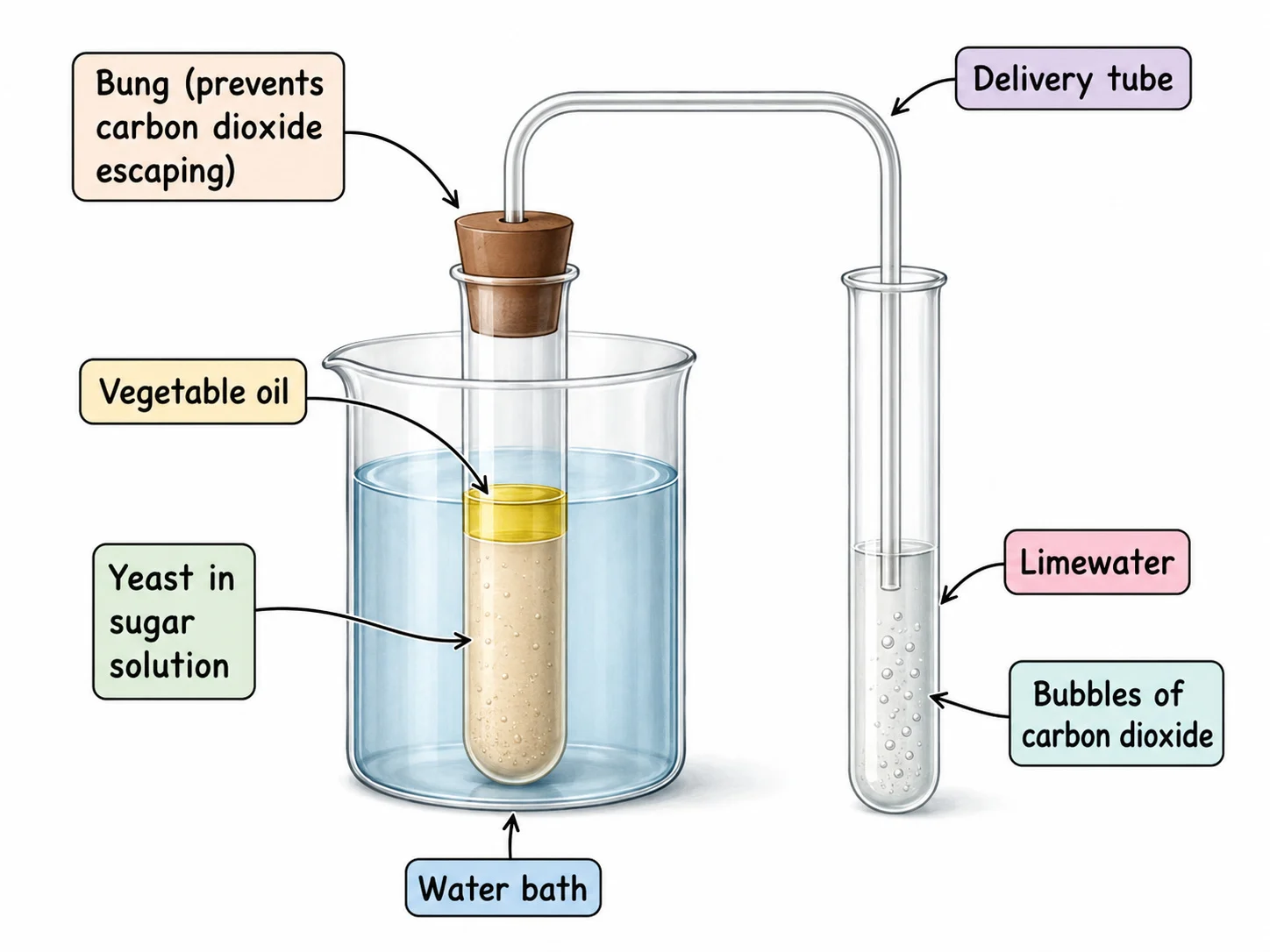
Practical — anaerobic respiration in yeast a yeast and sugar suspension is covered with oil (or boiled water is used to remove oxygen). CO2 bubbles are counted or limewater turns cloudy. Temperature or sugar type can be varied while other variables are controlled.
Anaerobic respiration in yeast: oil excludes oxygen and carbon dioxide is detected in limewater
7
Role of bacteria in yoghurt production
Role of bacteria in yoghurt production equipment is sterilised; milk is pasteurised and cooled; Lactobacillus is added and incubated. The bacteria convert lactose to lactic acid, which lowers pH, causes the milk proteins to coagulate (thicken) and gives flavour, and helps stop other microbes growing.
8
Industrial fermenters
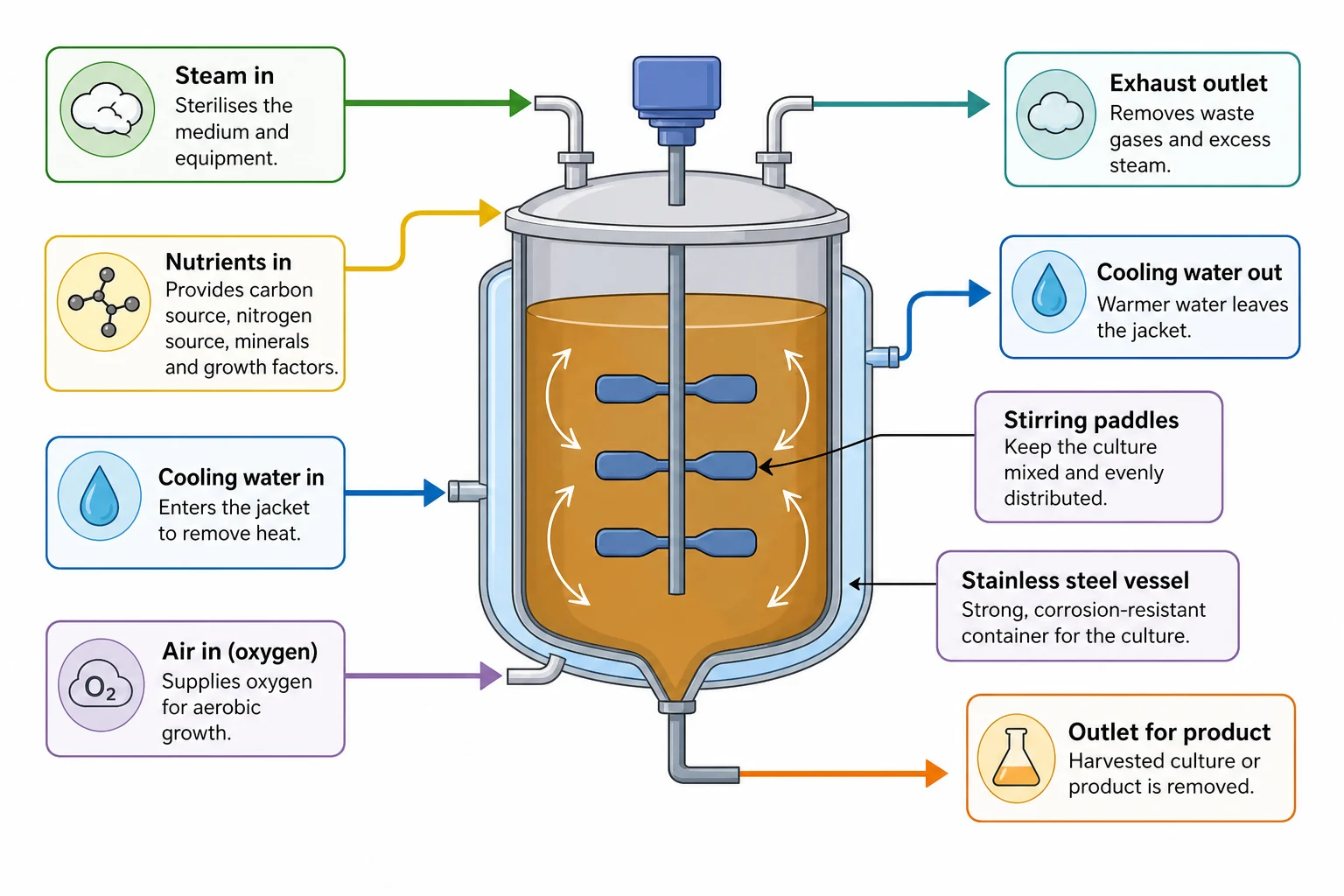
Industrial fermenters large stainless steel vessels used to grow microorganisms on a large scale. They are sterilised with steam and have controls for temperature (water jacket), pH, oxygen supply, nutrient supply and stirring, giving optimum conditions for maximum product.
Industrial fermenter with temperature control, air supply and stirring
9
Fish farming — why farm fish
Overfishing has reduced wild fish stocks. Farming gives a reliable protein supply, and the farmer can control feeding, water quality, predators and breeding to produce fast-growing, healthy fish.
10
Fish farming — water quality
Water is filtered to remove faeces and waste food, and kept well oxygenated for aerobic respiration. Clean water reduces disease and supports fast growth.
11
Fish farming — controlling predation
Intraspecific predation (within one species) is reduced by keeping fish of different sizes and ages apart. Interspecific predation (by other species) is prevented with nets, fences or separate tanks.
12
Fish farming — disease and feeding
Fish are kept at limited densities and may be given antibiotics, because disease spreads quickly between crowded fish. They are fed small amounts of high-protein food frequently, so growth is fast and little food is wasted to pollute the water.
13
Fish farming — selective breeding
Males and females are kept apart so farmers decide which fish breed. Only fish with desired features, such as fast growth, are used as parents, so these alleles become more common in the stock.
14
Types of pesticide
Insecticides kill insect pests, herbicides kill weeds that compete with crops for light, water and minerals, and fungicides kill fungi that cause crop diseases.
15
Bread-making in detail
Enzymes from the yeast break down starch in the flour to sugars. The yeast respires aerobically until the oxygen runs out, then anaerobically, releasing CO2 that makes the dough rise. Baking kills the yeast and evaporates the ethanol.
16
Finishing yoghurt
After incubation the yoghurt is cooled to about 5 °C to stop the bacteria working, then flavourings or fruit can be added. The low pH acts as a preservative, so yoghurt keeps longer than fresh milk.

Part 4 of 8Process & sequence

    • Mix yeast with glucose (or sugar) solution in a boiling tube.
    • Add a layer of oil on top to keep out oxygen.
    • Connect a delivery tube into limewater or count bubbles in water.
    • Place tubes in water baths at different temperatures.
    • Count bubbles of CO2 per minute (or measure gas volume).
    • Plot rate against temperature to find the optimum.

    Making yoghurtwrite these steps in this order; each step is a marking point.

    1. Sterilise equipment
    2. Pasteurise milk, then cool
    3. Add Lactobacillus bacteria
    4. Incubate at about 40 °C
    5. Lactose converted to lactic acid
    6. Milk thickens into yoghurt

Part 5 of 8Worked examples

1

In a yeast experiment, 36 bubbles were counted in 3 minutes at 30 °C. Calculate the rate.

  • Rate = 36 ÷ 3 = 12 bubbles per minute.
2Explain why fermenters have a water jacket.
  • Respiration of microorganisms releases heat.
    • Without cooling, the temperature would rise above the optimum and denature enzymes.
    • Cool water in the jacket removes heat and keeps temperature at the optimum, maximising growth and product yield.

Part 6 of 8Summary

    • Glasshouses control temperature, light and CO2 to increase yield.
    • Fertilisers replace mineral ions in soil.
    • Pests are controlled by pesticides or biological control.
    • Microorganisms make bread, beer and yoghurt.
    • Fermenters keep conditions optimal and sterile.

Part 7 of 8Keep going

  1. Food Production Edexcel IGCSE Biology 4BI1: what to do next

    These Food Production Edexcel IGCSE Biology 4BI1 notes covered the key ideas, worked examples and exam technique for this topic. Check your Food Production Edexcel IGCSE Biology 4BI1 understanding with the practice questions below, then reread any Food Production Edexcel IGCSE Biology 4BI1 point you were unsure about before moving on.

    Food Production Edexcel IGCSE Biology 4BI1: revision checklist

    • Revise the main Food Production Edexcel IGCSE Biology 4BI1 definitions until you can write them from memory.
    • Practise Food Production Edexcel IGCSE Biology 4BI1 exam questions under timed conditions.
    • Link each Food Production Edexcel IGCSE Biology 4BI1 idea to a diagram or a worked example.

Part 8 of 8Compare: Compare

Chemical pesticides vs biological control
FeaturePesticidesBiological control
SpeedFast-actingSlow to take effect
SpecificityOften kill harmless insects tooUsually specific to the pest
PersistenceCan build up in food chains (bioaccumulation)No toxic residues
ResistancePests can become resistantResistance unlikely
RiskPollutionControl agent may become a pest itself
Conditions in an industrial fermenter
FactorHow controlledWhy
TemperatureWater jacketOptimum for enzymes; respiration releases heat
pHProbes, add acid or alkaliKeep enzymes at optimum
OxygenSterile air pumped inFor aerobic respiration
NutrientsAdded through inletFor growth of microorganisms
MixingPaddles / stirrerEven distribution of nutrients and heat
ContaminationSteam sterilisationStop unwanted microbes competing

Key terms

Command terms

Command terms
Give / State / Name
Recall a fact; one idea per mark.
Define
Give the exact meaning using the specification keywords.
Describe
Give an account of what happens / the pattern in data, quoting values; no reasons needed.
Explain
Give reasons with linked statements (cause → effect). Each linked step is usually a separate marking point.
Suggest
Use knowledge in a new context; more than one answer may be accepted.
Compare
Similarities and differences; each point must refer to both items.
Calculate
Show working; include units; check significant figures. Method marks are given even if the final answer is wrong.
Discuss
Explore the issue from different angles and link the points.
Evaluate / Assess
Weigh strengths and weaknesses and reach a supported judgement.
Deduce
Draw a conclusion from the information given.
Justify
Support a statement/choice with evidence.

Exam technique

Keywords the mark scheme looks for in this lesson

Keywords the mark scheme looks for in this lesson
Glasshouse · Yield · Fertiliser · Pesticide · Biological control · Anaerobic respiration · Fermentation · Industrial fermenter · Aseptic technique
Learn each definition in the Key words tab exactly; a missing keyword in a definition usually loses the mark.

How to get full marks (examiner guidance)

How to get full marks (examiner guidance)
Use specification keywords exactly (e.g. eukaryotic/prokaryotic, enzyme–substrate complex, active site, complementary).
Link ideas
Link ideas for “explain” each marking point is usually a cause → consequence step; unlinked facts often score nothing.
Use the information in the question
“discuss/evaluate” answers must use the data provided and match the number of marks.
Convert units carefully (mg → g, cm3 → dm3) and show working for calculations.
Avoid vague words
“it”, “stuff”, “things”, “goes up”, “energy is made”. Name the substance and the process.
Do not extrapolate a graph line beyond the data or to zero unless asked.
Six-mark extended responses are marked on content AND a logical, linked line of reasoning.

Last updated:

\n