Skip to content
Dabour HubLEARN · PRACTICE · EXPLORESign inStudent

3.1Reproduction & Inheritance

Reproduction — Edexcel International GCSE Biology 4BI1 Revision Notes & Topical Questions

10 min read 8 parts Lesson 1 of 4 1 quiz

🩺
100% Curriculum Specification Match Lesson Doctor Verified
The only platform with 100% curriculum specification match and verified interactive question banks.
0%read
Lesson summary

Reproduction Edexcel IGCSE Biology 4BI1 notes: Compare sexual and asexual reproduction.Human body cells are diploid (46 chromosomes); gametes are haploid (23 chromosomes).Seeds need water, oxygen and a suitable temperature to germinate; light is not needed.During germination, sto…

  • Asexual reproduction in plants
  • Sexual vs asexual
  • Gametes and fertilisation
  • Flower structure
  • Adaptations for pollination
  • Fertilisation in plants

Part 1 of 8Key ideas

Key ideas
Human body cells are diploid (46 chromosomes); gametes are haploid (23 chromosomes).
Seeds need water, oxygen and a suitable temperature to germinate; light is not needed.
During germination, stored starch is broken down by amylase into sugars used in respiration until leaves photosynthesise.
Asexual reproduction in plants
Asexual reproduction in plants runners (strawberry), tubers (potato), bulbs, and cuttings.
Sperm are made in the testes; eggs are released from the ovaries.
Fertilisation in humans normally takes place in the oviduct (fallopian tube).
The embryo implants in the uterus lining; amniotic fluid protects the developing fetus.

Part 2 of 8Learning objectives

1
Compare sexual and asexual reproduction.
2
Describe the adaptations of insect- and wind-pollinated flowers.
3
Describe fertilisation in plants and the conditions needed for germination.
4
Describe the structure and function of the human reproductive systems.

Part 3 of 8Essential knowledge

1
Sexual vs asexual
Sexual vs asexual sexual reproduction needs gametes and fertilisation, producing genetically different offspring.
  • Asexual reproduction uses mitosis and one parent, so offspring are genetically identical.
  • Asexual is quicker and needs no mate;
    • sexual gives variation that can help a species survive changes such as new diseases.
2
Gametes and fertilisation
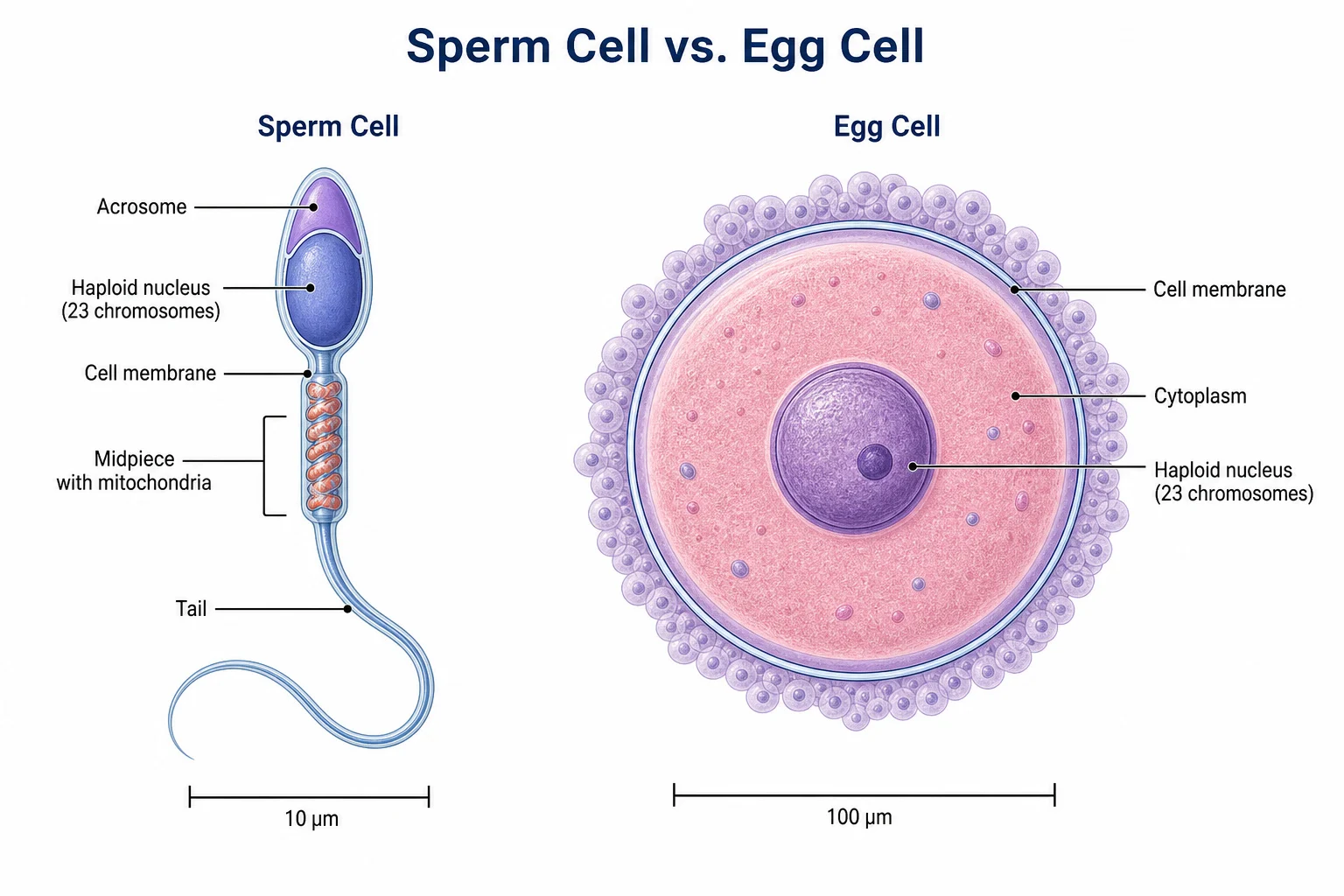
Gametes and fertilisation gametes are haploid, so when two fuse the zygote is diploid. In animals the gametes are sperm and egg; in flowering plants the male nucleus is in the pollen grain and the female nucleus is in the ovule.
Sperm and egg: contrasting structures and adaptations
3
Flower structure
Flower structure the male parts (stamen) are the anther, which makes pollen, and the filament. The female parts (carpel) are the stigma, style and ovary containing ovules. Petals attract insects in insect-pollinated flowers; sepals protect the bud.
4
Adaptations for pollination
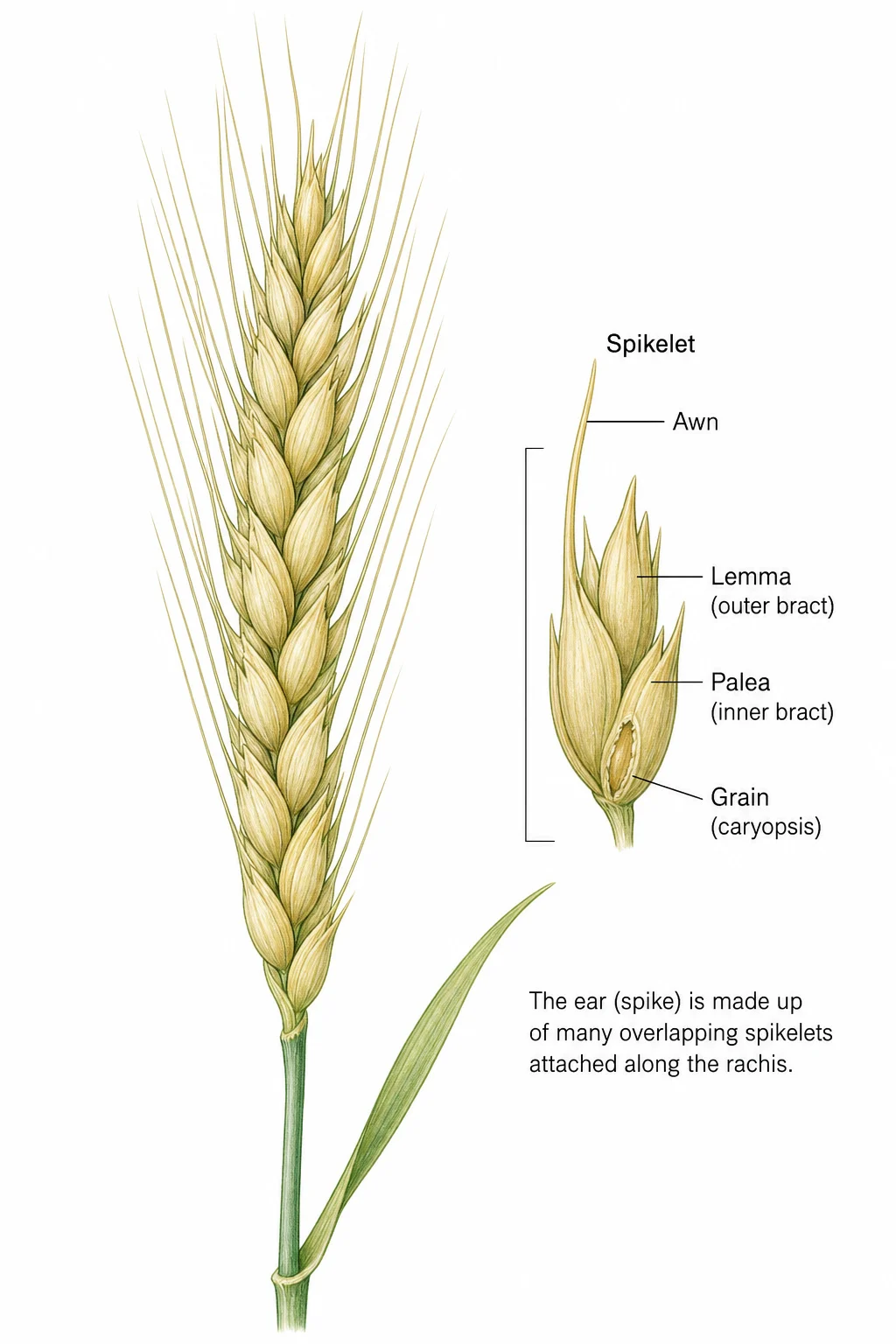
Adaptations for pollination insect-pollinated flowers have colourful scented petals, nectar and sticky stigmas inside the flower. Wind-pollinated flowers have exposed anthers and feathery stigmas and produce huge amounts of light pollen.
Wheat ear and flower structures in a wind-pollinated plant
5
Fertilisation in plants
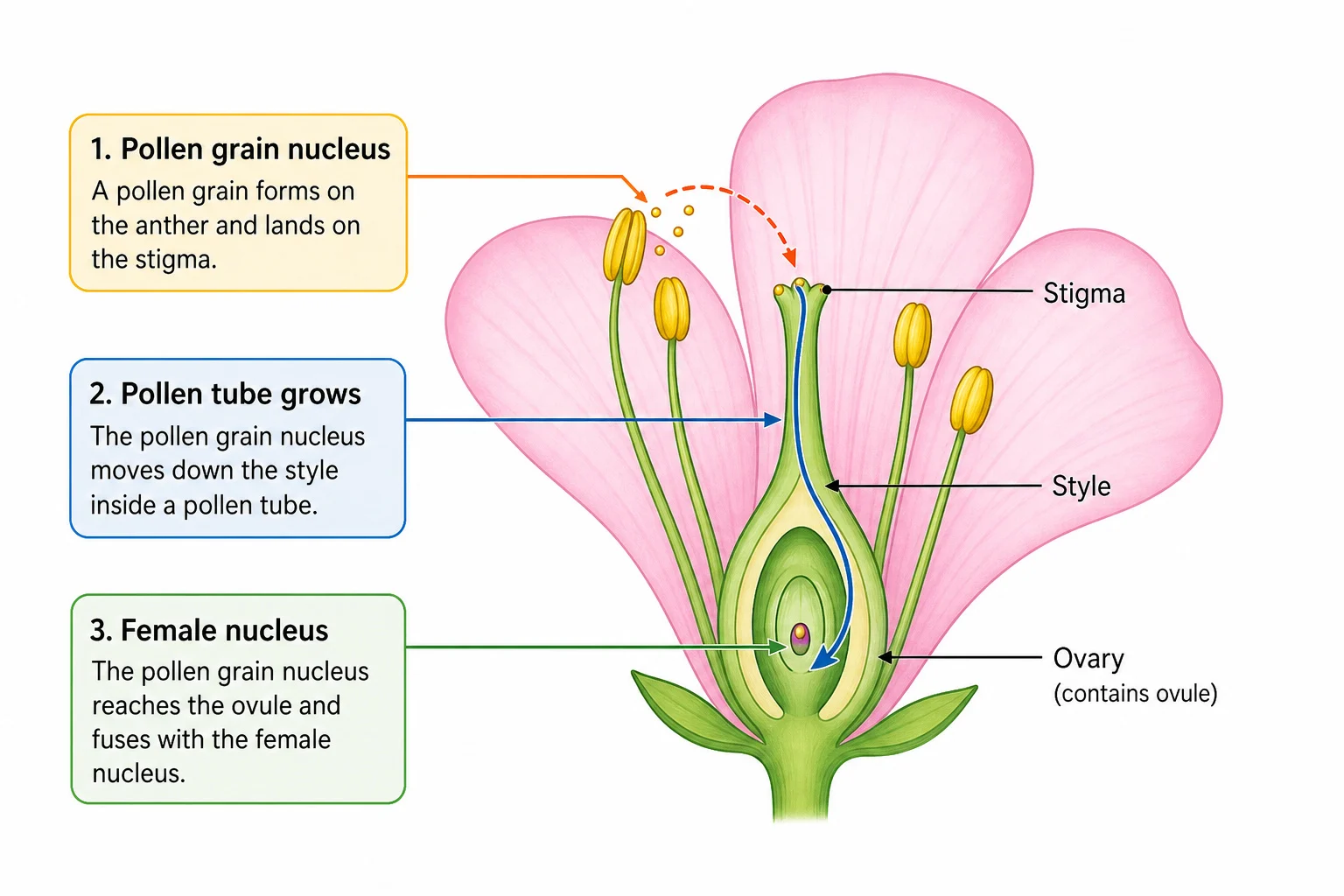
Fertilisation in plants after pollination a pollen tube grows down the style to the ovule; the male nucleus fuses with the ovule nucleus. The fertilised ovule becomes a seed containing an embryo and food store, and the ovary wall becomes the fruit, which helps dispersal.
Pollen tube growth and fertilisation inside a flower
6
Practical – conditions for germination
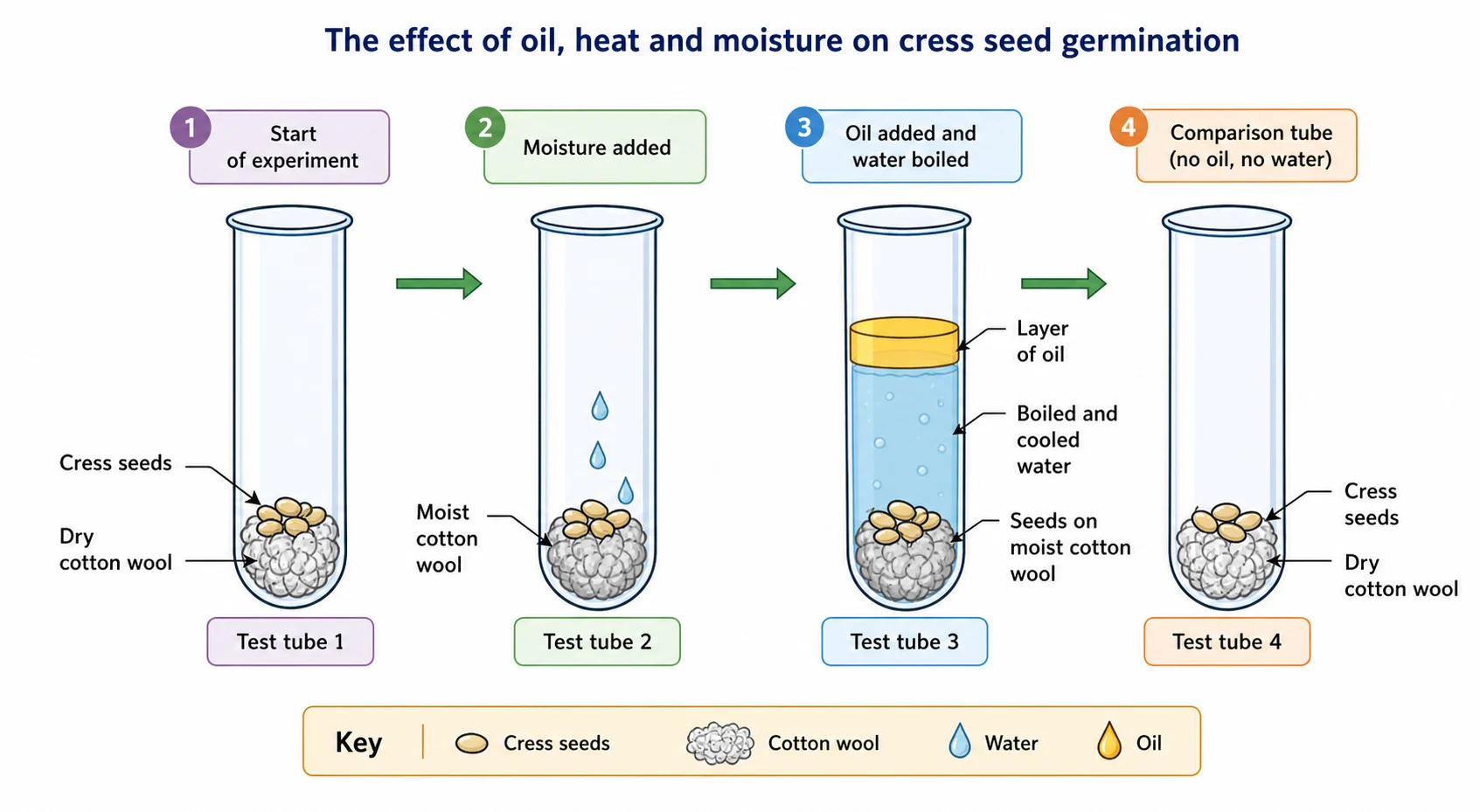
Practical – conditions for germination set up tubes of cress seeds: one with water, air and warmth (control); one dry; one with boiled cooled water covered with oil (no oxygen); one in a fridge. Only the control germinates well, showing water, oxygen and a suitable temperature are all needed.
Cress seed germination under different water, oxygen and temperature conditions
7
Germinating seeds
Germinating seeds water activates enzymes; amylase breaks down stored starch into maltose/glucose, and proteases break proteins into amino acids. These fuel respiration and growth until the seedling can photosynthesise. Dry mass therefore falls at first.
8
Asexual plant reproduction
Asexual plant reproduction strawberry plants send out runners that root and form new plants; potatoes grow from tubers. Gardeners take cuttings, dipping stems in rooting hormone, to produce many identical plants.
9
Human reproductive systems
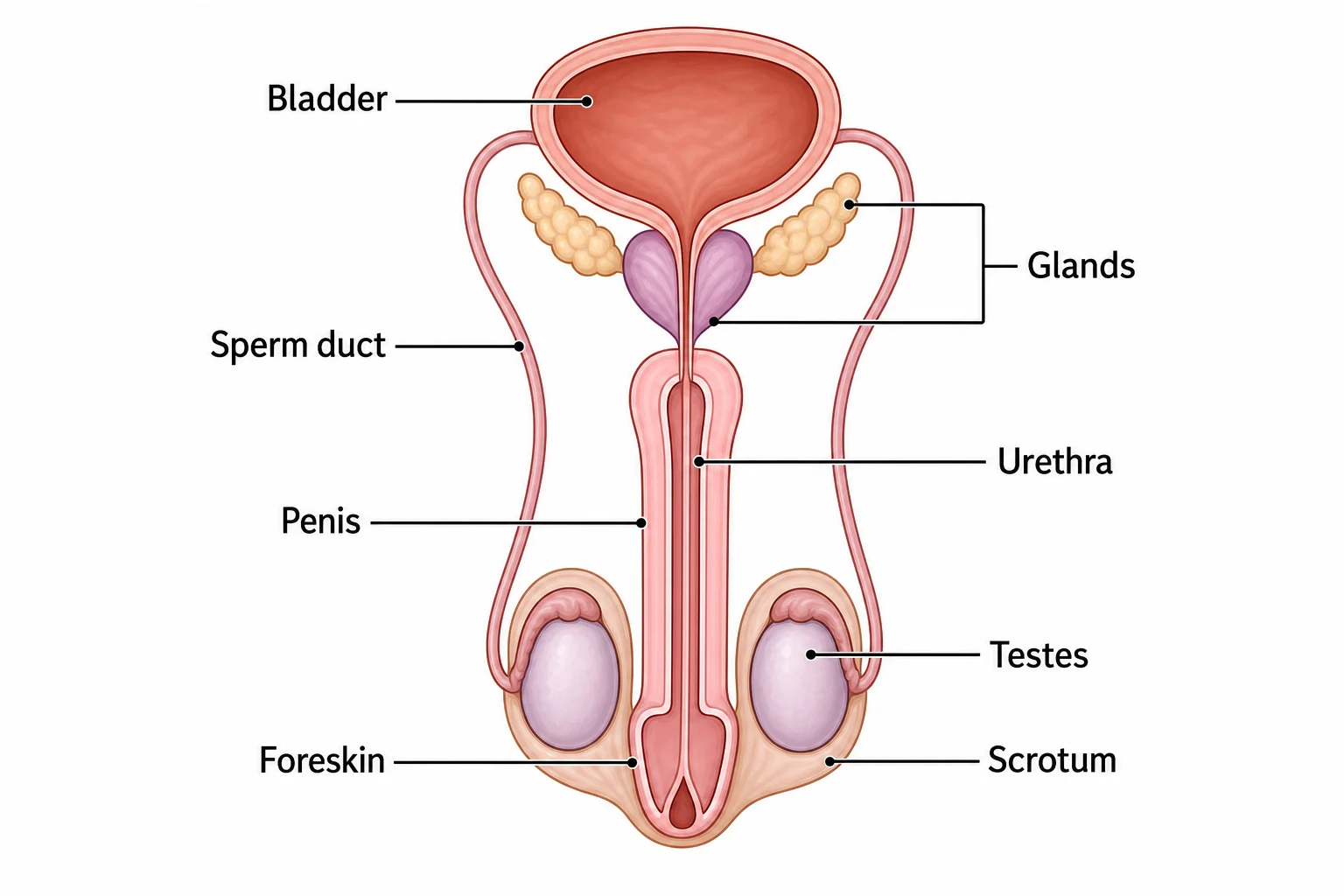
Human reproductive systems male – testes (make sperm and testosterone), scrotum, sperm duct, prostate gland and seminal vesicles (make fluid), urethra and penis.
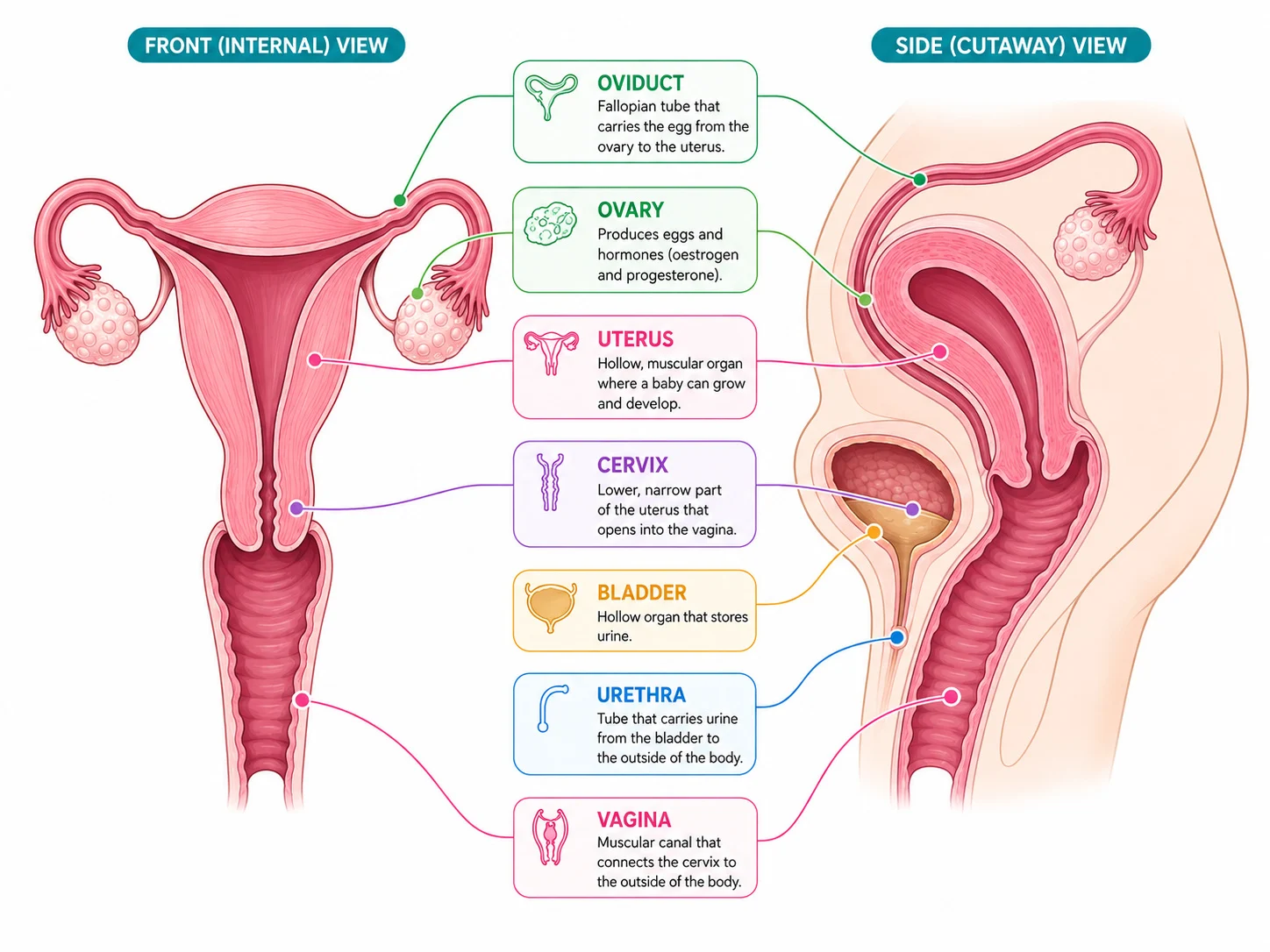
Female reproductive organs and their positions
Male reproductive system and the sperm duct
  • Female – ovaries, oviducts (site of fertilisation), uterus (where the fetus develops), cervix and vagina.
    • (release eggs, make oestrogen and progesterone)
  • The placenta lets oxygen and nutrients diffuse to the fetus and carbon dioxide and urea to the mother; the amnion and amniotic fluid protect the fetus.
10
The menstrual cycle
The cycle lasts about 28 days. Days 1–5: the uterus lining breaks down and is lost (menstruation). The lining then rebuilds. Around day 14 an egg is released (ovulation). If the egg is not fertilised, the lining breaks down again and a new cycle starts.
11
Oestrogen and progesterone
Oestrogen, made by the ovary as an egg matures, repairs and thickens the uterus lining, inhibits FSH and, at its peak, triggers LH release. Progesterone, from the corpus luteum after ovulation, maintains the lining. When progesterone falls, the lining breaks down.
12
FSH and LH
Both are released by the pituitary gland. FSH makes an egg mature in a follicle and stimulates the ovary to secrete oestrogen. LH triggers ovulation and turns the empty follicle into the corpus luteum, which makes progesterone.
13
Hormones in pregnancy
If an embryo implants, the corpus luteum keeps secreting progesterone until the placenta takes over. Progesterone keeps the uterus lining thick and stops further ovulation during pregnancy.
14
Placenta as an exchange surface
The placenta has a large surface area and a thin barrier between mother's and fetus's blood, which never mix. The umbilical cord links the fetus to the placenta. Glucose, amino acids, oxygen and antibodies pass to the fetus; CO2 and urea pass to the mother.
15
Placenta as a barrier
The placenta stops many pathogens and harmful substances, but not all: nicotine, alcohol, other drugs and some viruses can cross and harm the fetus. The placenta also secretes progesterone.
16
Secondary sexual characteristics
Testosterone in boys
  • facial and body hair, muscle growth, deeper voice, sperm production.
  • Oestrogen in girls: breast development, wider hips, body hair and the start of menstrual cycles.
  • These changes happen at puberty.
17
Gamete adaptations
Sperm have a tail to swim and many mitochondria to release energy for movement. The egg is much larger, with food stores in its cytoplasm to support the early embryo.
18
Structure of a seed
A seed contains an embryo root, an embryo shoot, one or two seed leaves (cotyledons) and a food store. Stored food supplies the seedling until its first leaves can photosynthesise.
19
Why the testes are in the scrotum
The scrotum holds the testes outside the abdomen, where the temperature is slightly lower than core body temperature, which is better for sperm production.

Part 4 of 8Process & sequence

    • Pollen lands on a stigma of the same species (pollination).
    • A pollen tube grows out of the pollen grain, down through the style.
    • The male nucleus travels down the pollen tube.
    • The tube enters the ovule through the micropyle.
    • The male nucleus fuses with the female nucleus in the ovule (fertilisation), forming a zygote.
    • The ovule develops into a seed and the ovary into a fruit.

    From pollination to seedwrite these steps in this order; each step is a marking point.

    1. Pollen lands on stigma
    2. Pollen tube grows down style
    3. Male nucleus enters ovule
    4. Nuclei fusezygote formed
    5. Ovule becomes seed
    6. Ovary becomes fruit

Part 5 of 8Worked examples

Respiration

Explain why the dry mass of germinating seeds decreases during the first few days.

  • Before leaves grow the seedling cannot photosynthesise.
    • Stored starch is broken down to glucose, which is used in respiration to release energy for growth.
    • Respiration converts glucose into carbon dioxide and water, which are lost, so dry mass falls until photosynthesis begins.

Suggest one advantage and one disadvantage to a farmer of growing crops from cuttings.

  • Advantage: all plants are genetically identical to a parent with desired features (e.g. high yield) and are produced quickly.
    • Disadvantagethere is no genetic variation, so a single disease or change in conditions could affect the whole crop.

Part 6 of 8Summary

    • Sexual reproduction gives variation; asexual gives clones.
    • Gametes are haploid; fertilisation restores the diploid number.
    • Flowers are adapted for insect or wind pollination.
    • Seeds need water, oxygen and warmth to germinate.
    • Human fertilisation happens in the oviduct; the embryo implants in the uterus.

Part 7 of 8Keep going

  1. Reproduction Edexcel IGCSE Biology 4BI1: what to do next

    These Reproduction Edexcel IGCSE Biology 4BI1 notes covered the key ideas, worked examples and exam technique for this topic. Check your Reproduction Edexcel IGCSE Biology 4BI1 understanding with the practice questions below, then reread any Reproduction Edexcel IGCSE Biology 4BI1 point you were unsure about before moving on.

    Reproduction Edexcel IGCSE Biology 4BI1: revision checklist

    • Revise the main Reproduction Edexcel IGCSE Biology 4BI1 definitions until you can write them from memory.
    • Practise Reproduction Edexcel IGCSE Biology 4BI1 exam questions under timed conditions.
    • Link each Reproduction Edexcel IGCSE Biology 4BI1 idea to a diagram or a worked example.
    • List the common Reproduction Edexcel IGCSE Biology 4BI1 mistakes and how to avoid them.

Part 8 of 8Compare: Compare

Insect- versus wind-pollinated flowers
FeatureInsect-pollinatedWind-pollinated
PetalsLarge, brightly coloured, scentedSmall, dull or absent
NectarPresentAbsent
AnthersInside flower, firmly attachedHang outside flower on long filaments
StigmaSmall, sticky, inside flowerLarge, feathery, outside flower
PollenSmall amounts, larger, sticky or spikyLarge amounts, small, light and smooth
Sexual vs asexual reproduction
FeatureSexualAsexual
Number of parentsTwo (usually)One
GametesYesNo
OffspringGenetically variedGenetically identical clones
SpeedSlowerFast, many offspring
AdvantageVariation helps survive environmental changeNo mate needed; good traits kept

Key terms

Command terms

Command terms
Give / State / Name
Recall a fact; one idea per mark.
Define
Give the exact meaning using the specification keywords.
Describe
Give an account of what happens / the pattern in data, quoting values; no reasons needed.
Explain
Give reasons with linked statements (cause → effect). Each linked step is usually a separate marking point.
Suggest
Use knowledge in a new context; more than one answer may be accepted.
Compare
Similarities and differences; each point must refer to both items.
Calculate
Show working; include units; check significant figures. Method marks are given even if the final answer is wrong.
Discuss
Explore the issue from different angles and link the points.
Evaluate / Assess
Weigh strengths and weaknesses and reach a supported judgement.
Deduce
Draw a conclusion from the information given.
Justify
Support a statement/choice with evidence.

Exam technique

Keywords the mark scheme looks for in this lesson

Keywords the mark scheme looks for in this lesson
Sexual reproduction · Asexual reproduction · Gamete · Fertilisation · Zygote · Pollination · Germination · Runner · Placenta
Learn each definition in the Key words tab exactly; a missing keyword in a definition usually loses the mark.

How to get full marks (examiner guidance)

How to get full marks (examiner guidance)
Use specification keywords exactly (e.g. eukaryotic/prokaryotic, enzyme–substrate complex, active site, complementary).
Link ideas
Link ideas for “explain” each marking point is usually a cause → consequence step; unlinked facts often score nothing.
Use the information in the question
“discuss/evaluate” answers must use the data provided and match the number of marks.
Convert units carefully (mg → g, cm3 → dm3) and show working for calculations.
Avoid vague words
“it”, “stuff”, “things”, “goes up”, “energy is made”. Name the substance and the process.
Do not extrapolate a graph line beyond the data or to zero unless asked.
Six-mark extended responses are marked on content AND a logical, linked line of reasoning.

Last updated:

\n