1.3Cell Structure and Molecular Biology
Membranes and transport — EST 2 Biology Revision Notes & Topical Questions
25 min read 40 parts Lesson 3 of 11 2 quizzes
Lesson summary
SAT Biology membranes and transport: explain membrane structure and predict how substances move by passive and active processes. The plasma membrane is a selectively permeable phospholipid bilayer.
- fluid mosaic
- Passive transport
- simple diffusion
- facilitated diffusion
- Active transport
- sodium-potassium pump
Part 1 of 5Fluid mosaic membrane
The plasma membrane is a selectively permeable phospholipid bilayer. Proteins dispersed through the bilayer act as enzymes, channels, carriers or pumps, while external carbohydrate chains help cells recognise one another.
Fluid mosaic
The membrane is called a fluid mosaic because its many components can move within the layer. Cholesterol between phospholipids helps regulate fluidity and increases membrane stability.
Part 2 of 5Diffusion and facilitated diffusion
Passive transport
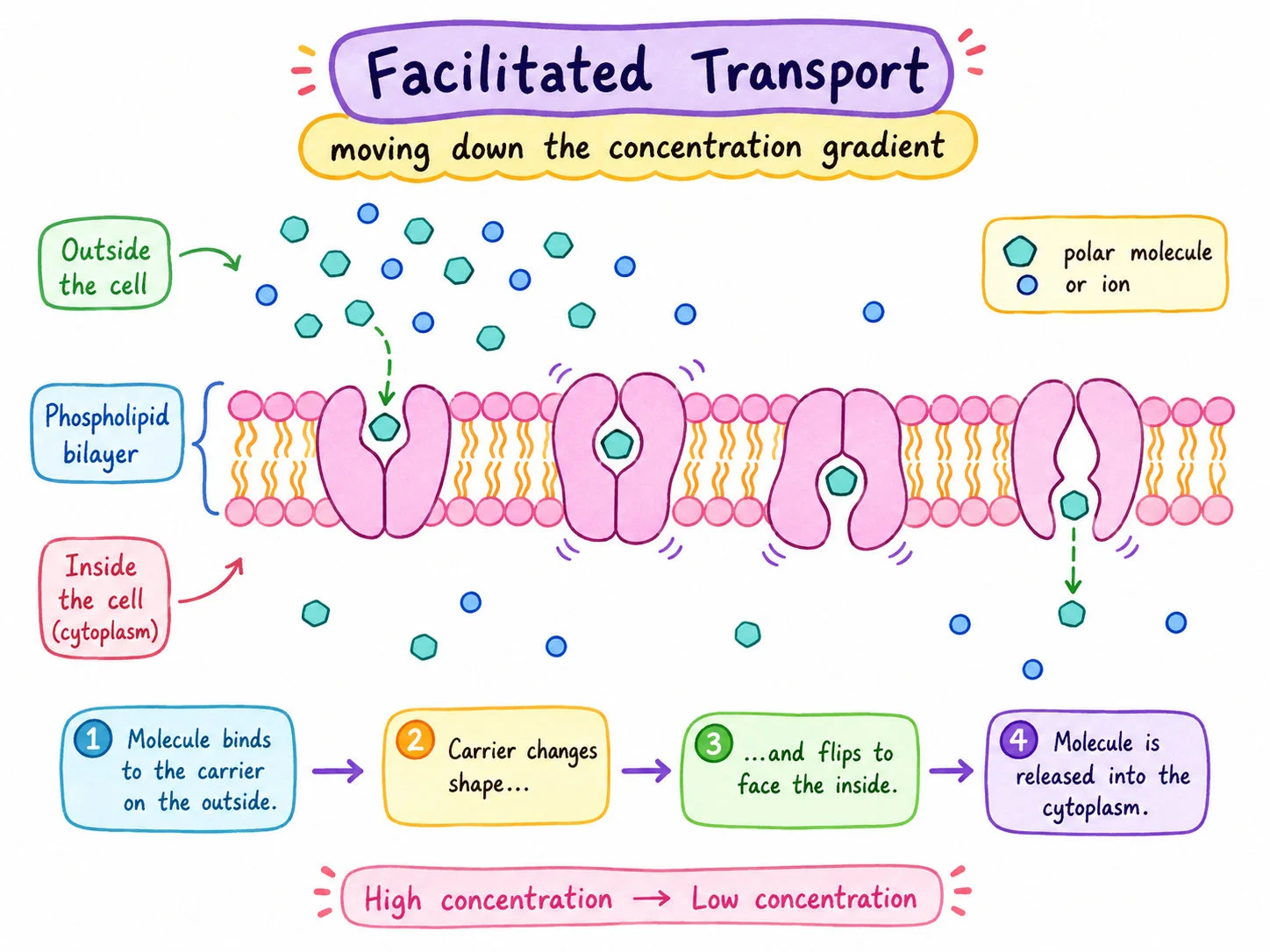
Passive transport moves particles down a concentration gradient from higher to lower concentration and does not require ATP. A steeper concentration gradient usually produces a faster rate of diffusion.
Simple diffusion
Small suitable particles may cross by simple diffusion. Ions and other substances that cannot pass directly through the bilayer use specific channel or carrier proteins in facilitated diffusion, which also requires no ATP.
Part 3 of 5Osmosis and tonicity
Osmosis
Osmosis is the diffusion of water across a selectively permeable membrane. Water moves toward the region with the greater solute concentration: from a hypotonic solution toward a hypertonic solution.
In a hypertonic solution a cell loses water and shrinks. In a hypotonic solution an animal cell may lyse, while a plant cell becomes turgid because its wall resists expansion. In an isotonic solution there is no net water movement.
Part 4 of 5Active transport and pumps
Active transport
Active transport moves substances against a concentration gradient and requires energy, usually from ATP. Membrane pumps maintain ion gradients even when diffusion would move the ions in the opposite direction.
Sodium-potassium pump
The sodium-potassium pump moves sodium and potassium ions across a nerve-cell membrane in opposite directions. This restores the ion distribution required for the neuron to return to its resting state after an impulse.
Part 5 of 5Bulk membrane transport
Exocytosis
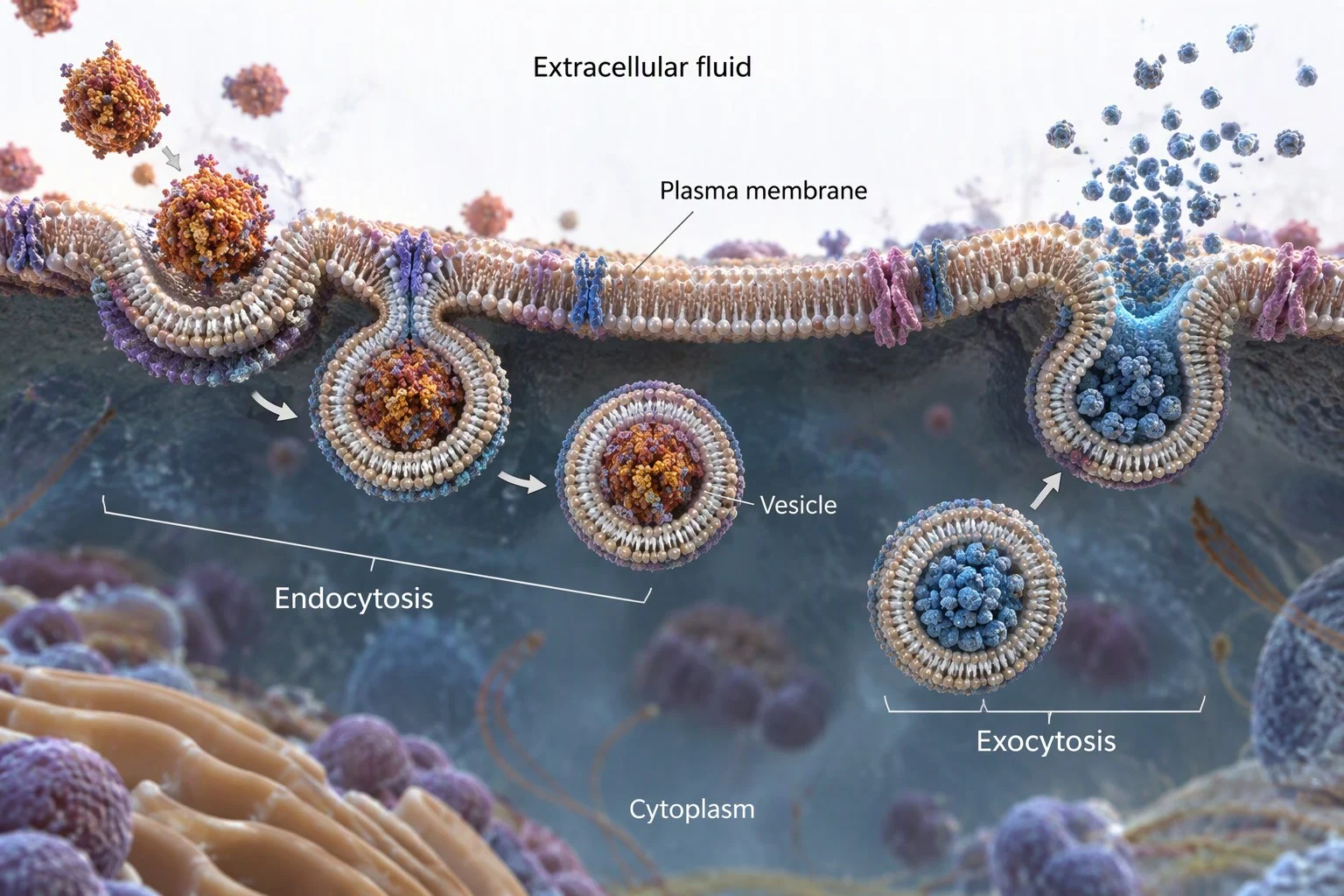
Exocytosis releases material when a vesicle fuses with the plasma membrane. In a synapse, vesicles use exocytosis to release neurotransmitter into the gap between cells.
Endocytosis
Endocytosis forms vesicles from the plasma membrane. Pinocytosis takes in dissolved substances, phagocytosis engulfs large particles, and receptor-mediated endocytosis captures specific substances bound to membrane receptors.
Marked practiceQuizzes for this lesson
Last updated:
\n