1.5Cell Structure and Molecular Biology
Cellular energetics — EST 2 Biology Revision Notes & Topical Questions
15 min read 28 parts Lesson 5 of 11 2 quizzes
SAT Biology cellular energetics: follow energy transfer through ATP, cellular respiration and photosynthesis. ATP stores energy that is immediately available for cell activities such as muscle contraction, nerve impulses and active transport.
- Glycolysis
- Krebs cycle
- light-dependent reactions
- Calvin cycle
Section 1 of 28ATP and energy transfer
Section 2 of 28Glycolysis and the Krebs cycle
Section 3 of 28Electron transport and fermentation

Section 4 of 28Light-dependent reactions
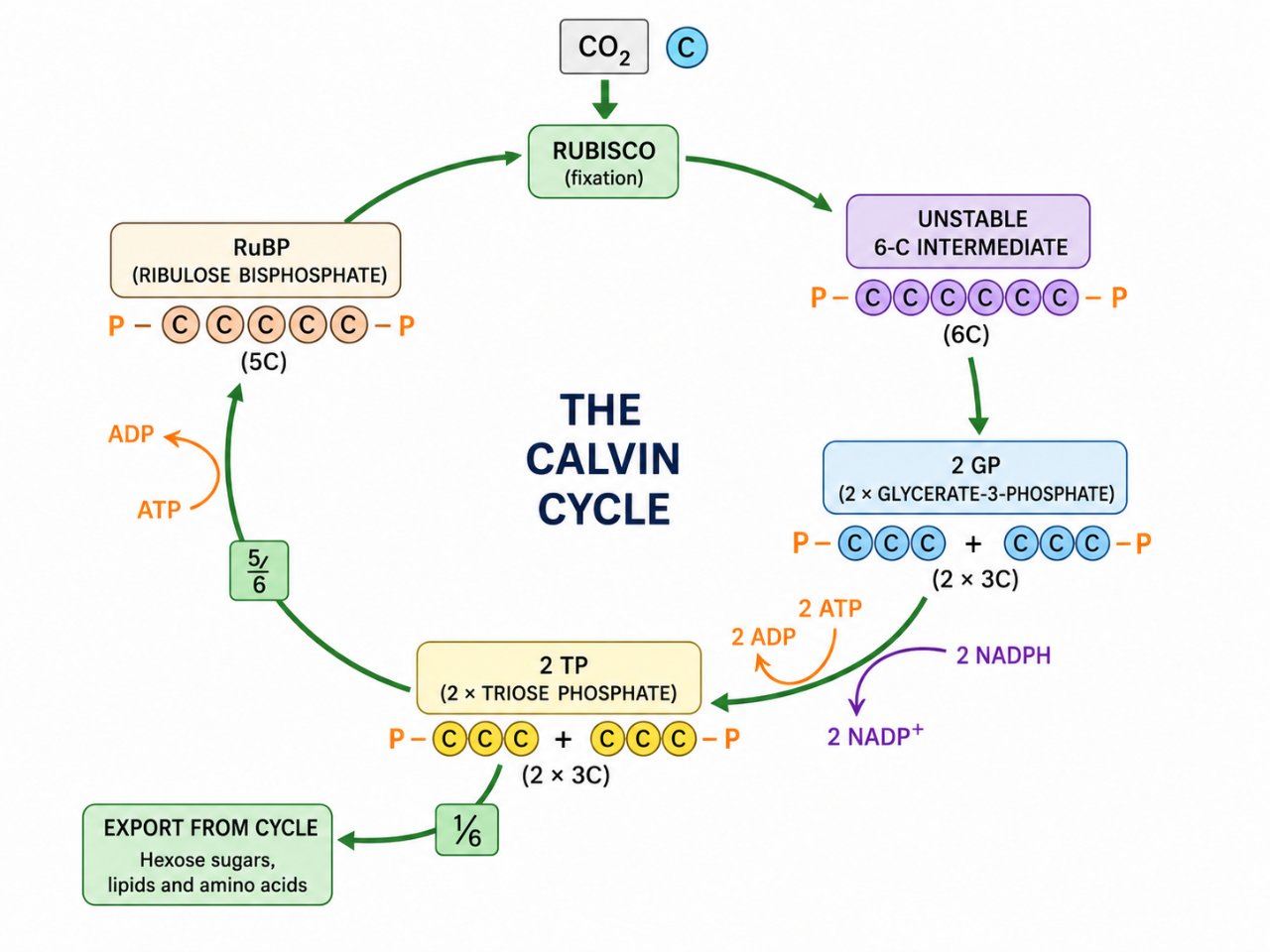
Section 5 of 28Calvin cycle and comparison

Section 6 of 28ATP as the energy currency
ATP stores energy that is immediately available for cell activities such as muscle contraction, nerve impulses and active transport.
Because the cell keeps only a small store of ATP, it is constantly recycled between ATP and ADP + Pi. Membrane pumps use ATP to maintain ion gradients even when diffusion would move the ions in the opposite direction; the sodium-potassium pump, for example, restores the ion distribution that a neurone needs to return to its resting state after an impulse.
Section 7 of 28Photosynthesis in two stages
| Stage | Location | Inputs | Outputs |
|---|---|---|---|
| Light-dependent reactions | Thylakoid membranes (grana) | Light, water, ADP + Pi, NADP+ | ATP, NADPH, oxygen (from splitting water) |
| Calvin cycle (light-independent) | Stroma | CO2, ATP, NADPH | Carbohydrate (G3P, glucose), ADP, NADP+ |
The ATP and NADPH from the light reactions power carbon fixation in the Calvin cycle.
Section 8 of 28Interpreting light-intensity data
A student counts oxygen bubbles from an aquatic plant with a lamp at different distances: 10 cm gives 60 bubbles per minute, 20 cm gives 16, and 40 cm gives 4.
Light intensity follows an inverse-square lawdoubling the distance cuts the intensity to about one quarter.
- which shows that light intensity is the limiting factor over this range.
Section 9 of 28Calvin cycle arithmetic
Each turn of the Calvin cycle fixes one CO2.
Section 10 of 28Exam technique: photosynthesis data
When analysing a graph or table, state the trend with numbers, give the explanation using the limiting factor idea, and link back to the molecules involved: less light means fewer excited electrons, so less ATP and NADPH, so slower carbon fixation.
Section 11 of 28Comparing respiration and photosynthesis
Photosynthesis stores energy in glucose using light and water splitting; respiration releases that energy as ATP.
- and carbon dioxide and water from respiration can be used in photosynthesis.
Summary
- ATP is the immediate energy currency, recycled between ATP and ADP;
- light intensity can limit photosynthesis;
- six turns of the Calvin cycle, using 18 ATP and 12 NADPH, are needed for each glucose.
Section 12 of 28Worked examples
Explain the pattern in bubble count 60, 16 and 4 at 10, 20 and 40 cm. [3]3 marks
Light intensity falls to about a quarter each time distance doubles; the rate falls similarly, so light is limiting, and less ATP and NADPH means less water split and less O2.
How many turns, ATP and NADPH are needed for one glucose? [3]3 marks
6 turns; 18 ATP; 12 NADPH.
What happens when ATP is converted to ADP? [2]2 marks
The terminal phosphate is removed and usable energy is released.
State the role of ATP in nerve cells. [2]2 marks
Powers the sodium-potassium pump that maintains ion gradients.
Section 13 of 28Evolution of photosynthesis
The first life forms emerged about 4 billion years ago, when there was no oxygen in the atmosphere.
- and prokaryotic photosynthetic pathways provided the foundation for the evolution of eukaryotic photosynthesis.
Section 14 of 28Chloroplast structure
Two key structures are the stroma and thylakoids.
Section 15 of 28Light-dependent reactions
- making an electrochemical gradient: a high H+ concentration in the lumen and a low concentration in the stroma.
PSI was discovered first and PSII later, and the names stuck, even though in linear flow PSII acts before PSI. The full names of the carriers are beyond the AP exam, but you need to know ATP synthase.
Section 16 of 28The Calvin cycle
The light-independent stage, the Calvin cycle, takes place in the stroma and makes complex organic molecules, including carbohydrates.
- and some of the product is used to regenerate the starting molecule while the rest leaves to form glucose.
When answering, trace the energy
- light excites electrons, the ETC pumps protons, ATP synthase makes ATP, and the ATP and NADPH power the Calvin cycle.
- Be specific about locations (thylakoid membrane, lumen, stroma), because marks are given for the correct place.
Section 17 of 28Exam technique: photosynthesis
State the location with each stagelight-dependent reactions in the thylakoid membranes, Calvin cycle in the stroma.
- so less ATP and NADPH is available for the Calvin cycle; low CO2 slows the Calvin cycle,
- so ATP and NADPH accumulate and the light reactions slow down.
Section 18 of 28Photosystems and pigments
Photosystems contain chlorophyll a and accessory pigments such as chlorophyll b and carotenoids.
Section 19 of 28Worked examples
Describe how a proton gradient forms in the thylakoid. [3]3 marks
Energy from electrons moving down the ETC pumps H+ from the stroma into the lumen.
State where the Calvin cycle occurs and why it depends on the light reactions. [2]2 marks
In the stroma; it uses ATP and NADPH made in the light reactions.
What is the role of ATP synthase? [2]2 marks
Protons flow through it down their gradient, and it makes ATP from ADP and Pi.
Explain how cyanobacteria changed the atmosphere. [2]2 marks
They photosynthesised and released oxygen, adding it to the atmosphere.
Section 20 of 28Overview of respiration
Cellular respiration releases energy from biological macromolecules, specifically glucose, to produce ATP. Respiration and/or fermentation occur in all living organisms. In eukaryotes, aerobic respiration is a series of enzyme-controlled reactions that capture the energy to make ATP from ADP + inorganic phosphate (Pi).
OverallC6H12O6 + 6O2 → 6CO2 + 6H2O + ATP.
Section 21 of 28Glycolysis, link reaction and Krebs cycle
| Stage | Location | Main events | Products |
|---|---|---|---|
| Glycolysis | Cytosol | Glucose (6C) is split into two 3-carbon pyruvate; ATP is made from ADP + Pi | 2 pyruvate, small net ATP, NADH |
| Pyruvate oxidation | Mitochondrial matrix | Both pyruvate molecules are oxidised to acetyl CoA, losing CO2 | Acetyl CoA, NADH, CO2 |
| Krebs (citric acid) cycle | Matrix | Acetyl CoA enters the cycle | NADH, FADH2, ATP, CO2 as waste |
Remember there are two pyruvate molecules per glucose, so two enter the mitochondrion. You are not expected to know the steps of the Krebs cycle or the names of the intermediate molecules.
Section 22 of 28Electron transport chain and chemiosmosis
Energy is transferred from electrons as they pass down the electron transport chain (ETC) in the inner mitochondrial membrane, through a series of oxidation-reduction reactions that establish an electrochemical gradient. This energy drives chemiosmosis: protons flow back through ATP synthase, driving oxidative phosphorylation. Oxygen is the final electron acceptor, forming water, and this stage produces most of the ATP.
Some organisms can decouple electron transport from oxidative phosphorylation: protons diffuse back across the membrane through a channel protein not linked to ATP synthase, so the energy is released as heat rather than making ATP.
Section 23 of 28Fermentation
Fermentation (anaerobic respiration) lets cells keep producing ATP when oxygen is absent. It yields much less ATP than aerobic respiration, because the ATP comes only from glycolysis, which does not need oxygen. Fermentation regenerates NAD+, which allows glycolysis to continue.
| Type | Organisms | Products |
|---|---|---|
| Ethanol fermentation | Yeast, some plants | Ethanol and CO2 |
| Lactic acid fermentation | Muscle cells, some bacteria | Lactate |
Section 24 of 28Comparing aerobic respiration and fermentation
| Feature | Aerobic respiration | Fermentation |
|---|---|---|
| Oxygen needed | Yes (final electron acceptor) | No |
| Site | Cytosol and mitochondria | Cytosol only |
| ATP yield | High (about 30 per glucose) | Low (2 per glucose) |
| End products | CO2 and water | Ethanol and CO2, or lactate |
Section 25 of 28Exam technique
For respiration questions, give the stage, the location, the inputs and outputs and the number of ATP where asked. When explaining why anaerobic conditions lower ATP yield, say that no oxygen means the electron transport chain stops, so only glycolysis makes ATP. Link yeast fermentation to bread and brewing.
Summary
- glycolysis (cytosol) gives pyruvate;
- pyruvate oxidation and the Krebs cycle (matrix) give CO2, NADH and FADH2;
- the ETC and chemiosmosis (inner membrane) give most of the ATP and water.
- Without oxygen only glycolysis plus fermentation remains.
Also remember that fats and proteins can be respired: fatty acids are converted to acetyl CoA and amino acids can enter the cycle after deamination, which links respiration to the breakdown of all the biological macromolecules.
Section 26 of 28Worked examples
State where glycolysis occurs and what it produces. [3]3 marks
In the cytosol; two pyruvate, some ATP and NADH.
Explain how the electron transport chain leads to ATP production. [4]4 marks
Energy from electrons pumps protons across the inner membrane, creating a gradient; protons flow through ATP synthase, making ATP; oxygen accepts electrons forming water.
Why does fermentation make less ATP? [2]2 marks
Only glycolysis makes ATP; there is no electron transport chain.
What is the role of NAD+ regeneration in fermentation? [2]2 marks
It allows glycolysis to continue to make ATP.
Section 27 of 28Key terms
| Term | Meaning |
|---|---|
| ATP | Adenosine triphosphate, the immediate energy currency. |
| NADPH | A reduced carrier that supplies hydrogen for the Calvin cycle. |
| Calvin cycle | Light-independent reactions that fix CO2 in the stroma. |
| Photolysis | Splitting of water by light. |
| Limiting factor | A factor in short supply restricting a process. |
| Term | Meaning |
|---|---|
| Stroma | The fluid of the chloroplast where the Calvin cycle occurs. |
| Thylakoid | Membrane sac where the light reactions occur. |
| Granum | A stack of thylakoids. |
| Photosystem | A cluster of pigments and proteins that harvest light. |
| ATP synthase | The enzyme that makes ATP using a proton gradient. |
| Chemiosmosis | Production of ATP using energy from a proton gradient. |
| Term | Meaning |
|---|---|
| Glycolysis | Splitting of glucose to pyruvate in the cytosol. |
| Krebs cycle | Cycle in the mitochondrial matrix producing NADH, FADH2, ATP and CO2. |
| Oxidative phosphorylation | ATP production driven by the electron transport chain. |
| Fermentation | ATP production without oxygen, using glycolysis. |
| Pyruvate | A 3-carbon product of glycolysis. |
Section 28 of 28Exam technique
Marked practiceQuizzes for this lesson
Last updated:
Magnification Triangle & Unit Conversion
Formula: M = I / A ⇔ A = I / M ⇔ I = M × A
Units: 1 mm = 1,000 μm = 1,000,000 nm.
Rule: Convert Image size (ruler mm) to μm by ×1,000 before dividing by Actual size.