1.5Cell Structure and Molecular Biology
Cellular energetics — EST 2 Biology Revision Notes & Topical Questions
15 min read 28 parts Lesson 5 of 11 2 quizzes
Lesson summary
SAT Biology cellular energetics: follow energy transfer through ATP, cellular respiration and photosynthesis. ATP stores energy that is immediately available for cell activities such as muscle contraction, nerve impulses and active transport.
- Glycolysis
- Krebs cycle
- light-dependent reactions
- Calvin cycle
Part 1 of 5ATP and energy transfer
ATP
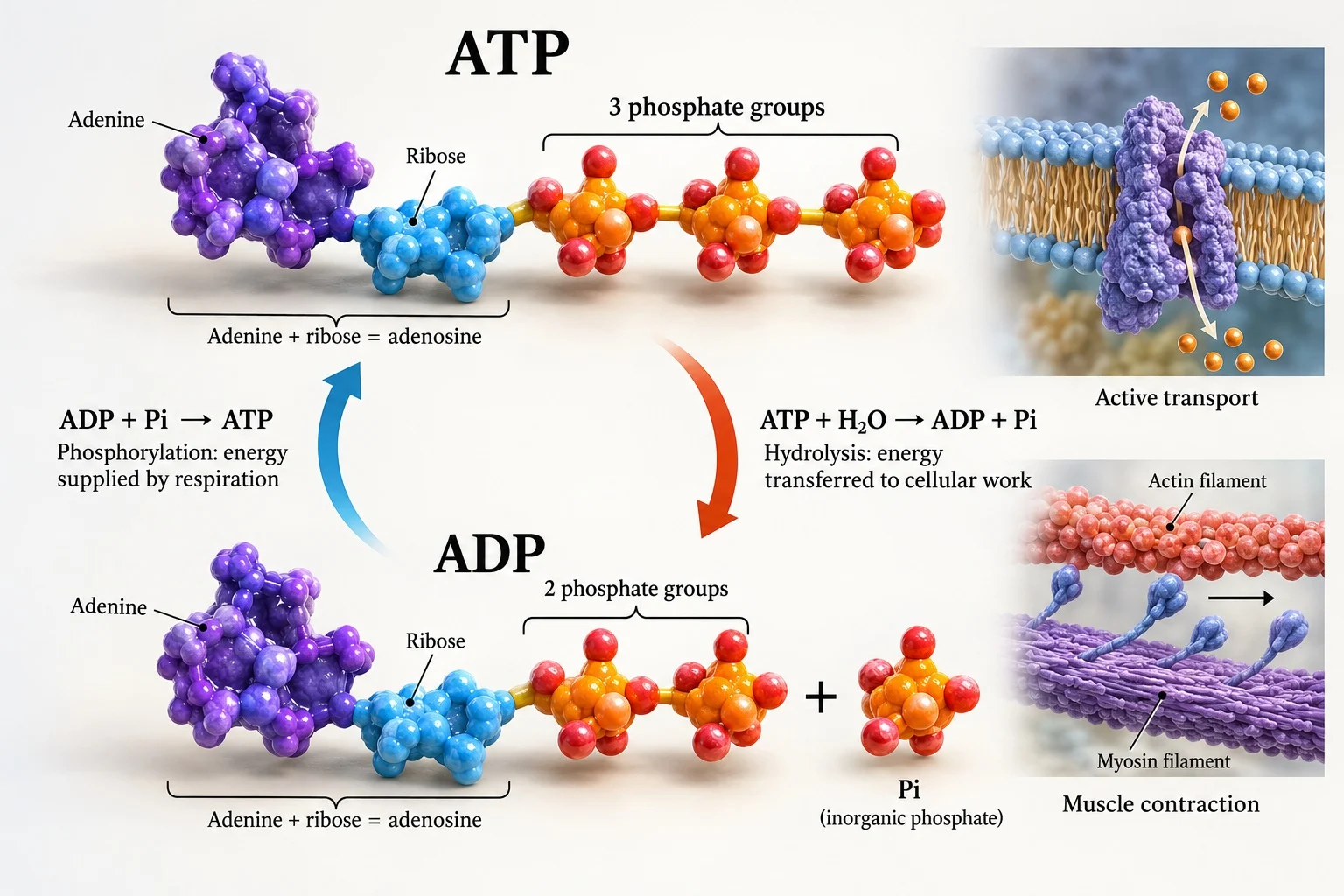
ATP stores energy that is immediately available for cell activities such as muscle contraction, nerve impulses and active transport. Removing its terminal phosphate converts ATP to ADP and releases usable energy.
Energy is required to add phosphate back to ADP. Cellular respiration transfers energy from glucose into ATP, while photosynthetic organisms first capture light energy and store it in chemical bonds.
Part 2 of 5Glycolysis and the Krebs cycle
1
Glycolysis
Glycolysis occurs in the cytoplasm and does not require oxygen. One glucose molecule is split into two pyruvate molecules, producing a net gain of two ATP and reduced electron carriers.
2
Krebs cycle
When oxygen is available, pyruvate enters the mitochondrion. The Krebs cycle occurs in the matrix, releases carbon dioxide, makes a small amount of ATP and transfers high-energy electrons to NADH and FADH₂.
Part 3 of 5Electron transport and fermentation

Electron transport and fermentation
NADH and FADH₂ carry electrons to an electron transport chain in the inner mitochondrial membrane. Electron energy pumps protons across the membrane; their return through ATP synthase drives the production of ATP.
Oxygen is the final electron acceptor in aerobic respiration, producing water. Without oxygen, fermentation regenerates the carrier needed for glycolysis; yeast produces ethanol and carbon dioxide, while muscle cells can produce lactate.
Part 4 of 5Light-dependent reactions
1Light-dependent reactions
Photosynthesis converts light energy into chemical energy. The light-dependent reactions occur in thylakoid membranes, where chlorophyll and accessory pigments absorb useful wavelengths of light.
2
Excited electrons pass through an electron transport chain that creates a proton gradient and powers ATP synthase. Photolysis replaces the lost electrons by splitting water, releasing oxygen and providing protons.
Part 5 of 5Calvin cycle and comparison

1
Calvin cycle
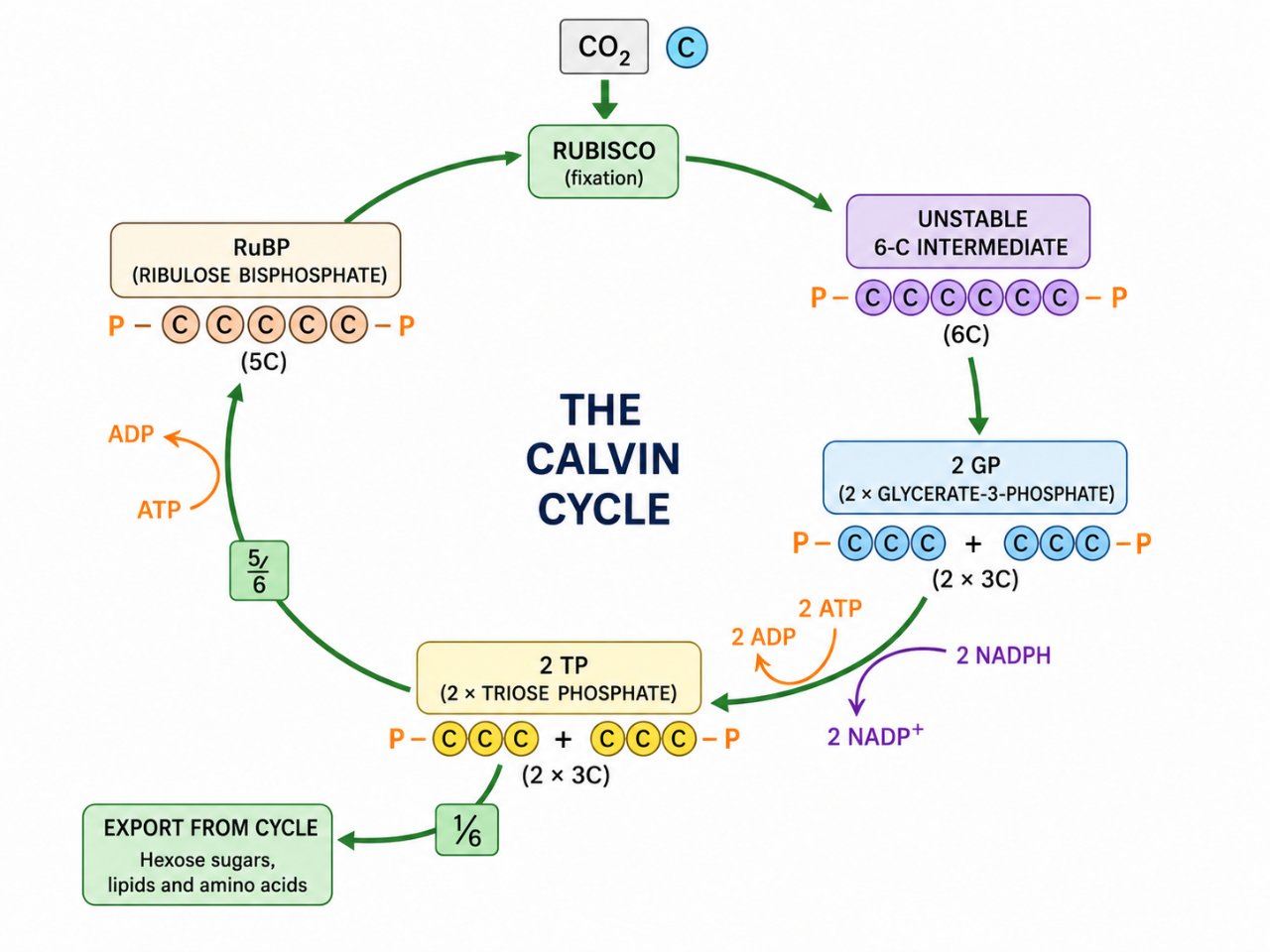
The Calvin cycle occurs in the chloroplast stroma. It uses carbon dioxide, ATP and reducing power supplied by the light reactions to fix carbon and produce three-carbon sugar molecules.
2
Respiration oxidises glucose, uses oxygen and releases carbon dioxide in mitochondria. Photosynthesis reduces carbon dioxide, releases oxygen and stores energy in sugars in chloroplasts; both processes use electron transport, proton gradients and ATP synthase.
Marked practiceQuizzes for this lesson
Last updated:
Cambridge 9700 AS Biology
Core Formula
Magnification Triangle & Unit Conversion
Formula: M = I / A ⇔ A = I / M ⇔ I = M × A
Units: 1 mm = 1,000 μm = 1,000,000 nm.
Rule: Convert Image size (ruler mm) to μm by ×1,000 before dividing by Actual size.