Theme C — Interaction and interdependence
Theme C — Interaction and interdependence — IB Biology HL Revision Notes & Topical Questions
5 min read 8 parts Lesson 1 of 11 Unit quiz
Curriculum Equation Key قوانين الرقم الهيدروجيني والاتزان الأيوني - pH & Acid-Base Equilibrium FormulasFast Exam Solution
pH = -log[H⁺] | pOH = -log[OH⁻] | pH + pOH = 14 | [H⁺][OH⁻] = 10⁻¹⁴
Word Equation & Conditions: الرقم الهيدروجيني = -لوغاريتم تركيز أيون الهيدروجين | pH + pOH = 14
Location & Specifications: الاتزان الأيوني، كيمياء 3 ثانوي، التحصيلي، و AP Chemistry.
Lesson summary
Theme C — Interaction and interdependence — IB BIOLOGY HL notes: Link enzymes, respiration, photosynthesis and the related practical skills in Theme C.Enzyme = a globular protein that acts as a biological catalyst, speeding up a specific reaction by lowering its activation energy…
- Metabolism
- Lock-and-key model
- Induced-fit model
- Calculate the initial rate from the tangent at t
- Induced fit
- FACE experiment
Section 1 of 8Enzymes and metabolism
Enzyme
Enzyme a globular protein that acts as a biological catalyst, speeding up a specific reaction by lowering its activation energy without being used up.
Metabolism
Metabolism the sum of reactions in a cell.
- Anabolism builds molecules and catabolism breaks them down.
Section 2 of 8Induced-fit model
Lock-and-key model
- Lock-and-key model the older model with a rigid active site.
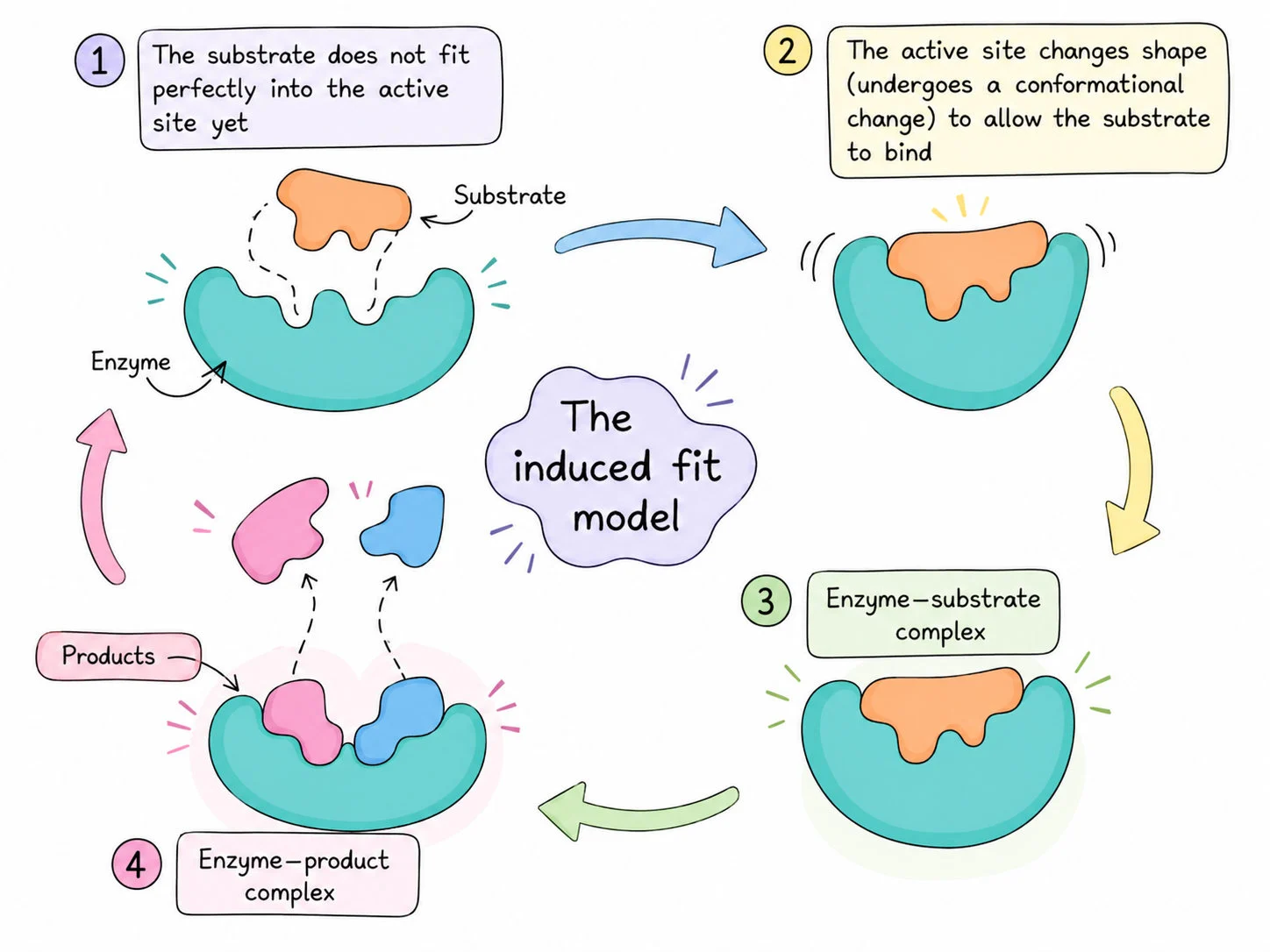
Induced-fit model
- Induced-fit model the active site flexes as the substrate enters, giving a tighter fit.
1
The substrate collides with the active site in the correct orientation.
2
Binding induces a change in the shape of the active site.
3
An enzyme–substrate complex forms and bonds in the substrate are stressed.
4
Activation energy is lowered and the reaction occurs, forming an enzyme–product complex.
5
The products are released and the enzyme is unchanged and reusable.
Section 3 of 8End-product inhibition
HL
- HL the final product of a pathway inhibits the first enzyme, usually allosterically.
Result
- Result production of the product matches demand.
Example
- Example isoleucine inhibits threonine deaminase.
Section 4 of 8Practical: effect of temperature on catalase
1
Prepare hydrogen peroxide at a fixed concentration and a catalase source such as yeast at a fixed volume.
2
Set water baths from 10 to 60 °C and equilibrate substrate and enzyme separately for 5 minutes.
3
Mix them and immediately collect oxygen in a measuring cylinder or gas syringe.
4
Record the volume at regular intervals.
5
Keep pH (using a buffer), volumes and concentrations constant.
6Calculate the initial rate from the tangent at t
0.
7
Repeat three times for means.
8
Plot rate against temperature to find the optimum.
Section 5 of 8Cell respiration
Respiration
Respiration the controlled release of energy from organic compounds to make ATP, which differs from gas exchange.
Topics in the theme
- Aerobic and anaerobic respiration in humans and yeast, including industrial uses.
- Measuring the rate with a respirometer.
- HLglycolysis, the link reaction, the Krebs cycle and oxidative phosphorylation, including NAD, FAD and oxygen.
- Lipids and carbohydrates as respiratory substrates.
Oxidation
Oxidation loss of electrons or hydrogen, or gain of oxygen.
Reduction
Reduction gain of electrons or hydrogen.
In respiration substrates are oxidised and NAD and FAD are reduced.
Rate of respiration
- It depends on pH, because carbon dioxide lowers pH.
- It depends on body size, because small animals have a larger surface area to volume ratio, lose heat faster and respire faster per gram.
Section 6 of 8Photosynthesis and experimental techniques
- Rf value = distance moved by the pigment spot ÷ distance moved by the solvent front, both from the origin line.
- It has no units and lies between 0 and 1.
| Technique | Features |
|---|---|
| Greenhouse or polytunnel | Carbon dioxide, light and temperature can be controlled one at a time, but only small plants fit |
| FACE experiment | Carbon dioxide is released over natural ecosystems, so large trees can be studied, but other variables cannot be controlled and must be monitored |
Section 7 of 8Key terms
| Term | Meaning |
|---|---|
| Enzyme | a globular protein that catalyses a specific reaction. |
| Induced fit | the model in which the active site changes shape as the substrate binds. |
| Activation energy | the energy needed to start a reaction. |
| Rf value | distance moved by a spot divided by distance moved by the solvent front. |
| Oxidation | loss of electrons or hydrogen. |
| FACE experiment | free-air carbon dioxide enrichment of natural ecosystems. |
Section 8 of 8Exam technique
1
Enzymes are used up in the reaction — they are unchanged and reusable.
2
Rf values can have units or exceed 1 — an Rf value has no units and lies between 0 and 1.
3
Oxidation and reduction are the same in respiration — substrates are oxidised and NAD and FAD are reduced.
4
Respiration makes energy — it releases energy from organic compounds to make ATP.
Last updated:
\n