Theme B — Form and function
Theme B — Form and function — IB Biology HL Revision Notes & Topical Questions
5 min read 9 parts Lesson 1 of 14 Unit quiz
Curriculum Equation Key قوانين الرقم الهيدروجيني والاتزان الأيوني - pH & Acid-Base Equilibrium FormulasFast Exam Solution
pH = -log[H⁺] | pOH = -log[OH⁻] | pH + pOH = 14 | [H⁺][OH⁻] = 10⁻¹⁴
Word Equation & Conditions: الرقم الهيدروجيني = -لوغاريتم تركيز أيون الهيدروجين | pH + pOH = 14
Location & Specifications: الاتزان الأيوني، كيمياء 3 ثانوي، التحصيلي، و AP Chemistry.
Lesson summary
Theme B — Form and function — IB BIOLOGY HL notes: Connect the Theme B topics from molecules to organs, using short facts on proteins, membranes, specialisation, gas exchange, transport and muscle.Condensation — it releases water and forms a covalent bond when monomers join to bu…
- Hydrolysis
- Polypeptide
- Essential amino acids
- Immobilised enzymes
- Mitochondrion
- Early embryo
Part 1 of 7Condensation, hydrolysis and polypeptides
Condensation
- Condensation it releases water and forms a covalent bond when monomers join to build carbohydrates and lipids.
Hydrolysis
- Hydrolysis it breaks a covalent bond by adding water.
Polypeptide
Polypeptide a chain of amino acids joined by peptide bonds, with a sequence coded by a gene.
Protein
- Protein it consists of one or more polypeptides.
Essential amino acids
- Essential amino acids they must come from food, and lacking one limits protein synthesis.
- Vegan diets combine sources such as legumes and grains to supply all of them.
Part 2 of 7Globular and fibrous proteins
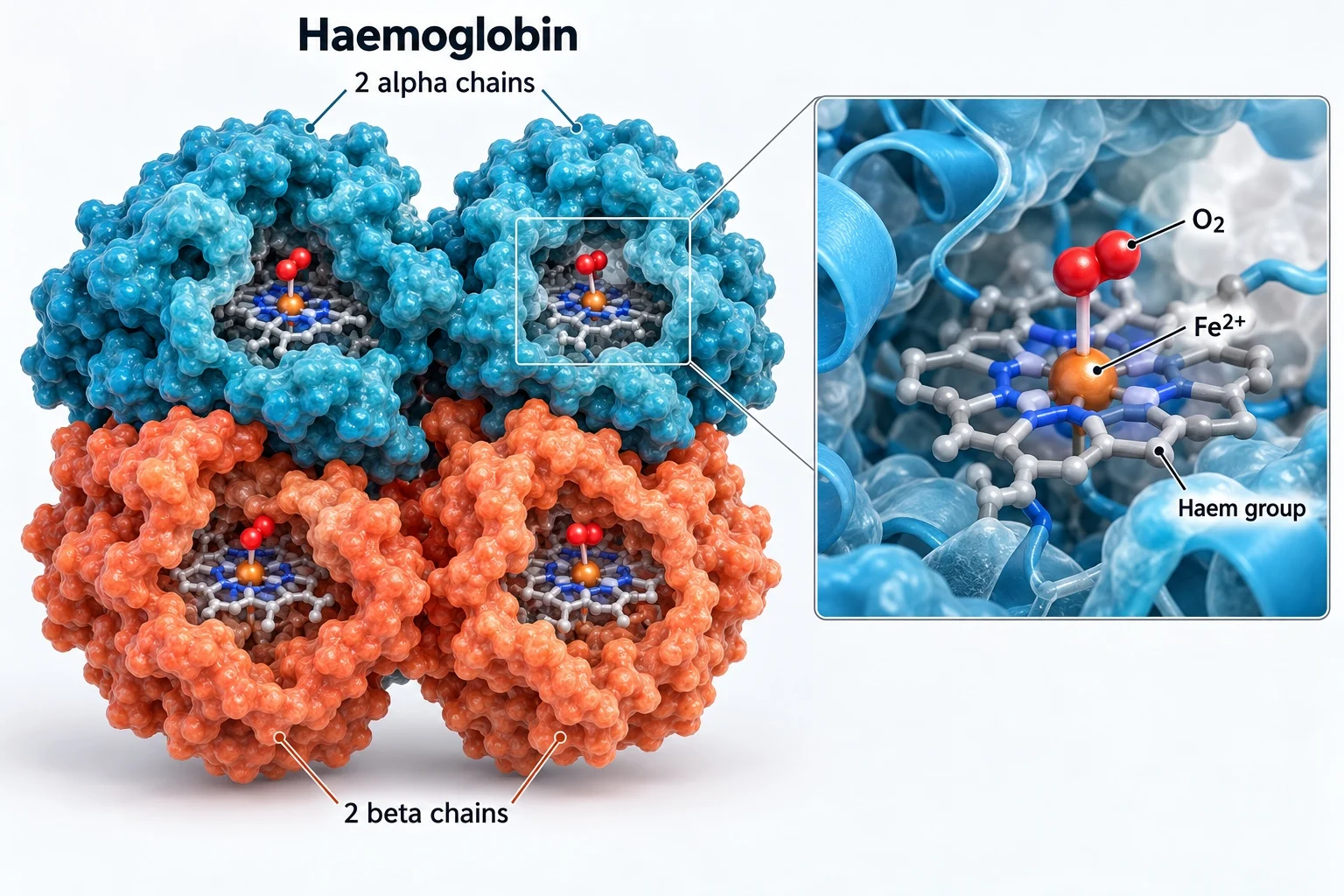
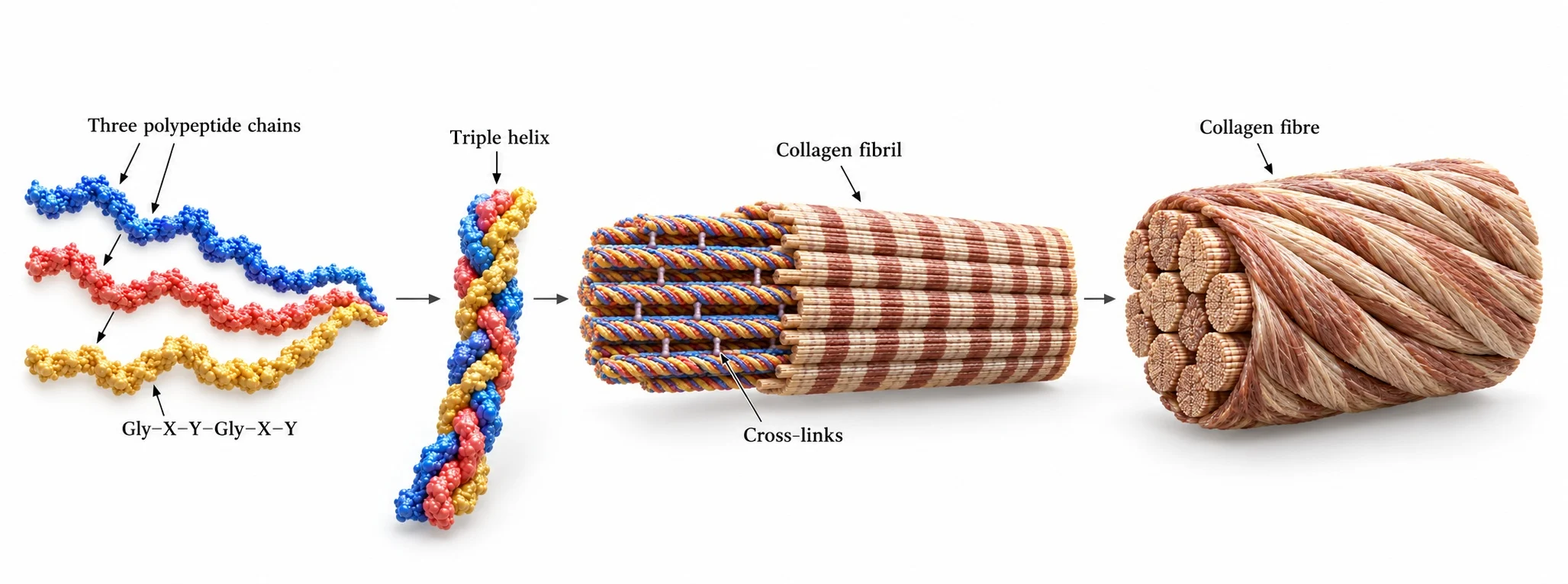
| Feature | Globular proteins | Fibrous proteins |
|---|---|---|
| Shape | Compact, roughly spherical | Long strands with cross-links (hydrogen bonds) |
| R groups | Hydrophobic inside, hydrophilic outside | Many hydrophobic R groups |
| Solubility | Soluble, so easily transported | Insoluble |
| Examples | Enzymes, immunoglobulins, haemoglobin (with a haem prosthetic group), insulin | Proteins with structural roles |
- Insulin
- it was the first protein sequenced.
- Polypeptide A has 21 amino acid residues and polypeptide B has 30, joined by three disulfide bridges.
- It is made in the pancreas and controls blood glucose.
Part 3 of 7Membrane glycoproteins and mitochondria
Glycoproteins and glycolipids in the cell-surface membrane have several roles.
- They act as receptors for hormones and neurotransmitters.
- They take part in endocytosis.
- They help cells stick together.
- They act as antigens, letting the immune system tell self from non-self.
Immobilised enzymes
- Immobilised enzymes some integral proteins are enzymes, such as those on intestinal microvilli that digest disaccharides.
Mitochondrion
- Mitochondrion it has a double membrane, 70S ribosomes and circular DNA.
- The link reaction and Krebs cycle occur in the matrix.
- Oxidative phosphorylation occurs on the inner membrane cristae.
Part 4 of 7Stem cells and cell specialisation
Stem cells and cell specialisation
Early embryo
- Early embryo the zygote divides by mitosis, and early cells are unspecialised and totipotent.
Blastocyst
- Blastocyst by this stage the inner cell mass is pluripotent.
Stem cell
Stem cell a cell that can divide repeatedly (self-renewal) and differentiate.
Differential gene expression
- Differential gene expression cells specialise in response to their position.
- Morphogens diffuse from source cells to form concentration gradients, such as Sonic hedgehog in limb development.
- Cells at high and low concentrations express different genes.
Silencing
- Silencing genes are switched off by DNA methylation or histone modification, and the DNA sequence is unchanged.
Part 5 of 7Ventilation and the heart
- Inhalation
1
The diaphragm and external intercostal muscles contract.
2
Thoracic volume increases.
3
Pressure falls below atmospheric pressure (Boyle's law).
4
Air flows in.
Forced exhalation
- Forced exhalation it uses the internal intercostal and abdominal muscles.
Spirometer
- Spirometer it measures tidal volume, vital capacity and reserve volumes, which increase with exercise.
Alveolar epithelium
- Alveolar epithelium it contains type I and type II pneumocytes.
Heart pressure graphs
- Heart pressure graphs the crossing points of the lines mark valve events.
- Ventricle pressure rising above atrium pressure closes the bicuspid valve.
- Ventricle pressure rising above aortic pressure opens the aortic valve.
- Ventricle pressure falling below aortic pressure closes the aortic valve.
- Atrium pressure rising above ventricle pressure reopens the bicuspid valve.
Heart rate
60 ÷ the length of one cardiac cycle in seconds.
Part 6 of 7Water transport and the lymphatic system
Water transport and the lymphatic system
Xylem
- Xylem water rises because of cohesion, the attraction between water molecules from hydrogen bonding.
Tissue fluid
- Tissue fluid it forms at capillaries, and some re-enters the capillaries while the rest enters closed-ended, large-pored lymph capillaries.
Lymph
- It moves by body movements and valves.
- It passes through lymph nodes, which contain macrophages.
- It carries lipids from the intestine and returns plasma proteins to the blood.
Protein return
- Protein return plasma proteins left in tissue fluid would raise its solute concentration and prevent water reabsorption.
Sedentary travellers can get swollen legs because lymph accumulates.
Part 7 of 7Muscle tissue
Skeletal muscle
- Skeletal muscle it is striated and made of fibres.
- Each fibre has a sarcolemma and many nuclei.
- Contractile proteins are organised in the fibre.
- The sarcoplasmic reticulum stores Ca2+.
Cardiac muscle is found in the heart.
Smooth muscle is found in blood vessels and organs.
Key terms
| Term | Meaning |
|---|---|
| Hydrolysis | breaking a covalent bond by adding water. |
| Polypeptide | a chain of amino acids linked by peptide bonds. |
| Stem cell | an unspecialised cell that can self-renew and differentiate. |
| Morphogen | a signalling molecule forming a gradient that determines cell fate. |
| Cohesion | attraction between water molecules due to hydrogen bonding. |
| Lymph | fluid in lymph vessels that carries lipids and returns proteins to the blood. |
Avoid these mistakes
1
Specialised cells have lost genes — their DNA is unchanged and different genes are expressed.
2
Totipotent and pluripotent are the same — totipotent cells can form any cell including extra-embryonic tissue, and pluripotent cells can form any body cell.
3
Lymph vessels are part of the blood circulation — they form a separate system that drains into veins.
4
Air is drawn in by the lungs actively expanding — muscles enlarge the thorax and the lower pressure draws air in.
Last updated:
\n