C1.1Theme C — Interaction and interdependence
Enzymes and metabolism — IB Biology HL Revision Notes & Topical Questions
10 min read 12 parts Lesson 2 of 11 2 quizzes
Curriculum Equation Key قوانين الرقم الهيدروجيني والاتزان الأيوني - pH & Acid-Base Equilibrium FormulasFast Exam Solution
pH = -log[H⁺] | pOH = -log[OH⁻] | pH + pOH = 14 | [H⁺][OH⁻] = 10⁻¹⁴
Word Equation & Conditions: الرقم الهيدروجيني = -لوغاريتم تركيز أيون الهيدروجين | pH + pOH = 14
Location & Specifications: الاتزان الأيوني، كيمياء 3 ثانوي، التحصيلي، و AP Chemistry.
Lesson summary
C1.1 Enzymes and metabolism — IB BIOLOGY HL notes: Explain how enzymes catalyse metabolic reactions, how their activity is affected and measured, and how inhibition controls metabolic pathways.Need for catalysts — most reactions are very slow or do not occur spontaneously at cell…
- Enzyme-substrate specificity
- Collisions
- Enzyme-substrate complex
- Active site
- Lock-and-key model
- Induced-fit hypothesis
Part 1 of 8Enzymes as biological catalysts
1Need for catalysts
- Need for catalysts most reactions are very slow or do not occur spontaneously at cell conditions.
- High temperature, pressure, extreme pH or high reactant concentration speed reactions but would harm cells.
2Enzymes
- Enzymes proteins that act as biological catalysts, allowing reactions at a suitable rate in living organisms.
- They are reusable and unchanged, so only a few are needed.
- They hold substrate molecules in the correct orientation and close together.
- The cell controls which enzymes it makes and so controls its reactions.
3Metabolism
Metabolism all the chemical reactions in cells and organisms, with the molecules involved called metabolites.
- Many reactions have several stages, each with its own enzyme, forming a metabolic pathway.
4Enzyme-substrate specificity
- Enzyme-substrate specificity a globular enzyme has an active site complementary (not identical) in shape and chemistry to its substrate,
- so thousands of enzymes are needed.
Part 2 of 8Anabolism and catabolism
| Feature | Anabolism | Catabolism |
|---|---|---|
| Process | Builds large molecules from small ones | Breaks large molecules into smaller ones |
| Energy | Endergonic, needs energy input | Exergonic, releases energy as free energy or heat |
| Reaction type | Often condensation | Often hydrolysis |
| Substrates | Several substrates make one product | One substrate gives two or more products |
| Purpose | Growth, repair and energy storage | Digestion, excretion and energy supply |
| Examples | Photosynthesis, protein synthesis, glycogen formation | Respiration, deamination releasing urea, digestion |
- Both are enzyme-catalysed and coupled to ATP, the main energy carrier.
Part 3 of 8Enzyme action and the induced-fit model
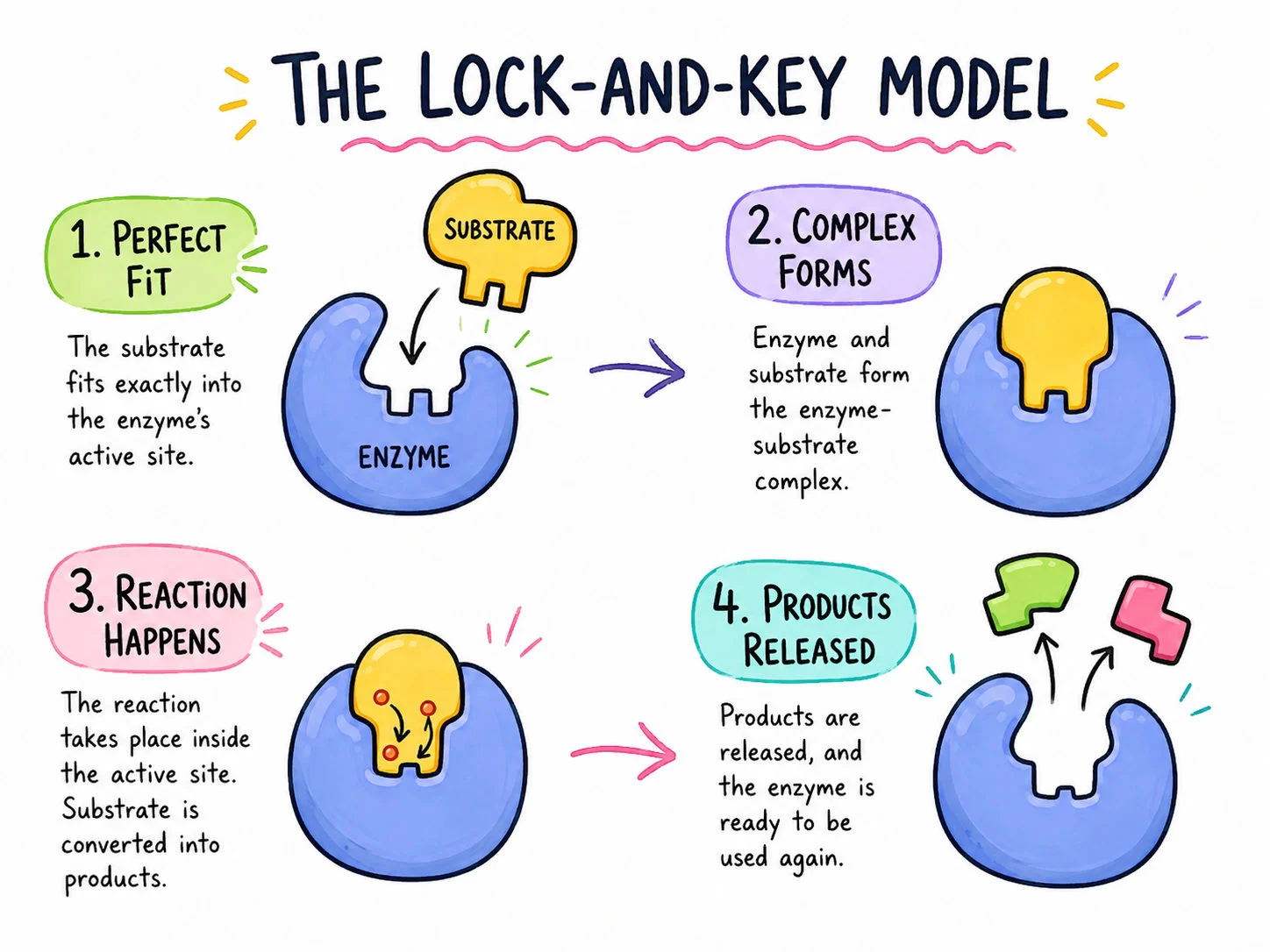
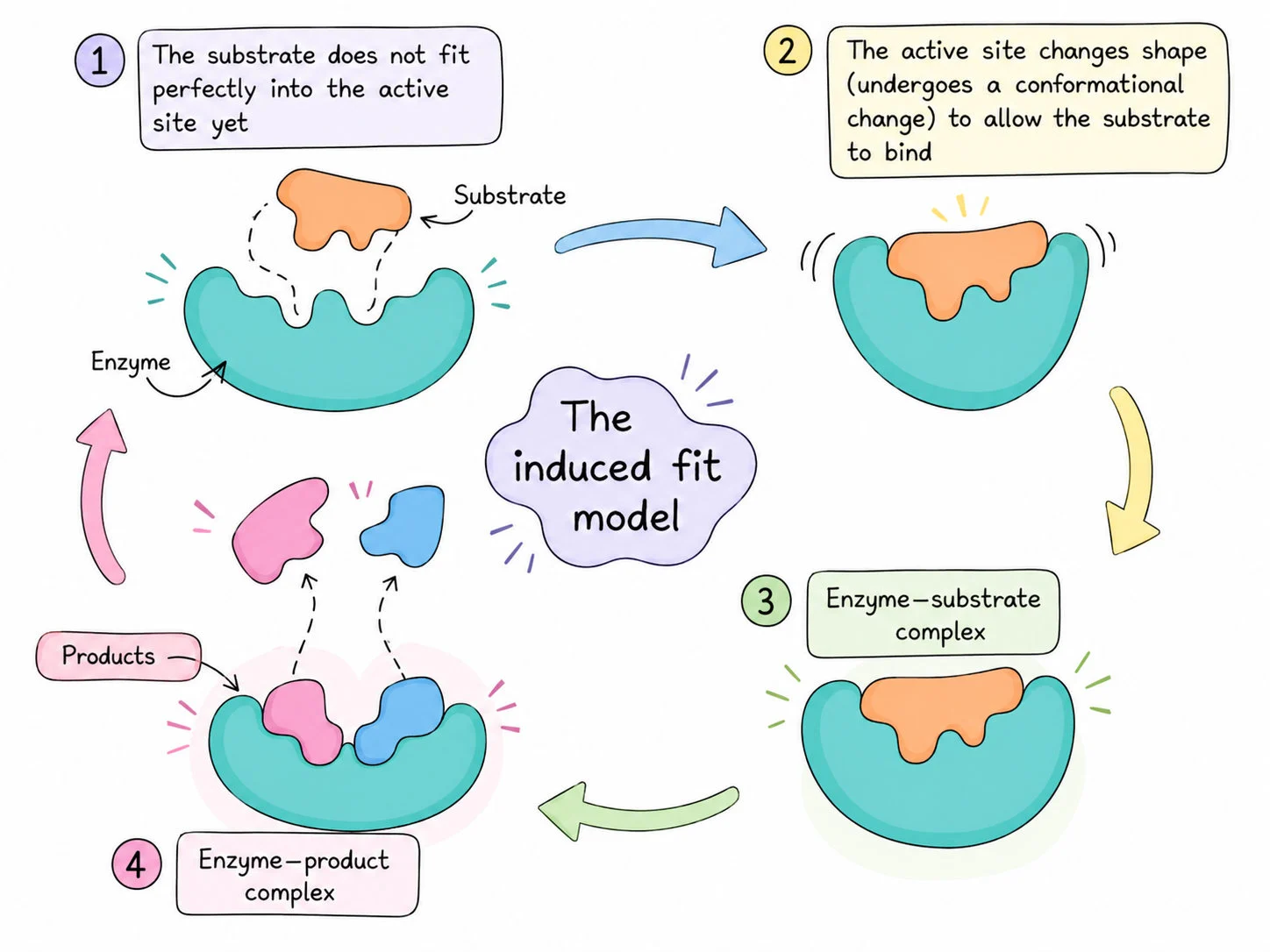
Collisions
- Collisions substrates collide at random with the active site,
- and the collision must have the correct orientation and speed, otherwise molecules bounce off.
- Some enzymes have two substrates that bind at separate sites at once.
Enzyme-substrate complex
- Enzyme-substrate complex a temporary complex in which the substrate is changed and the products detach, leaving the enzyme free.
Active site
- Active site a few amino acids in the 3-D protein shape bind the substrate, hold it in position and lower the energy needed.
- Catalase binds hydrogen peroxide, but DNA polymerase does not.
Lock-and-key model
- Lock-and-key model the active site is precisely complementary to the substrate.
Induced-fit hypothesis
- Induced-fit hypothesis the current model, in which the enzyme and sometimes the substrate change shape as the substrate enters.
- (conformational changes)
- This gives an ideal binding arrangement and maximises catalysis.
Molecular motion
- Molecular motion greater kinetic energy gives faster movement and more collisions, more complexes and more product.
Part 4 of 8Immobilised enzymes

Methods of immobilising enzymes
- Attachment to an inert substance such as glass.
- Entrapment in a matrix such as alginate gel.
- Entrapment in a partially permeable membrane.
Uses
- Uses food processing, environmental management, pharmaceuticals and manufacturing.
Advantages
- The product is not contaminated, so no filtering or further processing is needed.
- The enzyme can be reused, which is efficient and cheap.
- The enzyme is more tolerant of temperature and pH changes and more stable.
- Substrates meet higher enzyme concentrations, which raises throughput.
- Conditions can be controlled close to the optimum.
Part 5 of 8Reaction rates and activation energy
Rate of reaction
- Rate of reaction it is found from product formed or substrate used per unit time, or as 1 ÷ time taken (units s−1).
- A shorter time means a higher rate.
Rate changes during the reaction as substrate falls, so the graph starts linear and then plateaus.
Initial rate
Initial rate change in volume ÷ change in time, the gradient of a tangent at the origin, in cm3 s−1.
Nature of science
- Nature of science describing patterns and trends in graphs and sketching generalised graphs are examples of models.
Enzyme-substrate complex
- Enzyme-substrate complex the substrate is in a transition state before the product forms.
Energy changes
- Exergonic reactions release energy to the surroundings.
- Endergonic reactions absorb energy.
- These differ from exothermic and endothermic, which describe only thermal energy.
Activation energy
Activation energy the energy a substrate needs to become unstable enough to react.
- Enzymes lower it by reducing the stability of bonds in the substrate.
- The energy released by the reaction is unchanged, but the rate is faster.
Part 6 of 8Metabolic pathways
Metabolic pathways
Intracellular enzymes work inside the cell,
- such as those of glycolysis and the Krebs cycle,
- and extracellular enzymes are secreted in vesicles,
- such as digestive enzymes.
Energy and heat
- Aerobic respiration oxidises glucose to carbon dioxide and water, releasing free energy, some as heat because transfers are not 100% efficient.
- Endotherms (birds, mammals) use metabolic heat to keep body temperature constant, and ectotherms cannot.
- Endergonic reactions such as protein synthesis are linked to exergonic reactions by ATP.
Pathway types
- Linear pathways have a distinct start and end, such as glycolysis.
- Cyclic pathways have an end product that restarts the cycle, such as the Calvin cycle and Krebs cycle.
- Intermediates are metabolites that form new molecules or break down molecules with energy transfer.
Part 7 of 8Competitive and non-competitive inhibition
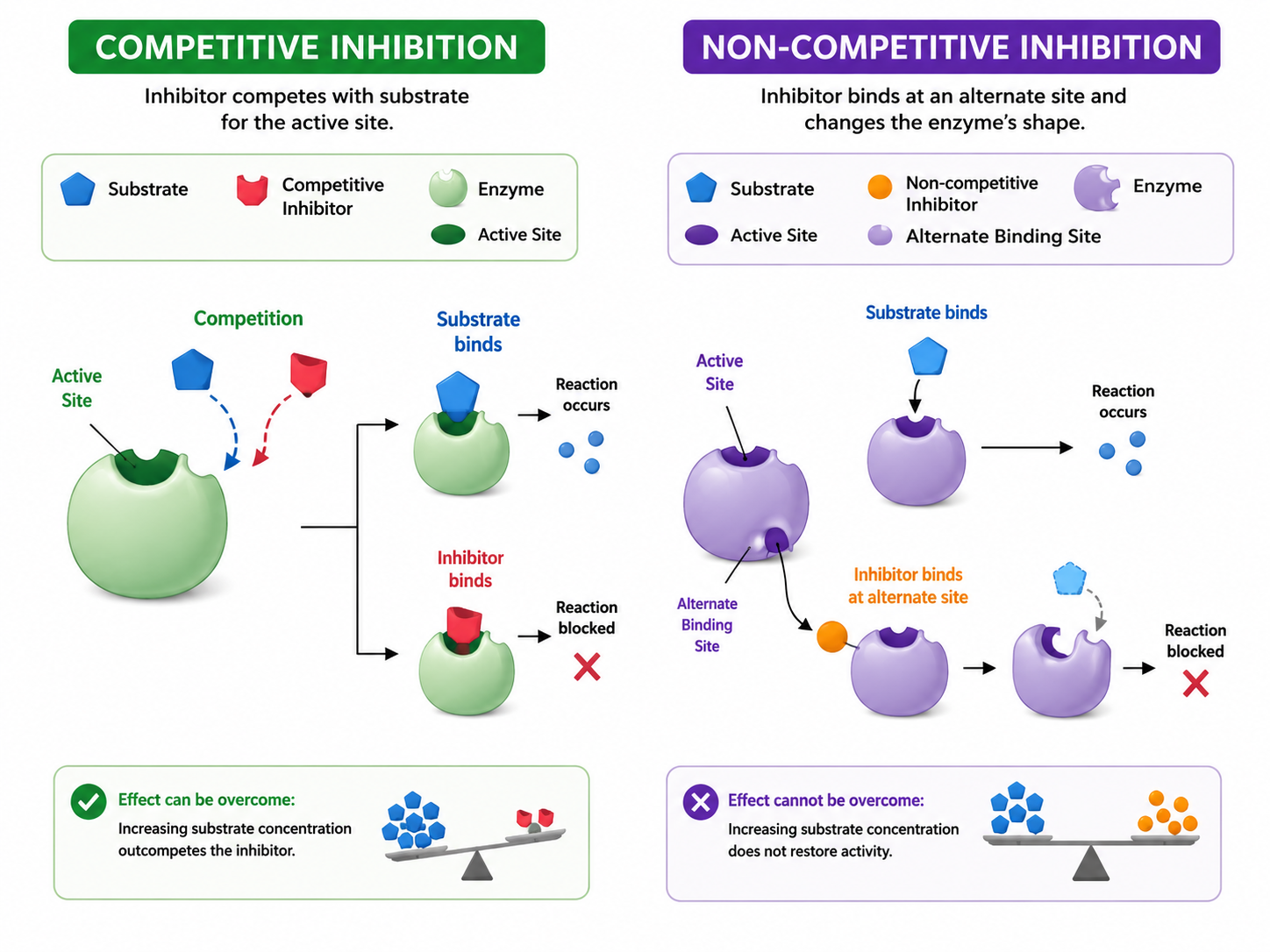
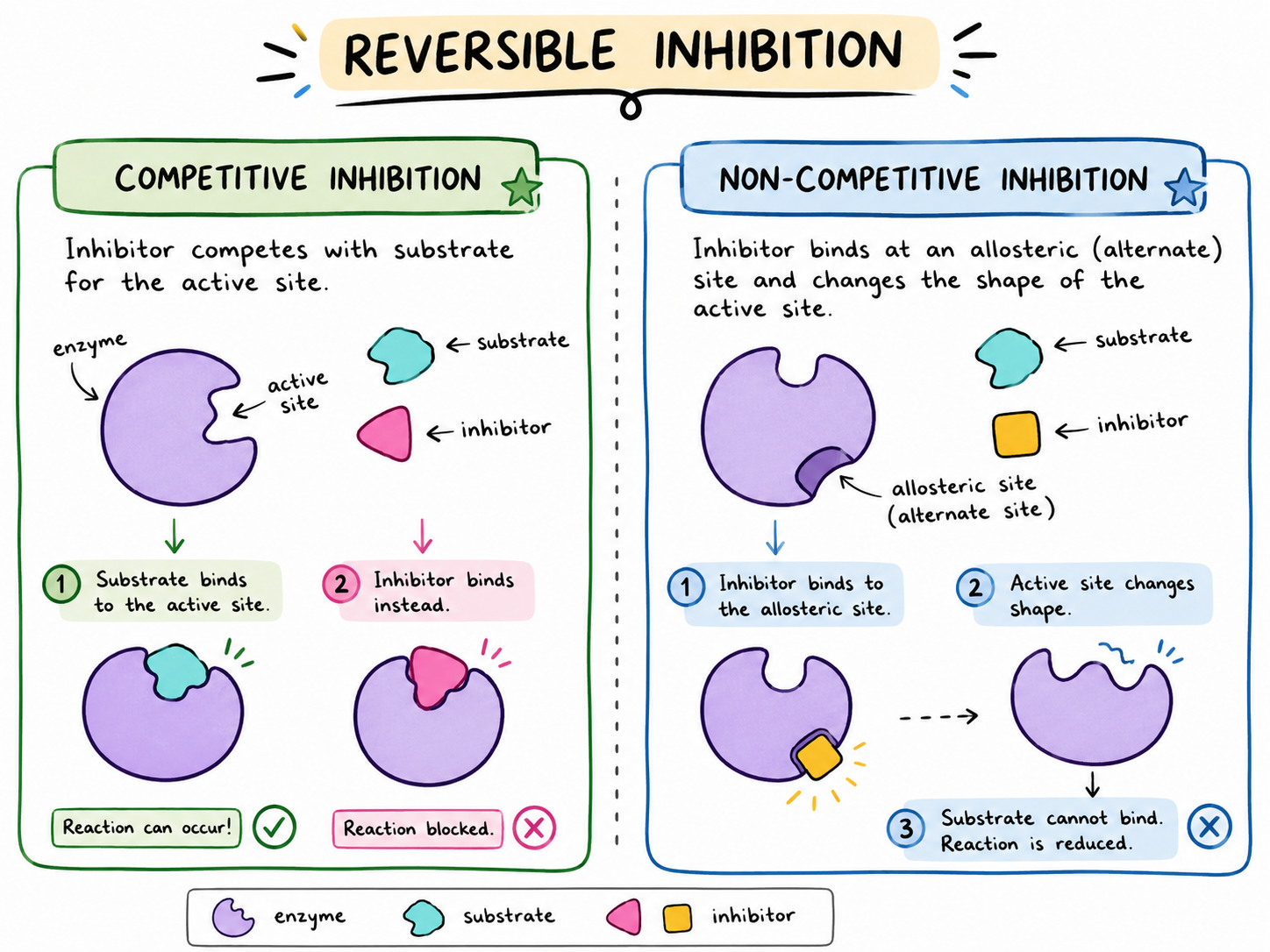
Competitive and non-competitive inhibition
Inhibitor
Inhibitor a chemical that binds an enzyme and reduces its activity, either formed in the cell or from outside.
Competitive inhibitors
- Competitive inhibitors they resemble the substrate, bind reversibly to the active site and compete with it.
- Statins resemble the substrate of the enzyme that makes cholesterol,
- so LDL cholesterol falls, reducing the risk of atherosclerosis and coronary heart disease.
Non-competitive inhibitors
- Non-competitive inhibitors they bind reversibly to an allosteric site away from the active site.
- Binding causes a conformational change that alters the active site while the effector stays bound.
| Feature | Competitive | Non-competitive |
|---|---|---|
| Binding site | Active site | Allosteric site |
| Resemblance to substrate | Similar | Unlike |
| Effect | Blocks the active site | Changes the shape of the active site |
| Raising substrate concentration | Overcomes inhibition | Cannot overcome it |
| Maximum rate | Unchanged | Lowered |
- Both types lower the initial rate, and a high enough inhibitor concentration stops the reaction.
Part 8 of 8End-product and mechanism-based inhibition
1End-product (feedback) inhibition
- End-product (feedback) inhibition an excess end product acts as an allosteric, non-competitive inhibitor of the first enzyme.
- It stops intermediates building up.
- When product falls, the inhibitor detaches and the enzyme restarts, forming a feedback loop.
2Isoleucine example
- Isoleucine example isoleucine inhibits threonine deaminase, the first enzyme of its own pathway in bacteria.
- Use of isoleucine in protein synthesis lowers its level, so more enzymes are free and production resumes.
3Mechanism-based inhibition
- Mechanism-based inhibition a substrate analogue forms covalent bonds with the active site and is changed into a reactive group.
- A stable inhibitor-enzyme complex forms and inhibition is irreversible.
4
Penicillin example
1
Growing bacterial walls of cross-linked peptidoglycan are opened by autolysins so new peptidoglycan can be added.
2
Penicillin resembles part of the peptide chain, so DD-transpeptidase binds it and forms a stable complex.
3
Cross-links can no longer form while autolysins keep making holes.
4
The weakened wall bursts by osmosis, which is death by lysis.
5
It works only on growing bacteria.
- Resistance
- mutations change the active site of DD-transpeptidase, and plasmid genes spread by conjugation, even between species.
Key terms
| Term | Meaning |
|---|---|
| Active site | the region of an enzyme where the substrate binds. |
| Activation energy | the energy needed for a reaction to start. |
| Induced fit | the active site changing shape as the substrate binds. |
| Allosteric site | a site away from the active site where effectors bind. |
| Competitive inhibitor | an inhibitor that binds the active site in place of the substrate. |
| End-product inhibition | control of a pathway by its product inhibiting an early enzyme. |
| Anabolism | building large molecules from small ones using energy. |
| Catabolism | breaking down large molecules and releasing energy. |
| Immobilised enzyme | an enzyme fixed to or trapped in a support. |
Avoid these mistakes
1
Enzymes are used up — they are reusable and unchanged.
2
The active site and substrate have the same shape — their shapes are complementary.
3
Denaturation breaks peptide bonds — it breaks bonds holding the 3-D shape only.
4
Raising substrate concentration overcomes all inhibition — it works for competitive but not non-competitive inhibitors.
Marked practiceQuizzes for this lesson
Last updated:
\n