C1.2Theme C — Interaction and interdependence
Cell respiration — IB Biology HL Revision Notes & Topical Questions
10 min read 12 parts Lesson 3 of 11 3 quizzes
Curriculum Equation Key معادلة التنفس الخلوي الهوائي الموزونة - Balanced Cellular Respiration EquationFast Exam Solution
C₆H₁₂O₆ + 6O₂ ➔ 6CO₂ + 6H₂O + 36-38 ATP
Word Equation & Conditions: Glucose + Oxygen -> Carbon Dioxide + Water + Energy (36-38 ATP) | جلوكوز + أكسجين ← ثاني أكسيد كربون + ماء + طاقة
Location & Specifications: الميتوكوندريا (Mitochondria) والسيتوسول.
Lesson summary
C1.2 Cell respiration — IB BIOLOGY HL notes: Explain ATP as the energy currency and describe aerobic and anaerobic respiration, glycolysis, the link reaction, the Krebs cycle, oxidative phosphorylation and respiratory substrates.Role — cell respiration releases energy in small st…
- Universal energy currency
- Not stored
- Energy and ATP are different
- Hydrolysis
- Controlled release
- Uses of the energy
Part 1 of 10ATP as the energy currency
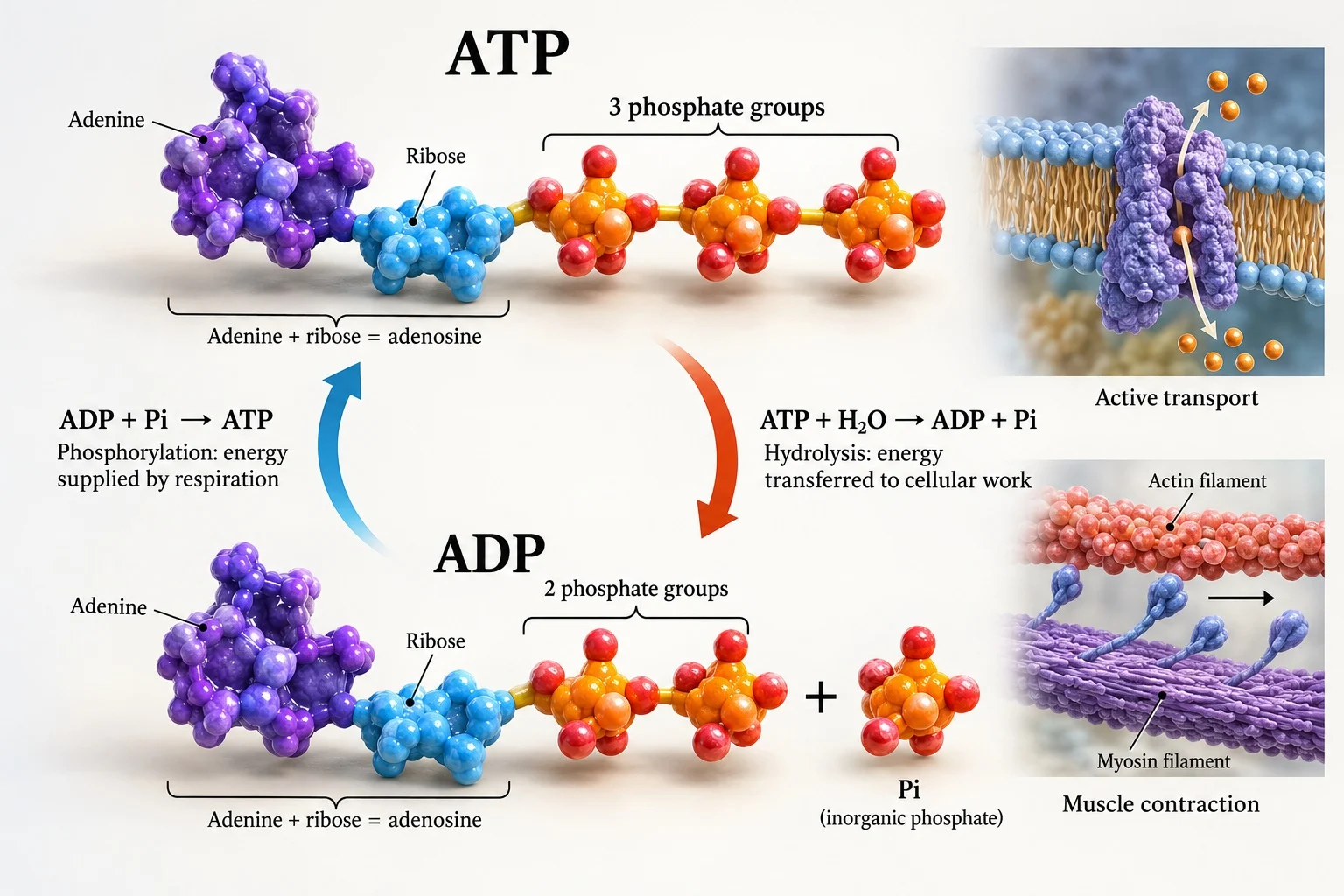
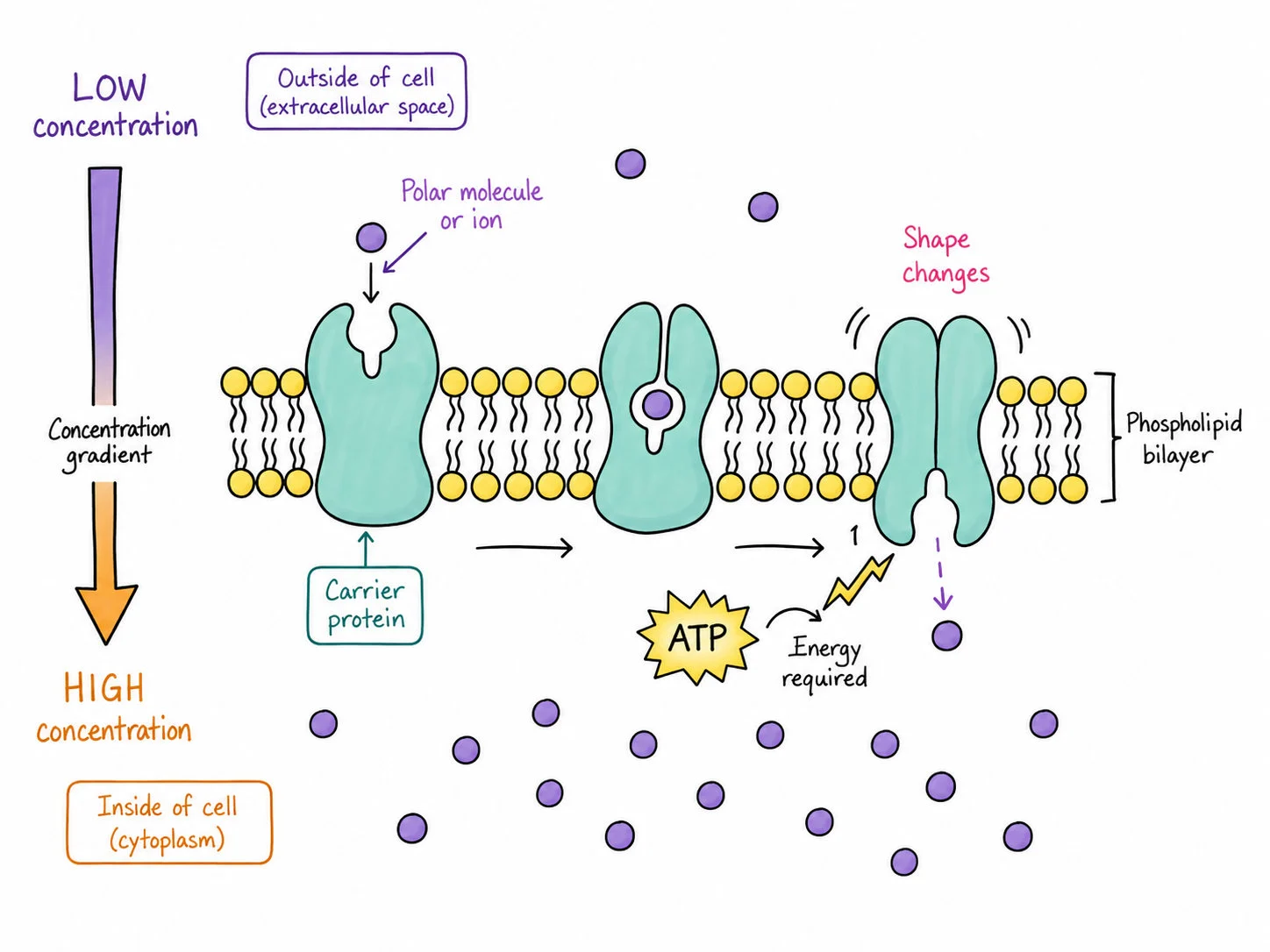
ATP as the energy currency
Role
- Role cell respiration releases energy in small steps and transfers it to ATP, and heat lost at each step warms endotherms.
Structure
- ATP is a phosphorylated nucleotide of ribose, adenine and three phosphate groups.
Universal energy currency
- Universal energy currency it is used in all organisms and reused countless times.
| Feature | Benefit |
|---|---|
| Small, sufficient energy release | Drives important reactions with little waste |
| Stable molecule | Does not break down without the ATPase enzyme |
| Recyclable | Reformed from ADP and Pi |
| Quick, easy hydrolysis | Meets sudden energy demand |
| Soluble and mobile | Carries energy to any part of the cell, by facilitated diffusion |
| Forms phosphorylated intermediates | Makes metabolites more reactive and lowers activation energy |
ATP as the energy currency
Processes using ATP
- Anabolic reactions making macromolecules.
- Active transport against concentration gradients.
- Movement of the whole cell.
- Movement of cell components such as chromosomes.
Not stored
- ATP is too reactive to store, so glucose and fatty acids are short-term stores, and glycogen, starch and triglycerides are long-term stores.
Energy and ATP are different
- Energy and ATP are different energy is the capacity to do work and ATP is a molecule that carries it.
Part 2 of 10ATP–ADP cycle and cell respiration and respiratory substrates
1Hydrolysis
- ATP is hydrolysed to ADP and Pi, releasing free energy (about 30.5 kJ mol−1 per phosphate removed first and second, and 14.2 kJ mol−1 for the third).
2Synthesis
- ADP and Pi combine to form ATP in an energy-requiring condensation reaction that releases water.
3Turnover
- Turnover humans use over 50 kg of ATP a day yet hold only about 200 g at any time, so cells must make ATP as needed.
1Respiration
Respiration the controlled release of energy from organic compounds to produce ATP, a catabolic process in every cell.
- Glucose enters glycolysis directly, so it is the main fuel.
- Lipids and proteins need several changes first, and proteins are used only when glucose and lipids are not available.
2Controlled release
- Controlled release enzymes release energy through a pathway rather than in one step, which would damage cells.
3Uses of the energy
- Uses of the energy anabolic processes, muscle contraction, active transport, moving molecules and heat for body temperature.
4
Respiration is a chemical process, while gas exchange is diffusion of oxygen and carbon dioxide.
Part 3 of 10Aerobic and anaerobic respiration
| Feature | Aerobic | Anaerobic |
|---|---|---|
| Oxidation of glucose | Complete | Incomplete |
| Oxygen | Required | Not required |
| ATP yield | High (about 30–36 per glucose) | Low (2 per glucose) |
| Products in humans | CO2 and H2O | Lactate |
| Location | Cytoplasm and mitochondria | Cytoplasm only |
Aerobic
- Aerobic water is a by-product and helps desert animals, and carbon dioxide is excreted.
- (used in photosynthesis by plants)
Anaerobic
- Anaerobic only glycolysis makes ATP, giving a short discharge of energy when oxygen runs out.
- It occurs in vigorous exercise or waterlogged soil.
- Plants and yeast make ethanol and carbon dioxide, and animals make lactate.
Word equations
- Aerobicglucose + oxygen → carbon dioxide + water + ATP.
- Anaerobic in humansglucose → lactate + ATP.
Part 4 of 10Factors affecting the rate of respiration and measuring respiration with a respirometer
Cell activity
- Cell activity muscle cells respire faster than adipose cells.
Organism size
- Organism size smaller organisms have a larger SA:V and respire faster to replace heat loss.
Oxygen supply
- Oxygen supply low oxygen makes cells respire anaerobically.
Substrate supply
- Substrate supply less glucose gives a lower rate.
Temperature
- Temperature the rate rises to the enzyme optimum and then falls as enzymes denature.
pH
- pH carbon dioxide lowers cell pH and can denature respiratory enzymes.
Apparatus
- Apparatus a sealed container with live organisms such as germinating seeds, an alkali such as potassium hydroxide to absorb CO2,
- and a capillary tube manometer with a scale.
- (preferable to animals)
Principle
Factors affecting the rate of respiration and measuring respiration with a respirometer
The organisms take up oxygen.
The alkali absorbs the CO2 they release.
Pressure inside falls and the manometer fluid moves towards the organisms.
Factors affecting the rate of respiration and measuring respiration with a respirometer
Controls
- Controls use a thermostatic water bath, a control tube with inert material of equal volume, and repeat readings for a mean.
Volume of oxygen consumed
πr2h, in mm3,
- where r is the radius of the capillary lumen and h the distance moved by the fluid;
- divide by time for mm3 min−1.
Technology
- Technology oxygen sensors, CO2 monitors and dataloggers give real-time data without hazards such as strong alkali,
- and respiration rate differs from breathing rate.
Part 5 of 10Oxidation and reduction
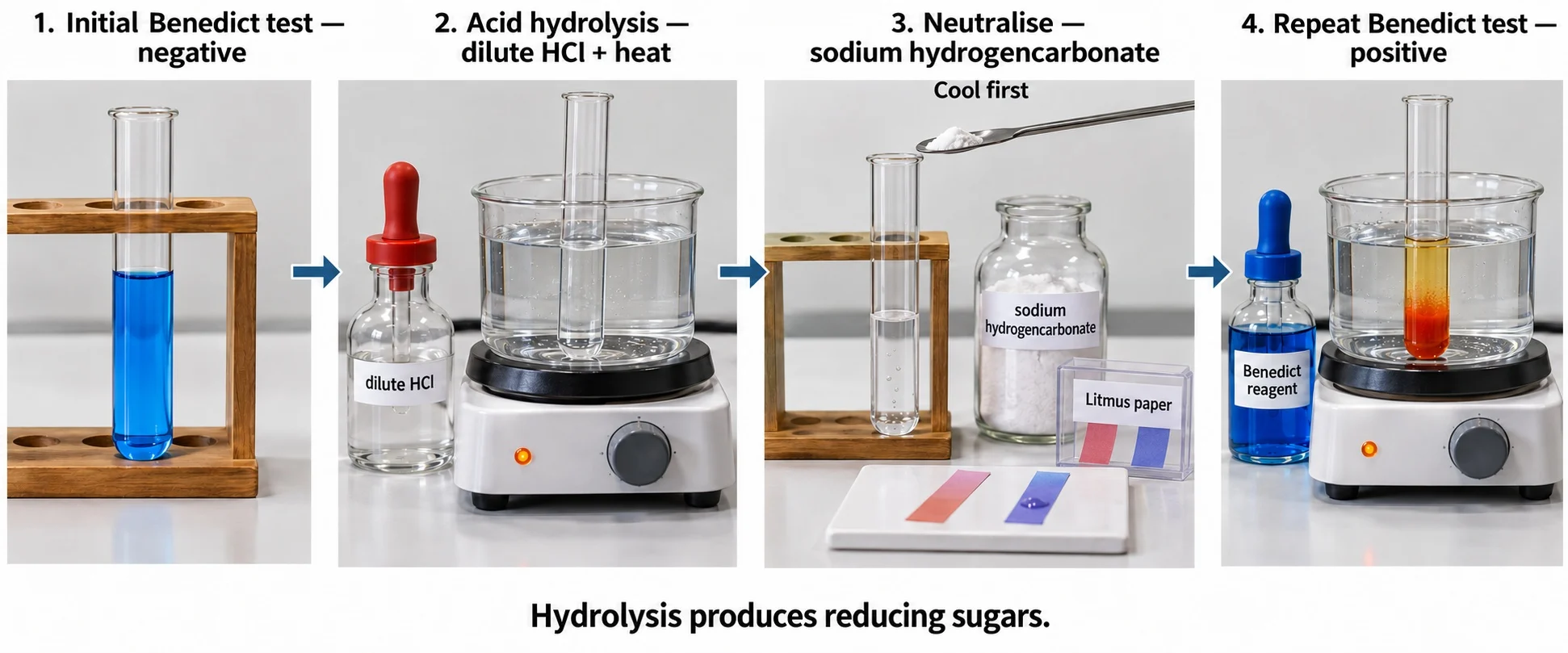
- Redox reactions occur together and transfer electrons.
| Oxidation | Reduction |
|---|---|
| Loss of electrons | Gain of electrons |
| Loss of hydrogen | Gain of hydrogen |
| Gain of oxygen | Loss of oxygen |
| Exergonic | Endergonic |
Reducing agents tend to donate electrons, and oxidising agents tend to accept them.
Electron carriers
- NAD and FAD are coenzymes that act as oxidising agents.
- NAD+ + 2e− + 2H+ → NADH + H+
- FAD + 2e− + 2H+ → FADH2
- NAD+ is the oxidised form and NADH the reduced form, and they release electrons to return to the original form.
Part 6 of 10Glycolysis
- Site and result
- in the cytoplasm, one glucose gives two pyruvate (3C), a net gain of two ATP and two reduced NAD.
- (four made, two used)
- in the cytoplasm, one glucose gives two pyruvate (3C), a net gain of two ATP and two reduced NAD.
1
Phosphorylation: two ATP phosphorylate glucose (6C) to fructose-1,6-bisphosphate, which is less stable and more reactive.
2
Lysis: fructose-1,6-bisphosphate splits into two triose phosphate (3C).
3
Oxidation: dehydrogenase removes hydrogen from each triose phosphate to reduce NAD, forming glycerate-3-phosphate.
4
ATP formation: phosphates pass to ADP by substrate-linked phosphorylation to make four ATP and two pyruvate.
- Each step is catalysed by a different enzyme.
Part 7 of 10Anaerobic respiration pathways
- Purpose
- reduced NAD is reoxidised so glycolysis continues with a net yield of about two ATP.
| Feature | Lactate fermentation | Alcoholic fermentation |
|---|---|---|
| Organisms | Mammalian muscle and some microorganisms | Yeast and plants |
| Pathway | Pyruvate is reduced to lactate by lactate dehydrogenase, with pyruvate as hydrogen acceptor | Pyruvate is decarboxylated to ethanal, releasing CO2, then ethanal is reduced to ethanol by alcohol dehydrogenase |
| Products | Lactate | Ethanol and carbon dioxide |
| Fate | Oxidised back to pyruvate for the Krebs cycle, or converted to glycogen in the liver | Ethanol is a waste product |
1Oxygen debt
- Oxygen debt the extra oxygen needed to oxidise lactate explains deeper, faster breathing after exercise.
2
Yeast in bread
Anaerobic respiration pathways
Flour starch is hydrolysed to maltose and glucose, which yeast respires aerobically at first.
When oxygen is used up, anaerobic respiration makes CO2 bubbles that make the dough rise.
Baking kills the yeast and evaporates the ethanol, leaving a fluffy texture.
- Yeast is also used for ethanol in beer and wine.
Part 8 of 10Link reaction and Krebs cycle
- Link reaction
- in the mitochondrial matrix, pyruvate undergoes oxidative decarboxylation.
Link reaction and Krebs cycle
Carbon dioxide is removed to leave a 2C molecule.
It is oxidised, reducing NAD to NADH, to give an acetyl compound.
Acetyl combines with coenzyme A to form acetyl CoA.
- Per pyruvate it gives acetyl CoA, CO2 and reduced NAD, and it happens twice per glucose.
- Krebs cycle
- in the matrix, a cycle of enzyme-controlled reactions.
1
Acetyl CoA (2C) joins oxaloacetate (4C) to form citrate (6C), releasing coenzyme A.
2
Citrate is decarboxylated, releasing two CO2.
3
Citrate is oxidised, reducing 3 NAD and 1 FAD.
4
Substrate-level phosphorylation forms one ATP.
5
Oxaloacetate is regenerated.
- Yield per glucose
- 4 CO2, 2 ATP, 6 reduced NAD and 2 reduced FAD.
Part 9 of 10Oxidative phosphorylation
- Electron transport chain
- carriers in the inner mitochondrial membrane form a series of redox reactions.
Oxidative phosphorylation
Electrons from reduced NAD and FAD pass from carrier to carrier, regenerating NAD+ and FAD.
Energy released is used to pump protons across the membrane into the intermembrane space.
A proton gradient builds up because the membrane is impermeable to protons.
- Chemiosmosis
Oxidative phosphorylation
Protons flow back into the matrix through ATP synthase by facilitated diffusion.
ATP synthase turns like a water wheel and phosphorylates ADP to ATP.
Oxygen
- Oxygen the final electron acceptor, reduced with protons from the matrix to form metabolic water.
- Without oxygen, NADH and FADH2 are not reoxidised, the chain stops and ATP is no longer made.
Yield
- Yield about 2.5–3 ATP per reduced NAD, giving about 30–32 ATP per glucose in total.
Part 10 of 10Lipids and carbohydrates as substrates
| Feature | Lipids | Carbohydrates |
|---|---|---|
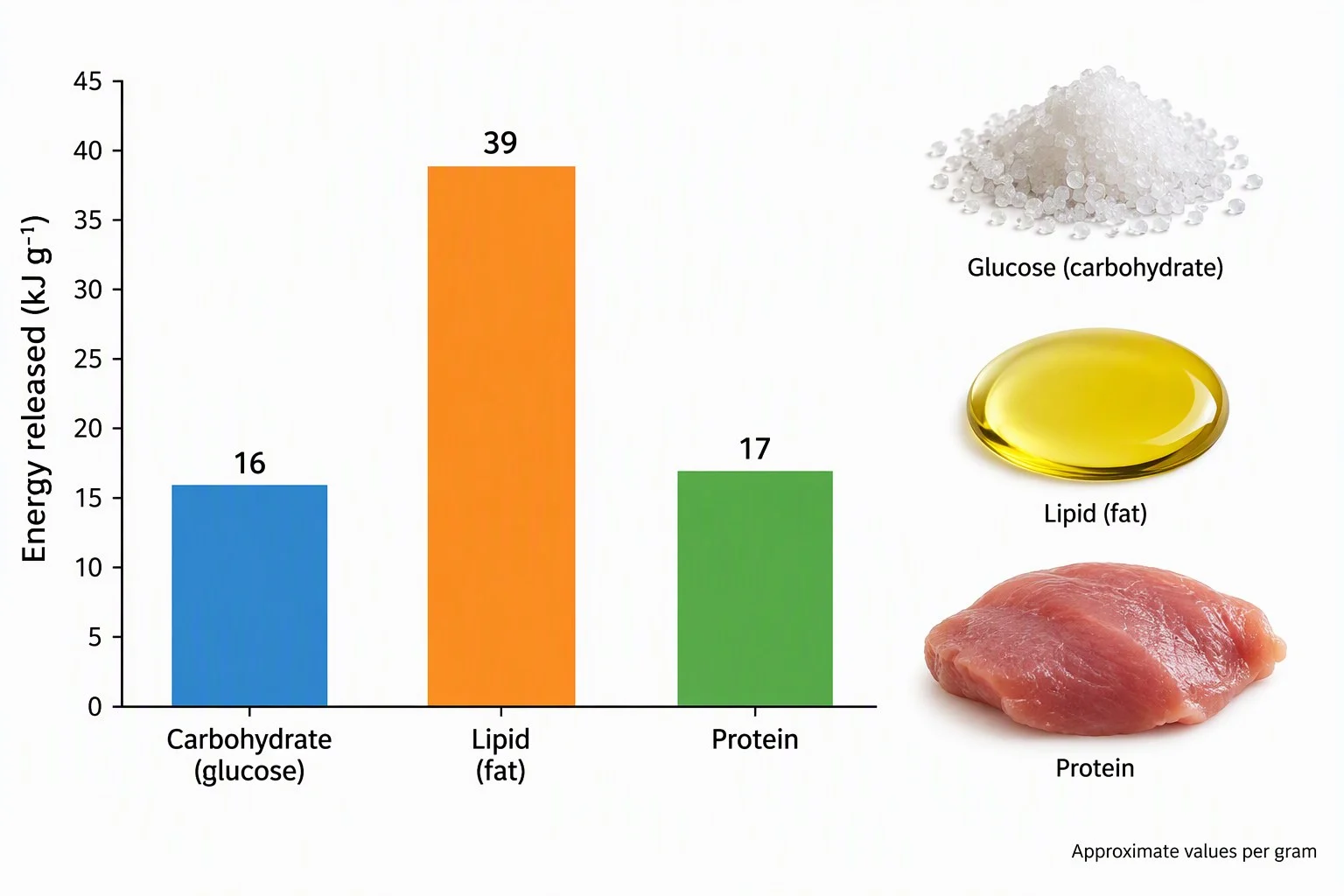
| Energy per gram | More than twice as much | Less |
| Metabolic water | More | Less |
| Solubility | Insoluble, so no osmotic effect | Soluble, so osmotic effect |
| Breakdown | Hydrolysed less easily, so energy is transferred more slowly | Hydrolysed more easily, so energy is transferred faster |
Reason for high yield
- Reason for high yield lipids have fewer oxygen atoms, so their carbon and hydrogen atoms are more oxidisable.
Roles
- Roles fat stores help animals survive harsh periods and plants store oil in seeds and fruits,
- while desert animals use lipids as a source of metabolic water.
Entry to respiration
- Glycolysis and anaerobic respiration need carbohydrate.
- Lipids are broken into fatty acids and then 2C acetyl groups that combine with coenzyme A to give acetyl CoA for the Krebs cycle.
Key terms
| Term | Meaning |
|---|---|
| ATP | adenosine triphosphate, the molecule that carries energy for cell work. |
| Glycolysis | splitting of glucose in the cytoplasm into two pyruvate with net two ATP. |
| Link reaction | conversion of pyruvate to acetyl CoA in the matrix. |
| Krebs cycle | a cycle in the matrix that oxidises acetyl CoA and reduces NAD and FAD. |
| Chemiosmosis | ATP synthesis driven by protons flowing down a gradient through ATP synthase. |
| Electron carrier | a molecule such as NAD or FAD that accepts and donates electrons. |
| Oxygen debt | extra oxygen needed after anaerobic exercise to clear lactate. |
| Respirometer | apparatus for measuring oxygen consumption. |
Avoid these mistakes
1
ATP is stored in large amounts — it is made as needed and cannot be stored.
2
Anaerobic respiration makes no ATP — glycolysis still yields a net two ATP.
3
Ethanal and ethanol are the same — ethanal is reduced to ethanol in yeast.
4
Oxygen is used in the Krebs cycle directly — oxygen is the final electron acceptor in the electron transport chain.
Marked practiceQuizzes for this lesson
Last updated:
Cambridge 9700 AS Biology
Core Formula
Magnification Triangle & Unit Conversion
Formula: M = I / A ⇔ A = I / M ⇔ I = M × A
Units: 1 mm = 1,000 μm = 1,000,000 nm.
Rule: Convert Image size (ruler mm) to μm by ×1,000 before dividing by Actual size.