C2.1Theme C — Interaction and interdependence
Chemical signalling — IB Biology HL Revision Notes & Topical Questions
10 min read 12 parts Lesson 5 of 11 2 quizzes
Curriculum Equation Key قوانين الرقم الهيدروجيني والاتزان الأيوني - pH & Acid-Base Equilibrium FormulasFast Exam Solution
pH = -log[H⁺] | pOH = -log[OH⁻] | pH + pOH = 14 | [H⁺][OH⁻] = 10⁻¹⁴
Word Equation & Conditions: الرقم الهيدروجيني = -لوغاريتم تركيز أيون الهيدروجين | pH + pOH = 14
Location & Specifications: الاتزان الأيوني، كيمياء 3 ثانوي، التحصيلي، و AP Chemistry.
Lesson summary
C2.1 Chemical signalling — IB BIOLOGY HL notes: Explain how ligands, receptors and signal transduction pathways carry messages between cells and how feedback regulates signalling.Cell signalling = sending messages to cells so that a multicellular organism controls and coordinates…
- Quorum sensing
- Vibrio fischeri
- Neurotransmitter action
- Neurotransmitter categories
- Transmembrane receptors
- Intracellular receptors
Part 1 of 10Cell signalling pathways
1Cell signalling
Cell signalling sending messages to cells so that a multicellular organism controls and coordinates its body and responds to its environment, even between distant cells.
2
Stages
1
A stimulus or signal is received by a receptor.
2
The signal is converted into a form that can be passed on, which is transduction.
3
The signal is transmitted to a target (effector).
4
An appropriate response is made.
- Ligands = signalling molecules such as proteins and amino acids, nucleotides, steroids and amines.
- A ligand is secreted by a sending cell and travels through the extracellular space.
- It binds to a specific receptor on the target cell, such as a glycoprotein with a binding site.
- The message is relayed by a chain of chemical messengers inside the cell, triggering a response.
Part 2 of 10Quorum sensing in bacteria
Quorum sensing
Quorum sensing bacteria use ligands to monitor population size and change gene expression when a threshold is reached.
Mechanism
Quorum sensing in bacteria
Bacteria release ligands that bind to receptors on other bacteria.
More bacteria release more ligands.
A threshold number of occupied receptors triggers a change in gene expression, showing that a quorum has been met.
- Vibrio fischeri
- a marine bacterium living in the light organ of the bobtail squid.
- Benefit to the squidbioluminescence lights the underside and gives camouflage against the bright sky.
- Benefit to the bacteriaamino acids and sugar from the squid.
- The bacteria release an autoinducer that binds the cytoplasmic receptor LuxR.
- At a threshold of autoinducer-LuxR complexes, transcription leads to the enzyme luciferase.
- Luciferase catalyses an oxidation that releases energy as light, but only when the colony is large enough.
Part 3 of 10Types of signalling molecule
| Type | Features | Examples |
|---|---|---|
| Hormones | Made by endocrine glands, carried in blood, affect target cells with complementary receptors on the surface membrane or inside | Insulin, glucagon, thyroxine, testosterone |
| Neurotransmitters | Cross the synaptic cleft from presynaptic to postsynaptic neurone and are broken down afterwards | Acetylcholine, norepinephrine, dopamine |
| Cytokines | Proteins from nearly all cells that bind surface receptors and cannot enter the cytoplasm, changing gene expression | Interleukin, erythropoietin, interferon |
| Calcium ions | Ca2+ acts in muscle contraction and at synapses, and may act as a second messenger | Pumped out again so the response is rapid and short-lived |
Types of signalling molecule
Neurotransmitter action
- Neurotransmitter action binding opens sodium channels on the postsynaptic membrane, and enough binding generates an impulse.
Cytokines
- Cytokines they signal between white blood cells in immune responses and regulate the cell cycle in embryonic development.
Calcium
- Ca2+ influx changes protein shape in muscle fibres, and at a synapse Ca2+ entering the presynaptic knob triggers neurotransmitter release.
Part 4 of 10Chemical diversity and effects
Chemical diversity and effects
Signalling molecules must bind receptors (shape and chemistry) and be small and soluble to move around.
Hormone categories
- Amines (melatonin, thyroxin, epinephrine) and peptides or proteins (insulin, glucagon, ADH) are hydrophilic and bind external receptors.
- Steroids (oestradiol, progesterone, testosterone) are hydrophobic, cross membranes and bind intracellular receptors.
Neurotransmitter categories
- Neurotransmitter categories amines, gases (nitric oxide), amino acids (glutamate, glycine) and peptides (endorphins).
- (dopamine, epinephrine)
- Most are hydrophilic and bind surface receptors.
- Some also act as hormones, such as epinephrine.
- Some neurones release several neurotransmitters at once, giving several outcomes.
| Feature | Neurotransmitters | Hormones |
|---|---|---|
| Range | Localised, across a synapse of about 20 nm | Distant, carried in the blood |
| Duration | Short-lived | Longer-lasting |
Part 5 of 10Receptors and transduction
1
Transmembrane receptors
- Transmembrane receptors they span the membrane.
- Hydrophilic regions at each end contact the aqueous surroundings, and a hydrophobic region lies in the lipid tails.
- Ligands bind the external site instead of entering the cell.
2
Intracellular receptors
- Intracellular receptors non-polar ligands such as steroid hormones diffuse through the bilayer and bind receptors in the cytoplasm or nucleus.
3
Signal transduction pathway
Signal transduction pathway the cascade of events after a ligand binds.
- Transmembrane: the ligand binds the external region, changing the shape of the internal region,
- then phosphorylation events and a second messenger follow.
- Intracellular: a ligand-receptor complex is activated and follows the pathway.
4
Cellular responses
- Regulation of gene expression by controlling transcription or translation.
- Change in metabolic activity.
- Regulation of enzyme activity.
- Cell death.
- Rearrangement of the cytoplasm.
- Regulation of proteins such as membrane channels.
Part 6 of 10Acetylcholine and ligand-gated channels
- Cholinergic synapses use acetylcholine (ACh) and ACh changes membrane potential, the voltage across the membrane.
1
An action potential reaching the presynaptic membrane releases ACh into the cleft.
2
ACh diffuses across and binds ligand-gated sodium channels (transmembrane receptors) in the postsynaptic membrane.
3
The channel changes shape and opens, so Na+ diffuses in down its gradient.
4
The charge across the membrane reverses and a new impulse starts.
5
Acetylcholinesterase breaks ACh down to stop continued stimulation.
6
Products are absorbed back into the presynaptic membrane and recycled into vesicles.
Part 7 of 10G proteins and receptor tyrosine kinases
1G-protein-coupled receptor (GPCR)
G-protein-coupled receptor (GPCR) a transmembrane receptor that activates an intracellular G-protein, found only in eukaryotes and the largest group of eukaryote membrane receptors.
- G-proteins bind GTP (active) or GDP (inactive), like switches.
2
G-protein activation
1
A non-steroid ligand binds the GPCR, causing a conformational change.
2
GTP replaces GDP on the attached G-protein.
3
The G-protein splits into a GTP-bound alpha subunit and a beta-gamma dimer.
4
Subunits act on enzymes and ion channels and release second messengers.
5
Hydrolysis of GTP to GDP returns the G-protein to its inactive state at the GPCR.
1Receptor tyrosine kinase (RTK)
Receptor tyrosine kinase (RTK) a transmembrane receptor whose intracellular part is phosphorylated by ATP after ligand binding.
- It assembles relay proteins, and one RTK can trigger several pathways at once.
2
Insulin action
1
Insulin binds the RTK of adipose, muscle and liver cells.
2
Tyrosine is phosphorylated and relay proteins are produced.
3
Vesicles with glucose transporters fuse with the cell surface membrane.
4
Permeability to glucose increases and facilitated diffusion of glucose speeds up.
Part 8 of 10Epinephrine and the second messenger model
- Epinephrine (adrenaline) raises blood glucose in stress by the second messenger model.
1
Epinephrine binds receptors on the membrane of liver cells.
2
Adenylyl cyclase is activated and converts ATP to cyclic AMP (cAMP), the second messenger.
3
cAMP activates protein kinase A.
4
Protein kinase A phosphorylates and activates phosphorylase kinase.
5
Phosphorylase kinase activates glycogen phosphorylase.
6
Glycogen phosphorylase breaks glycogen down to glucose (glycogenolysis), raising blood glucose.
Amplification
- Amplification each epinephrine molecule makes many cAMP molecules, which activate many enzymes.
Nature of science
- Nature of science naming conventions are international cooperation: adrenaline and epinephrine (Greek, 'above kidney') are both in common use.
- (Latin, 'at kidney')
Part 9 of 10Intracellular receptors and gene expression, oestradiol and progesterone effects
Transcription factor
Transcription factor a protein that controls transcription by binding a specific DNA region; a gene that is transcribed and translated is expressed.
Steroid hormones are small and hydrophobic, so they cross the cell membrane and nuclear pores and bind intracellular receptors.
- Oestradiol controls up to 100 genes and regulates the female fertility cycle.
Oestradiol pathway
1
Oestradiol diffuses through the cell surface membrane into the cytoplasm.
2
It diffuses through a nuclear pore into the nucleus.
3
It attaches to the ER receptor held in a protein complex, changing the receptor's shape.
4
The receptor detaches and diffuses to the gene.
5
It binds a cofactor and the promoter region, stimulating RNA polymerase binding and transcription.
- Progesterone and testosterone follow a similar path.
Oestradiol
- Oestradiol it regulates female sexual characteristics, and is made in the ovaries, placenta and testes.
- The hypothalamus releases gonadotropin-releasing hormone, which stimulates the pituitary to release LH and FSH.
- LH and FSH control the menstrual cycle, with targets in the uterus, breasts and bone marrow.
- Oestradiol can inhibit or promote GnRH release, giving negative or positive feedback.
Progesterone
- Progesterone a steroid made by the corpus luteum and placenta.
- It maintains the endometrium for implantation and prevents further ovulation in pregnancy.
- It forms a ligand-receptor complex in the cytoplasm, causing expression of genes such as a growth factor for endometrial cell proliferation.
Part 10 of 10Feedback regulation
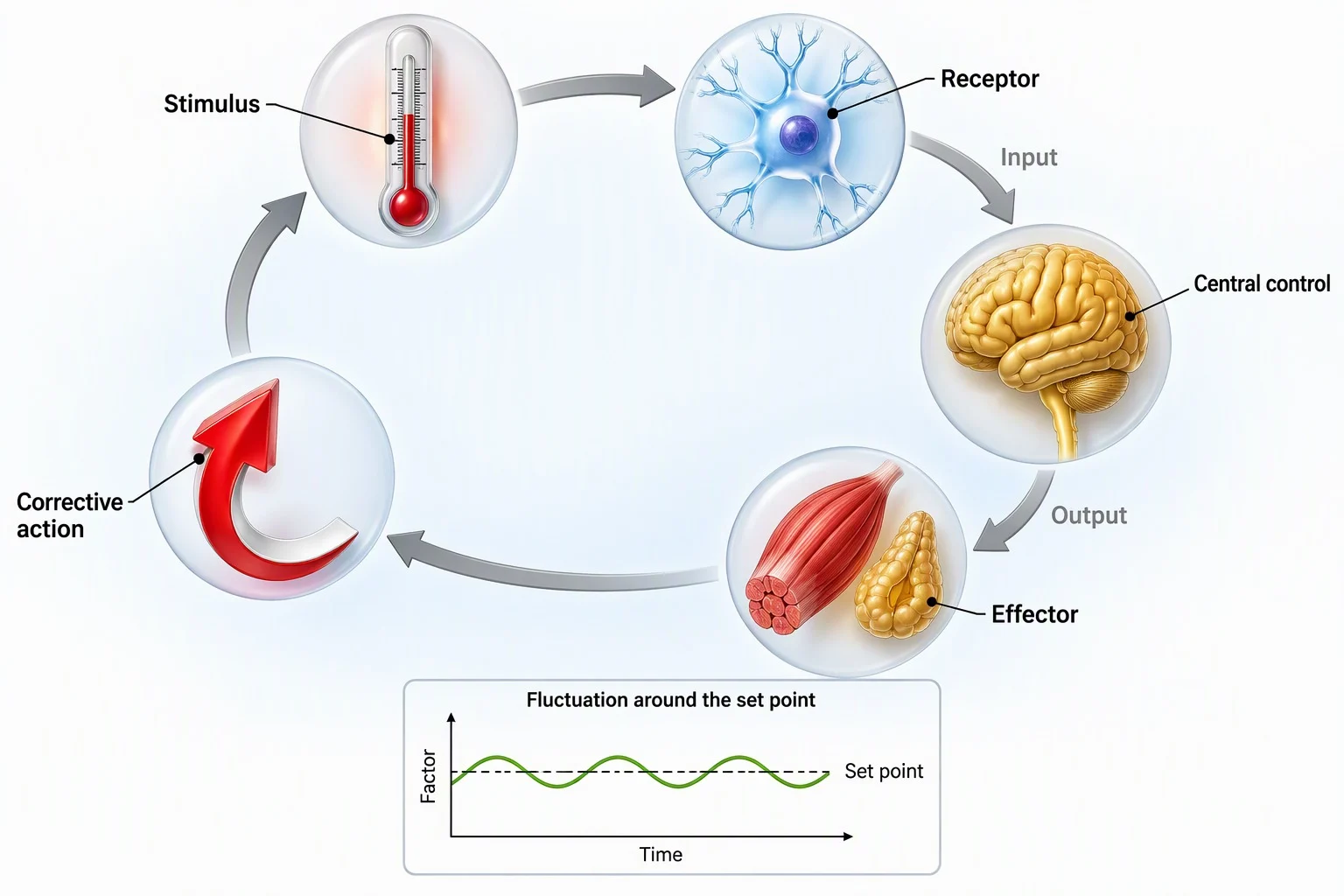
Negative feedback
- Negative feedback most homeostatic mechanisms use it to keep factors such as temperature or blood glucose within limits.
- A receptor detects a stimulus, a coordination system (nervous or hormonal) passes information, and an effector (muscle or gland) responds.
- A rise in the factor leads to a response lowering it, and a fall leads to a response raising it.
Positive feedback
- Positive feedback the response drives the factor further from normal and enhances the stimulus.
- In labour, cervical stretching sends impulses to the brain, the pituitary releases oxytocin, contractions strengthen and stretch the cervix further.
- In blood clotting, activated platelets release chemicals that activate more platelets, closing the wound quickly before the body returns to negative feedback.
- In hypothermia, falling temperature lowers metabolism, which lowers temperature further, but this is not homeostasis.
Key terms
| Term | Meaning |
|---|---|
| Ligand | a signalling molecule that binds a specific receptor. |
| Signal transduction | converting and relaying a signal inside the cell to a response. |
| Second messenger | a molecule such as cAMP or Ca2+ that relays a signal inside the cell. |
| GPCR | a G-protein-coupled receptor that activates a G-protein. |
| Quorum sensing | bacteria sensing population density through ligands. |
| Transcription factor | a protein that controls gene transcription by binding DNA. |
| Negative feedback | a response that reverses a change and restores normal limits. |
| Positive feedback | a response that enhances the original change. |
Avoid these mistakes
1
All hormones act through surface receptors — steroid hormones are hydrophobic and use intracellular receptors.
2
Neurotransmitters and hormones act over the same distance — neurotransmitters act across about 20 nm, hormones travel in the blood.
3
Positive feedback maintains homeostasis — it amplifies change, while negative feedback restores balance.
4
Ligand binding alone is the response — it starts a transduction pathway that produces the response.
Marked practiceQuizzes for this lesson
Last updated:
\n