C2.2Theme C — Interaction and interdependence
Neural signalling — IB Biology HL Revision Notes & Topical Questions
10 min read 12 parts Lesson 6 of 11 2 quizzes
Curriculum Equation Key قوانين الرقم الهيدروجيني والاتزان الأيوني - pH & Acid-Base Equilibrium FormulasFast Exam Solution
pH = -log[H⁺] | pOH = -log[OH⁻] | pH + pOH = 14 | [H⁺][OH⁻] = 10⁻¹⁴
Word Equation & Conditions: الرقم الهيدروجيني = -لوغاريتم تركيز أيون الهيدروجين | pH + pOH = 14
Location & Specifications: الاتزان الأيوني، كيمياء 3 ثانوي، التحصيلي، و AP Chemistry.
Lesson summary
C2.2 Neural signalling — IB BIOLOGY HL notes: Explain neurone structure, resting and action potentials, impulse speed, synaptic transmission and integration of signals in the nervous system.Nervous system — the central nervous system (CNS) is the brain and spinal cord, and the pe…
- Resting potential
- Refractory period
- All-or-nothing
- Propagation
- Oscilloscope
- Correlation
Part 1 of 10Nervous system and neurones
Nervous system and neurones
Nervous system
- Nervous system the central nervous system (CNS) is the brain and spinal cord, and the peripheral nervous system (PNS) is all the nerves.
- It senses surroundings, coordinates responses and regulates body functions by electrical impulses along neurones.
- A nerve is a bundle of neurones.
Neurone structure
- A long axon carries impulses away from the cell body, often insulated by Schwann cells forming a myelin sheath.
- The cell body holds the nucleus and organelles.
- Dendrites extend from the cell body and axon terminals and connect to other neurones.
| Neurone | Role | Structure |
|---|---|---|
| Sensory | Carries impulses from receptors to the CNS | Cell body branching off the middle, one long dendron and one long axon |
| Relay | Connects sensory and motor neurones inside the CNS | Short, highly branched axons and dendrites |
| Motor | Carries impulses from the CNS to effectors (muscles or glands) | Large cell body in the CNS, many branched dendrites for a large surface area |
Part 2 of 10Resting potential
Impulse
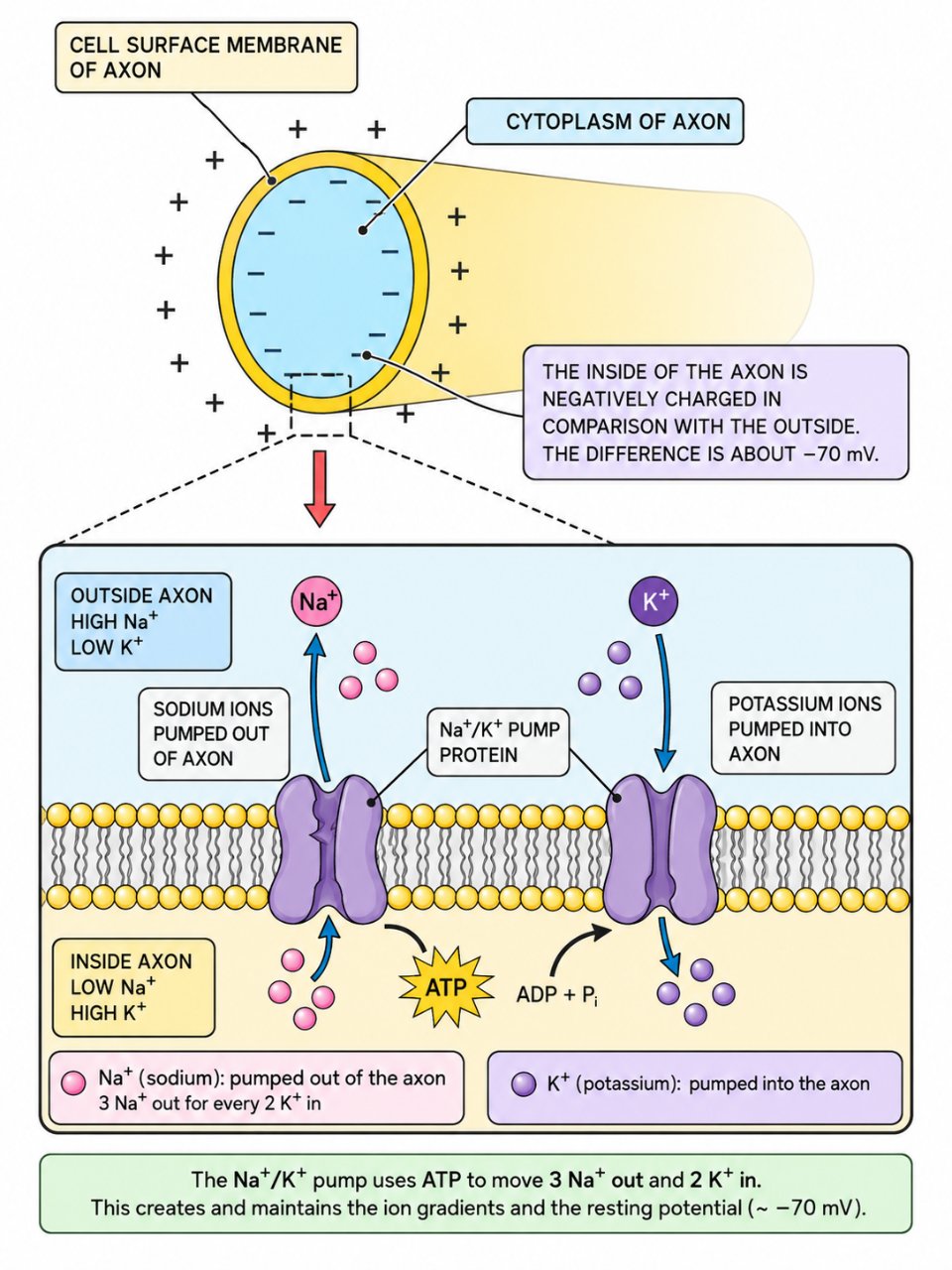
- Impulse it is a momentary reversal of the potential difference across the membrane, not an electrical current flowing like a wire.
Resting potential
Resting potential the membrane potential of a neurone not transmitting an impulse, about −70 mV, with the inside negative.
Causes
1
Sodium-potassium pumps use ATP to pump 3 Na+ out and 2 K+ in, creating concentration gradients.
2
Both ions diffuse back by facilitated diffusion through channels.
3
The membrane is much less permeable to Na+ than K+, so K+ leaves faster than Na+ enters.
4
More positive ions are outside, and negatively charged proteins inside add to the negative charge.
- Polarised
- the membrane at resting potential is polarised, and depolarisation is the reversal of the potential difference.
Part 3 of 10Action potential
Action potential
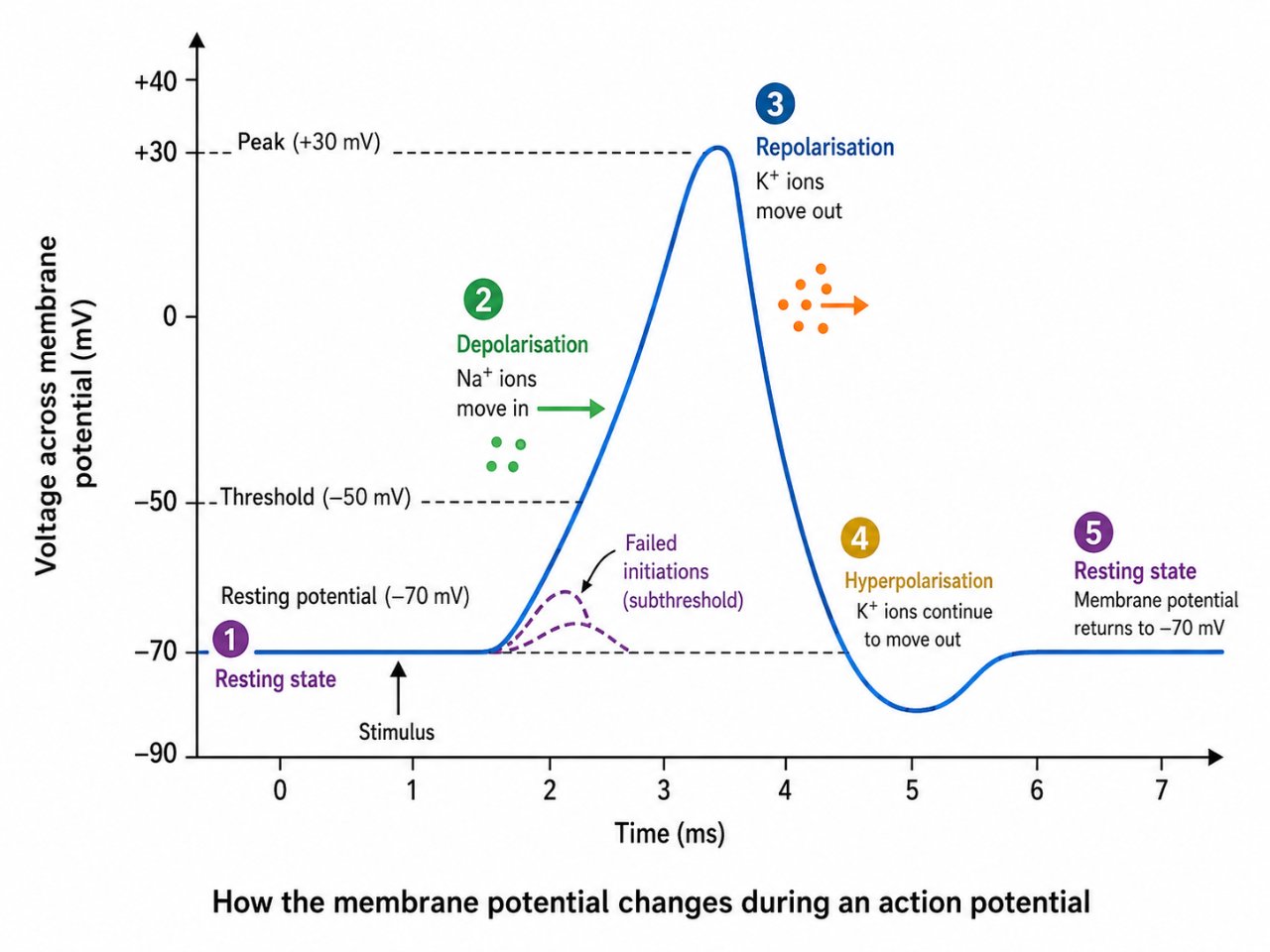
Action potential the reversal of the potential from about −70 mV to about +40 mV when a neurone is stimulated.
Depolarisation
Action potential
A few sodium channels open and Na+ enters down its gradient, making the inside less negative.
At the threshold potential of about −50 mV, voltage-gated sodium channels open and many more Na+ enter.
The potential rises to about +40 mV.
- Repolarisation
1
About 1 ms later, voltage-gated sodium channels close.
2
Voltage-gated potassium channels open and K+ diffuses out down its gradient, making the inside negative again.
3
A brief hyperpolarisation follows, when the potential is more negative than resting.
4
Potassium channels close and the pumps restore resting potential.
Voltage-gated channels are closed at rest, while some potassium channels are open at rest to produce the resting potential.
Refractory period
- Refractory period the membrane cannot respond during hyperpolarisation, so action potentials are discrete and travel in one direction.
All-or-nothing
- All-or-nothing an action potential is generated only if the threshold is reached.
- A stronger stimulus raises the frequency of action potentials, not their size, so the brain detects stimulus size by frequency.
Part 4 of 10Propagation and local currents, oscilloscope traces
Propagation
- Propagation depolarisation at one site causes the next section to reach threshold, repeating along the axon.
Local currents
- Inside the axon, Na+ diffuses from the depolarised section to the neighbouring section, reducing its negative potential.
- Outside the axon, Na+ moves from the resting section to the depolarised section.
- These movements cause a wave of depolarisation and repolarisation.
- Oscilloscope
- it shows time in ms on the x-axis and membrane potential in mV on the y-axis, measured with electrodes on each side of the membrane.
- Resting potential is a flat line at −70 mV.
- An action potential is a spike up to +30 to +40 mV, with the rising phase depolarisation and the falling phase repolarisation.
- A slow rise appears before the threshold because few sodium channels are open, then a brief hyperpolarisation follows.
Part 5 of 10Speed of nerve impulses
Factors
- Myelination — myelinated neurones conduct far faster because the insulation allows saltatory conduction.
- Axon diameter — a wider axon has less resistance and conducts faster.
Squid giant axons are unmyelinated and up to 1 mm wide,
- but conduct more slowly than narrower myelinated mammalian axons.
- (human neurones are 4–100 µm)
Myelin
- Schwann cells wrap the axon in layers of phospholipid membrane, giving high electrical resistance.
- Nodes of Ranvier are the uninsulated gaps with clusters of ion channels and pumps.
- Saltatory conduction = the impulse jumping from node to node, through local currents between nodes, up to 50 times faster than in an unmyelinated axon.
Part 6 of 10Correlation and Pearson's test
1Correlation
Correlation an association between variables, which does not prove causation.
2Scatter graph
- Scatter graph plot the variables; correlation can be positive, negative or absent.
3Correlation coefficient (r)
- Correlation coefficient (r) it ranges from −1 to +1, where ±1 is perfect, closer to ±1 is stronger and 0 means none.
4
Pearson's linear correlation test needs quantitative data with a normal distribution.
Make a scatter graph and check for a linear trend.
State a null hypothesis.
Calculate r
(nΣxy − ΣxΣy) ÷ √[(nΣx2 − (Σx)2)(nΣy2 − (Σy)2)].
If r is close to ±1, there is a strong linear correlation and the null hypothesis can be rejected.
- Coefficient of determination (R2) = r squared, expressed as a percentage.
- Close to 1 means the dependent variable can be predicted from the independent variable, and close to 0 means no correlation.
Part 7 of 10Synapses and synaptic transmission
Synapse
Synapse the junction of two neurones (or a neurone and a receptor or muscle fibre) with a synaptic cleft between them,
- where there is no physical contact.
Steps of transmission
1
An impulse depolarises the presynaptic membrane.
2
Calcium ions enter through calcium channels.
3
Vesicles move to and fuse with the presynaptic membrane and release neurotransmitter by exocytosis.
4
The neurotransmitter diffuses across the cleft and binds receptors on the postsynaptic membrane.
5
Sodium channels open and Na+ diffuses into the postsynaptic cell.
6
If the threshold is reached, an action potential starts in the postsynaptic neurone.
7
The neurotransmitter is broken down to prevent continued stimulation.
Unidirectional
- Unidirectional neurotransmitter is released on one side and receptors are on the other, so transmission goes one way only.
Acetylcholine (ACh)
- Acetylcholine (ACh) more than 40 neurotransmitters exist, including dopamine and noradrenaline.
- ACh is made in the presynaptic neurone from choline and an acetyl group, and cholinergic synapses use it.
- Acetylcholinesterase hydrolyses ACh to acetate and choline, which are reabsorbed to remake ACh.
Part 8 of 10Effects of exogenous chemicals on synapses
Neonicotinoids
- Neonicotinoids synthetic nicotine-like pesticides.
- They bind irreversibly to ACh receptors at insect cholinergic synapses because acetylcholinesterase cannot break them down.
- Impulses cannot cross, causing paralysis and death.
- They are not toxic to mammals because mammals have fewer cholinergic synapses and the compounds bind less strongly.
- They are controversial because of harm to pollinators such as bees.
Cocaine
- Cocaine it blocks reuptake of neurotransmitters, mainly by binding the dopamine transporter protein.
- Dopamine builds up in the synapse, causing pleasure, and serotonin and norepinephrine also raise confidence and energy.
- Regular users make more dopamine receptors, which gives increased sensitivity and depression when levels fall.
Part 9 of 10Inhibition and summation
Inhibitory synapse
- Inhibitory synapse the neurotransmitter opens potassium channels so K+ leaves, the postsynaptic cell is hyperpolarised and the threshold is not reached.
- Inhibition cancels the Na+ entry from excitatory synapses on the same cell body.
- It prevents random impulses and allows specific pathways, such as a reflex pulling the arm away without moving the leg.
- Inhibitory pathways develop over time, which refines fine movements.
Summation
- Summation one impulse may release too little ACh, open too few channels and fail to reach the threshold, so impulses are added together.
- Temporal summation = several impulses in quick succession at one synaptic knob.
- Spatial summation = impulses arriving at once at different synaptic knobs on the same cell body.
Benefits of summation
- It magnifies the effect of a stimulus.
- It lets a combination of stimuli trigger a response.
- It prevents the nervous system being overwhelmed.
- Synapses slow transmission and pass impulses only when inputs are sufficient.
Part 10 of 10Pain and the brain
1Pain receptors (nociceptors)
- Pain receptors (nociceptors) sensory receptors with free, unencapsulated nerve endings.
- TRP channels open in response to high temperature, acid or chemicals such as capsaicin.
- Positive ions enter, the threshold is reached and an action potential travels to the CNS.
- Impulses reach the cerebral cortex, where pain is perceived and a protective response follows.
- Sensitivity to damaging stimuli gives a survival and reproductive advantage.
2Cerebrum
- Cerebrum about 80% of brain mass, controlling conscious activities such as vision, hearing, speech, thinking and memory.
- It has two hemispheres, each with a cerebral cortex (grey matter) of neurone cell bodies.
- Folding of the cortex increases its area for more neurones and connections.
- Complex pathways give emergent properties such as consciousness, the qualitative perception of feelings and a complex awareness of the environment.
Key terms
| Term | Meaning |
|---|---|
| Resting potential | the membrane potential of an unstimulated neurone, about −70 mV. |
| Threshold potential | the membrane potential, about −50 mV, at which an action potential is triggered. |
| Saltatory conduction | impulse jumping between nodes of Ranvier in myelinated axons. |
| Refractory period | the time after an action potential when the membrane cannot be stimulated. |
| Synaptic cleft | the gap between two neurones at a synapse. |
| Temporal summation | adding the effect of impulses arriving in quick succession. |
| Spatial summation | adding the effect of impulses from different synaptic knobs at once. |
| Neurotransmitter | a chemical that carries a signal across a synapse. |
| Hyperpolarisation | the membrane potential becoming more negative than resting potential. |
Avoid these mistakes
1
A nerve impulse is a current flowing along the axon like in a wire — it is a wave of membrane potential reversal.
2
A stronger stimulus gives a bigger action potential — action potentials are all-or-nothing, and stimulus size is coded by frequency.
3
Sodium-potassium pumps are the only cause of resting potential — unequal ion permeability also contributes.
4
Impulses jump across the synaptic cleft — neurotransmitter diffuses across it.
Marked practiceQuizzes for this lesson
Last updated:
\n