C3.1Theme C — Interaction and interdependence
Integration of body systems — IB Biology HL Revision Notes & Topical Questions
10 min read 12 parts Lesson 7 of 11 2 quizzes
Curriculum Equation Key قوانين الرقم الهيدروجيني والاتزان الأيوني - pH & Acid-Base Equilibrium FormulasFast Exam Solution
pH = -log[H⁺] | pOH = -log[OH⁻] | pH + pOH = 14 | [H⁺][OH⁻] = 10⁻¹⁴
Word Equation & Conditions: الرقم الهيدروجيني = -لوغاريتم تركيز أيون الهيدروجين | pH + pOH = 14
Location & Specifications: الاتزان الأيوني، كيمياء 3 ثانوي، التحصيلي، و AP Chemistry.
Lesson summary
C3.1 Integration of body systems — IB BIOLOGY HL notes: Explain how nervous and hormonal systems integrate body systems, including reflexes, heart and ventilation control, and plant hormones.Integration — complex organisms use body systems of component parts, which need coordinat…
- Emergent properties
- Communication
- Nervous system
- Endocrine system
- Spinal cord
- Motor output
Part 1 of 10Levels of organisation and emergent properties
Integration
- Integration complex organisms use body systems of component parts,
- which need coordination and cell-to-cell communication, such as hormones made in the endocrine system acting on the reproductive system.
Hierarchy
- Hierarchy specialised cells form tissues, tissues form organs, organs form organ systems, and systems form the organism.
- Epithelial tissue absorbs food in the small intestine and muscle tissue contracts to move parts of the body.
- The heart contains cardiac muscle, blood vessel and connective tissues.
Emergent properties
- Emergent properties multicellular organisms can do things that unicellular organisms cannot,
- such as moving over large distances and digesting large macromolecules.
- The whole is greater than the sum of its parts, as a cheetah is an effective predator through integration of all its systems.
- Reductionism studies individual cells, while emergent properties favour a systems approach.
Communication
- Communication the nervous and endocrine systems often work together to maintain digestion, heart rate, blood glucose and blood pressure.
- The blood system transports oxygen, glucose, urea (to the kidneys) and hormones such as FSH and LH from the pituitary to the ovaries.
Part 2 of 10Nervous and endocrine systems, the brain as an integrating organ
Nervous and endocrine systems, the brain as an integrating organ
Nervous system
- Nervous system the CNS and PNS (nerves) send electrical impulses along neurones, and nerves reach all sense organs.
- (brain and spinal cord)
Endocrine system
- Endocrine system glands secrete hormones into the blood,
- and hormones alter the activity of target organs with complementary receptors on the surface membrane or inside the cell.
- Effects can be long-lived while the hormone stays bound.
- Hormones control functions that do not need an instant response and travel more slowly than nerve impulses.
Nervous and endocrine systems, the brain as an integrating organ
Regions of the brain
- The cerebral cortex is the folded outer layer in two hemispheres for intelligence, memory, consciousness and personality.
- The cerebellum lies below the cortex and controls balance, muscle coordination and movement.
- The brainstem relays messages between the cortex, cerebellum and spinal cord,
- and its medulla controls unconscious activities such as heart rate and breathing.
- The pituitary gland makes hormones including FSH and LH.
- The hypothalamus regulates body temperature and produces hormones that control the pituitary.
Role
- Role the brain processes information, and interactions within it produce learning and memory.
Receptors giving input
- Conscious: photoreceptors in the retina, chemoreceptors in the tongue, thermoreceptors in the skin and mechanoreceptors in the inner ear.
- Unconscious: osmoreceptors in the carotid arteries and hypothalamus, baroreceptors in the carotid arteries and aorta,
- and proprioceptors in muscles and joints.
Part 3 of 10Spinal cord and receptors
Spinal cord
- Spinal cord it links the body and brain and can integrate unconscious reflex information alone.
- White matter holds the axons carrying information to and from the brain.
- Grey matter holds neurones and synapses that create reflex responses.
- Sensory information enters along sensory neurones and leaves along motor neurones in a reflex arc.
Receptors
- Receptors specialised cells that act as transducers, converting light, heat or sound into electrical impulses in a sensory neurone.
- Some touch receptors are just the endings of sensory neurones.
- A weak stimulus does not depolarise enough to start an impulse, while a strong one generates an action potential that travels to the CNS.
Taste receptor sequence for salt
1
Sodium ions diffuse through selective channels in the microvilli of chemoreceptor cells.
2
The membrane depolarises, giving the receptor potential.
3
Voltage-gated calcium channels open and Ca2+ enters.
4
Vesicles of neurotransmitter are released by exocytosis from the base.
5
An action potential starts in the sensory neurone and travels to the brain.
Part 4 of 10Motor output and nerves, reflex arcs and the cerebellum
Motor output
- Motor output the motor cortex of the cerebrum processes movements, and motor neurones carry impulses to muscles.
Neuromuscular junction
- Neuromuscular junction it works like a synapse between motor neurone branches and a muscle cell.
1
An action potential makes Ca2+ enter the presynaptic neurone.
2
Vesicles of acetylcholine fuse with the presynaptic membrane.
3
ACh diffuses across and binds receptors on the sarcolemma.
4
Ion channels open and Na+ enters, depolarising the sarcolemma.
5
The action potential passes down the T-tubules.
6
Voltage-gated calcium channels of the sarcoplasmic reticulum open and Ca2+ floods the sarcoplasm.
7
Ca2+ binds troponin, which moves tropomyosin and exposes myosin-binding sites, so the sliding filament process begins.
- Nerves
- bundles of sensory or motor neurones, myelinated or not, with each Schwann cell wrapping about 1 mm of myelin sheath.
Reflex
Reflex a rapid, automatic response without conscious thought, minimising damage and aiding survival.
- Awareness comes after the response because the information takes longer to reach the conscious brain.
- Blinking protects the eye surface, coughing protects airways, the pupil reflex protects the eye from bright light and the knee reflex aids balance.
Reflex arc
Reflex arc a pathway from receptor to effector that bypasses conscious brain regions.
Pain reflex arc
1
A nociceptor in the skin detects a sharp or hot stimulus.
2
An afferent (sensory) neurone carries an impulse to the spinal cord.
3
A relay neurone in the grey matter receives it.
4
The relay neurone synapses with a motor neurone.
5
The motor neurone carries the impulse to the effector muscle, which contracts and pulls the hand away.
- Cerebellum
- it coordinates balance, posture, walking, hand and finger movement, eye movement and speech.
- It receives feedback from the moving area and from sense organs, but the motor cortex starts movement.
Part 5 of 10Melatonin and epinephrine
Circadian rhythms
Circadian rhythms daily cycles of physiology and behaviour, such as sleep, body temperature and hormone secretion, in a 24-hour cycle.
Melatonin
- Melatonin the pineal gland secretes it into the blood, rising in the evening in response to darkness and falling at dawn.
- The retina detects light and signals the pineal gland, which acts as an endocrine clock and calendar as day length changes.
- Targets include the hypothalamus, pituitary, immune cells, gonads, kidney and cardiovascular system.
- Rising melatonin causes tiredness and sleep, and falling levels prepare for waking.
- It contributes to the night-time fall in body temperature and urine production.
- Secretion continues on a slightly longer cycle without light, so light resets the clock each day.
Epinephrine (adrenaline)
- Epinephrine (adrenaline) in stress, fear or excitement, sympathetic neurones stimulate the adrenal medulla to secrete it,
- producing the fight-or-flight response.
- It binds receptors in target organs, including the SAN, raising the frequency of excitation and heart rate.
- More blood brings more oxygen and glucose to muscle, raising aerobic respiration.
- It stimulates the cardiovascular control centre in the medulla, further speeding the heart.
- Blood vessels to the digestive system and skin constrict, but blood flow to the brain stays constant.
Part 6 of 10Control of the endocrine system and feedback control of heart rate
Control of the endocrine system and feedback control of heart rate
Hypothalamus
- Hypothalamus it monitors blood passing through the brain and releases hormones or stimulates the pituitary.
- It regulates body temperature, osmoregulation (releasing ADH if blood is too concentrated), digestive activity and appetite hormones.
- It controls pituitary hormones for metabolism, growth, puberty, sexual function, sleep and mood.
Pituitary gland
- Pituitary gland it lies below the hypothalamus and has two sections.
- The anterior pituitary makes and releases hormones, some of which stimulate other glands.
- The posterior pituitary stores and releases hormones made by the hypothalamus, such as ADH and oxytocin.
Control of the endocrine system and feedback control of heart rate
Medulla
- Medulla the cardioregulatory centre at the base of the brain is under unconscious control through the autonomic nervous system.
- The acceleratory centre speeds the heart and the inhibitory centre slows it, and both connect to the SAN.
Increasing heart rate
- Increasing heart rate impulses pass along sympathetic neurones, norepinephrine is released at the SAN, and the SAN fires faster.
Decreasing heart rate
- Decreasing heart rate impulses pass along parasympathetic neurones, acetylcholine is released at the SAN, and the SAN fires slower.
Detection
- Exercise raises blood carbon dioxide and causes an initial fall in blood pressure.
- Chemoreceptors detect pH, oxygen and carbon dioxide, and baroreceptors detect blood pressure, in the aorta arch and carotid sinus.
- Higher impulse frequency activates the acceleratory centre, and lower frequency activates the inhibitory centre.
Part 7 of 10Feedback control of ventilation and control of peristalsis
- Respiratory centres in the medulla send impulses to the diaphragm and intercostal muscles at a stable slow rate at rest.
- Carbon dioxide transport
- About 85% as hydrogen carbonate ions in plasma.
- About 10% bound to haemoglobin as carbaminohaemoglobin.
- About 5% dissolved in plasma.
- pH change
1
CO2 diffuses into red blood cells and combines with water to form carbonic acid, catalysed by carbonic anhydrase.
2
Carbonic acid dissociates into H+ and HCO3−.
3
H+ lowers blood pH, which chemoreceptors in the medulla detect.
4
Impulses to the diaphragm and intercostal muscles increase, raising ventilation.
5
CO2 is removed, pH returns to normal and ventilation returns to resting rate, which is negative feedback.
Peristalsis
Peristalsis a wave of muscle contractions along the oesophagus or small intestine that moves the bolus of food.
Control
- Control the enteric nervous system works unconsciously with smooth muscle.
- (a web of sensory, relay and motor neurones in the gut wall)
1
Stretch receptors detect the distension caused by the bolus.
2
Relay neurones synapse with two motor neurones.
3
One releases an excitatory neurotransmitter,
- so longitudinal muscle behind the bolus contracts to shorten that section and circular muscle contracts to narrow the lumen, preventing backward movement.
4
The other releases an inhibitory neurotransmitter, so muscle ahead of the bolus relaxes and opens the lumen.
Part 8 of 10Tropisms and phototropism
1Tropism
Tropism a plant growth response to an external stimulus such as light, gravity, water or an object, positive if towards the stimulus and negative if away.
- Growing to light maximises photosynthesis, growth in line with gravity orients seedlings, growth to water improves uptake and climbing gains height.
2Phototropism
- Phototropism shoots are positively phototropic, a vital response because plants cannot move.
3Gravitropism (geotropism)
- Gravitropism (geotropism) stems grow away from gravity (negative) and roots grow towards it (positive).
4
Investigating tropisms
- Grow plants under different filters (red, blue, green), remove or cover shoot tips, or position radicles up, down or horizontally.
- Record qualitative diagrams of seedling growth or quantitative angles of curvature.
5Nature of science
- Nature of science qualitative and quantitative observations.
- Qualitative results are descriptions such as colour changes,
- and quantitative results are numerical measurements that need mathematical processing,
- such as means, standard deviation and statistical tests.
- Raw data use the same decimal places, and processed data use the same or one more.
- Both types are subject to bias, and both can be useful together.
6
Precision, accuracy and reliability
- Precision = how close repeated readings are to each other, reduced by random error through repeat measurements and means.
- Accuracy = closeness to the true value, reduced by systematic error through recalibrating instruments and adjusting technique.
- Reliability = consistency of results, raised by careful measuring, suitable instruments and repeat trials that identify anomalies.
Part 9 of 10Plant hormones and auxin
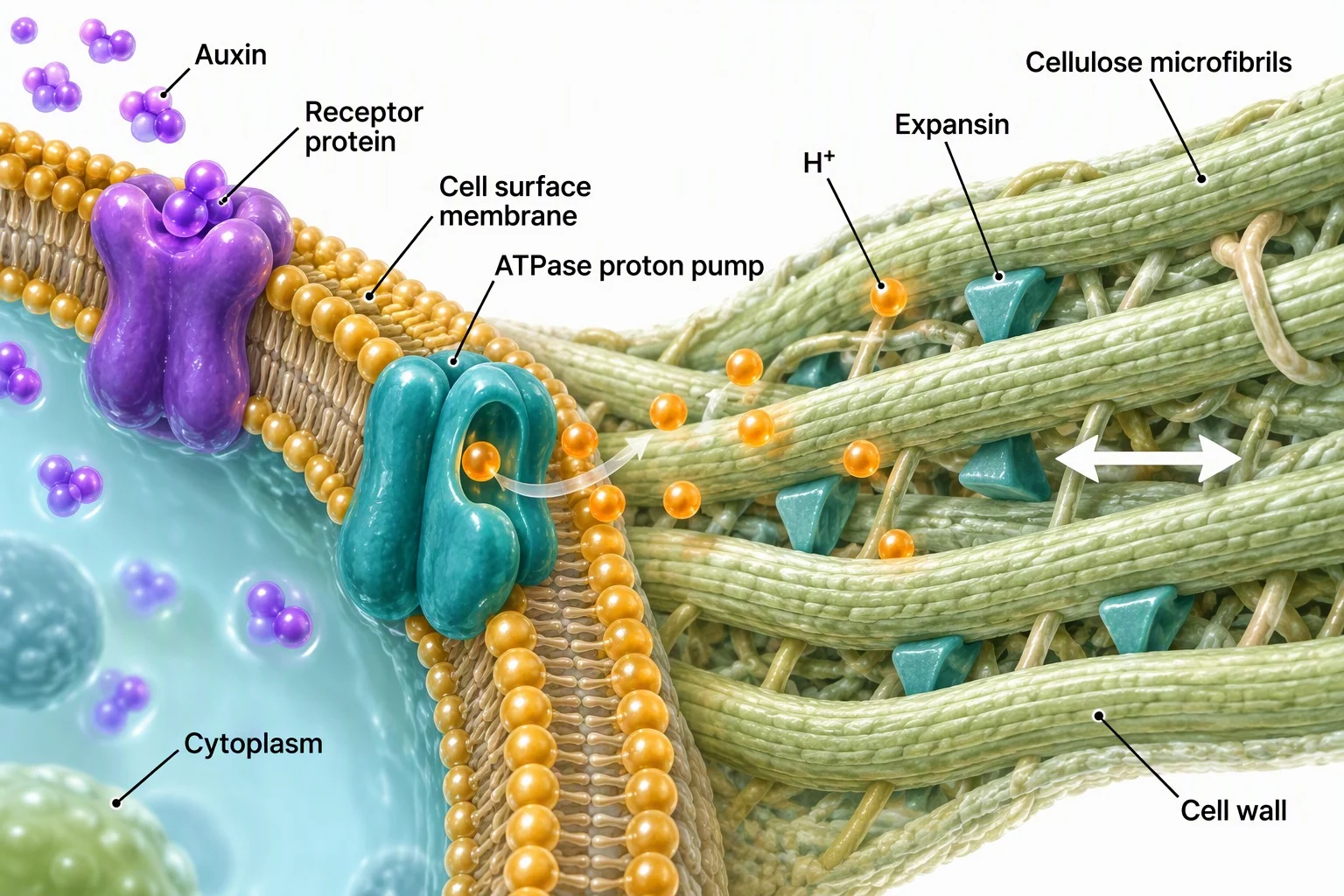
- Phytohormones plant hormones that regulate growth, development, reproduction, longevity and death.
| Hormone | Effect |
|---|---|
| Auxins | Cell elongation |
| Abscisic acid | Suppresses growth |
| Cytokinins | Increase the rate of cell division |
| Ethylene | Promotes fruit ripening |
| Gibberellin | Controls elongation, germination, flowering and dormancy |
| Brassinosteroids | Regulate growth, development and stress responses |
Plant hormones and auxin
Auxin (IAA)
- Auxin (IAA) made in the growing shoot tip and moving into surrounding tissues, it causes shoot cells to elongate.
- In roots auxin inhibits growth, and very high concentrations inhibit shoot growth.
Auxin efflux carriers (PIN3)
- Auxin efflux carriers (PIN3) auxin enters cells by diffusion but leaves through efflux carriers, an ATP-requiring active process.
- Placing carriers on one side of the cell makes auxin move one way and sets up a gradient across a stem or root in response to light or gravity.
Phototropism mechanism
Plant hormones and auxin
Light on one side of the shoot makes PIN3 carriers move auxin from the lit to the shaded side.
More auxin on the shaded side makes cells elongate faster there.
The shoot bends towards the light.
- Elongation mechanism
1
Auxin binds a receptor on the cell surface membrane.
2
ATPase proton pumps move H+ into the cell wall, acidifying it.
3
Expansins loosen bonds between cellulose microfibrils.
4
Potassium channels open, K+ in the cytoplasm rises, and water potential falls.
5
Water enters by osmosis through aquaporins, raising pressure so the wall stretches and the cell elongates.
Part 10 of 10Root-shoot integration and fruit ripening
1
Auxin and cytokinin interact to integrate root and shoot growth.
- Auxin is made in shoots, causes cell elongation and is transported in phloem sap from shoot to root.
- Cytokinin is made in roots, causes cell division and is transported in xylem from root to shoot.
- At low concentrations auxin limits cytokinin action, and rising cytokinin counteracts this and inhibits auxin signalling.
- At high concentrations of both, these interactions are prevented.
2
Ethylene (IUPAC name ethene)
- Ethylene (IUPAC name ethene) a gas made by fruit in late ripening, an example of positive feedback.
- It diffuses to adjacent fruit and triggers more ethylene release, so all the fruit ripen together.
Key terms
| Term | Meaning |
|---|---|
| Reflex arc | the pathway from receptor to effector in a reflex. |
| Medulla | the brainstem region controlling heart rate and breathing. |
| Chemoreceptor | a receptor that detects chemicals such as H+ or CO2. |
| Baroreceptor | a receptor that detects blood pressure. |
| Circadian rhythm | a physiological cycle lasting about 24 hours. |
| Tropism | a plant growth response to a directional stimulus. |
| Auxin | a plant hormone that causes cell elongation in shoots. |
| Peristalsis | a wave of muscle contraction that moves food along the gut. |
| Emergent property | a property of a whole system not found in its parts. |
Avoid these mistakes
1
Nerves and hormones are interchangeable — nerve impulses are fast and short-lived, while hormones are slow and longer lasting.
2
Reflexes need the conscious brain — they pass through the spinal cord without it.
3
Auxin always stimulates growth — it inhibits root growth and very high shoot concentrations inhibit shoots.
4
Precision and accuracy mean the same — precise readings can all share the same systematic error.
Marked practiceQuizzes for this lesson
Last updated:
\n