C3.2Theme C — Interaction and interdependence
Defence against disease — IB Biology HL Revision Notes & Topical Questions
10 min read 12 parts Lesson 8 of 11 2 quizzes
Curriculum Equation Key قوانين الرقم الهيدروجيني والاتزان الأيوني - pH & Acid-Base Equilibrium FormulasFast Exam Solution
pH = -log[H⁺] | pOH = -log[OH⁻] | pH + pOH = 14 | [H⁺][OH⁻] = 10⁻¹⁴
Word Equation & Conditions: الرقم الهيدروجيني = -لوغاريتم تركيز أيون الهيدروجين | pH + pOH = 14
Location & Specifications: الاتزان الأيوني، كيمياء 3 ثانوي، التحصيلي، و AP Chemistry.
Lesson summary
C3.2 Defence against disease — IB BIOLOGY HL notes: Explain pathogens, the body's barriers and immune responses, HIV, antibiotics and resistance, zoonoses and vaccination.Disease = an illness or disorder of body or mind that leads to poor health, with a set of signs and symptoms.…
- Nature of science
- Childbed fever (puerperal fever)
- Mucous membranes
- Amplification
- Adaptive response
- Phagocytes
Part 1 of 10Pathogens and disease, case studies of careful observation
Disease
Disease an illness or disorder of body or mind that leads to poor health, with a set of signs and symptoms.
Pathogen
Pathogen any microorganism that causes disease.
- Pathogens include bacteria, fungi, protists and viruses.
- Many bacteria, fungi and protists are harmless, but all viruses are pathogenic because they live only inside cells.
- No archaea are known to be pathogenic in humans.
Communicable diseases are infectious and pass from a diseased host to a healthy one, such as tuberculosis, athlete's foot, malaria and cholera.
Non-communicable diseases are not infectious, such as cancer, cardiovascular disease and malnutrition.
Nature of science
- Nature of science careful observation leads to progress, as knowledge of symptoms, incubation times and transmission allows control or eradication.
1Cholera
- Cholera a water- and food-borne disease caused by Vibrio cholerae.
- It spreads through contaminated water, food or utensils where sanitation is poor, because infected people pass large numbers of bacteria in faeces.
- In 1854, over 500 died in a month in Soho, London.
- John Snow, who knew the symptoms from an outbreak in 1832, mapped the cases and traced them to one water pump.
- Removing the pump handle ended the outbreak, and the pump was a few feet from a contaminated cesspit.
- His observations supported the germ theory of disease and changed sanitation in the 19th century.
2Childbed fever (puerperal fever)
- Childbed fever (puerperal fever) a bacterial infection of the female reproductive tract after birth, spread by direct contact,
- and the commonest cause of childbirth deaths in the 19th century.
- Ignaz Semmelweis noticed more deaths in one maternity ward and found a correlation with autopsies done by staff who then delivered babies without washing their hands.
- He introduced mandatory hand washing and later washing of instruments, and deaths fell, founding routine hand washing in healthcare.
Part 2 of 10Skin and mucous membranes, blood clotting
Skin
- Skin a tough physical barrier covered with harmless microorganisms.
- Cuts are sealed by blood clots.
- Sebum from sebaceous glands in hair follicles keeps skin pH low, which inhibits microbial growth.
Mucous membranes
- Mucous membranes they line airways, the areas around the reproductive organs and the digestive system.
- Goblet cells make mucus containing glycoproteins that trap microorganisms and particles.
- Cilia of the ciliated epithelium sweep mucus upwards, and it is swallowed and destroyed by stomach acid or expelled.
- Mucus contains lysozyme, an enzyme with antibacterial action.
Role
- Role clotting limits blood loss and stops microorganisms entering a cut that has breached the first line of defence.
Platelets
Platelets cell fragments that form a temporary plug and release clotting factors.
Blood
- Blood it has four components: plasma, red cells, white cells and platelets.
Cascade
1
Clotting factors trigger the release of the enzyme thrombin.
2
Thrombin converts soluble fibrinogen into insoluble fibrin.
3
Fibrin forms a mesh that traps platelets and blood cells and seals the wound.
4
Exposure to air hardens the mesh into a scab.
- Amplification
- a small stimulus produces a large amount of fibrin, which seals the wound quickly.
Part 3 of 10Innate and adaptive immunity
| Feature | Innate immune system | Adaptive immune system |
|---|---|---|
| Recognition | Any non-self antigen | Specific non-self antigens |
| Present at birth | Yes, and does not change | Absent in young babies and develops with age |
| Memory | None | Immunological memory builds up |
| Response | Broad, non-specific, such as phagocytes | Specific, producing antibodies and memory cells |
Antigen
Antigen a molecule that can trigger an immune response.
- All cells have antigens, and self antigens are tolerated while non-self antigens start a response.
- Pollen and other allergens can act as non-self antigens, causing allergy.
- Antigens occur on cancer cells, bacterial cell walls, virus envelopes and pollen, and some glycolipids and glycoproteins act as antigens.
Adaptive response
- Adaptive response on first exposure, events lead to antibodies and memory cells;
- on re-exposure the response is faster and larger, destroying the pathogen before symptoms.
Vaccination uses this by introducing pathogens safely.
Part 4 of 10White blood cells
Phagocytes
- Phagocytes produced continuously in the bone marrow, they remove dead cells and invading microorganisms in a non-specific response.
- They move by amoeboid movement to the infection and attach to pathogens.
- The membrane extends around the pathogen and engulfs it by endocytosis.
- Enzymes from lysosomes digest it.
Lymphocytes
- T cells and B cells in the specific response, found in the lymph nodes and blood.
T cells
- T cells they are made in bone marrow and mature in the thymus.
- T cell receptors are antibody-like and specific to one antigen.
- A T cell is activated when it binds its antigen on an antigen-presenting cell (a macrophage, infected body cell or the pathogen).
- Activated T cells divide by mitosis into clones with the same receptor.
B cells
- B cells they mature in the bone marrow.
- Each B cell has different antibody receptors and binds a specific antigen, forming an antigen-antibody complex.
- Binding plus signals from T helper cells activates the B cell, which divides by mitosis.
- Effector cells become plasma cells that make specific antibodies.
- Memory cells stay in the blood for a faster future response.
Part 5 of 10ABO and rhesus antigens, activation of B cells and clonal expansion
Red blood cell antigens determine the blood group.
- The ABO marker gives group A, B, AB or O, and the Rhesus marker gives Rh positive or negative.
ABO antigen structure
- Type Athe H marker modified with N-acetylgalactosamine.
- Type Bthe H marker modified with galactose.
- Type ABboth modifications.
- Type Othe H marker is unmodified, so there are no A or B antigens.
Transfusion
- Transfusion antibodies in the recipient bind incompatible red cells, causing agglutination (clumping) that can block vessels and be fatal.
- Activation
1
A phagocyte engulfs a pathogen and presents its antigens on its surface as an antigen-presenting cell.
2
A T helper cell with a complementary receptor binds and is activated.
3
The activated T helper cell binds complementary receptors on a specific B cell and releases signalling proteins.
4
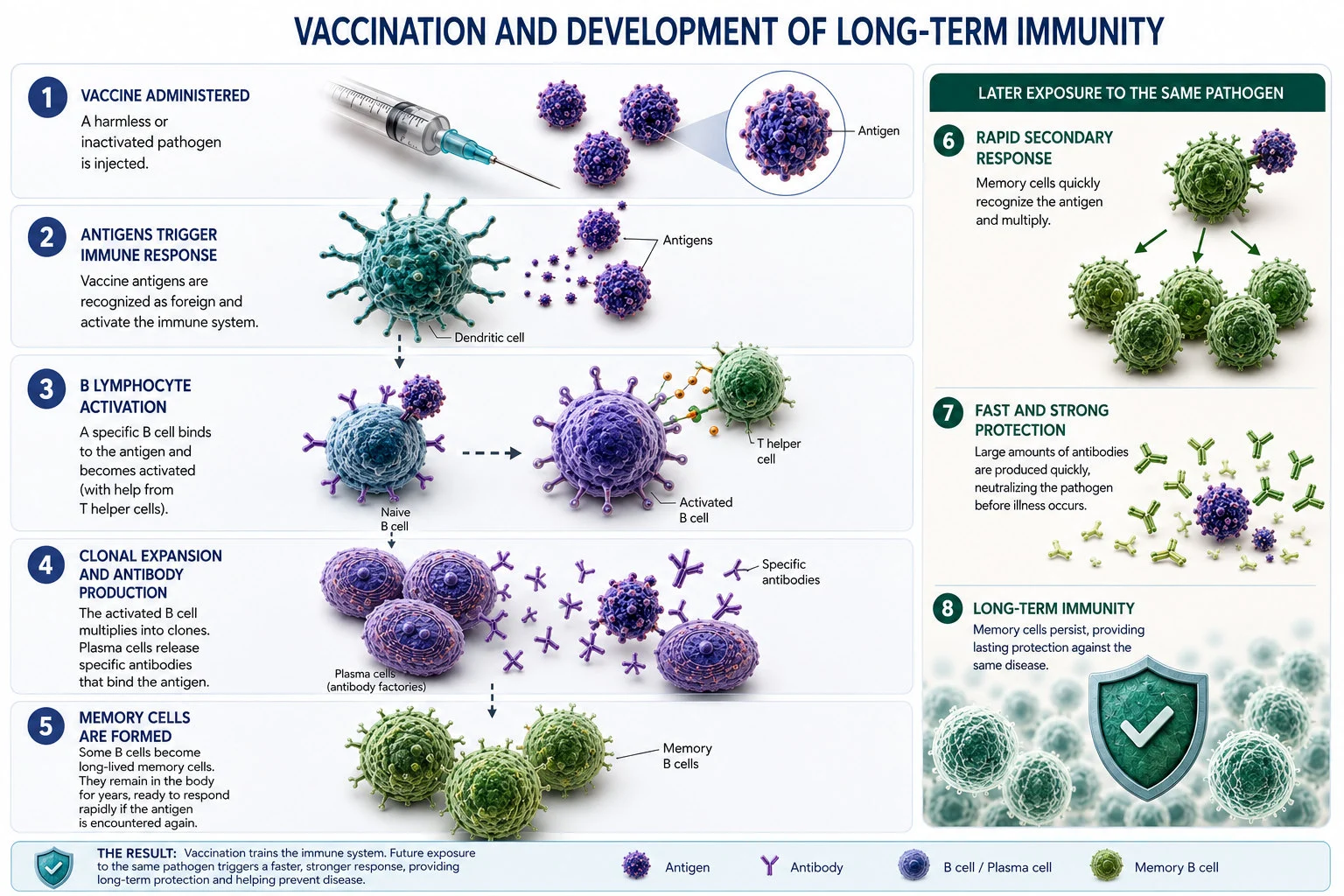
The activated B cell clones itself into plasma cells and memory cells.
- Clonal expansion
- the activated B cell divides by mitosis into many clones, each making the same antibody.
- Antibodies from plasma cells last weeks or months.
- Memory cells form immunological memory and can last for years or a lifetime.
Part 6 of 10Primary and secondary responses, HIV and AIDS
Primary response
- Primary response the first exposure to an antigen causes antibody and memory cell production and may give immunity if they persist after the pathogen is gone.
Secondary response
- Secondary response on re-exposure, memory cells divide quickly into plasma cells and more memory cells, producing up to 2000 antibodies per second.
- The response is much faster and larger, destroying the pathogen before symptoms develop.
Strains
- Strains measles has one strain so reinfection is unlikely,
- but colds and influenza viruses develop new strains with different antigens,
- so each needs a new primary response.
HIV
- HIV a retrovirus with RNA and reverse transcriptase that makes DNA in the host cell.
- It cannot survive outside the human body and has no vector, spreading by direct exchange of body fluids (sexual intercourse, blood donation, shared needles, mother to child across the placenta, at birth or through breast milk).
Infection
- HIV attacks T helper cells, which are needed for antibody production.
- Early on antibodies appear and can be detected, so the person is HIV positive.
- Later the ability to make antibodies falls and the immune system cannot fight opportunistic pathogens.
- AIDS (acquired immune deficiency syndrome) is the syndrome in which several diseases occur at once.
Treatment
- Treatment anti-retroviral drugs slow progression, so many HIV positive people live a full life with normal life expectancy.
HIV is the virus and AIDS is the syndrome it causes.
Part 7 of 10Antibiotics
Antibiotics
Antibiotics drugs that inhibit the growth of microorganisms, mostly killing bacteria without harming host cells.
- They block processes specific to prokaryotes, such as transcription, translation, DNA replication, ribosome function and cell wall formation.
Sources
- Sources some come from saprotrophic fungi, such as penicillin from Penicillium, which kills nearby bacteria in competition, and others are synthetic.
- Penicillin interferes with cell wall formation.
- Some bacteria such as tuberculosis resist it with thicker, less permeable walls or enzymes that break it down.
Viruses
- Viruses antibiotics do not work on viruses because they are particles without metabolism or cell structure.
- Viruses use host mechanisms, so targeting them would harm the host.
- Antivirals target viral enzymes without harming the host cell.
Part 8 of 10Antibiotic resistance
- Mechanism (natural selection)
1
Mutation produces a resistant bacterium in a variable population.
2
The antibiotic kills non-resistant bacteria and resistant ones survive.
3
Resistant bacteria reproduce with less competition and pass on the gene.
4
The whole population becomes resistant.
Bacteria have one copy of each gene, so a mutant gene acts at once, and they reproduce rapidly.
Penicillin resistance
- Penicillin resistance some bacteria acquire a gene for β-lactamase (penicillinase) that breaks down penicillin.
Future
- Future overuse exerts selective pressure and new strains emerge, such as MRSA, resistant to many antibiotics and very hard to treat.
- Finding new antibiotics is expensive and slow.
Measures to avoid resistance
- Avoid prescribing antibiotics for non-serious or non-bacterial infections.
- Keep high hygiene standards in hospitals.
- Minimise routine use in animal agriculture.
- Develop new antibiotics.
Nature of science
- Nature of science new techniques open new research,
- and the WHO treats resistance as a priority, with researchers using chemical libraries of compounds with antibacterial properties to design new antibiotics.
Part 9 of 10Zoonoses and vaccines and herd immunity
Species barriers
- Species barriers a disease may be species-specific because the host lacks the necessary receptors or the body temperature does not allow the disease to develop.
Zoonotic disease
Zoonotic disease a disease that crosses from animals to humans.
- It is a growing concern because of close contact between humans and animals,
- making control and eradication difficult and risking pandemics such as COVID-19.
- Animal products can be affected too.
- Some diseases arise in animals and develop into human-only strains, such as HIV.
Vaccine
Vaccine a source of antigens or DNA or RNA coding for antigens, which induces immunity without causing disease.
- Live attenuated vaccines contain weakened pathogens.
- Inactivated vaccines contain killed pathogens, parts of pathogens or antigens alone.
- They are given by injection into a vein or muscle, or orally.
Action
- Action a vaccine triggers a primary response, memory cells form,
- and later exposure gives a faster, stronger secondary response with a higher antibody concentration.
Herd immunity
- Herd immunity when enough of a population is vaccinated, the pathogen has few unvaccinated hosts, which protects everyone.
- A fall in vaccination leaves the population at risk of mass infection.
- It prevents epidemics and pandemics, and children are vaccinated early because they are seen regularly by medical staff.
- Some programmes aim at eradication, such as smallpox, eradicated in 1980 after a WHO programme running since the mid-1950s.
Part 10 of 10Evaluating research and COVID-19 data
Nature of science
- Nature of science scientists publish research so peers can evaluate its accuracy and validity.
- Media may report findings, such as side effects, before peer review, biasing public views and harming new medicines.
- Scientists use a pragmatic approach, weighing overall practicality and effectiveness rather than certainty for an individual.
- In COVID-19 vaccine development the vaccine was safe and effective for most people while a few had difficulties,
- and media reports of side effects caused some distrust.
Percentage difference
(difference between two values ÷ average of the two values) × 100, comparing directly comparable values at the same time,
- such as cases in two regions.
Percentage change
(change ÷ original value) × 100, comparing the same data set at different times.
- If the original value is larger, the result is a percentage decrease, shown as a negative number.
Key terms
| Term | Meaning |
|---|---|
| Antigen | a molecule that triggers an immune response. |
| Phagocyte | a white blood cell that engulfs and digests pathogens. |
| Clonal expansion | repeated mitosis of an activated B cell to make many identical cells. |
| Plasma cell | a differentiated B cell that secretes antibodies. |
| Memory cell | a long-lived lymphocyte that gives a fast secondary response. |
| Herd immunity | protection of a population when enough members are immune. |
| Zoonosis | a disease that passes from animals to humans. |
| Retrovirus | an RNA virus that uses reverse transcriptase to make DNA. |
| Agglutination | clumping of red blood cells by antibodies binding antigens. |
Avoid these mistakes
1
Antibiotics treat viral infections — viruses have no cell structure or metabolism to target.
2
HIV and AIDS are the same — HIV is the virus and AIDS is the syndrome it causes.
3
Bacteria become resistant because the antibiotic makes them mutate — mutations are random and the antibiotic selects the resistant ones.
4
Innate immunity improves with each infection — the adaptive system builds memory, the innate system does not change.
Marked practiceQuizzes for this lesson
Last updated:
\n