Theme C — Interaction and interdependence
Theme C — Interaction and interdependence — IB Biology SL Revision Notes & Topical Questions
5 min read 11 parts Lesson 1 of 9 Unit quiz
Lesson summary
Theme C — Interaction and interdependence — IB BIOLOGY SL notes: Connect enzymes, respiration, photosynthesis, neural signalling, defence and populations in Theme C.Optimum = the temperature or pH at which the enzyme rate is highestThe rate falls on either side of the optimum as …
- Cell respiration
- Stage locations
- Respirometer
- Respiration compared with breathing
- Oxygen source
- Action spectrum
Part 1 of 9Enzymes
- Optimum = the temperature or pH at which the enzyme rate is highest
- The rate falls on either side of the optimum as bonds in the enzyme are disrupted.
Part 2 of 9Cell respiration
1
Cell respiration
Cell respiration the controlled release of energy from organic compounds to produce ATP
- Oxidation is the loss of electrons or hydrogen and releases energy.
- Respiration releases energy and does not make energy.
2
Stage locations
- Stage locations glycolysis occurs in the cytoplasm and not in the mitochondria
3
ATP yield
- ATP yield aerobic respiration gives far more ATP than anaerobic respiration
4
Anaerobic products depend on the organism
- Human muscle cells make lactate.
- Yeast makes ethanol and carbon dioxide.
5
ATP
- ATP an immediate, short-term energy carrier and not a store lasting for days
6
Respirometer
- Respirometer a control tube with dead seeds or glass beads shows that changes are caused by living tissue
7
Respiration compared with breathing
- Respiration compared with breathing respiration is a chemical process in cells and breathing is ventilation of the lungs
Part 3 of 9Photosynthesis
Oxygen source
- Oxygen source the oxygen released comes from water
Pigments
- Pigments chlorophyll absorbs mostly red and blue light
Action spectrum
Action spectrum a graph of the rate of photosynthesis at each wavelength
Limiting factors
- If the rate stays the same as light rises but rises with CO2, then CO2 is limiting.
- The rate falls above 40 °C because enzymes denature.
Rf
Rf distance moved by a pigment divided by distance moved by the solvent front
- Distances of 2 cm and 8 cm give an Rf of 0.25.
- A pigment with a very low Rf has a strong affinity for the stationary phase.
Pondweed experiment
- Pondweed experiment the water is boiled and cooled before sodium hydrogencarbonate is added
- This removes dissolved CO2 so that the concentration is known.
FACE experiments
- FACE experiments costly and hard to replicate
Part 4 of 9Action potential
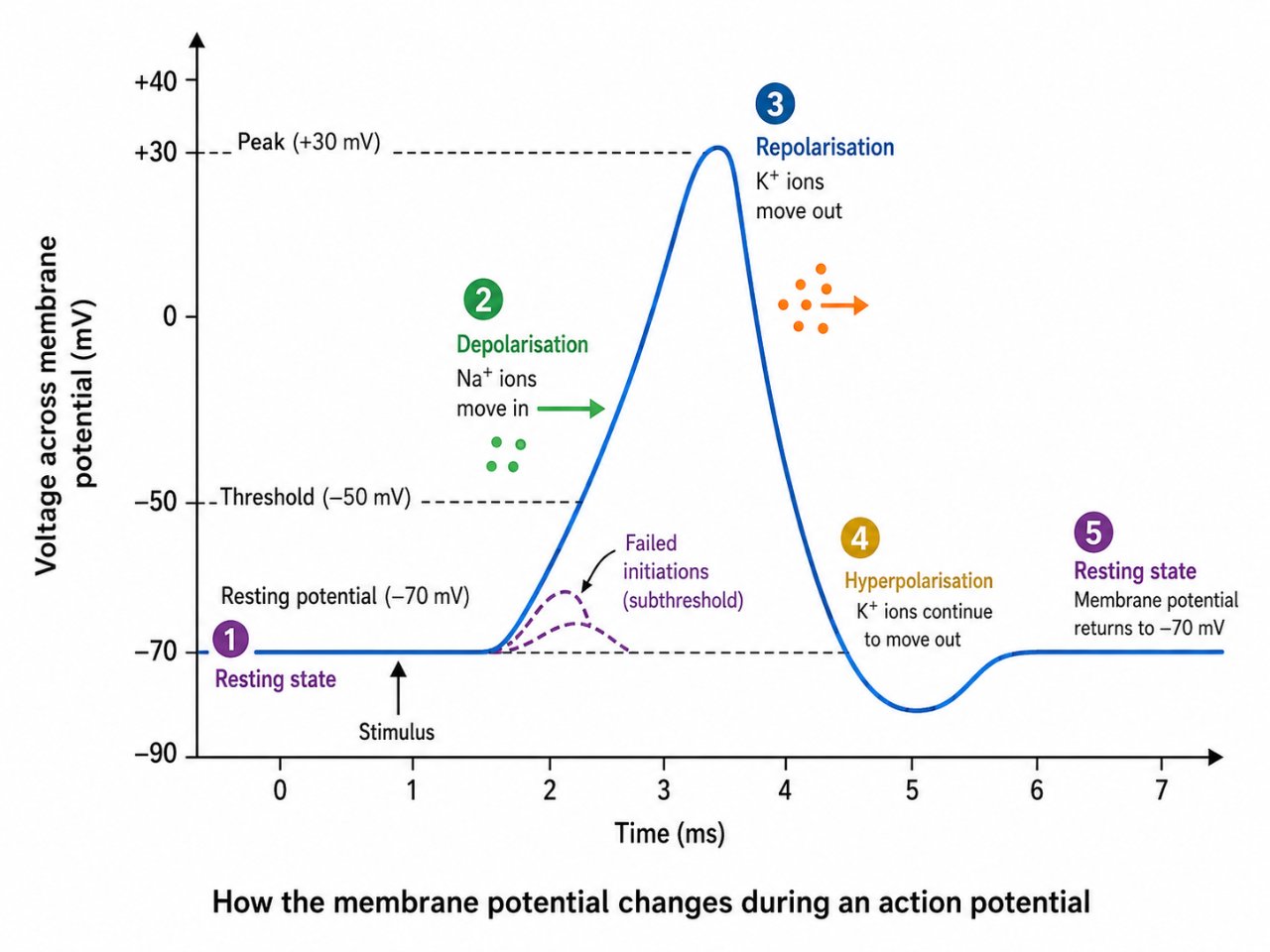
1
The stimulus raises the membrane to threshold, about -50 mV from a resting potential of -70 mV.
2
Voltage-gated Na+ channels open.
3
Na+ enters and the inside becomes positive, reaching about +40 mV.
4
Na+ channels close and K+ channels open.
5
K+ leaves and the membrane repolarises.
6
The pump restores the resting distribution of ions.
Sodium-potassium pump
- Sodium-potassium pump uses ATP to move 3 Na+ out and 2 K+ in
Propagation
- Propagation an action potential is propagated along the axon and is not electricity flowing
Stimulus strength
- Stimulus strength a stronger stimulus gives a higher frequency of impulses and not a bigger impulse
Myelin
- Myelin insulates the axon, and impulses jump between the gaps
Part 5 of 9Synapse
- Cholinergic synapse transmission
1
The action potential reaches the presynaptic terminal.
2
Ca2+ channels open and Ca2+ enters.
3
Vesicles release acetylcholine by exocytosis.
4
Acetylcholine diffuses across the cleft and binds receptors.
5
Na+ enters and the postsynaptic membrane depolarises.
6
Acetylcholinesterase breaks down the acetylcholine.
- Signal transfer
- a chemical neurotransmitter crosses the synapse and the impulse itself does not jump across
Part 6 of 9Neural and defence terms
Dendrite
Dendrite a short branch of a neurone that receives signals
Interneurone
Interneurone a relay neurone inside the CNS
Neuromuscular junction
Neuromuscular junction the synapse between a motor neurone and a muscle fibre
Feedback
- Feedback involves a receptor, a control centre and an effector, and signals are nerve impulses
Phototropism
- Phototropism involves efflux carriers and cell elongation
Phagocyte
Phagocyte a white blood cell that engulfs and digests pathogens by endocytosis
Signs and symptoms
- Signs and symptoms signs are measurable features of disease and symptoms are what the patient feels
Part 7 of 9Sampling populations
Transect
- Transect a line across a habitat along which samples are taken
- It is better than random quadrats when an environmental gradient exists, such as from shore to dunes.
- Systematic sampling shows how species change along the gradient.
Lincoln index
- Lincoln index population size = first catch × second catch / marked recaptures
- Round estimates to whole organisms.
Saprotroph
Saprotroph a decomposer that secretes enzymes externally and absorbs the digested products
Omnivore
- Omnivore hard to place in a pyramid because it feeds at several trophic levels and its energy must be split between them
Part 8 of 9Population growth and relationships
Sigmoid growth
- Sigmoid growth has three phases, with limiting factors setting the carrying capacity
- At carrying capacity births and deaths fluctuate around a balance.
Competition
- Competition interspecific between species and intraspecific within a species, for a named resource
Parasites
- Parasites they harm hosts, usually without killing them quickly
Chi-squared test
- Chi-squared test state the null hypothesis, give the degrees of freedom and the critical value
- A significant result shows an association and does not prove that species depend on each other.
Part 9 of 9More from the specification
1Catalytic reaction rates and amino acids
- Catalytic reaction rates and amino acids enzyme catalytic rates depend on correct three-dimensional folding of constituent amino acids forming active binding sites.
2Enzyme Active Site Specificity
- An enzyme molecule features a distinct three-dimensional active site whose catalytic shape is complementary to specific substrate molecules.
3Enzyme-Substrate Complex Formation
- Catalysis begins when substrate molecules collide with and bind to the active site,
- forming a temporary enzyme-substrate complex that lowers the activation energy of the chemical reaction.
4Induced Fit Model
- Upon substrate binding, the active site undergoes conformational changes that strain chemical bonds in the substrate molecule, accelerating metabolic conversion into products.
5Enzymatic Digestion of Starch
- The enzyme amylase breaks down complex starch polysaccharides into maltose disaccharide molecules through specific enzyme-substrate interactions.
6Amylase
- Enzyme that breaks starch into maltose.
7Enzyme-substrate complex
- The temporary structure formed when a substrate binds to an enzyme's active site.
8Activation energy
- The energy needed for a substrate to become unstable enough to react.
9Anabolic reaction
- Builds large molecules from small ones using energy.
10Catabolic reaction
- A reaction breaking larger molecules into smaller ones.
11Amino acid
- The unit from which proteins are made; the sequence decides the protein's shape and function.
12Immobilised enzyme
- An enzyme fixed to a surface or trapped in a matrix so it can be reused.
13Substrate
- The molecule that an enzyme acts on and which binds to the active site.
14Complex
- Two or more molecules joined, such as an antibody and antigen.
15Starch
- An insoluble polysaccharide of glucose used by plants for energy storage.
16Metabolism
- The chemical reactions in a cell that release energy and build molecules.
Key terms
| Term | Meaning |
|---|---|
| Optimum | The condition giving the highest enzyme rate. |
| Rf value | Distance moved by the pigment divided by distance moved by the solvent front. |
| Sodium-potassium pump | A pump that uses ATP to move 3 Na+ out and 2 K+ in. |
| Phagocyte | A white blood cell that engulfs and digests pathogens. |
| Lincoln index | A mark-recapture estimate of population size. |
| Saprotroph | A decomposer that secretes enzymes externally and absorbs the products. |
Avoid these mistakes
1
Saying respiration makes energy — it releases energy from organic compounds to make ATP
2
Saying that the impulse jumps across the synapse — a neurotransmitter diffuses across the cleft
3
Saying that the chi-squared test proves dependence — it shows a significant association only
4
Saying glycolysis happens in the mitochondria — it happens in the cytoplasm
Last updated:
\n