C1.2Theme C — Interaction and interdependence
Cell respiration — IB Biology SL Revision Notes & Topical Questions
5 min read 13 parts Lesson 3 of 9 3 quizzes
Curriculum Equation Key Balanced Cellular Respiration EquationFast Exam Solution
C₆H₁₂O₆ + 6O₂ ➔ 6CO₂ + 6H₂O + 36-38 ATP
Word Equation & Conditions: Glucose + Oxygen -> Carbon Dioxide + Water + Energy (36-38 ATP)
Lesson summary
C1.2 Cell respiration — IB BIOLOGY SL notes: Describe the structure and role of ATP, aerobic and anaerobic respiration, and how respiration rate is measured.ATP = adenosine triphosphate, a phosphorylated nucleotide of ribose, an adenine base and three phosphate groupsRole — a sma…
- Energy compared with ATP
- Hydrolysis
- Energy stores
- Respiration compared with gas exchange
- Water of respiration
- Glycolysis
Part 1 of 11Structure and role of ATP
Structure and role of ATP
ATP
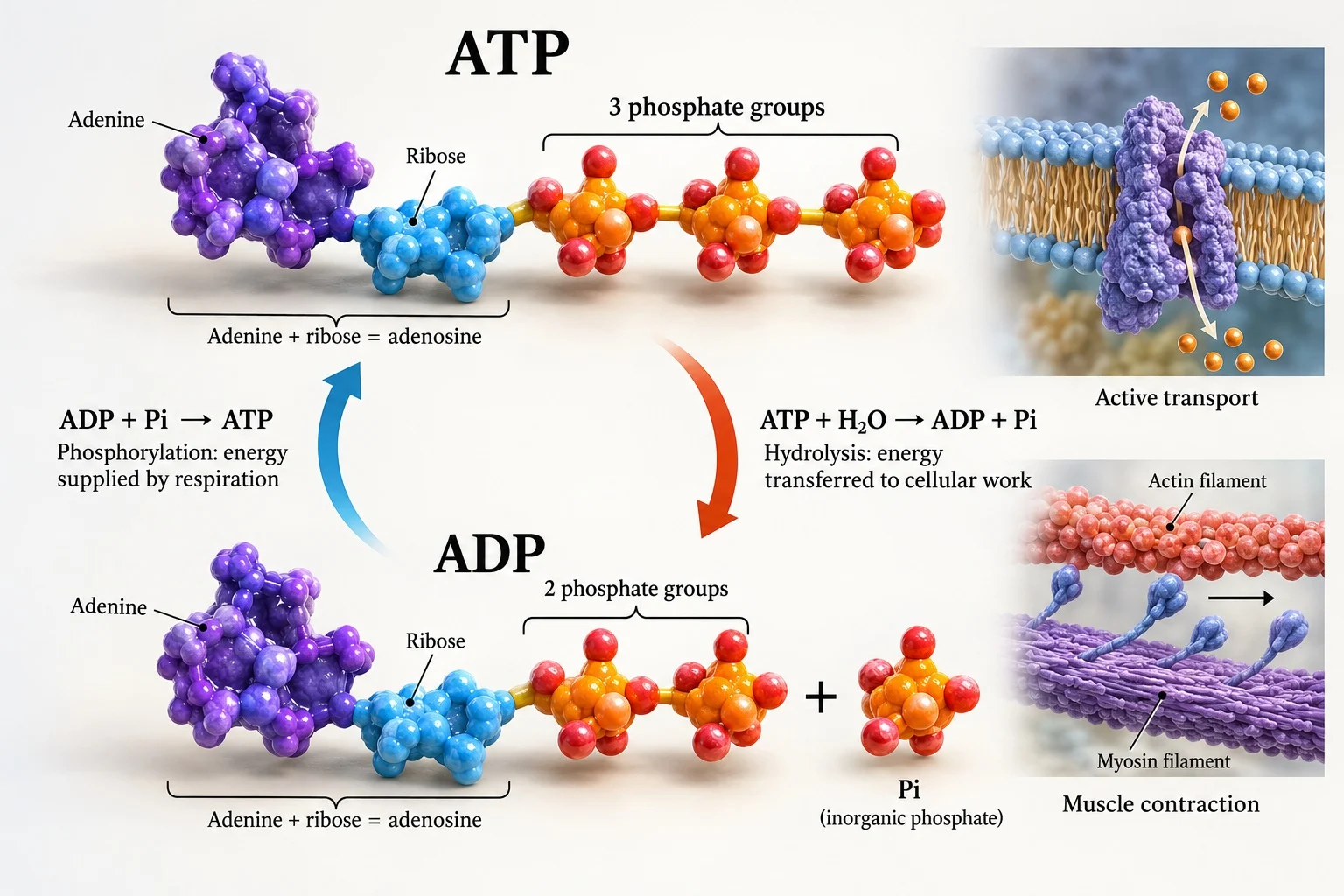
ATP adenosine triphosphate, a phosphorylated nucleotide of ribose, an adenine base and three phosphate groups
Role
- Role a small, soluble short-term store of chemical energy that links energy-yielding and energy-requiring reactions
- It is called the universal energy currency because every organism uses it for many different tasks and recycles it.
Uses of ATP
- Active transport across membranes against the concentration gradient.
- Anabolic reactions that build macromolecules.
- Movement of the whole cell and of cell components such as chromosomes and vesicles.
- Muscle contraction.
Energy compared with ATP
- ATP carries energy, so the two words must not be used interchangeably
Part 2 of 11Why ATP suits its role
| Property | Benefit to the cell |
|---|---|
| Releases a moderate amount of energy | Enough for reactions with little waste, and gives fine control |
| Stable without its enzyme | Breaks down only when ATPase acts, so no energy leaks |
| Formation is reversible | ATP is recycled from ADP and Pi many times |
| Hydrolysis is quick, with one enzyme | Meets a sudden demand for energy |
| Small and soluble | Moves freely to where energy is needed |
| Phosphorylates metabolites | Makes them more reactive and lowers activation energy |
Part 3 of 11ATP-ADP cycle
1Hydrolysis
- ATP → ADP + Pi, releasing energy for work such as DNA synthesis
- Removing the first phosphate releases about 30.5 kJ mol-1.
- ADP can lose another phosphate to form AMP, and the exact values need not be learned.
2Synthesis
- ADP + Pi → ATP is a condensation reaction that needs energy from respiration or photosynthesis
3Turnover
- Turnover a person recycles over 50 kg of ATP a day but holds only about 200 g at once
- ATP rarely crosses the plasma membrane, so each cell makes its own as needed.
4Energy stores
- Energy stores glucose and fatty acids store energy short term and glycogen, starch and triglycerides long term
5Heat
- Heat energy transfers occur in small steps and the heat lost warms the bodies of endotherms
Part 4 of 11Cell respiration and substrates
1Cell respiration
Cell respiration the controlled release of energy from organic compounds to produce ATP
- It is a catabolic series of enzyme-controlled steps in every cell.
- A stepwise pathway avoids damaging sudden energy release.
2Glucose
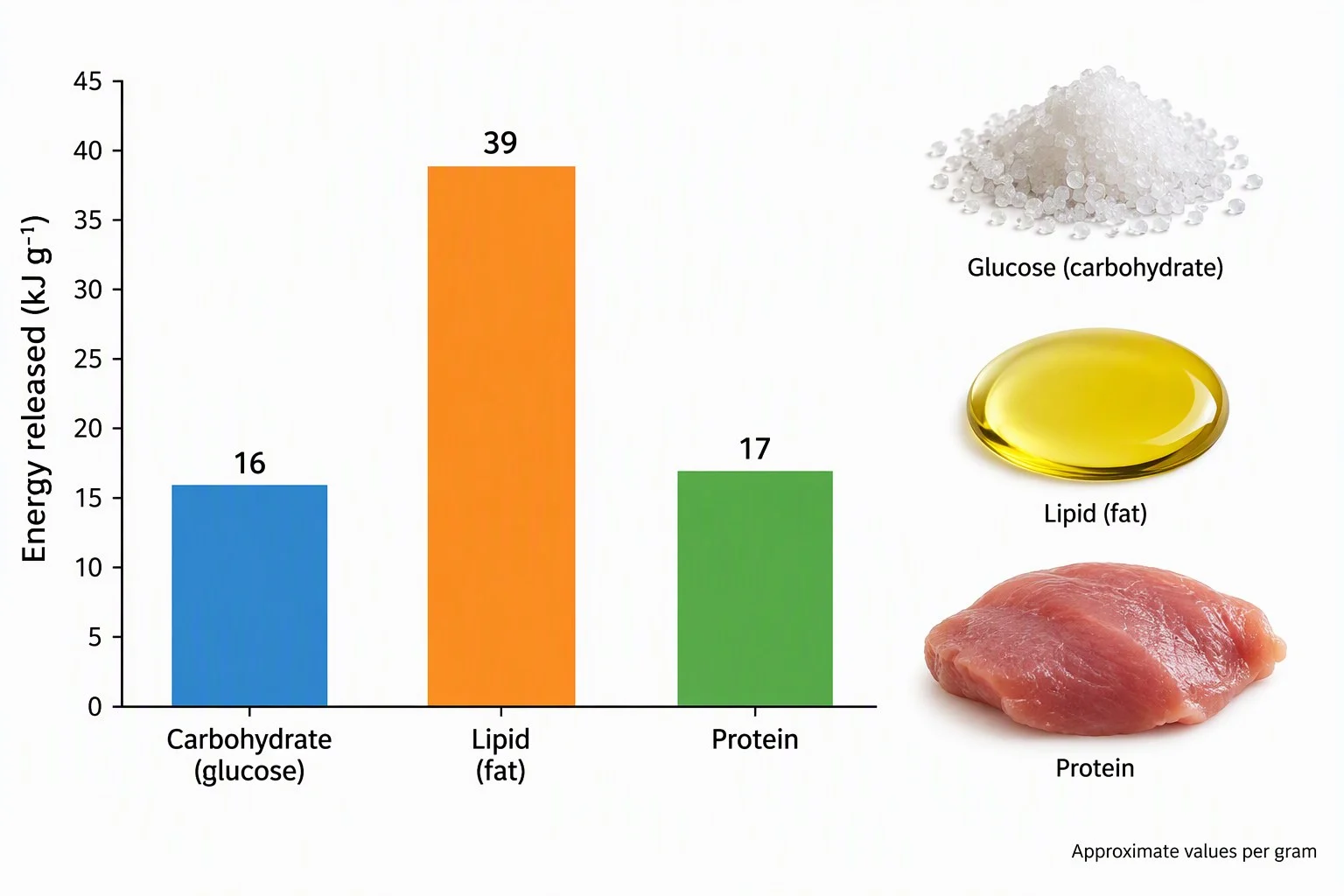
- Glucose the main respiratory fuel, which enters glycolysis directly
3Lipids
- Lipids converted first and used in prolonged activity
4Proteins
- Proteins mainly structural, and respired only when carbohydrate and fat run low
5Respiration compared with gas exchange
- Respiration compared with gas exchange respiration is a chemical process and gas exchange is the diffusion of carbon dioxide and oxygen
6Water of respiration
- Water of respiration some desert animals rely on this metabolic water
Part 5 of 11Aerobic respiration
Equation
- Equation glucose + oxygen → carbon dioxide + water, with ATP produced
Glycolysis
- Glycolysis in the cytoplasm, glucose → two pyruvate, with a net gain of 2 ATP
Mitochondria
- Mitochondria pyruvate is fully oxidised and CO2 is released
- Oxygen is the final electron acceptor and forms water.
- Most of the ATP comes from these mitochondrial stages.
Yield
- Yield about 30-36 ATP per glucose, compared with 2 ATP anaerobically
1
Glucose is phosphorylated using ATP.
2
Glycolysis splits it into two pyruvate, gaining some ATP.
3
Pyruvate enters the mitochondrion.
4
Carbon is removed as CO2 during oxidation.
5
Oxygen accepts electrons and forms water.
6
Most ATP is made in the mitochondrion.
Part 6 of 11Anaerobic respiration
Anaerobic respiration
When it occurs
- When it occurs oxygen supply cannot keep up with demand, as in a sprint, or oxygen cannot reach the cells, as in waterlogged soil
Partial oxidation
- Partial oxidation glucose is only partly oxidised, so most chemical energy stays locked in lactate or ethanol
- Only glycolysis continues, giving about 2 ATP per glucose.
- It takes place in the cytoplasm without the mitochondria.
- It gives a short, fast supply of ATP when oxygen is limited.
Humans
- Humans glucose → pyruvate → lactate, which lets glycolysis continue during intense exercise
- Lactate is later oxidised in the liver, which needs extra oxygen.
Yeast and plants
- Yeast and plants glucose → pyruvate → ethanol + CO2, used in baking and brewing
- Yeast CO2 makes bread rise and the ethanol evaporates on baking.
Part 7 of 11Respiration compared
| Feature | Aerobic | Anaerobic (humans) | Anaerobic (yeast) |
|---|---|---|---|
| Oxygen used | Yes | No | No |
| Oxidation of glucose | Complete | Incomplete | Incomplete |
| Location | Cytoplasm then mitochondria | Cytoplasm | Cytoplasm |
| Products | CO2 and water | Lactate | Ethanol and CO2 |
| ATP yield per glucose | Large | 2 | 2 |
| Substrates | Carbohydrate, lipid, protein | Carbohydrate only | Carbohydrate only |
| Uses | Normal activity | Short intense exercise | Baking and brewing |
- Lipid compared with carbohydrate
- lipid gives about twice as much energy per gram and needs more oxygen per gram
- Lipid cannot be used anaerobically.
- Carbohydrate energy is released more rapidly.
Part 8 of 11Factors affecting respiration rate
Cell activity
- Cell activity muscle cells respire faster than adipose cells
Body size
- Body size small organisms have a high SA:V and lose heat fast, so they respire faster
Oxygen supply
- Oxygen supply low oxygen shifts cells to anaerobic pathways
Substrate supply
- Substrate supply less glucose gives a lower rate
Temperature
- Temperature the rate rises to the enzyme optimum and then falls as enzymes denature
pH
- pH carbon dioxide acidifies tissues, which may inhibit enzymes
Part 9 of 11Measuring respiration with a respirometer
- Respirometer
- measures oxygen consumption of live organisms such as seeds or invertebrates
- A sealed chamber holds the organisms, with KOH or soda lime to absorb CO2 and a capillary manometer with a scale.
- The organisms take up O2 and the CO2 is absorbed, so the pressure falls.
- The manometer fluid moves towards the organisms.
1
Add soda lime and a gauze platform to a tube.
2
Place a known mass of germinating seeds on the gauze.
3
Seal the tube and connect it to a capillary containing coloured fluid.
4
Equilibrate in a thermostatic water bath at a set temperature.
5
Record the fluid movement over a fixed time.
6
Repeat at other temperatures and calculate the rates.
- Volume of oxygen taken up
- πr2h, where r is the capillary radius and h the distance moved
- Rate = volume divided by time, in mm3 min-1.
Part 10 of 11Reliability and technology
Reliability
- Use a thermostatic water bath because temperature changes alter the gas pressure.
- Use a control tube with an equal volume of inert beads to compensate for atmospheric pressure changes.
- Repeat the experiment and calculate a mean to remove anomalies.
Ethics
- Ethics use seeds rather than animals where possible
Technology
- Technology oxygen and CO2 sensors with dataloggers give real-time data without caustic alkali
Part 11 of 11More from the specification
1Structure of ATP
- Adenosine triphosphate consists of an adenine nitrogenous base, a ribose sugar, and three linked phosphate groups.
2ATP/ADP energy cycle
- Hydrolysis of the terminal phosphoanhydride bond produces adenosine diphosphate (ADP) and inorganic phosphate (Pi), releasing approximately 30.5 kJ/mol of free energy.
3Continuous regeneration
- Energy released from catabolic respiration drives the endergonic phosphorylation of ADP back to ATP in living organisms.
4Respirometer rate determination
- Measuring average oxygen consumption in germinating seeds using closed respirometry under constant temperature conditions.
5Constants
- Factors deliberately kept the same so the result has one cause.
Key terms
| Term | Meaning |
|---|---|
| ATP | Adenosine triphosphate, the molecule that carries energy to where it is needed in the cell. |
| Cell respiration | The controlled release of energy from organic compounds to produce ATP. |
| Glycolysis | The splitting of glucose into two pyruvate in the cytoplasm, giving a net gain of 2 ATP. |
| Aerobic respiration | Complete oxidation of a respiratory substrate using oxygen to give a large yield of ATP. |
| Anaerobic respiration | Partial breakdown of glucose without oxygen giving a small yield of ATP. |
| Lactate | The product of anaerobic respiration in human cells. |
| Respirometer | A sealed apparatus that measures oxygen uptake by living organisms. |
| ATPase | The enzyme that hydrolyses ATP to release energy. |
Avoid these mistakes
1
Using energy and ATP as the same thing — ATP is a molecule that carries energy to where it is needed
2
Saying ATP is stored in large amounts — it is made on demand and continually recycled
3
Saying anaerobic respiration makes no ATP — glycolysis still gives about 2 ATP per glucose
4
Confusing respiration with breathing — respiration is a chemical process in cells
Marked practiceQuizzes for this lesson
Last updated:
Cambridge 9700 AS Biology
Core Formula
Magnification Triangle & Unit Conversion
Formula: M = I / A ⇔ A = I / M ⇔ I = M × A
Units: 1 mm = 1,000 μm = 1,000,000 nm.
Rule: Convert Image size (ruler mm) to μm by ×1,000 before dividing by Actual size.