C1.1Theme C — Interaction and interdependence
Enzymes and metabolism — IB Biology SL Revision Notes & Topical Questions
5 min read 12 parts Lesson 2 of 9 2 quizzes
Curriculum Equation Key قوانين الرقم الهيدروجيني والاتزان الأيوني - pH & Acid-Base Equilibrium FormulasFast Exam Solution
pH = -log[H⁺] | pOH = -log[OH⁻] | pH + pOH = 14 | [H⁺][OH⁻] = 10⁻¹⁴
Word Equation & Conditions: الرقم الهيدروجيني = -لوغاريتم تركيز أيون الهيدروجين | pH + pOH = 14
Location & Specifications: الاتزان الأيوني، كيمياء 3 ثانوي، التحصيلي، و AP Chemistry.
Lesson summary
C1.1 Enzymes and metabolism — IB BIOLOGY SL notes: Explain how enzymes catalyse metabolic reactions and how temperature, pH and concentrations affect their rate.Enzyme = a globular protein that acts as a biological catalystIt lets reactions occur at a suitable rate in the conditi…
- Why enzymes are needed
- Shared features
- Energy terms
- Active site
- Specificity
- Summary equation
Section 1 of 12Enzymes as catalysts
Enzyme
Enzyme a globular protein that acts as a biological catalyst
- It lets reactions occur at a suitable rate in the conditions found in living cells.
- It is reusable and unchanged by the reaction, so a small amount is enough.
Why enzymes are needed
- Why enzymes are needed heat, pressure, extreme pH or high reactant concentration would speed reactions but would damage cells
- Reactants must collide at the correct angle and speed, which is very rare without a catalyst.
- The enzyme holds the substrates close and correctly aligned.
Control
- Control the cell controls which enzymes it makes, so it controls which reactions run
- Which genes are expressed decides which enzymes exist.
Metabolism
Metabolism all the chemical reactions in cells and organisms
- Metabolites are the intermediates and products.
- A metabolic pathway is a chain or cycle of reactions, each step catalysed by a separate enzyme.
Section 2 of 12Anabolism and catabolism
| Feature | Anabolism | Catabolism |
|---|---|---|
| Process | Builds larger molecules from smaller ones | Breaks larger molecules into smaller ones |
| Reaction type | Condensation | Hydrolysis |
| Energy | Requires energy (endergonic) | Releases energy (exergonic) |
| Examples | Photosynthesis, protein synthesis, glycogen formation | Digestion, respiration, deamination giving urea |
| Purpose | Growth, repair and energy storage | Energy supply and excretion |
Anabolism and catabolism
Shared features
- Shared features both are enzyme-catalysed and coupled to ATP
Energy terms
- Energy terms endergonic and exergonic refer to net energy, whereas endothermic and exothermic refer to heat only
Section 3 of 12Enzyme structure and specificity
Enzyme structure and specificity
Active site
Active site the region where the substrate binds
- It is made of only a few amino acids whose positions depend on the 3D shape of the protein.
- It binds the substrate, holds it in position and lowers the energy needed for the reaction.
Specificity
- Specificity the shapes and chemical properties of the active site and substrate are complementary
- Complementary means they fit because of specific differences, not that they are the same.
- Catalase binds hydrogen peroxide but DNA polymerase cannot.
- Some enzymes need two substrates to bind at once.
1
The enzyme and substrate move randomly and collide in the correct orientation.
2
The substrate binds to the active site, forming a temporary enzyme-substrate complex.
3
The substrate changes structure inside the complex.
4
The products form and detach from the active site.
5
The unchanged enzyme is free to bind again.
- Summary equation
- 1E + S2ES3EP4E + P
Section 4 of 12Lock-and-key and induced fit
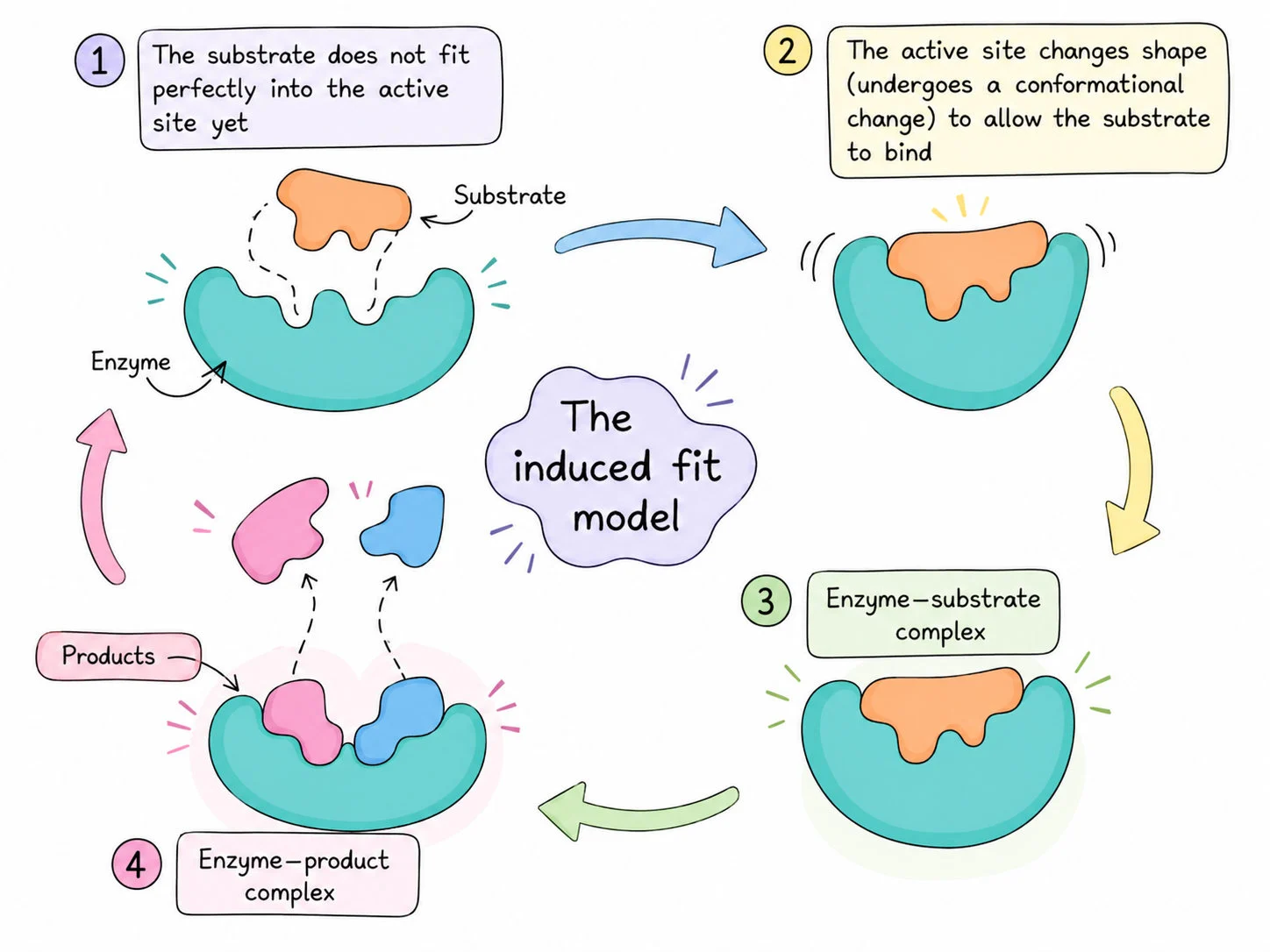
Lock-and-key model
Lock-and-key model the older idea that a rigid active site is exactly complementary to the substrate
Induced-fit hypothesis
Induced-fit hypothesis the current model in which the enzyme, and sometimes the substrate, change shape slightly on binding
- The changes are called conformational changes.
- They give an ideal binding arrangement and strain the bonds of the substrate.
- This maximises the ability of the enzyme to catalyse the reaction.
Section 5 of 12Activation energy
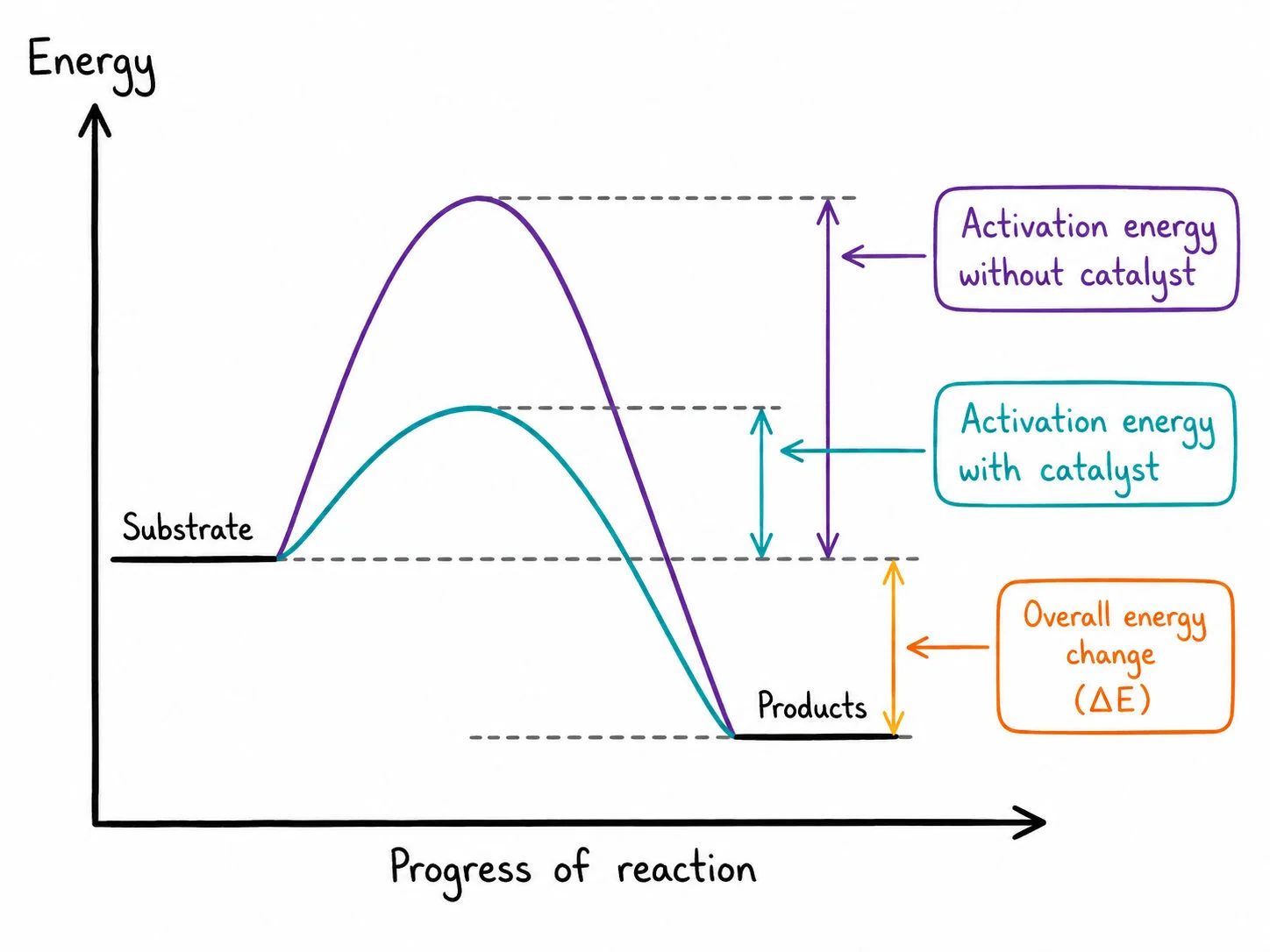
Activation energy
Activation energy
Activation energy the energy needed by the substrate to become unstable enough to react
Enzymes lower the activation energy by reducing the stability of bonds in the substrate
- The overall energy released by the reaction is unchanged.
- The reaction is therefore faster.
Exergonic reaction
- Exergonic reaction energy is released to the surroundings
Endergonic reaction
- Endergonic reaction energy is absorbed from the surroundings
Intracellular and extracellular enzymes
- Intracellular and extracellular enzymes glycolysis enzymes work inside cells and digestive enzymes are secreted
Section 6 of 12Immobilised enzymes

Molecular motion
- Molecular motion greater kinetic energy gives faster movement and more collisions between enzyme and substrate
- Immobilised substrates rely on movement of the enzyme.
Immobilisation methods
- Attachment to an inert substance such as glass.
- Entrapment in a matrix such as alginate gel.
- Entrapment within a partially permeable membrane.
Uses
- Uses food processing, pharmaceuticals, manufacturing and environmental management
Advantages
- The product is not contaminated and needs no further filtering.
- The enzyme is reused, which saves cost.
- The enzyme is more tolerant of temperature and pH changes.
- A higher enzyme concentration increases throughput.
- Conditions can be kept close to the optimum.
Section 7 of 12Denaturation and heat
Denaturation
- Denaturation high temperature or extreme pH breaks the hydrogen and ionic bonds between R groups
- Peptide bonds stay intact.
- The shape of the active site changes permanently, so the substrate cannot bind.
- The enzyme often becomes insoluble and precipitates.
- Avoid saying the enzyme is destroyed or killed.
Human enzymes
- Human enzymes optima are often near 37 °C and few work above 50 °C
Metabolic heat
- Metabolic heat energy transfers in cells are not complete, so some energy is lost as heat
- Endotherms such as birds and mammals use it to keep a constant body temperature.
- Heat output rises with metabolic rate, for example in muscles during exercise.
Section 8 of 12Factors affecting enzyme activity
| Feature | Temperature | pH | Substrate concentration |
|---|---|---|---|
| Low values | Few collisions and a slow rate | Active site charge altered | Few collisions and many empty sites |
| Rising values | More kinetic energy and collisions | Rate rises towards the optimum | Rate rises roughly in proportion |
| At the optimum or maximum | Highest rate | Highest rate | All active sites occupied |
| Beyond it | Denaturation and a fast fall | Denaturation and a fall | Plateau with no further increase |
| Graph shape | Asymmetric peak | Symmetric peak | Curve levelling off |
Optimum pH
- Optimum pH differs between enzymes, with pepsin best near pH 2 and salivary amylase near pH 7
- pH is logarithmic, so each unit is a tenfold change in H+ concentration.
Substrate saturation
- Substrate saturation at the plateau, more enzyme gives more active sites and a higher rate
Enzyme concentration
- Enzyme concentration more enzyme raises the rate if substrate is plentiful
Section 9 of 12Enzyme practicals
Design
- Design choose the independent variable, a measurable dependent variable with units, intervals and controlled variables
- (temperature, pH or substrate concentration)
Catalase
- Catalase breaks down toxic hydrogen peroxide into water and oxygen
- Collect the volume of oxygen in a set time.
- For temperature, keep the water bath level above the reactants and swirl the flask for even heating.
Amylase and starch
- Amylase and starch amylase hydrolyses starch to maltose and glucose and works best at pH 7 and 37 °C
1
Prepare buffers across a range of pH values.
2
Equilibrate the starch and amylase at a fixed temperature.
3
Mix the enzyme, buffer and starch and start the timer.
4
Sample into iodine in potassium iodide at regular intervals.
5
Record the time until the iodine stays yellow-brown instead of blue-black.
6
Calculate the rate as 1 / time and plot it against pH.
- Colorimetry
- follow the loss of colour as starch is broken down
- Calibrate the colorimeter with a weak iodine solution and use a red filter.
- Make a calibration graph from serial dilutions of a stock starch solution.
- Transmission rises as the colour fades.
Section 10 of 12Calculating rates
Rate from quantity
- Rate from quantity rate = change in volume or mass of product or substrate divided by time
Rate from time
- Rate from time rate = 1 / time taken, in s-1
Graph shape
- Graph shape the curve starts as a straight line then plateaus as the substrate is used up
- A steeper line means a faster rate.
Initial rate
- Initial rate draw a tangent at the origin, then rate = Δy / Δx
- Units are for example cm3 s-1.
Nature of science
- Nature of science sketch graphs are models of how rate depends on a variable
- Describe direction, key values, gradient changes and the plateau.
- More enzyme raises the plateau.
Section 11 of 12Key terms
| Term | Meaning |
|---|---|
| Enzyme | A globular protein that acts as a biological catalyst. |
| Active site | The region of an enzyme where the substrate binds. |
| Induced fit | The model in which binding changes the shape of the enzyme and sometimes the substrate for an ideal fit. |
| Activation energy | The energy needed for a substrate to become unstable enough to react. |
| Anabolism | Enzyme-catalysed reactions that build larger molecules and need energy. |
| Catabolism | Enzyme-catalysed reactions that break down larger molecules and release energy. |
| Denaturation | A permanent change in the shape of an enzyme caused by heat or extreme pH. |
| Immobilised enzyme | An enzyme fixed to a surface or trapped in a matrix so it can be reused. |
Section 12 of 12Exam technique
1
Saying the active site and the substrate have the same shape — they are complementary
2
Saying heat kills or destroys an enzyme — it denatures because weak bonds break
3
Saying high temperature breaks peptide bonds — it breaks the weaker bonds between R groups
4
Saying a higher substrate concentration always increases the rate — the rate plateaus when the active sites are saturated
Marked practiceQuizzes for this lesson
Last updated:
\n