C2.2Theme C — Interaction and interdependence
Neural signalling — IB Biology SL Revision Notes & Topical Questions
5 min read 11 parts Lesson 5 of 9 2 quizzes
Curriculum Equation Key قوانين الرقم الهيدروجيني والاتزان الأيوني - pH & Acid-Base Equilibrium FormulasFast Exam Solution
pH = -log[H⁺] | pOH = -log[OH⁻] | pH + pOH = 14 | [H⁺][OH⁻] = 10⁻¹⁴
Word Equation & Conditions: الرقم الهيدروجيني = -لوغاريتم تركيز أيون الهيدروجين | pH + pOH = 14
Location & Specifications: الاتزان الأيوني، كيمياء 3 ثانوي، التحصيلي، و AP Chemistry.
Lesson summary
C2.2 Neural signalling — IB BIOLOGY SL notes: Describe neurone structure, the resting and action potentials, factors affecting conduction speed, and synaptic transmission.Central nervous system (CNS) = the brain and spinal cord, the coordinating centrePeripheral nervous system (P…
- Peripheral nervous system (PNS)
- Direction rule
- Resting potential
- Sodium-potassium pump
- Different permeability
- Negative proteins
Part 1 of 9Nervous system and neurones
Nervous system and neurones
Central nervous system (CNS)
Central nervous system (CNS) the brain and spinal cord, the coordinating centre
Peripheral nervous system (PNS)
Peripheral nervous system (PNS) all the nerves outside the CNS, reaching the sense organs and effectors
Nerve
Nerve a bundle of many neurone fibres
Impulse
- Impulse not a current flowing in a wire but a brief reversal of the membrane potential that moves along the neurone
Neurone structure
- A cell body holds the nucleus.
- Dendrites receive impulses from other neurones.
- A long axon carries impulses away from the cell body.
- Axon terminals pass the signal on.
Direction rule
- Direction rule an axon always carries impulses away from its cell body
Part 2 of 9Types of neurone
| Feature | Sensory | Relay | Motor |
|---|---|---|---|
| Carries impulses | Receptor to CNS | Within the CNS | CNS to effector |
| Cell body position | Side branch in the middle of the fibre | Inside the CNS | At the end, inside the CNS |
| Fibres | Long dendron and long axon | Short, highly branched | Many dendrites and a long axon |
| Connects to | Relay neurone | Sensory and motor neurones | Muscle or gland |
Part 3 of 9Resting potential
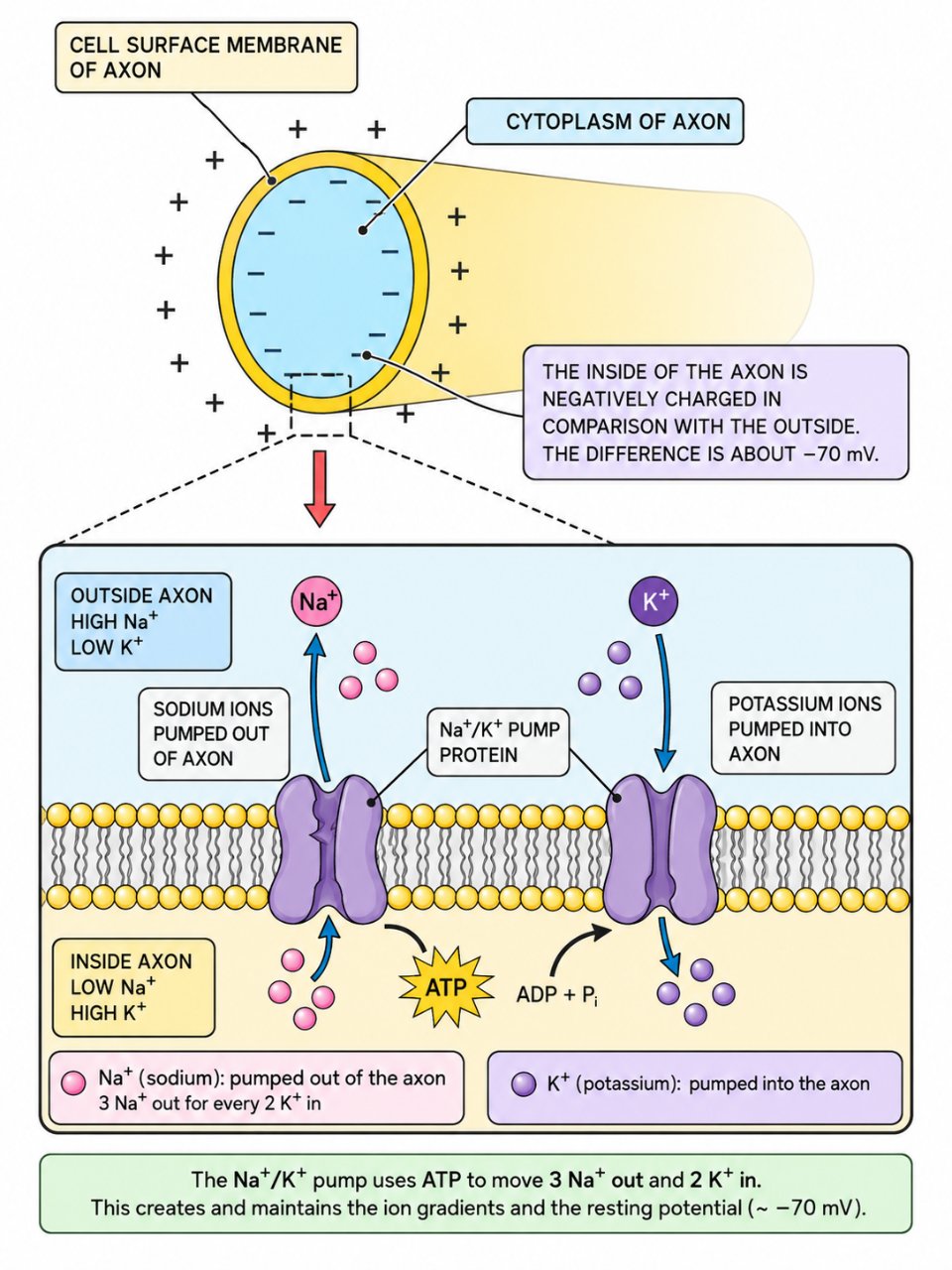
Resting potential
Resting potential the potential difference across the membrane of a neurone that is not transmitting, about -70 mV
- The inside of the axon is negative compared with the outside.
- A membrane at resting potential is polarised.
Sodium-potassium pump
- Sodium-potassium pump uses ATP to move 3 Na+ out and 2 K+ in
- This creates concentration gradients for both ions.
Different permeability
- Different permeability the membrane is much less permeable to Na+ than to K+
- K+ diffuses out faster than Na+ diffuses in, through channels by facilitated diffusion.
- More positive ions are therefore outside than inside.
Negative proteins
- Negative proteins negatively charged proteins inside the axon add to the negative charge
Part 4 of 9Action potential
- Action potential = a momentary reversal of the membrane potential from about -70 mV to about +40 mV
- It is all-or-nothing, so its size does not depend on the stimulus.
1
A stimulus depolarises the membrane locally to the threshold of about -50 mV.
2
Voltage-gated Na+ channels open.
3
Na+ floods in and the inside becomes positive.
4
Na+ channels close and K+ channels open.
5
K+ leaves and the membrane repolarises.
6
The pump restores the resting distribution of ions.
Oscilloscope trace
- Oscilloscope trace shows the rise, the fall and a brief overshoot below the resting level
Propagation
- Propagation local currents depolarise the next section of the axon, so the impulse travels along it
Stimulus strength
- Stimulus strength a stronger stimulus gives more frequent impulses and not bigger ones
| Feature | Resting | Depolarisation | Repolarisation |
|---|---|---|---|
| Membrane potential | About -70 mV | Rises to about +40 mV | Falls back towards -70 mV |
| Channels open | Few leak channels | Voltage-gated Na+ | Voltage-gated K+ |
| Ion movement | Pump maintains gradients | Na+ diffuses in | K+ diffuses out |
| Inside charge | Negative | Positive | Negative again |
| Energy use | ATP for the pump | Passive diffusion | Passive diffusion |
Part 5 of 9Speed of conduction
Myelination
- Schwann cells wrap round the axon in layers of phospholipid membrane
- The lipid has a high electrical resistance, so the sheath insulates the axon.
- Only the gaps called nodes of Ranvier are uninsulated.
- The impulse jumps from node to node by saltatory conduction.
Diameter
- Diameter a wider axon offers less resistance, so it conducts faster
Comparison
- Comparison a giant unmyelinated squid axon up to 1 mm wide is slower than a thin myelinated mammalian axon of 4-100 µm
| Feature | Myelinated | Unmyelinated |
|---|---|---|
| Conduction | Saltatory | Continuous |
| Speed | Fast, up to about 100 m s−1 | Slow, about 1 m s−1 |
| Ion exchange | Only at the nodes | Along the whole length |
| Energy cost | Lower | Higher |
- Measuring speed
- stimulate at one point and record the arrival time at a second point
- Speed = distance between the electrodes divided by the time delay, in m s-1.
Part 6 of 9Analysing correlations
1Correlation
Correlation an association between two variables, which never proves cause
- Scatter graphs show positive, negative or no correlation.
- Squid axon diameter and myelination are variables that can be correlated with speed.
2Pearson's correlation coefficient r
- Pearson's correlation coefficient r for quantitative, normally distributed data, from -1 to +1
- A value near +1 or -1 shows a strong linear correlation and 0 shows none.
- The formula is given in the exam.
Analysing correlations
Plot a scatter graph.
State a null hypothesis that there is no correlation.
Calculate r from the sums of x, y, xy, x2 and y2.
- Coefficient of determination R2
- r squared, expressed as a percentage
- Near 100% means the dependent variable can be predicted accurately from the independent variable.
- Near 0 means no prediction is possible.
Part 7 of 9Synapse structure
Synapse structure
Synapse
Synapse the junction between two neurones, separated by the synaptic cleft
- Where neurones meet they do not touch.
Locations
- Between neurones.
- Between a receptor cell and a sensory neurone.
- Between a motor neurone and a muscle fibre.
Part 8 of 9Synaptic transmission
- Chemical transmission
- the impulse cannot jump the cleft, so it is converted to a chemical signal and back
1
An action potential depolarises the presynaptic membrane.
2
Ca2+ channels open and Ca2+ enters the presynaptic neurone.
3
Vesicles move to the membrane and release acetylcholine by exocytosis.
4
Acetylcholine diffuses across the cleft and binds to receptors on the postsynaptic membrane.
5
Na+ channels open and Na+ enters, depolarising the postsynaptic membrane.
6
If enough acetylcholine binds, the threshold is reached and an action potential travels on.
7
Acetylcholinesterase hydrolyses the acetylcholine to stop the stimulation.
- One-way
- vesicles are only presynaptic and receptors only postsynaptic, so transmission goes one way
Part 9 of 9Acetylcholine and other transmitters
Acetylcholine (ACh)
- Acetylcholine (ACh) made in the presynaptic neurone from choline and an acetyl group
- Synapses that use it are cholinergic.
- Acetylcholinesterase hydrolyses it to choline and acetate.
- The products are absorbed back into the presynaptic neurone and rebuilt into ACh.
Other transmitters
- Other transmitters over 40 are known, such as dopamine and noradrenaline
Neonicotinoids
- Neonicotinoids insecticides that block acetylcholine receptors in insects
Key terms
| Term | Meaning |
|---|---|
| Resting potential | The potential difference across the membrane of a neurone at rest, about -70 mV. |
| Action potential | A brief reversal of the membrane potential from about -70 mV to about +40 mV. |
| Depolarisation | The reversal of the membrane potential as Na+ enters the axon. |
| Saltatory conduction | The jumping of the impulse from one node of Ranvier to the next along a myelinated axon. |
| Synapse | The junction between two neurones, including the synaptic cleft. |
| Neurotransmitter | A chemical released by a presynaptic neurone that crosses the cleft and binds to receptors. |
| Acetylcholinesterase | The enzyme that hydrolyses acetylcholine in the synaptic cleft. |
| Sodium-potassium pump | A pump that uses ATP to move 3 Na+ out and 2 K+ in. |
Avoid these mistakes
1
Saying an impulse is an electric current flowing along the nerve — it is a wave of membrane potential reversal
2
Saying a stronger stimulus gives a bigger impulse — it gives more frequent impulses
3
Saying the impulse jumps across the synapse — a neurotransmitter diffuses across the cleft
4
Saying myelin conducts the impulse — it insulates the axon and the impulse jumps between nodes
Marked practiceQuizzes for this lesson
Last updated:
\n