Movement into and out of Cells
3. Movement into and out of Cells — Cambridge IGCSE Biology 0610 Revision Notes & Topical Questions
5 min read 11 parts Lesson 1 of 4 1 quiz
Curriculum Equation Key قوانين الرقم الهيدروجيني والاتزان الأيوني - pH & Acid-Base Equilibrium FormulasFast Exam Solution
pH = -log[H⁺] | pOH = -log[OH⁻] | pH + pOH = 14 | [H⁺][OH⁻] = 10⁻¹⁴
Word Equation & Conditions: الرقم الهيدروجيني = -لوغاريتم تركيز أيون الهيدروجين | pH + pOH = 14
Location & Specifications: الاتزان الأيوني، كيمياء 3 ثانوي، التحصيلي، و AP Chemistry.
Lesson summary
3. Movement into and out of Cells — IGCSE BIOLOGY notes: Explain diffusion, osmosis and active transport, and predict how cells respond to the solutions around them.Diffusion = the net movement of particles from a region of higher concentration to a region of lower concentration,…
- Passive process
- Partially permeable membrane
- Concentration gradient
- Temperature
- Surface area to volume ratio
- Water potential
Part 1 of 9Diffusion
1Diffusion
Diffusion the net movement of particles from a region of higher concentration to a region of lower concentration, down a concentration gradient,
- as a result of their random movement.
2Passive process
- Passive process it needs no energy from the cell;
- the energy comes from the kinetic energy of random (Brownian) motion.
3Partially permeable membrane
- Partially permeable membrane the cell membrane lets some molecules cross easily and others with difficulty or not at all.
- The simplest selection is by molecule size.
4Uses
- Uses organisms obtain requirements, remove wastes and carry out gas exchange for respiration by diffusion.
Part 2 of 9Examples of diffusion in organisms
| Site | Substance | From | To |
|---|---|---|---|
| Small intestine | Glucose, amino acids, fatty acids, glycerol | Lumen of the intestine | Blood and lymph in the villi |
| Leaf | Oxygen | Air spaces between mesophyll cells | Mitochondria in all cells |
| Leaf | Carbon dioxide | Air spaces between mesophyll cells | Chloroplasts in mesophyll cells |
| Leaf | Water vapour | Stomatal pores | Air outside the stomata |
| Lungs | Oxygen | Alveolar air space | Blood in capillaries around the alveoli |
| Lungs | Carbon dioxide | Blood in capillaries around the alveoli | Alveolar air space |
Part 3 of 9Factors that affect the rate of diffusion
1Concentration gradient
- Concentration gradient the greater the difference across the membrane, the faster the net diffusion.
- More molecules on the high side move across than from the low side.
2Temperature
- Temperature higher temperature gives molecules more kinetic energy, so net diffusion is faster.
3Distance
- Distance the shorter the distance, the faster the diffusion.
- Capillary and alveolar walls are one cell thick.
4Surface area to volume ratio
- Surface area to volume ratio the larger a cell or structure, the smaller its ratio and the slower the exchange.
- Root hair cells and the folded lining of the ileum have increased surface area.
Part 4 of 9Water as a solvent
Transport
- Transport dissolved substances are carried in the xylem, the phloem and the blood.
Digestion
- Digestion dissolved food molecules can be moved from the alimentary canal to cells all over the body.
Excretion
- Excretion urea and excess salts dissolve in water and are removed in urine.
Cytoplasm
- Cytoplasm water is a major part of cytoplasm and allows metabolic reactions to happen.
Part 5 of 9Osmosis
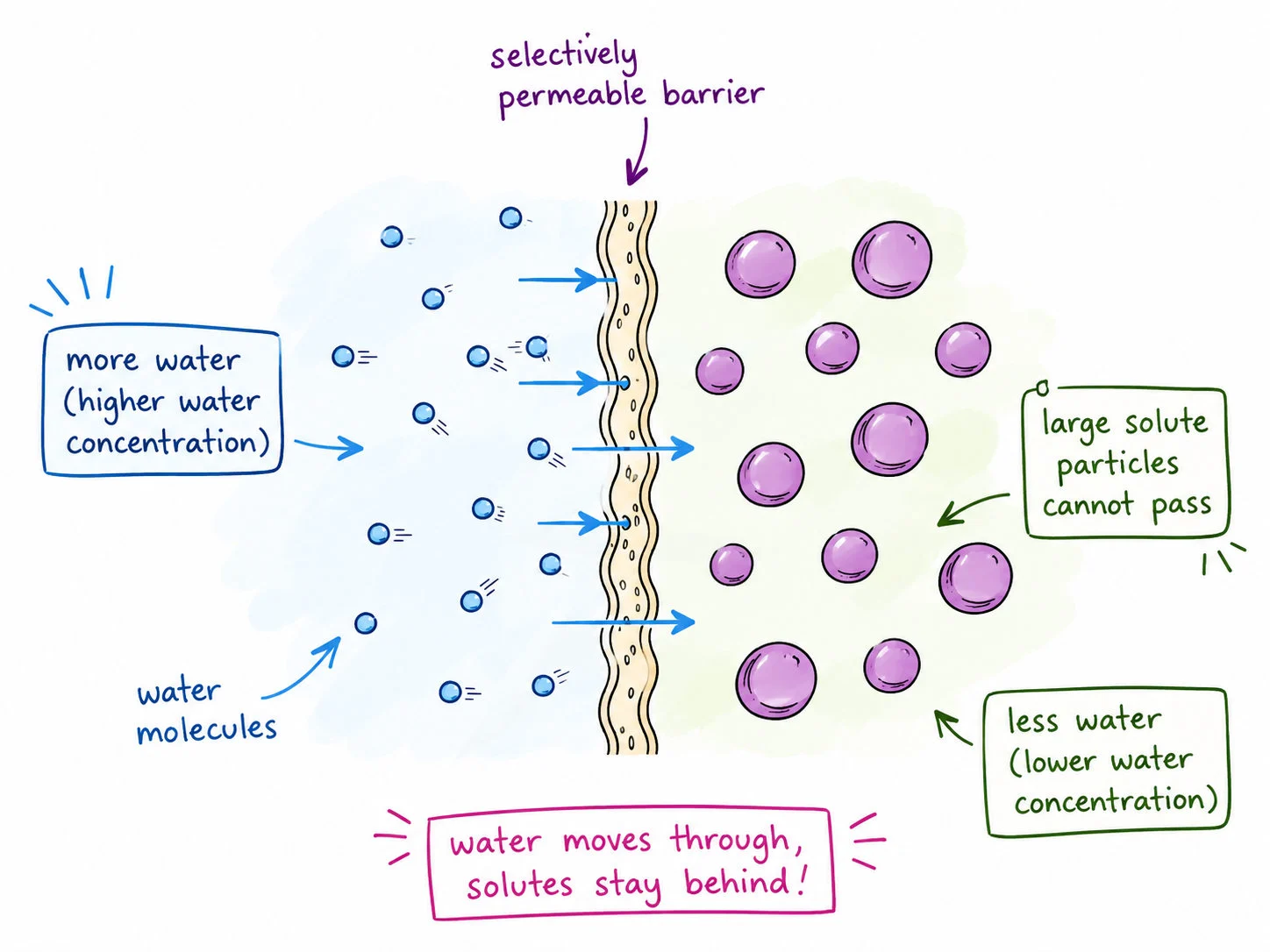
Osmosis
Osmosis the net movement of water molecules from a region of higher water potential (dilute solution) to a region of lower water potential (concentrated solution) through a partially permeable membrane.
Water potential
- Water potential high water potential means a dilute solution with low solute concentration;
- low water potential means a concentrated solution.
Membrane
- Membrane the cell membrane lets small molecules such as water through but not larger solute molecules.
Part 6 of 9Osmosis in plant and animal cells
| Solution outside | Plant cell | Animal cell |
|---|---|---|
| Dilute (higher water potential) | Water enters; vacuole expands and pushes the membrane against the wall; cell becomes turgid and does not burst | Water enters; with no wall, the membrane stretches and the cell bursts |
| Same concentration | No net movement; cell is unchanged | No net movement; cell is unchanged |
| Concentrated (lower water potential) | Water leaves; cell becomes flaccid and may be plasmolysed (membrane pulls away from wall) | Water leaves; cell shrivels (crenation) |
Part 7 of 9Osmosis experiments
1
Cut cylinders of potato (or radish) of identical size and measure the initial mass of each.
2
Place one cylinder in each of distilled water and sucrose solutions of increasing concentration.
3
Leave for the same time (20–30 minutes) at the same temperature.
4
Remove, blot dry to remove surface liquid and reweigh each cylinder.
5
Calculate the percentage change in mass for each solution.
Part 8 of 9Active transport
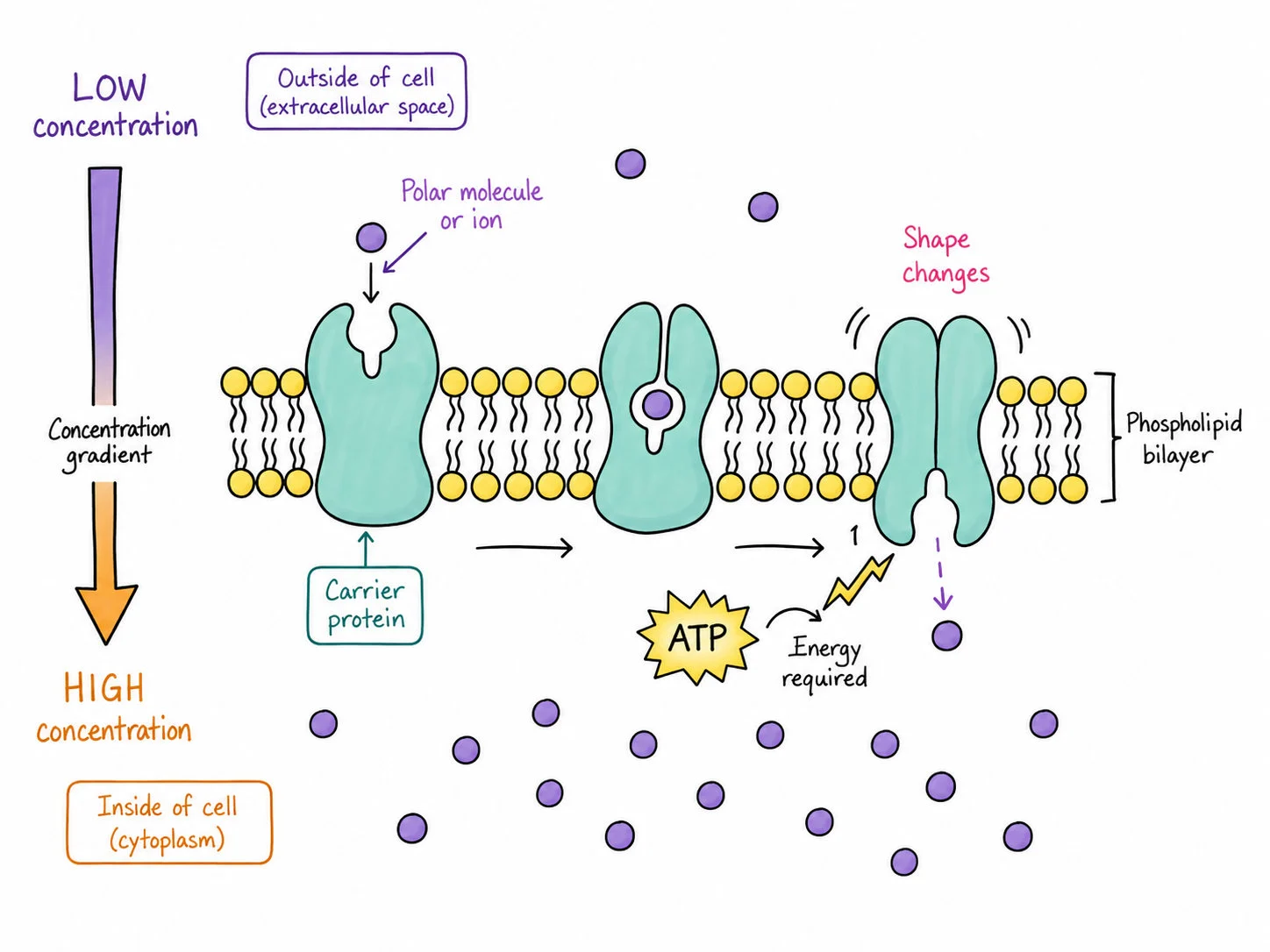
Active transport
Active transport
Active transport the movement of particles through a cell membrane from a region of lower concentration to a region of higher concentration, using energy from respiration.
Energy
- Energy it is needed because particles move against the concentration gradient, opposite to diffusion.
Examples
- Examples uptake of glucose by epithelial cells in the villi and by kidney tubules in the nephron.
- Uptake of mineral ions from soil water by root hair cells.
Cell features
- Cell features cells that actively transport have many mitochondria, and the process slows if respiration or oxygen supply falls.
Part 9 of 9Comparing diffusion, osmosis and active transport
| Feature | Diffusion | Osmosis | Active transport |
|---|---|---|---|
| Particles moved | Any, mainly gases and solutes | Water only | Ions and molecules |
| Direction | Down a concentration gradient | From high to low water potential | Against a concentration gradient |
| Energy from respiration | No | No | Yes |
| Membrane / proteins | Not required | Partially permeable membrane | Carrier proteins in the membrane |
Key terms
| Term | Meaning |
|---|---|
| Diffusion | Net movement of particles down a concentration gradient. |
| Osmosis | Net movement of water through a partially permeable membrane from higher to lower water potential. |
| Active transport | Movement of particles against a concentration gradient using energy from respiration. |
| Turgid | A plant cell full of water, pushing on its cell wall. |
| Flaccid | A plant cell that has lost water and is limp. |
| Plasmolysis | The cell membrane pulling away from the cell wall when water is lost. |
| Crenation | Shrivelling of an animal cell that has lost water by osmosis. |
| Partially permeable membrane | A membrane that lets some molecules through and not others. |
Avoid these mistakes
1
Saying osmosis moves solute — it is the movement of water only.
2
Using concentration of water loosely — use higher or lower water potential, or dilute versus concentrated solution.
3
Thinking active transport works without oxygen — it needs energy from respiration.
4
Believing plant cells burst in dilute solution — the cell wall prevents bursting and the cell becomes turgid.
Topic quiz · 40 questionsQuiz for this lesson
Last updated:
Cambridge 9700 AS Biology
Core Formula
Magnification Triangle & Unit Conversion
Formula: M = I / A ⇔ A = I / M ⇔ I = M × A
Units: 1 mm = 1,000 μm = 1,000,000 nm.
Rule: Convert Image size (ruler mm) to μm by ×1,000 before dividing by Actual size.