3.2Movement into and out of Cells
Osmosis — Cambridge IGCSE Biology 0610 Revision Notes & Topical Questions
5 min read 6 parts Lesson 3 of 4 1 quiz
Lesson summary
Diffusion, osmosis and active transport — IGCSE BIOLOGY notes: Osmosis; Osmosis in plant and animal cells; Investigating osmosis.Osmosis is the net movement of water molecules from a region of higher water potential (dilute solution) to a region of lower water potential (concentr…
- Explaining osmosis
- Turgid cell
- Flaccid and plasmolysed cells
- Percentage change in mass
- Interpreting results
- Where the line crosses 0% change
Section 1 of 6Osmosis
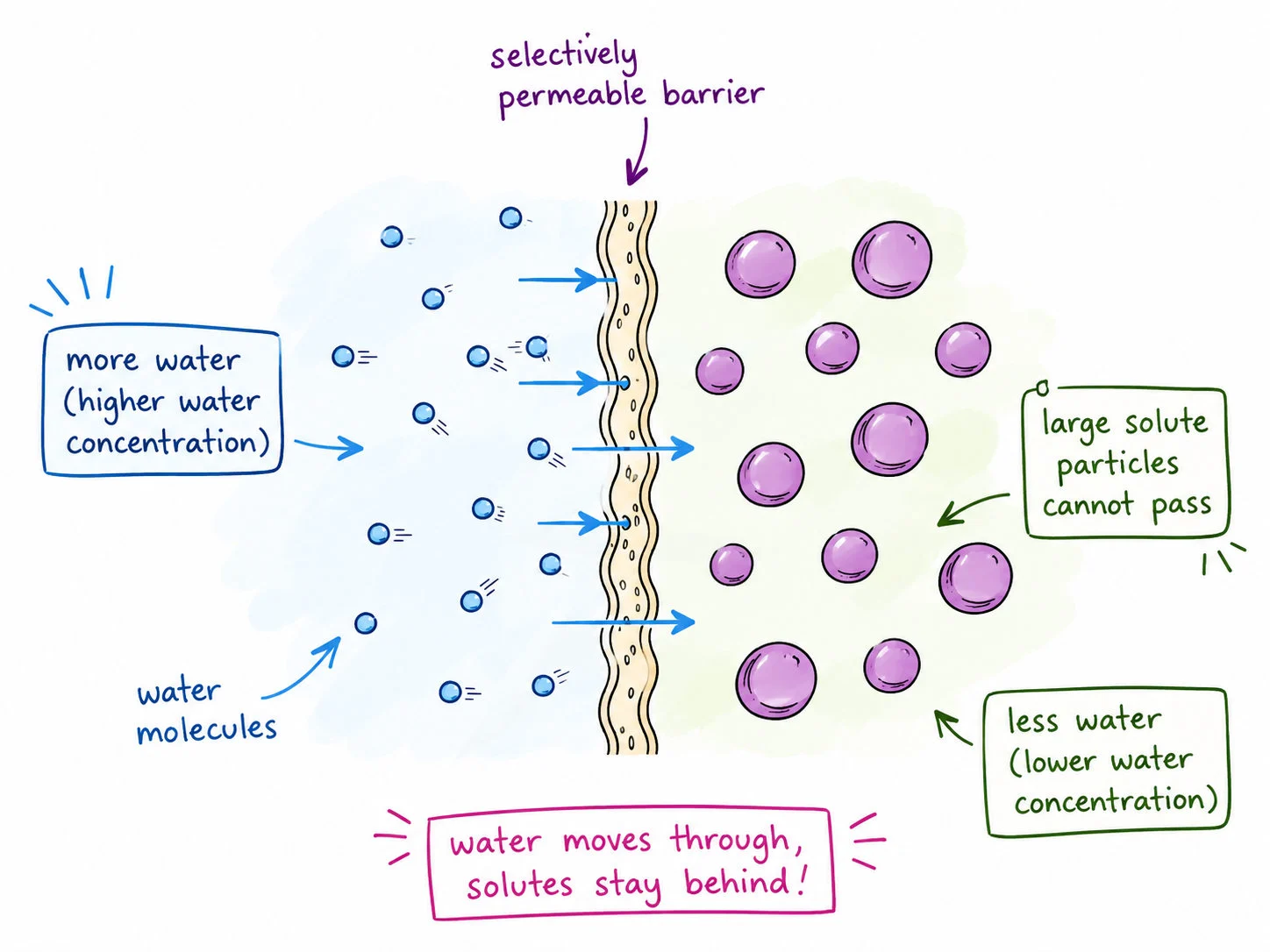
Osmosis
Osmosis is the net movement of water molecules from a region of higher water potential (dilute solution) to a region of lower water potential (concentrated solution), through a partially permeable membrane.
- It is passive — it needs no energy from respiration.
- The membrane lets small water molecules through but not larger solute molecules such as sucrose.
Water potential
(Supplement) is the tendency of water to move.
- Pure water has the highest water potential; a concentrated sugar solution has a low water potential.
- High water potential = dilute solution = low solute concentration.
- Low water potential = concentrated solution = high solute concentration.
Explaining osmosis
- Explaining osmosis refer to water potential, never to "movement of solute".
Section 2 of 6Osmosis in plant and animal cells
| Solution outside compared with the cell | Plant cell | Animal cell |
|---|---|---|
| Higher water potential (dilute, e.g. pure water) | Water enters; the cell becomes turgid; the wall stops it bursting | Water enters; the cell swells and bursts (lysis) as it has no wall |
| Same water potential | No net movement | No net movement |
| Lower water potential (concentrated) | Water leaves; the cell becomes flaccid, then plasmolysed | Water leaves; the cell shrinks (crenation) |
Osmosis in plant and animal cells
Turgid cell
- Turgid cell swollen with water, so the vacuole pushes the membrane against the cell wall.
- Supplementturgor pressure presses the membrane against the inelastic wall and supports the plant.
- The wall resists further water entry and prevents bursting.
Flaccid and plasmolysed cells
- Flaccid and plasmolysed cells in a lower water potential solution the cell loses water.
- A flaccid cell is soft and does not press on the wall, so the plant wilts.
- Supplementin plasmolysis the cytoplasm and membrane pull away from the cell wall.
Blood
- Blood animal cells lack a wall, so the water potential of the blood must be controlled.
Section 3 of 6Investigating osmosis
1
Cut equal-sized cylinders of potato with a cork borer and trim to the same length; blot dry.
2
Measure and record the initial mass of each cylinder with a balance.
3
Place each cylinder in a different sucrose concentration (e.g. 0.0, 0.2, 0.4, 0.6, 0.8 mol/dm3), with the same volume and temperature.
4
Leave for the same time (20–30 minutes).
5
Remove, blot gently to remove surface solution, and reweigh.
6
Calculate the percentage change in mass and plot it against concentration.
1Percentage change in mass
(final mass − initial mass) ÷ initial mass × 100, in %.
2Interpreting results
- Interpreting results the mass change shows the direction of water movement.
- Mass gain — water entered the tissue, so the solution was more dilute.
- Mass loss — water left the tissue, so the solution was more concentrated.
- No change — no net movement, so the water potentials are equal (water still moves in both directions equally).
3Where the line crosses 0% change
- Where the line crosses 0% change the solution has the same water potential as the potato cells.
4Visking (dialysis) tubing
Visking (dialysis) tubing models a partially permeable membrane.
- Tubing filled with sucrose solution and placed in water: water enters by osmosis and the level in an attached tube rises.
- The pores let water and glucose through but not large molecules such as sucrose.
Section 4 of 6More from the specification
More from the specification
Osmotic Water Uptake in Plants
- Water moves down a water potential gradient from a dilute external solution into plant root hair cells across selectively permeable plasma membranes.
Water Absorption in the Intestine
- Osmotic gradients across the epithelial lining of the small intestine and colon facilitate the rapid absorption of water and dissolved minerals into the bloodstream.
Investigating Osmosis in Plant Tissues
- Controlled laboratory investigations using potato cylinders in varying sucrose concentrations determine the internal tissue water potential when no net mass change occurs.
Organism
- A living thing, such as a plant or an animal.
Gradient
- A difference in concentration.
Solvent
- A liquid, such as water, in which other substances dissolve.
Concentration gradient
- The difference in concentration of a substance between two regions.
Section 5 of 6Key terms
| Term | Meaning |
|---|---|
| Partially permeable membrane | A membrane that allows some molecules through but not others. |
| Osmosis | The net movement of water molecules from a region of higher water potential to a region of lower water potential through a partially permeable membrane. |
| Water potential | A measure of the tendency of water to move; pure water has the highest. |
| Turgid | A plant cell swollen with water, pushing against its cell wall. |
| Flaccid | A plant cell that has lost water and is soft. |
| Plasmolysis | The cytoplasm and membrane pulling away from the cell wall after water loss. |
Section 6 of 6Exam technique
1
Osmosis is the movement of solute — osmosis is the net movement of water through a partially permeable membrane.
2
Water moves from high concentration to low concentration — say from higher water potential (dilute) to lower water potential (concentrated).
3
A plant cell bursts in pure water — it becomes turgid because the cell wall prevents bursting.
4
Diffusion stops when concentrations are equal — particles still move, but there is no net movement.
Marked practiceQuizzes for this lesson
Last updated:
\n