14.5Coordination and Response
Tropic responses — Cambridge IGCSE Biology 0610 Revision Notes & Topical Questions
20 min read 40 parts Lesson 5 of 5 1 quiz
Lesson summary
14.5 Tropic responses — IGCSE BIOLOGY notes: Describe gravitropism and phototropism in shoots and roots, the experiments that investigate them, and the role of auxin.Tropism — a plant growth response towards (positive) or away from (negative) a stimulus.Plant responses are usuall…
- Cell elongation
- Unequal distribution
- Phototropism of a shoot
- Gravitropism of a shoot
- Gravitropism of a root
- Synthetic plant hormones
Section 1 of 40Tropisms
Tropism
- Tropism a plant growth response towards (positive) or away from (negative) a stimulus.
- Plant responses are usually much slower than animal responses.
Gravitropism
- Gravitropism growth towards or away from gravity.
Phototropism
- Phototropism growth towards or away from the direction of the light source.
Section 2 of 40Responses of shoots and roots
| Part | Phototropism | Gravitropism |
|---|---|---|
| Shoot | Positive (towards light) | Negative (away from gravity) |
| Root | Negative (away from light) | Positive (towards gravity) |
Shoots
- Shoots grow up towards light so the leaves can absorb sunlight.
Roots
- Roots grow down into the soil to anchor the plant and absorb water and minerals.
Section 3 of 40Investigating phototropism
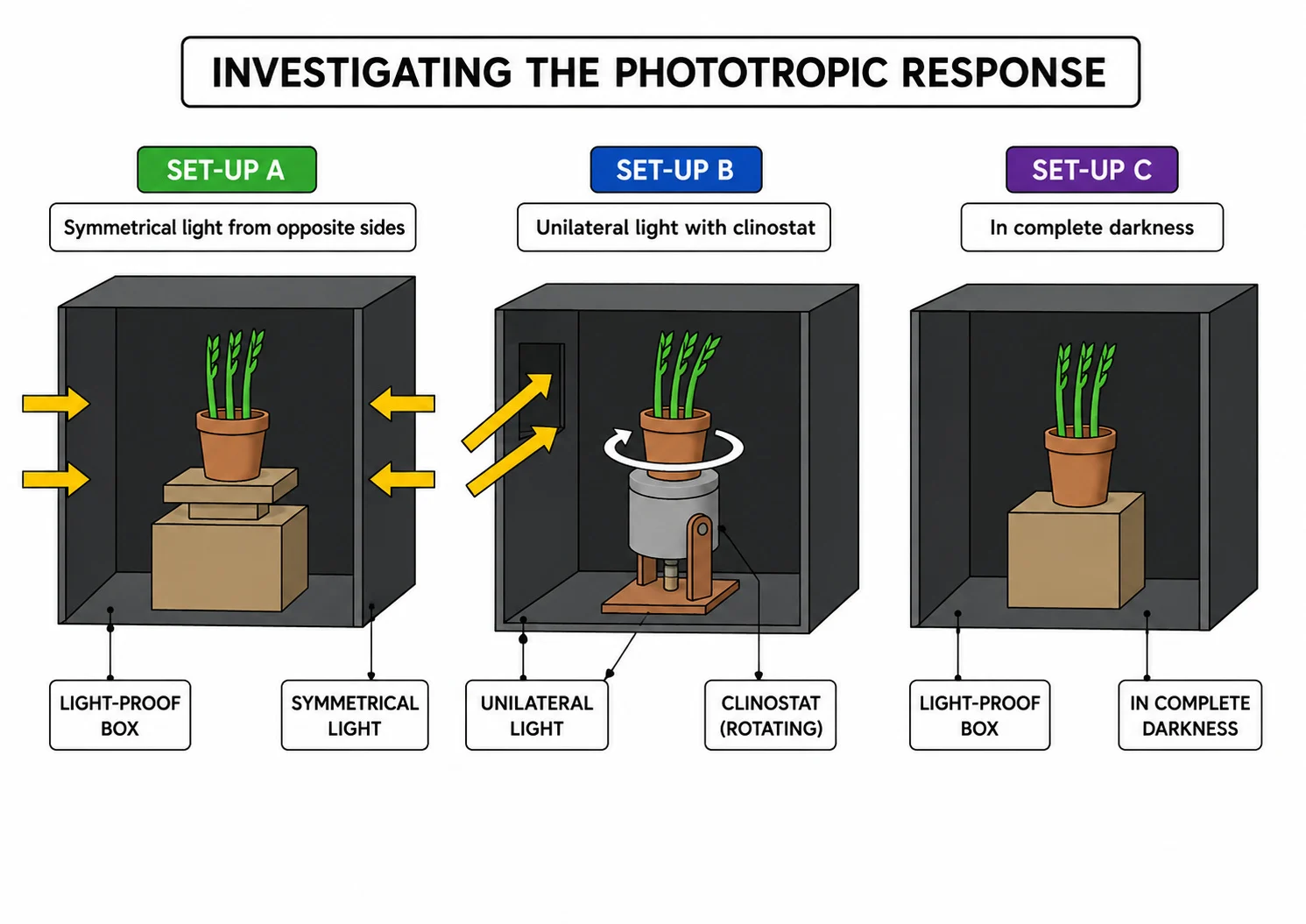
1
Set up three identical seedlings: A lit from one side, B on a clinostat, C in darkness.
2
The seedlings in A grow towards the light source.
3
A clinostat slowly rotates the plant, so all sides receive equal light and B grows straight up.
4
The seedlings in C grow straight up, tall and slender with yellowing leaves, because there is no light.
Section 4 of 40Investigating gravitropism
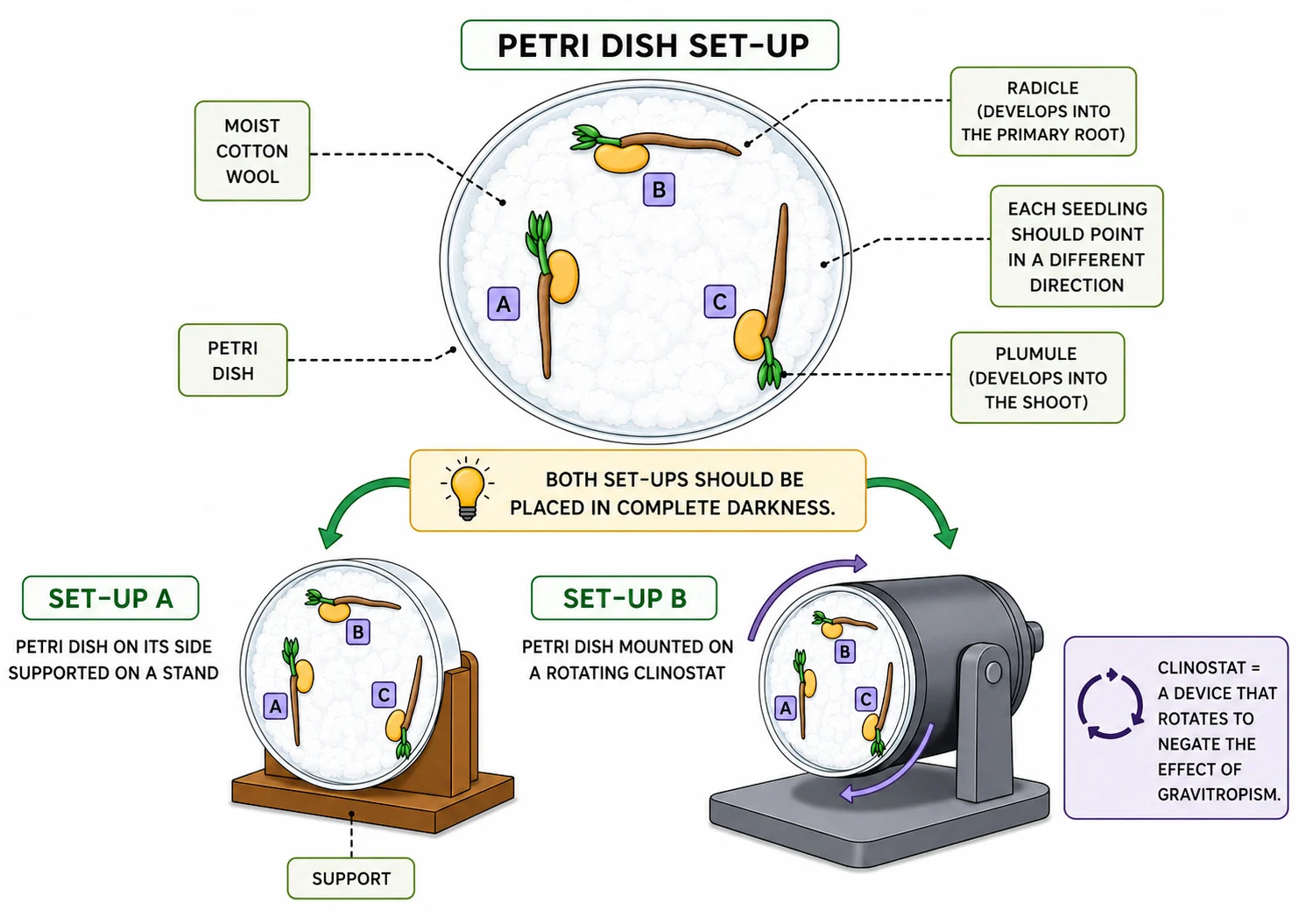
1
Place damp cotton wool in two petri dishes.
2
Put three bean seedlings in each dish with the radicle pointing down, horizontal and up.
3
Fix one dish on its side and attach the other to a clinostat.
4
Keep both in a light-proof box for two days, so light does not affect growth.
5
Fixed dish: all roots grow down and all shoots grow up, whatever their starting position.
6
Clinostat dish: gravity acts evenly, so roots and shoots grow straight outwards with no response.
Section 5 of 40Auxin and the control of shoot growth
Auxin
- Auxin a plant growth hormone made in the tips of growing shoots and roots.
- Auxin diffuses from the tip to regions behind the tip.
Cell elongation
- Cell elongation auxin makes cells behind the tip grow longer, and more auxin means faster elongation.
Unequal distribution
- Unequal distribution auxin spreads unevenly in response to light and gravity.
- Growth is by cell elongation, not by making new cells.
Section 6 of 40Auxin in phototropism and gravitropism
Phototropism of a shoot
- Phototropism of a shoot with light from one side, auxin collects on the shaded side.
- Cells on the shaded side elongate faster, so the shoot bends towards the light.
Gravitropism of a shoot
- Gravitropism of a shoot auxin collects on the lower side, which elongates faster, so the shoot grows upwards.
Gravitropism of a root
- Gravitropism of a root a high auxin concentration inhibits elongation.
- The lower side grows more slowly than the upper side, so the root bends downwards.
Section 7 of 40Tip experiments
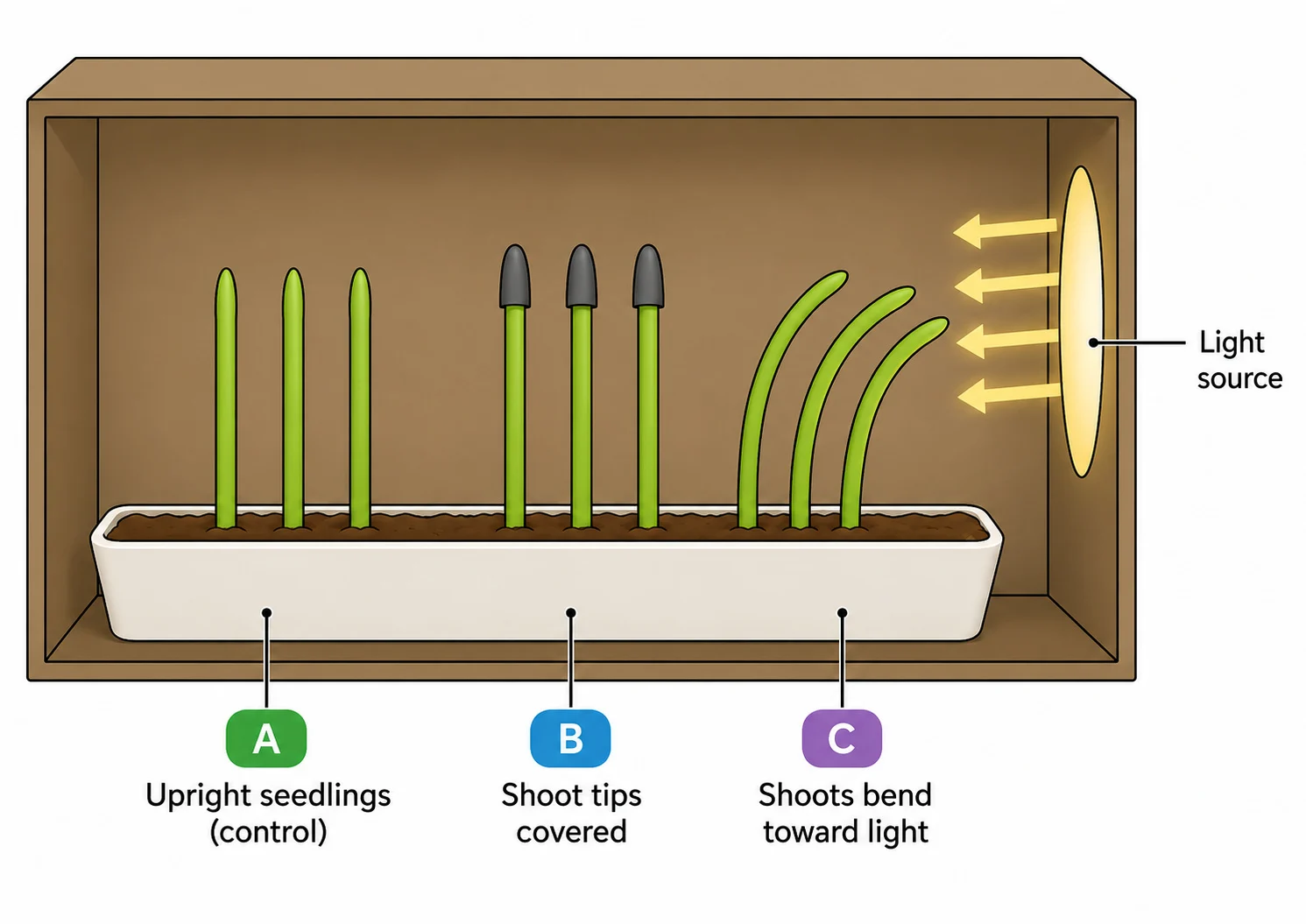
| Seedling | Treatment | Result |
|---|---|---|
| A | Tip removed | No auxin is made, so the stem does not grow longer |
| B | Light reaches the tip evenly | Auxin is equal on both sides, so the stem grows evenly |
| C | Light reaches one side of the tip | More auxin on the shaded side, so that side grows faster and the stem bends to the light |
- Synthetic plant hormones
- some, such as 2,4-D, are used as weedkillers.
Section 8 of 40More from the specification
1Motor neurone
- Neurone carrying impulses from the CNS to effectors.
2Radial muscle
- Iris muscle that widens the pupil when it contracts.
3Sense organ
- An organ containing groups of receptors.
4Circular muscle
- Iris muscle that narrows the pupil when it contracts.
5Asymmetric Auxin Distribution in Phototropism
- Auxin synthesized at the shoot apex migrates towards the shaded side of the stem, stimulating cellular elongation and causing the shoot to bend towards the unidirectional light source.
6Gravitropism Mechanisms in Shoots and Roots
- Gravity causes auxin accumulation on the lower side of organs; in shoots, this stimulates faster elongation for upward growth,
- (negative gravitropism)
- whereas in roots, high auxin concentrations inhibit elongation for downward growth.
- (positive gravitropism)
7Adaptive Significance of Plant Tropisms
- Directional growth responses ensure that photosynthetic shoots maximize incident light capture while root systems penetrate deep subterranean soil layers for water and mineral anchors.
8Homeostasis
- The maintenance of a constant internal environment.
9Retina
- Layer of the eye containing light receptors.
10Synapse
- A junction between two neurones where an impulse passes by neurotransmitter diffusing across a gap.
11Pupil reflex
- Change in pupil diameter in response to light intensity.
12Ciliary muscle
- Muscle that changes the tension on the lens.
13Suspensory ligaments
- Fibres that connect the ciliary muscle to the lens.
14Negative feedback
- A mechanism in which a change from the set point triggers a response that returns the factor to the set point.
15Muscle cell
- Mitochondria
16Glucose
- A simple sugar; the unit that starch, glycogen and cellulose are built from.
17Neurone
- A nerve cell that carries electrical impulses.
18Reflex
- Rapid, involuntary and automatic response to a stimulus.
19Insulin
- A pancreatic hormone that lowers blood glucose.
20Control
- A test on distilled water used for comparison.
Section 9 of 40More from the specification
- Temperature
- Increases, as water evaporates faster
Section 10 of 40Tropisms
Tropism
- Tropism a directional growth response of a plant to a directional stimulus.
- Growth towards the stimulus is a positive tropism.
- Growth away from the stimulus is a negative tropism.
Plants cannot move from place to place but can change the direction of growth.
Speed
- Speed tropisms are produced by growth, so they are slower than animal reflexes.
Control
- Control tropisms are controlled by chemicals, since plants have no nervous system.
Section 11 of 40Phototropism and gravitropism compared
| Tropism | Stimulus | Shoot response | Root response |
|---|---|---|---|
| Phototropism | Light from one side | Positive: grows towards light | Negative or no response |
| Gravitropism (geotropism) | Gravity | Negative: grows upward | Positive: grows downward |
- A seed planted upside down still turns its shoot upward and its root downward.
Section 12 of 40Survival value
Shoots
- Shoots bending towards light displays the leaves in the best position for photosynthesis and growth.
Roots
- Roots growing downwards finds water and mineral ions and anchors the plant.
Seedlings
- Seedlings a seedling germinating underground grows upward in the dark and reaches the surface.
Section 13 of 40Where the response happens
Detection
- Detection the tip of the shoot detects light direction.
- (the coleoptile in a grass seedling)
Bending
- Bending the region just below the tip is where cells elongate.
Roots
- Roots the tip detects gravity and the zone of elongation behind it responds.
Section 14 of 40Investigating tropisms
1
Germinate seedlings on damp cotton wool in identical conditions.
2
Place one set in a box with a window on one side, and a control set lit evenly or on a clinostat.
3
For gravitropism, lay seedlings horizontally and compare them with upright controls kept in the dark.
4
After a few days observe the direction of shoots and roots and measure the angles of bending.
5
Keep temperature, water and seedling age constant so only the stimulus differs.
Section 15 of 40Other tropisms and etiolation
Hydrotropism
- Hydrotropism growth of roots towards water.
Thigmotropism
- Thigmotropism growth in response to touch, as when pea tendrils coil round a support.
Nastic responses
- Nastic responses non-directional responses, such as a Venus fly trap closing.
Etiolation
- Etiolation a plant in a dark cupboard grows tall, thin and pale as it searches for light.
Section 16 of 40More from the specification
1
Auxin Distribution in Plant Tropisms
- Auxin accumulates on the lower or shaded sides of plant organs, promoting elongation in shoots and inhibiting elongation in root cells.
2
Reflex Action Effector Pathways
- In animals, motor neurones transmit nerve impulses to effector muscles to bring about rapid motor actions.
- (e.g., iris sphincter muscles in the pupil reflex)
3
Homeostatic Control of Blood Glucose
- The pancreas continuously monitors blood glucose levels, secreting insulin to stimulate glycogenesis and maintain homeostatic equilibrium.
4
Signaling Dynamics
- Chemical vs Electrical — Nerve impulses along neurones provide instant localized control,
- whereas hormones like insulin or auxin mediate broader, sustained physiological responses.
5
Motor neurone
- Neurone carrying impulses from the CNS to effectors.
6
Radial muscle
- Iris muscle that widens the pupil when it contracts.
7
Sense organ
- An organ containing groups of receptors.
8
Circular muscle
- Iris muscle that narrows the pupil when it contracts.
9
Homeostasis
- The maintenance of a constant internal environment.
10
Retina
- Layer of the eye containing light receptors.
11
Synapse
- A junction between two neurones where an impulse passes by neurotransmitter diffusing across a gap.
12
Pupil reflex
- Change in pupil diameter in response to light intensity.
13
Ciliary muscle
- Muscle that changes the tension on the lens.
14
Suspensory ligaments
- Fibres that connect the ciliary muscle to the lens.
15
Negative feedback
- A mechanism in which a change from the set point triggers a response that returns the factor to the set point.
16
Muscle cell
- Mitochondria
17
Glucose
- A simple sugar; the unit that starch, glycogen and cellulose are built from.
18
Neurone
- A nerve cell that carries electrical impulses.
19
Insulin
- A pancreatic hormone that lowers blood glucose.
20
Hormone
- A chemical substance produced by a gland and carried by the blood that alters the activity of specific target organs.
Section 17 of 40Auxin
Auxin
- Auxin a plant growth regulator (hormone) made in the tips of shoots and roots.
- It spreads from the tip by diffusion to regions behind the tip.
Effect
- Effect it stimulates cells behind the tip to elongate, and more auxin means faster elongation.
Elongation
- Elongation growth is an increase in cell length, not cell division.
Chemical messenger
- Chemical messenger auxin is the messenger of tropisms.
Section 18 of 40Opposite effects in shoots and roots
Shoots
- Shoots auxin promotes cell elongation.
Roots
- Roots a high concentration inhibits elongation.
This difference explains why shoots and roots respond oppositely to gravity.
Section 19 of 40Auxin and phototropism in the shoot
1
Light shines from one side of the shoot.
2
Auxin moves to the shaded side of the shoot.
3
The shaded side has a higher auxin concentration.
4
Cells on the shaded side elongate more than cells on the lit side.
5
The shoot bends towards the light.
- Uniform light from above, or a clinostat, gives equal auxin distribution and the shoot grows straight up.
Section 20 of 40Auxin and gravitropism
| Organ | Auxin when horizontal | Effect on lower side | Result |
|---|---|---|---|
| Shoot | More on the lower side | Growth stimulated | Bends upward |
| Root | More on the lower side | Growth inhibited | Bends downward |
Auxin and gravitropism
Gravity causes auxin to accumulate on the lower side in both organs.
In a horizontal root the upper side, with less auxin, grows more, so the root curves downward.
Section 21 of 40Agar block evidence
1
Cut off coleoptile tips and place them on agar blocks for a time.
2
The blocks absorb auxin from the tips.
3
Place a block off-centre on a decapitated coleoptile in the dark.
4
The coleoptile bends away from the side with the block because cells below it elongate more.
5
A block that never touched a tip causes no bending, so the effect is due to a substance made in the tip.
Section 22 of 40Mica barrier evidence
Mica barrier evidence
A mica barrier that blocks movement across the tip prevents redistribution of auxin, so there is no bending.
It is the concentration of auxin, not auxin production, that differs between the two sides.
Section 23 of 40Uses of auxin
Weedkillers
- Weedkillers synthetic auxins make broad-leaved weeds grow too fast and die, leaving narrow-leaved crops such as wheat.
Rooting powder
- Rooting powder cuttings dipped in auxin grow roots faster.
Fruit growth
- Fruit growth sprays can produce seedless fruit and delay or promote ripening.
Section 24 of 40More from the specification
More from the specification
Tropic Growth Responses in Plants
- Plants navigate environmental stimuli through auxin-mediated tropisms,
- producing directional growth changes in roots and shoots without involving nerve cells or muscle tissues.
Reflex Arcs in Animals
- Reflex arcs in the animal nervous system provide rapid, protective responses using sensory, relay,
- and motor neurones to transmit electrical impulses to effector muscles.
Protective Pupil Reflex
- The pupil reflex regulates retinal light exposure through the involuntary contraction and relaxation of antagonistic iris muscles, shielding photoreceptor cells from excessive light levels.
Physiological Homeostatic Systems
- The mammalian nervous system works in conjunction with endocrine glands to monitor and maintain steady internal body temperature and circulating blood glucose levels.
Motor neurone
- Neurone carrying impulses from the CNS to effectors.
Radial muscle
- Iris muscle that widens the pupil when it contracts.
Sense organ
- An organ containing groups of receptors.
Circular muscle
- Iris muscle that narrows the pupil when it contracts.
Homeostasis
- The maintenance of a constant internal environment.
Retina
- Layer of the eye containing light receptors.
Synapse
- A junction between two neurones where an impulse passes by neurotransmitter diffusing across a gap.
Pupil reflex
- Change in pupil diameter in response to light intensity.
Ciliary muscle
- Muscle that changes the tension on the lens.
Suspensory ligaments
- Fibres that connect the ciliary muscle to the lens.
Negative feedback
- A mechanism in which a change from the set point triggers a response that returns the factor to the set point.
Muscle cell
- Mitochondria
Glucose
- A simple sugar; the unit that starch, glycogen and cellulose are built from.
Neurone
- A nerve cell that carries electrical impulses.
Reflex
- Rapid, involuntary and automatic response to a stimulus.
Insulin
- A pancreatic hormone that lowers blood glucose.
Section 25 of 40Classic coleoptile experiments
| Treatment | Result | Conclusion |
|---|---|---|
| Tip removed, light from one side | No bending | The tip is needed |
| Tip covered with an opaque cap | No bending | The tip detects light |
| Base covered, tip exposed | Bends towards light | The bending region is below the tip |
| Mica sheet on the shaded side of the tip | No bending | A substance moves down the shaded side |
| Agar jelly between tip and shoot | Bends | The substance passes through jelly |
Section 26 of 40History of the evidence
1Darwin
- Darwin showed that the tip senses light.
2Boysen-Jensen
- Boysen-Jensen showed that a chemical passes through a gelatin block but not through mica.
3Went
- Went collected the chemical in agar and showed it caused bending.
Section 27 of 40Planning a valid investigation
1
State the question, for example whether gravity affects root direction.
2
Identify the independent variable (direction of stimulus) and the dependent variable (angle of curvature).
3
Control temperature, water and seedling age.
4
Use a number of seedlings and calculate a mean angle.
5
Include a control, such as an upright seedling or one on a clinostat.
6
Measure the angle with a protractor at regular intervals.
- To exclude light effects in a gravitropism experiment, carry it out in the dark.
Section 28 of 40Applications in the field
1Seedling emergence
- Seedling emergence shoots grow upward through soil in darkness because of negative gravitropism.
2Windowsill plants
- Windowsill plants lean towards the window because of phototropism, and rotating pots gives even growth.
3Crops flattened by storms
- Crops flattened by storms shoots bend upward again by negative gravitropism.
4Greenhouses
- Greenhouses lamps placed above plants encourage upright, even growth.
Section 29 of 40Observations and explanations
| Observation | Explanation |
|---|---|
| Shoots curve towards a window | More auxin on the shaded side, so greater elongation there |
| Roots grow down even in darkness | Gravity makes auxin collect on the lower side, which inhibits root elongation |
| Seedlings on a slowly rotating clinostat grow straight | Rotation spreads the stimulus evenly, so growth is equal |
| Plants in a dark cupboard are long and pale | Shoots elongate to reach light but make no chlorophyll without it |
Section 30 of 40Plant and animal responses compared
Plant tropisms
- Plant tropisms slower, controlled by hormones, and result in growth.
Animal responses
- Animal responses often rapid, using nerves, and result in movement by muscles.
Section 31 of 40More from the specification
1
Sensory reception contrasting with sense organs
- Sensory reception contrasting with sense organs plants lack specialised animal sense organs, utilizing differential auxin distribution to respond directionally to light and gravity.
2
Auxin distribution and differential elongation
- Auxin accumulates on the shaded side of shoot tips, stimulating cellular elongation so that stems grow towards unilateral light.
3
Gravitropism in roots and shoots
- Gravity causes auxin to settle on the lower side;
- high auxin concentrations promote growth in shoots but inhibit cell elongation in roots.
4
Comparison of nervous vs plant hormonal control
- While animals coordinate responses via electrical impulses in neurones and reflex arcs, plants rely on slower chemical diffusion of auxin.
5
Reflex arc pathway
- Reflex arc pathway sensory neurones transmit rapid electrical impulses to spinal relay neurones without conscious brain intervention.
6
Blood glucose regulation
- Blood glucose regulation pancreas detects circulating glucose levels, secreting insulin or glucagon to maintain homeostasis.
7
Auxin cell elongation
- Auxin cell elongation plant shoot cells elongate on the shaded side under auxin stimulation to achieve phototropic bending.
8
Motor neurone
- Neurone carrying impulses from the CNS to effectors.
9
Radial muscle
- Iris muscle that widens the pupil when it contracts.
10
Sense organ
- An organ containing groups of receptors.
11
Circular muscle
- Iris muscle that narrows the pupil when it contracts.
12
Homeostasis
- The maintenance of a constant internal environment.
13
Retina
- Layer of the eye containing light receptors.
14
Synapse
- A junction between two neurones where an impulse passes by neurotransmitter diffusing across a gap.
15
Pupil reflex
- Change in pupil diameter in response to light intensity.
16
Ciliary muscle
- Muscle that changes the tension on the lens.
17
Suspensory ligaments
- Fibres that connect the ciliary muscle to the lens.
18
Negative feedback
- A mechanism in which a change from the set point triggers a response that returns the factor to the set point.
19
Muscle cell
- Mitochondria
20
Glucose
- A simple sugar; the unit that starch, glycogen and cellulose are built from.
21
Neurone
- A nerve cell that carries electrical impulses.
22
Reflex
- Rapid, involuntary and automatic response to a stimulus.
23
Insulin
- A pancreatic hormone that lowers blood glucose.
Section 32 of 40Tropisms
1Tropism
- Tropism a directional growth response of a plant to a stimulus.
2Phototropism
- Phototropism response to light.
3Gravitropism (geotropism)
- Gravitropism (geotropism) response to gravity.
4Positive and negative
- Positive and negative growth towards the stimulus is positive and away is negative.
Section 33 of 40The role of auxin
Auxin
- Auxin a plant growth hormone made in the tips of shoots and roots that controls cell elongation.
Light from one side
- Light from one side auxin moves to the shaded side of the shoot.
- Higher auxin concentration on the shaded side makes those cells elongate more.
- The shoot bends towards the light.
Horizontal shoot
- Horizontal shoot auxin accumulates on the lower side and promotes growth there, so the shoot bends upward.
Root
- Root a high auxin concentration inhibits elongation, so the lower side grows less and the root bends downward.
Section 34 of 40Evidence from experiments
1Tip removed
- Tip removed there is no bending, because the source of auxin is lost.
2Tip covered with foil
- Tip covered with foil there is no bending, because the tip cannot detect light.
3Agar jelly between tip and shoot
- Agar jelly between tip and shoot bending still occurs, showing that a chemical diffuses.
4Mica barrier on the shaded side
- Mica barrier on the shaded side auxin cannot reach the cells, so there is no bending.
Section 35 of 40Site of action
Made in the tip
- Made in the tip auxin is produced at the tip.
Acts behind the tip
- Acts behind the tip it works in the zone of elongation, where cells increase in length by taking up water.
Section 36 of 40Uses of plant hormones
Rooting powder
- Rooting powder synthetic auxin on cuttings makes roots grow.
Selective weedkillers
- Selective weedkillers broad-leaved weeds grow so fast they die.
Seedless fruit
- Seedless fruit fruit grows without fertilisation.
Clinostat
- Clinostat slow rotation removes the one-sided effect of gravity, so shoots grow straight.
Section 37 of 40Survival value
Shoots
- Shoots a bent shoot captures more light for photosynthesis.
Roots
- Roots roots growing downward anchor the plant and find water and minerals.
Section 38 of 40More from the specification
Plant tropisms without sense organs
- Plant tropisms without sense organs plant shoot and root tips lack animal sense organs, relying on asymmetric auxin accumulation to guide directional growth.
Tropisms in Plants vs Nervous Coordination in Animals
- Directional growth tropisms in plants are slow responses mediated by hormonal gradients,
- whereas animal behavioural coordination depends on the nervous system composed of sensory, relay,
- and motor neurones.
Rapid Reflex Actions and Muscle Effectors
- In a spinal reflex arc, an electrical impulse bypasses conscious brain processing to activate effector muscles, triggering rapid protective movements such as the withdrawal reflex or the pupil light constriction reflex.
Endocrine Control of Blood Glucose Levels
- When blood glucose concentration fluctuates, the endocrine system coordinates homeostatic feedback: insulin promotes glucose storage as glycogen,
- while glucagon stimulates glycogen breakdown to elevate circulating glucose levels.
Thermoregulatory Homeostasis in Mammals
- Mammals maintain a stable internal core body temperature via autonomic nervous signals that control skeletal muscle shivering, arteriole vasoconstriction,
- and sweat gland secretion.
Motor neurone
- Neurone carrying impulses from the CNS to effectors.
Radial muscle
- Iris muscle that widens the pupil when it contracts.
Sense organ
- An organ containing groups of receptors.
Circular muscle
- Iris muscle that narrows the pupil when it contracts.
Homeostasis
- The maintenance of a constant internal environment.
Retina
- Layer of the eye containing light receptors.
Synapse
- A junction between two neurones where an impulse passes by neurotransmitter diffusing across a gap.
Pupil reflex
- Change in pupil diameter in response to light intensity.
Ciliary muscle
- Muscle that changes the tension on the lens.
Suspensory ligaments
- Fibres that connect the ciliary muscle to the lens.
Negative feedback
- A mechanism in which a change from the set point triggers a response that returns the factor to the set point.
Muscle cell
- Mitochondria
Glucose
- A simple sugar; the unit that starch, glycogen and cellulose are built from.
Neurone
- A nerve cell that carries electrical impulses.
Reflex
- Rapid, involuntary and automatic response to a stimulus.
Insulin
- A pancreatic hormone that lowers blood glucose.
Section 39 of 40Key terms
| Term | Meaning |
|---|---|
| Tropism | A directional growth response of a plant to a stimulus. |
| Phototropism | Growth towards or away from the direction of light. |
| Gravitropism | Growth towards or away from gravity. |
| Auxin | A plant hormone made in shoot and root tips that controls cell elongation. |
| Clinostat | Apparatus that slowly rotates a plant to cancel the effect of one-sided light or gravity. |
| Cell elongation | Growth in which existing cells become longer. |
| Term | Meaning |
|---|---|
| Tropism | A directional growth response of a plant to a stimulus. |
| Phototropism | Growth in response to the direction of light. |
| Gravitropism | Growth in response to gravity. |
| Positive tropism | Growth towards the stimulus. |
| Negative tropism | Growth away from the stimulus. |
| Etiolation | Tall, thin, pale growth of a plant kept in the dark. |
| Term | Meaning |
|---|---|
| Auxin | A plant growth hormone made in shoot and root tips that controls cell elongation. |
| Cell elongation | Growth by cells becoming longer. |
| Agar | A jelly used to collect and carry diffusing chemicals. |
| Decapitated | With the tip removed. |
| Rooting powder | A powder containing auxin that makes cuttings grow roots. |
| Term | Meaning |
|---|---|
| Coleoptile | The protective sheath around the shoot of a grass seedling. |
| Clinostat | Apparatus that rotates plants slowly to remove one-sided stimulus effects. |
| Control variable | A factor kept constant so only the independent variable changes. |
| Mica | A thin sheet that blocks the movement of chemicals. |
| Gravitropism | Growth in response to gravity. |
| Term | Meaning |
|---|---|
| Tropism | A directional growth response of a plant to a stimulus. |
| Auxin | A plant growth hormone controlling cell elongation. |
| Phototropism | Growth in response to light. |
| Gravitropism | Growth in response to gravity. |
| Hydrotropism | Growth of roots towards water. |
| Selective weedkiller | A synthetic auxin that kills broad-leaved weeds but not narrow-leaved crops. |
Section 40 of 40Exam technique
1
Saying tropic growth is due to cell division — auxin makes existing cells elongate.
2
Saying roots are positively phototropic — roots are negatively phototropic and positively gravitropic.
3
Saying auxin collects on the lit side — it collects on the shaded side.
4
Forgetting the light-proof box in the gravitropism experiment — it removes light as a variable.
1
Saying plants move towards light — they grow towards it, they do not change place.
2
Saying roots show positive phototropism — roots are negatively phototropic or do not respond.
3
Using vague wording like gravity tropism — the correct term is gravitropism or geotropism.
4
Saying the whole shoot detects the stimulus equally — the tip detects it.
1
Saying auxin makes the light side grow faster — the shaded side grows faster.
2
Thinking auxin acts the same way in roots and shoots — high concentrations inhibit roots.
3
Saying auxin is made on the shaded side — it is made in the tip and redistributed.
4
Saying bending is due to unequal cell division — it is due to unequal cell elongation.
1
Not stating control variables — temperature, water and seedling age must be kept constant.
2
Saying one seedling is enough evidence — several seedlings and a mean are needed.
3
Mixing up the detecting region and the responding region — the tip detects and the region below responds.
4
Giving conclusions without evidence — each conclusion must come from the results.
1
Saying auxin is made in the leaves — it is made in the tips of shoots and roots.
2
Saying roots are positively phototropic — they are negatively phototropic or do not respond.
3
Saying light bends the shoot directly — auxin redistribution causes unequal growth.
4
Saying auxin moves to the lit side — it moves to the shaded side.
5
Mixing up positive and negative tropisms — positive is towards the stimulus.
Marked practiceQuizzes for this lesson
Last updated:
\n