17.2Inheritance
Mitosis Core — Cambridge IGCSE Biology 0610 Revision Notes & Topical Questions
10 min read 21 parts Lesson 3 of 9 1 quiz
Lesson summary
17.2 Mitosis — IGCSE BIOLOGY notes: Describe mitosis, its role in growth, repair, replacement and asexual reproduction, and stem cells.Mitosis = nuclear division giving rise to genetically identical cells.Diploid cells — most body cells have two copies of each chromosome.Doubling…
- Doubling beforehand
- Chromosome number
- Daughter cells
- Embryonic stem cells
- Differentiation
- Uncontrolled mitosis
Section 1 of 21What mitosis is
Mitosis
Mitosis nuclear division giving rise to genetically identical cells.
Diploid cells
- Diploid cells most body cells have two copies of each chromosome.
Doubling beforehand
- Doubling beforehand chromosomes copy themselves before division so each new cell is still diploid.
Every body cell except the gametes comes from mitosis of the zygote.
Section 2 of 21Process of mitosis
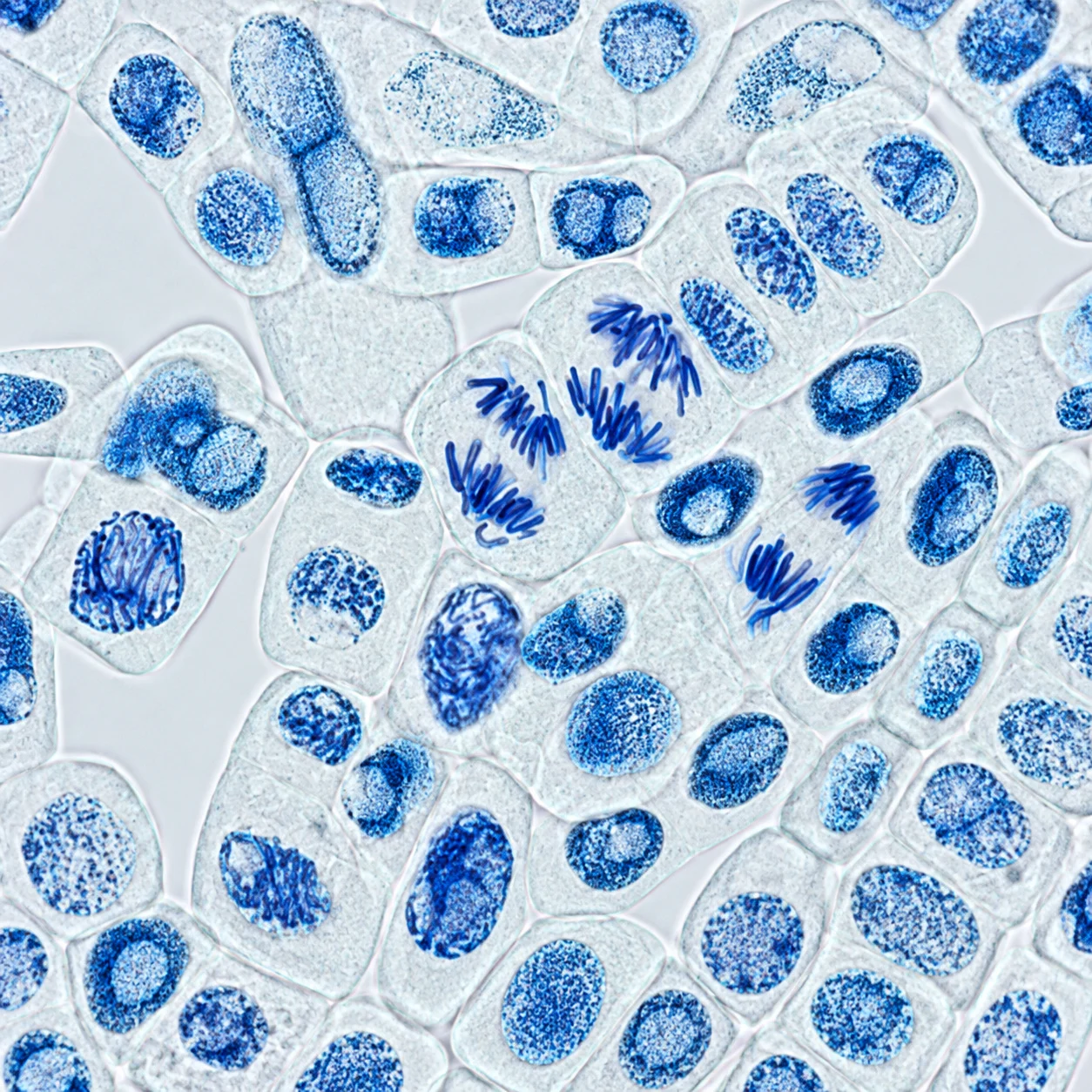
1
Each chromosome in the nucleus copies itself exactly, forming X-shaped chromosomes.
2
The chromosomes line up along the centre of the cell.
3
Cell fibres pull the copies apart.
4
The cell divides into two, each with a copy of every chromosome.
- Chromosome number
- maintained in each daughter cell.
Section 3 of 21Uses of mitosis
Growth
- Growth produces new cells, for example when a zygote divides to form an embryo.
Repair
- Repair replaces damaged or dead cells.
Replacement
- Replacement replaces cells such as skin cells and red blood cells.
Asexual reproduction
- Asexual reproduction produces offspring genetically identical to the parent.
Section 4 of 21Stem cells
Stem cells
- Stem cells unspecialised cells in many tissues that divide by mitosis.
Daughter cells
- Daughter cells can become specialised for specific functions.
Embryonic stem cells
- Embryonic stem cells the zygote divides by mitosis to form a ball of about 150 to 200 unspecialised cells.
Differentiation
- Differentiation these cells begin to specialise as the foetus develops, forming the tissues of the body.
Section 5 of 21More from the specification
1
Replication of nuclear genes
- Replication of nuclear genes precise chromosome replication during interphase ensures identical transmission of genetic genes into daughter cell nuclei.
2
Monohybrid inheritance
- Inheritance of one gene.
3
Exact Duplicate Nuclear Division
- Mitosis produces two genetically identical daughter nuclei with the same diploid chromosome number as the mother cell, essential for organismal growth, tissue repair,
- and asexual propagation.
4
Preservation of Parental Allelic Identity
- Because DNA replication and mitotic segregation occur without crossing over, all daughter cells inherit identical copies of each allele, maintaining phenotypic fidelity across cellular generations.
5
Chromosome Condensation and Metaphase Alignment
- Chromatin condenses into distinct visible chromosomes that align symmetrically along the cellular equatorial plate, guided by microtubules attached to kinetochores.
6
Homozygous
- Having two identical alleles.
7
Sequence
- The order of bases in DNA or amino acids in a protein.
8
Phenotype
- The observable characteristic.
9
Heterozygous
- Having two different alleles.
10
Probability
- The chance that an offspring has a given genotype or phenotype.
11
Punnett square
- A grid predicting offspring genotypes.
12
Blood group
- A phenotype set by alleles I-A, I-B and I-O.
13
Protein synthesis
- Making proteins from amino acids using the DNA code.
14
Allele
- A version of a gene.
15
Inheritance
- Transmission of genetic information from generation to generation.
16
Recessive
- Expressed only when no dominant allele is present.
17
Dominant
- Expressed when present in the genotype.
18
Protein
- A long chain of amino acids containing carbon, hydrogen, oxygen and nitrogen.
19
Meiosis
- Reduction division giving four genetically different haploid cells.
20
Genotype
- The alleles an organism has.
Section 6 of 21Chromosomes and genes
Chromosome
- Chromosome a thread-like structure of DNA in the nucleus that carries genetic information.
Gene
- Gene a length of DNA that codes for a protein.
Diploid body cells
- Diploid body cells human cells have 46 chromosomes in 23 pairs, one of each pair from each parent.
Chromatids
- Chromatids before division DNA is copied so each chromosome is two identical chromatids joined at the centromere.
Section 7 of 21Definition and result
Mitosis
Mitosis nuclear division giving rise to genetically identical daughter cells with the same chromosome number as the parent.
Daughter cells
- Daughter cells two cells from one, each with 46 chromosomes in humans.
Genetic identity
- DNA was copied exactly, so daughter cells match the parent and each other.
Variation
- Variation none is produced, apart from rare mutations.
Section 8 of 21Stages of mitosis
1
Interphase: the cell grows and the DNA is replicated.
2
Prophase: chromosomes become visible as pairs of chromatids and the nuclear membrane breaks down.
3
Metaphase: chromosomes line up along the equator of the cell.
4
Anaphase: spindle fibres pull the chromatids to opposite poles.
5
Telophase: new nuclear membranes form around the two sets of chromosomes.
6
Cytokinesis: the cytoplasm divides, giving two identical diploid cells.
Section 9 of 21The cell cycle
1Cell cycle
- Cell cycle interphase, then mitosis, then cytokinesis.
2Interphase
- Interphase not a resting phase, as the cell also makes extra organelles and proteins.
3Time spent
- Time spent most of a cell's life is in interphase.
4Non-dividing cells
- Non-dividing cells cells that rarely divide, like neurones, stay in a resting state.
5Checkpoints
- Checkpoints ensure DNA has been copied correctly before division proceeds.
6Cytokinesis
- Cytokinesis in plants a new cell plate forms, in animals the membrane pinches in.
Section 10 of 21Observing mitosis in root tips
1
Cut off the tip of a young onion or garlic root, where cells divide rapidly.
2
Place it in warm hydrochloric acid to separate the cells.
3
Put it on a slide and add a stain such as acetic orcein, which colours chromosomes.
4
Cover with a coverslip and press gently to spread one layer of cells.
5
View under a microscope and identify the stage of each cell by the position of the chromosomes.
Section 11 of 21Mitotic index
1Stage length
- Stage length the stage with the most cells is the longest.
2Mitotic index
- Mitotic index the number of cells in mitosis divided by the total number of cells.
3High values
- High values found in rapidly growing tissue and in cancers.
Section 12 of 21More from the specification
1
Monohybrid inheritance and Punnett squares
- Monohybrid inheritance and Punnett squares a Punnett square diagram calculates expected genotype ratios in offspring, determining probabilities for dominant and recessive phenotypes.
2
Recessive allele expression in offspring
- Recessive allele expression in offspring individual offspring exhibit recessive traits such as short stem height only when inheriting two identical non-dominant alleles.
3
Mitotic preservation of parental genes
- Mitotic preservation of parental genes mitosis replicates maternal and paternal alleles identically, ensuring daughter cells retain complete parental gene complements without segregation.
4
Mitosis and genetic consistency
- Mitosis produces two genetically identical diploid daughter cells, essential for growth, tissue repair, and asexual reproduction.
5
Monohybrid inheritance and Punnett squares
- A Punnett square models the segregation of maternal and paternal alleles, predicting genotypic and phenotypic ratios in offspring.
6
Dominant vs recessive alleles
- Dominant alleles are expressed in both homozygous and heterozygous individuals,
- whereas recessive traits only appear in homozygous recessive genotypes.
7
Blood group
- A phenotype set by alleles I-A, I-B and I-O.
8
Protein synthesis
- Making proteins from amino acids using the DNA code.
9
Monohybrid inheritance
- Inheritance of one gene.
10
Homozygous
- Having two identical alleles.
11
Sequence
- The order of bases in DNA or amino acids in a protein.
12
Gamete
- A haploid sex cell.
13
Phenotype
- The observable characteristic.
14
Specific
- Able to act on only one type of substrate.
15
Heterozygous
- Having two different alleles.
16
Probability
- The chance that an offspring has a given genotype or phenotype.
17
Punnett square
- A grid predicting offspring genotypes.
18
Allele
- A version of a gene.
19
Inheritance
- Transmission of genetic information from generation to generation.
20
Recessive
- Expressed only when no dominant allele is present.
21
Dominant
- Expressed when present in the genotype.
22
Meiosis
- Reduction division giving four genetically different haploid cells.
Section 13 of 21Why mitosis is needed
Growth
- Growth a zygote becomes a multicellular organism by repeated mitosis.
Repair
- Repair damaged or dead cells are replaced, for example skin after a cut.
Replacement
- Replacement red blood cells and gut lining cells are constantly renewed.
Asexual reproduction
- Asexual reproduction mitosis produces offspring identical to the parent.
Section 14 of 21Asexual reproduction
Asexual reproduction
Asexual reproduction production of genetically identical offspring from one parent by mitosis.
Examples
- Examples bacteria divide, Hydra and yeast bud, and plants form runners and bulbs.
| Advantage | Disadvantage |
|---|---|
| Only one parent needed | No genetic variation |
| Fast, with many offspring | Disease can wipe out the whole population |
| Good traits are preserved | Cannot adapt to change |
Section 15 of 21Natural clones
| Organism | Method |
|---|---|
| Strawberry plant | Runners grow new plants |
| Potato | Tubers sprout new plants |
| Yeast | Budding |
| Bacteria | Binary fission |
Section 16 of 21Stem cells
Stem cells
- Stem cells unspecialised cells that divide by mitosis and can differentiate into many cell types.
Embryonic stem cells
- Embryonic stem cells can become any cell type.
Adult stem cells
- Adult stem cells for example in bone marrow, are more limited.
Medical uses
- Medical uses replacing damaged tissue and treating blood disorders.
Ethical concern
- Ethical concern using embryos to obtain stem cells.
Section 17 of 21Control of division and cancer
Normal control
- Normal control new cells are made only when needed.
Tumour
- Tumour a mutation in control genes can make cells divide uncontrollably, forming a lump.
Cancer
- Cancer occurs when cells from a malignant tumour spread to other parts of the body.
Risk factors
- Risk factors ultraviolet light, tobacco smoke and some viruses.
Treatment
- Treatment surgery, radiation and chemotherapy; early detection improves survival.
Chemotherapy
- Chemotherapy targets dividing cells, so it also affects hair follicles and skin.
Section 18 of 21Cloning and tissue culture
1Tissue culture
- Tissue culture small pieces of plant tissue grow on sterile nutrient agar with plant hormones, giving many identical plantlets quickly.
2Uses
- Uses propagating rare plants and plants with desirable traits, such as disease-resistant crops.
3Dolly the sheep
- Dolly the sheep the first mammal cloned from an adult cell, by placing the nucleus of a body cell into an egg cell whose nucleus had been removed.
4Benefits
- Benefits uniform crops and preservation of endangered species.
5Risks
- Risks loss of genetic diversity and vulnerability to a single disease.
6Differences between clones
- Differences between clones are due to the environment, since the genotype is the same.
Section 19 of 21More from the specification
1
Chromosomes and Mitotic Replication
- Prior to mitosis, each chromosome replicates its DNA to form two identical sister chromatids;
- during division, chromosomes line up and separate to ensure each daughter cell receives an exact copy of parental genes.
2
Monohybrid Inheritance and Alleles
- Alternative forms of a single gene are known as alleles;
- an individual carrying two identical alleles is homozygous,
- whereas an individual with two different alleles is heterozygous.
3
Punnett Square Genetic Crosses
- A Punnett square is a grid used to determine genotypes and phenotypes of offspring resulting from the combination of maternal and paternal gametes during sexual inheritance.
4
Dominant vs Recessive Phenotypic Expression
- A dominant allele masks the phenotypic effect of a recessive allele; a recessive trait is only expressed phenotypically when an individual is homozygous recessive.
- (such as cystic fibrosis or short height mutations)
5
Chromosomes and Mitotic Replication
- Prior to mitosis, each chromosome replicates its DNA to form two identical sister chromatids;
- during division, chromosomes line up and separate to ensure each daughter cell receives an exact copy of parental genes.
6
Monohybrid Inheritance and Alleles
- Alternative forms of a single gene are known as alleles;
- an individual carrying two identical alleles is homozygous,
- whereas an individual with two different alleles is heterozygous.
7
Punnett Square Genetic Crosses
- A Punnett square is a grid used to determine genotypes and phenotypes of offspring resulting from the combination of maternal and paternal gametes during sexual inheritance.
8
Dominant vs Recessive Phenotypic Expression
- A dominant allele masks the phenotypic effect of a recessive allele; a recessive trait is only expressed phenotypically when an individual is homozygous recessive.
- (such as cystic fibrosis or short height mutations)
9
Chromosomes and Mitotic Replication
- Prior to mitosis, each chromosome replicates its DNA to form two identical sister chromatids;
- during division, chromosomes line up and separate to ensure each daughter cell receives an exact copy of parental genes.
10
Monohybrid Inheritance and Alleles
- Alternative forms of a single gene are known as alleles;
- an individual carrying two identical alleles is homozygous,
- whereas an individual with two different alleles is heterozygous.
11
Punnett Square Genetic Crosses
- A Punnett square is a grid used to determine genotypes and phenotypes of offspring resulting from the combination of maternal and paternal gametes during sexual inheritance.
12
Dominant vs Recessive Phenotypic Expression
- A dominant allele masks the phenotypic effect of a recessive allele; a recessive trait is only expressed phenotypically when an individual is homozygous recessive.
- (such as cystic fibrosis or short height mutations)
13
Blood group
- A phenotype set by alleles I-A, I-B and I-O.
14
Protein synthesis
- Making proteins from amino acids using the DNA code.
15
Monohybrid inheritance
- Inheritance of one gene.
16
Homozygous
- Having two identical alleles.
17
Sequence
- The order of bases in DNA or amino acids in a protein.
18
Gamete
- A haploid sex cell.
19
Phenotype
- The observable characteristic.
20
Heterozygous
- Having two different alleles.
21
Probability
- The chance that an offspring has a given genotype or phenotype.
22
Punnett square
- A grid predicting offspring genotypes.
23
Daughter cell
- Cell produced by cell division.
24
Chromosome
- A thread-like structure of DNA carrying genes.
25
Allele
- A version of a gene.
26
Inheritance
- Transmission of genetic information from generation to generation.
27
Recessive
- Expressed only when no dominant allele is present.
28
Dominant
- Expressed when present in the genotype.
29
Protein
- A long chain of amino acids containing carbon, hydrogen, oxygen and nitrogen.
30
Meiosis
- Reduction division giving four genetically different haploid cells.
Section 20 of 21Key terms
| Term | Meaning |
|---|---|
| Mitosis | Nuclear division giving genetically identical cells. |
| Replication | Exact copying of chromosomes before division. |
| Stem cell | An unspecialised cell that divides and can become specialised. |
| Differentiation | Specialisation of a cell for a function. |
| Diploid | Having two sets of chromosomes. |
| Term | Meaning |
|---|---|
| Mitosis | Nuclear division giving genetically identical cells. |
| Chromatid | One of the two identical copies of a replicated chromosome. |
| Interphase | The stage when the cell grows and DNA is replicated. |
| Cytokinesis | Division of the cytoplasm. |
| Mitotic index | Cells in mitosis divided by total cells. |
| Spindle fibre | A fibre that pulls chromatids to the poles. |
| Term | Meaning |
|---|---|
| Asexual reproduction | Reproduction giving genetically identical offspring from one parent. |
| Stem cell | An unspecialised cell that can divide and differentiate. |
| Tumour | A lump of cells formed by uncontrolled division. |
| Cancer | Disease in which cells divide uncontrollably and spread. |
| Tissue culture | Growing plant cells or tissue on sterile nutrient agar. |
| Clone | A genetically identical organism. |
Section 21 of 21Exam technique
1
Saying mitosis halves the chromosome number — it keeps it the same.
2
Saying the daughter cells are different — they are genetically identical.
3
Saying mitosis makes gametes — meiosis does.
4
Saying chromosomes are copied after division — they are copied before.
1
Saying mitosis halves the chromosome number — daughter cells keep the same number.
2
Saying interphase is a resting phase — DNA is copied and organelles are made.
3
Putting the stages in the wrong order — prophase, metaphase, anaphase, telophase after interphase.
4
Saying DNA is copied after division — it is copied before.
1
Saying mitosis makes gametes — meiosis does.
2
Saying stem cells are already specialised — they are unspecialised.
3
Saying clones have different genes — they share the same genotype.
4
Saying cancer is caused by controlled mitosis — it is uncontrolled cell division.
Marked practiceQuizzes for this lesson
Last updated:
\n