3.3.4Stoichiometry
Pitch and Loudness — Cambridge IGCSE Chemistry 0620 Revision Notes & Topical Questions
5 min read 5 parts Lesson 26 of 28 Unit quiz
Part 1 of 5Pitch and Frequency
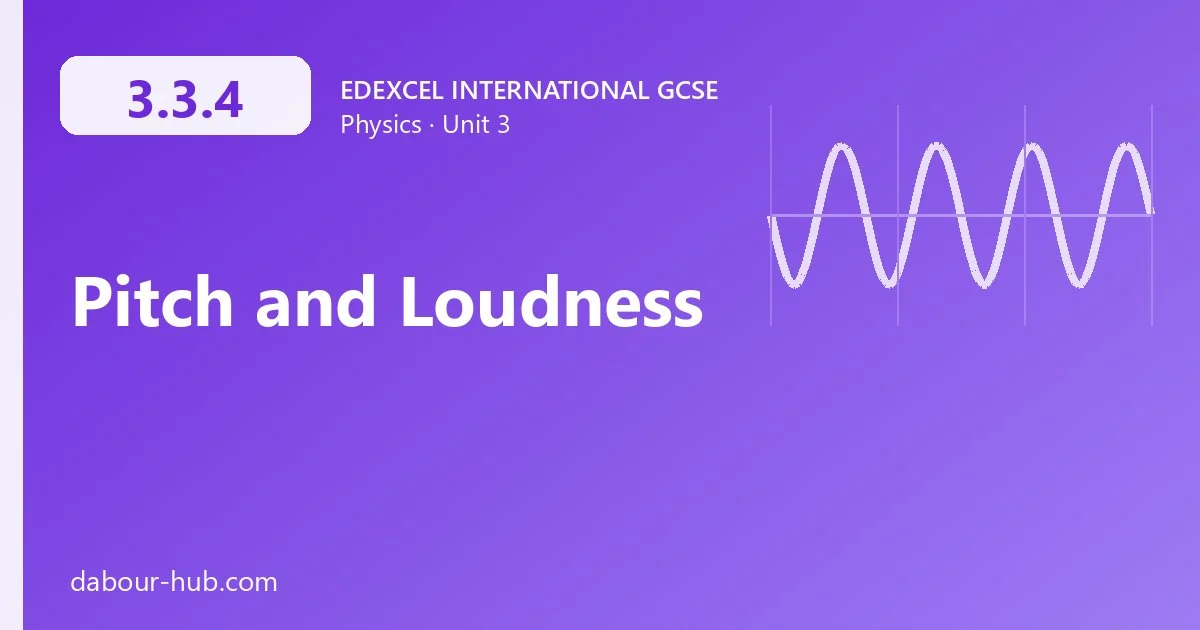
Pitch is how high or low a sound seems to a listener, and it is set by the frequency of the vibrating source.
High pitch
- A sound produced by a high frequency of vibration has a high pitch, such as a whistle or a bird song.
Low pitch
- A sound produced by a low frequency of vibration has a low pitch, such as a large bass drum.
Frequency
- The number of complete waves passing a point each second, measured in hertz (Hz).
Period
- The time for one complete wave to pass a point, found from T = 1 ÷ f and measured in seconds.
Part 2 of 5Loudness and Amplitude
Loudness depends on the amplitude of the wave, which is the maximum displacement from the rest position.
Loudness and Amplitude
Loudness
- The loudness of a sound is related to the amplitude of the vibrations that produce it.
Large amplitude
- A large amplitude gives a loud sound because the vibrating source moves through a greater distance.
Small amplitude
- A small amplitude gives a quiet sound, and changing it does not alter the pitch of the note.
Oscilloscope
- On an oscilloscope amplitude is shown as the height of the trace and the period as horizontal distance.
| Change to the wave | Effect on pitch | Effect on loudness |
|---|---|---|
| Higher frequency | Higher | No change |
| Lower frequency | Lower | No change |
| Larger amplitude | No change | Louder |
| Smaller amplitude | No change | Quieter |
Part 3 of 5Range of Hearing
Human hearing covers a fixed band of frequencies, with sounds outside it having special names.
1
Humans can normally hear sound with frequencies between about 20 Hz and 20 000 Hz.
2
Sound below 20 Hz is called infrasound, which people cannot hear, although some animals such as elephants can detect it.
3
Sound above 20 000 Hz is called ultrasound, which is used in medical scans and in industrial cleaning equipment.
4
The upper limit of hearing usually falls with age, so older people often cannot hear the highest pitches.
Part 4 of 5Worked Example
Question
- An oscilloscope trace shows 5 complete waves in a time of 0.010 s.
- Calculate the frequency of the sound.
- Frequency is the number of complete waves produced each second, so f = number of waves ÷ time taken.
- Substitute the valuesf = 5 ÷ 0.010 s.
- f = 500 Hz.
Answer The frequency is 500 Hz, which lies inside the human hearing range, so the sound would be audible with a fairly high pitch.
Part 5 of 5Exam Checklist & Tips
3.3.4 – Key Points for the Exam
- Pitch How high or low a sound is perceived to be, set by its frequency.
- Loudness How loud a sound is perceived to be, set by the amplitude of the wave.
- Frequency The number of complete waves passing a point per second, in hertz.
- Amplitude The maximum displacement of a wave from its rest position.
- Infrasound Sound with a frequency below the range of human hearing, under 20 Hz.
- Ultrasound Sound with a frequency above the range of human hearing, over 20 000 Hz.
Common Mistakes
- Saying a louder sound has a higher pitch; loudness depends on amplitude while pitch depends on frequency.
- Confusing amplitude with frequency or wavelength when describing a wave on an oscilloscope.
- Using a period in milliseconds without converting to seconds before calculating frequency.
- Describing ultrasound as sound that people can hear because it is high pitched.
Last updated:
\n