2.4Waves
Paper chromatography — Question Bank (Cambridge) — Cambridge IGCSE Physics 0625 Revision Notes & Topical Questions
10 min read Lesson 17 of 35 Unit quiz
Cambridge Past Paper Bank
2.4 Paper chromatography
13 Multiple-Choice Questions with Official Mark Schemes
Question 1
0620/23_Summer_2025_Q38
Question 2
0620/13_Summer_2026_Q40
Question 3
0620/21_Summer_2025_Q40
Question 4
0620/23_Winter_2019_Q3
Question 5
0620/11_Winter_2025_Q37
Question 6
0620/22_Spring_2021_Q3
Question 7
0620/23_Summer_2018_Q2
Question 8
0620/22_Summer_2023_Q39
Question 9
0620/12_Summer_2023_Q38
Question 10
0620/11_Summer_2024_Q38
Question 11
0620/22_Summer_2025_Q39
Question 12
0620/22_Spring_2024_Q40
Question 13
0620/12_Spring_2025_Q40
Cambridge Lower Secondary Stage 8
2.4 Paper chromatography – Complete Question Bank & Mark Scheme
Total Questions13 Questions with Verified Solutions & Past Paper Mark Schemes
Multiple Choice Questions (Exam Practice)
Question 1
Paper Ref: 0620/23_Summer_2025_Q38
Paper Ref: 0620/23_Summer_2025_Q38
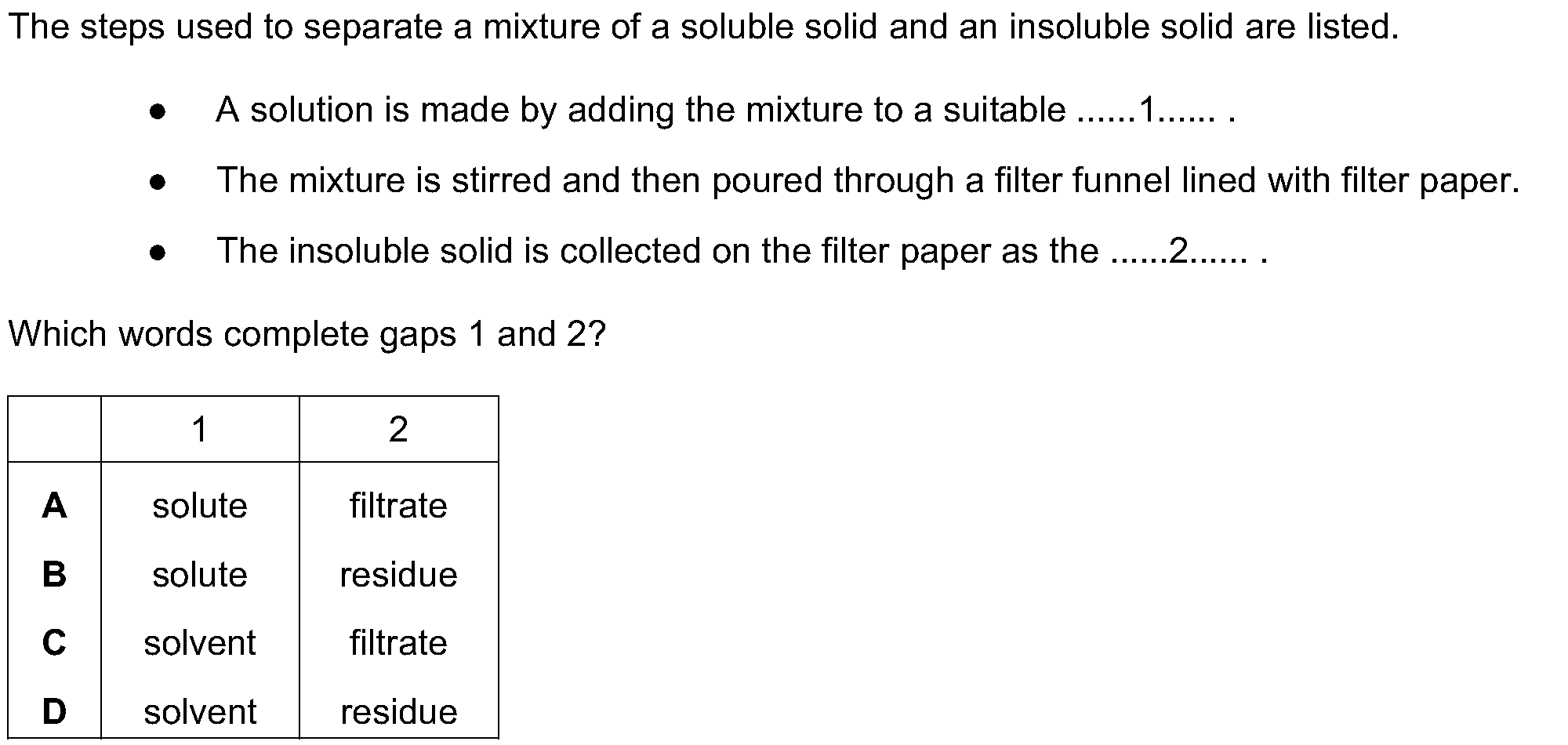
The steps used to separate a mixture of a soluble solid and an insoluble solid are listed.
e A solution is made by adding the mixture to a suitable …… Ta. .
e The mixture is stirred and then poured through a filter funnel lined with filter paper.
e The insoluble solid is collected on the filter paper as the …… Que. .
Which words complete gaps 1 and 2?
1 2
A solute filtrate
B solute residue
Cc solvent filtrate
D solvent residue
Options:
A
B
C
D
Correct Key: D
A
B
C
D
Correct Key: D
Question 2
Paper Ref: 0620/13_Summer_2026_Q40
Paper Ref: 0620/13_Summer_2026_Q40
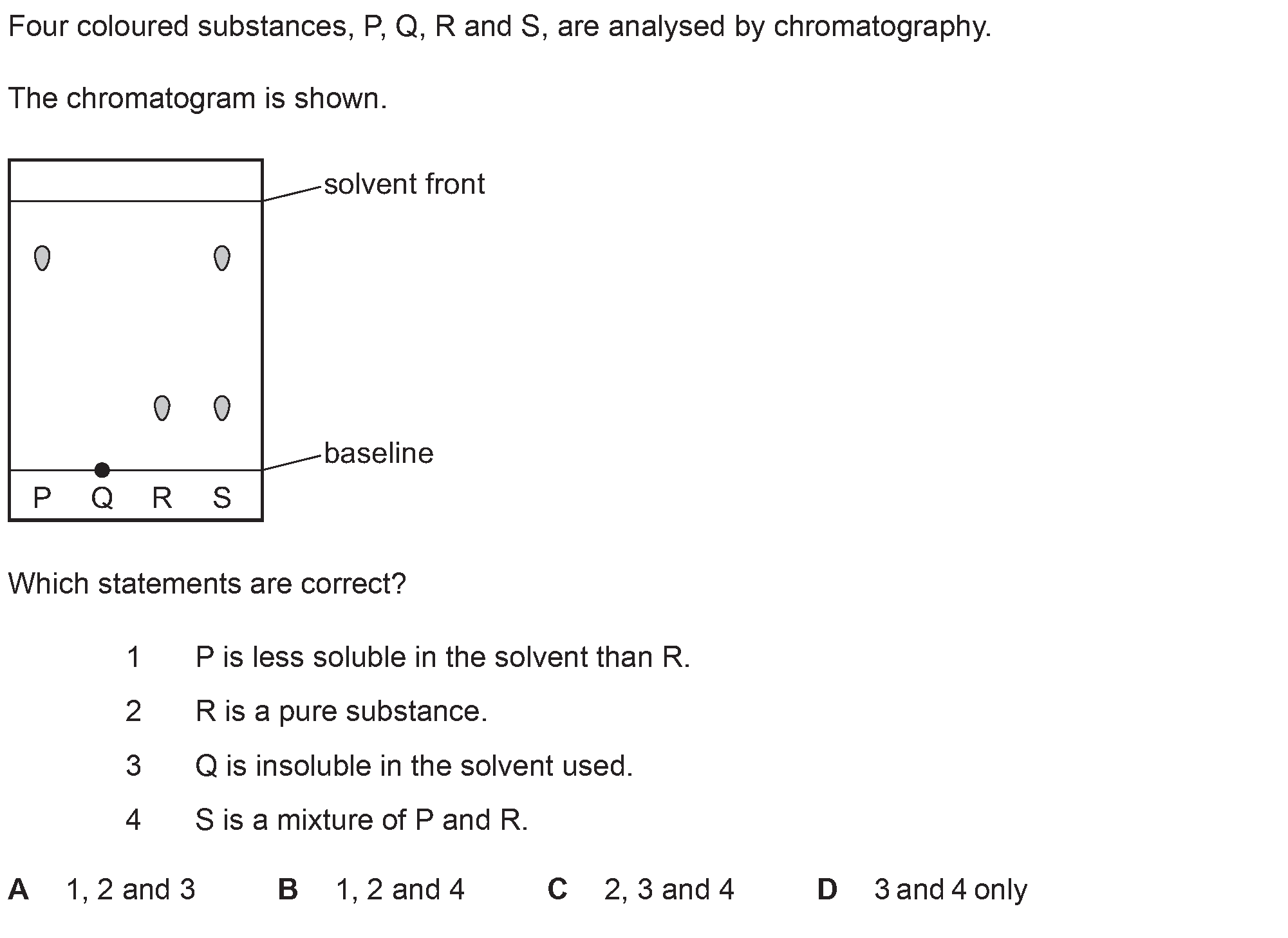
Four coloured substances, P, Q, R and S, are analysed by chromatography.
The chromatogram is shown.
solvent front
baseline
Which statements are correct?
1 P is less soluble in the solvent than R.
2 R is a pure substance.
3 Q is insoluble in the solvent used.
4
S is a mixture of P and R.
A 1,2and3 B 1,2and4 C 2,3and4 D 3and4only
The chromatogram is shown.
solvent front
baseline
Which statements are correct?
1 P is less soluble in the solvent than R.
2 R is a pure substance.
3 Q is insoluble in the solvent used.
4
S is a mixture of P and R.
A 1,2and3 B 1,2and4 C 2,3and4 D 3and4only
Options:
A
B
C
D
Correct Key: C
A
B
C
D
Correct Key: C
Question 3
Paper Ref: 0620/21_Summer_2025_Q40
Paper Ref: 0620/21_Summer_2025_Q40
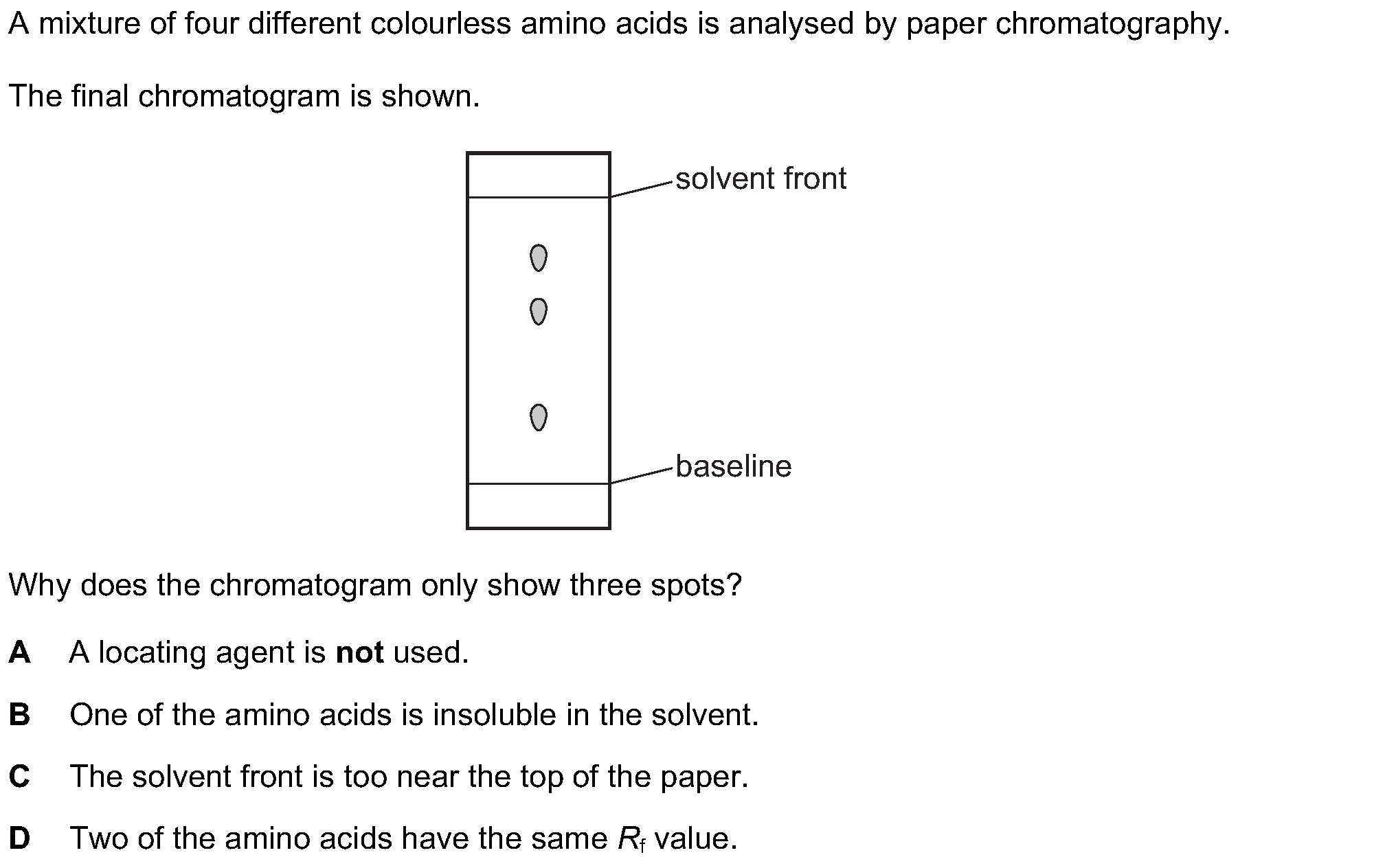
A mixture of four different colourless amino acids is analysed by paper chromatography.
The final chromatogram is shown.
P| solvent front
baseline
Why does the chromatogram only show three spots?
A_ A locating agent is not used.
B One of the amino acids is insoluble in the solvent.
C_ The solvent front is too near the top of the paper.
D
Two of the amino acids have the same R; value.
The final chromatogram is shown.
P| solvent front
baseline
Why does the chromatogram only show three spots?
A_ A locating agent is not used.
B One of the amino acids is insoluble in the solvent.
C_ The solvent front is too near the top of the paper.
D
Two of the amino acids have the same R; value.
Options:
A
B
C
D
Correct Key: D
A
B
C
D
Correct Key: D
Question 4
Paper Ref: 0620/23_Winter_2019_Q3
Paper Ref: 0620/23_Winter_2019_Q3
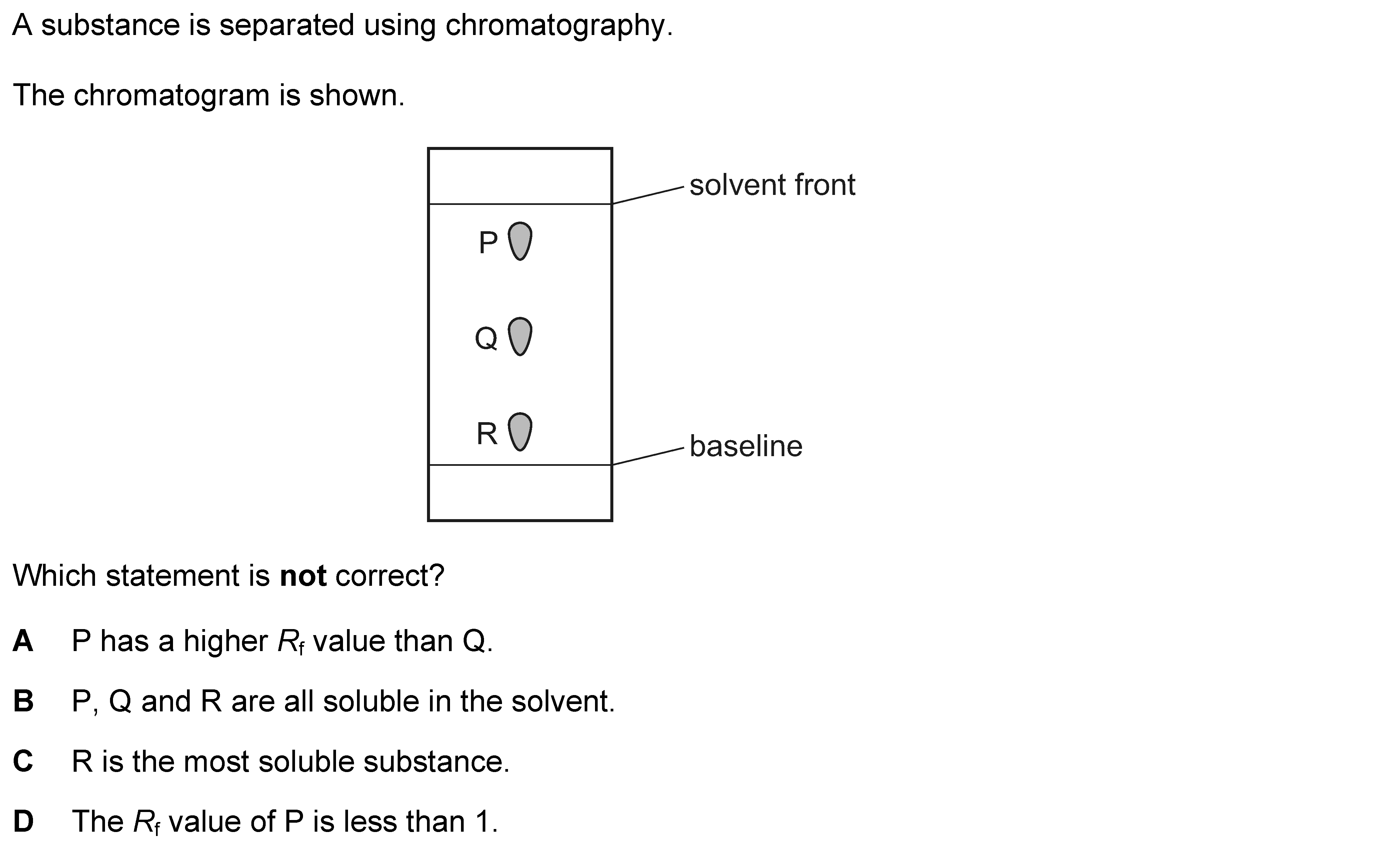
A substance is separated using chromatography.
The chromatogram is shown.
po solvent front
PQ
ad
R ? baseline
Which statement is not correct?
A Phas a higher R; value than Q.
P, Q and R are all soluble in the solvent.
R is the most soluble substance.
0 OO DW
The R; value of P is less than 1.
The chromatogram is shown.
po solvent front
PQ
ad
R ? baseline
Which statement is not correct?
A Phas a higher R; value than Q.
P, Q and R are all soluble in the solvent.
R is the most soluble substance.
0 OO DW
The R; value of P is less than 1.
Options:
A
B
C
D
Correct Key: C
A
B
C
D
Correct Key: C
Question 5
Paper Ref: 0620/11_Winter_2025_Q37
Paper Ref: 0620/11_Winter_2025_Q37
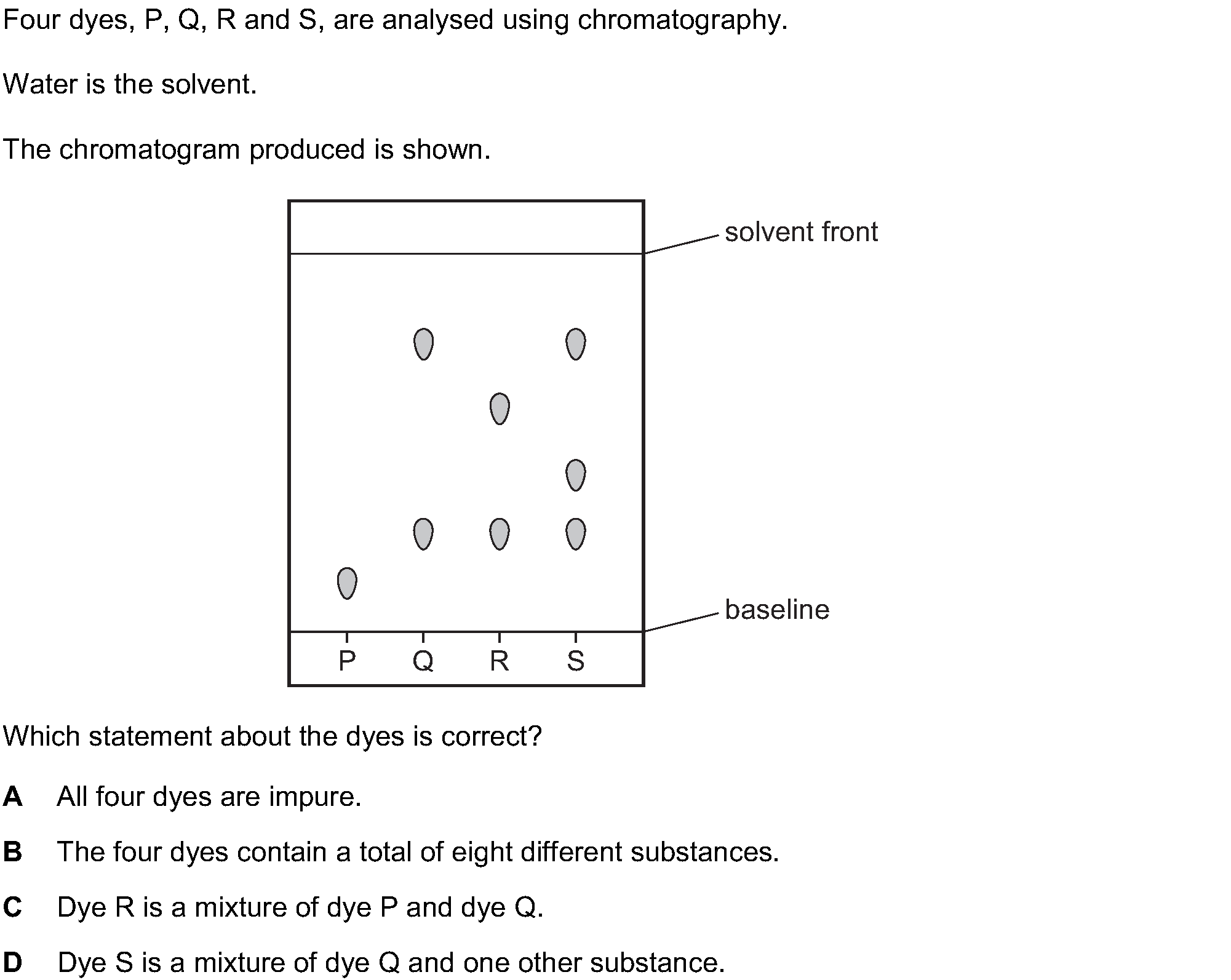
Four dyes, P, Q, R and S, are analysed using chromatography.
Water is the solvent.
The chromatogram produced is shown.
solvent front
baseline
Which statement about the dyes is correct?
QO DW
All four dyes are impure.
The four dyes contain a total of eight different substances.
Dye R is a mixture of dye P and dye Q.
Dye S is a mixture of dye Q and one other substance.
Options:
A
B
C
D
Correct Key: D
A
B
C
D
Correct Key: D
Question 6
Paper Ref: 0620/22_Spring_2021_Q3
Paper Ref: 0620/22_Spring_2021_Q3
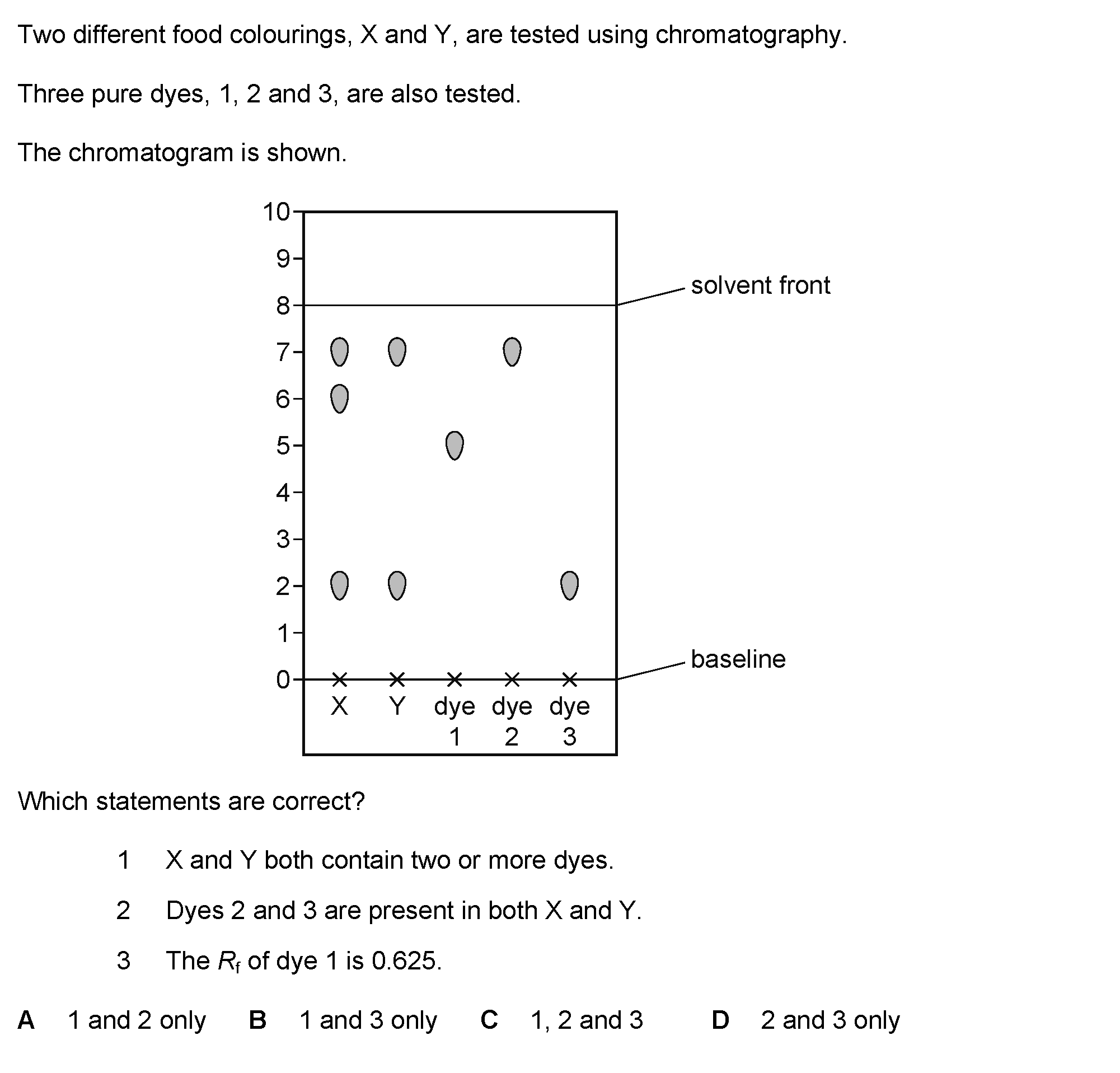
Two different food colourings, X and Y, are tested using chromatography.
Three pure dyes, 1, 2 and 3, are also tested.
The chromatogram is shown.
1
solvent front
baseline
Oo -]~A NY wo fF a ON O OO OD
X Y dye dye dye
1 2 3
Which statements are correct?
1. Xand Y both contain two or more dyes.
2 Dyes 2 and 3 are present in both X and Y.
3 TheR, of dye 1 is 0.625.
A iand2only B tand3only C 1,2and3 D 2and3 only
Options:
A
B
C
D
Correct Key: C
A
B
C
D
Correct Key: C
Question 7
Paper Ref: 0620/23_Summer_2018_Q2
Paper Ref: 0620/23_Summer_2018_Q2
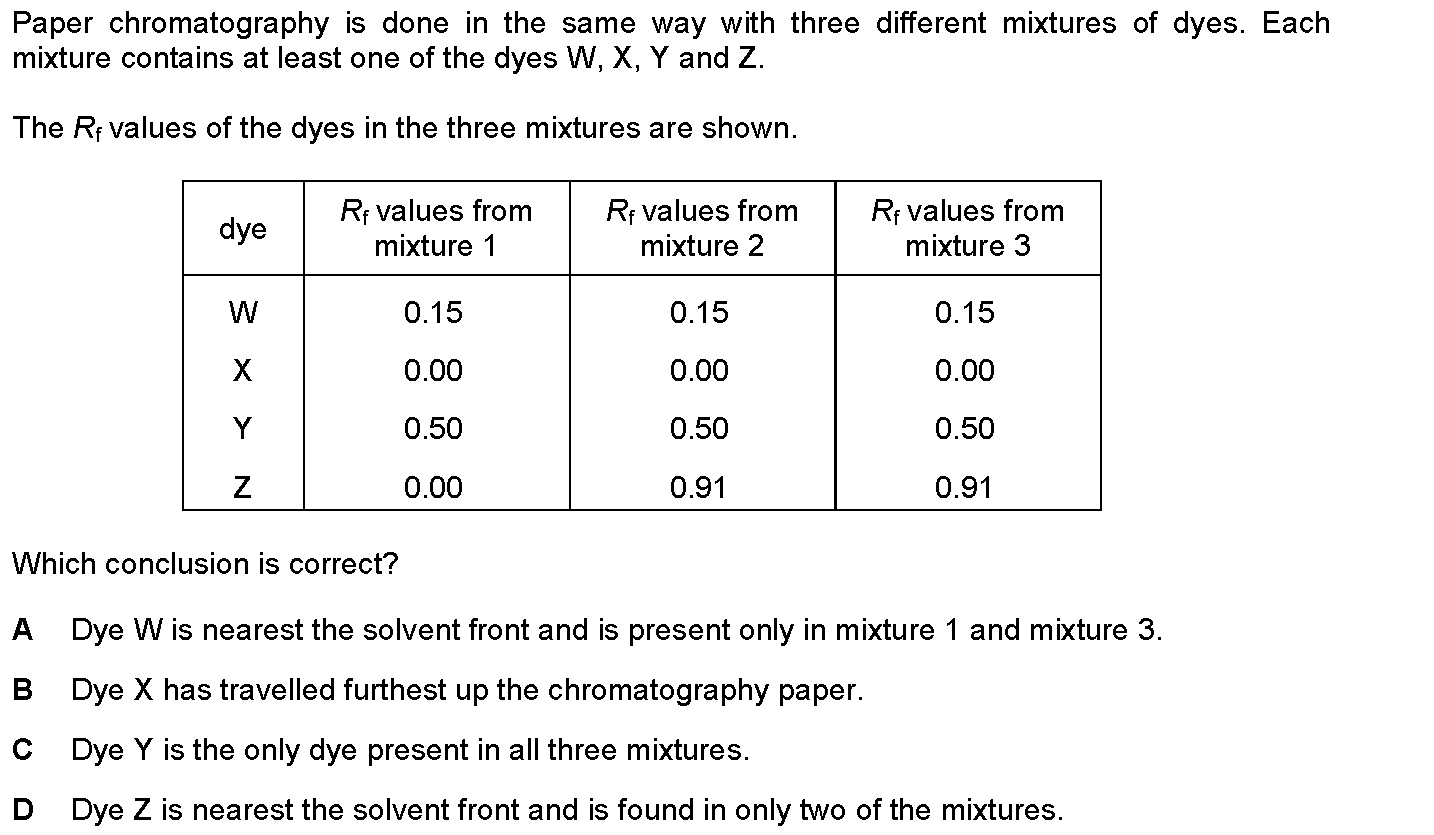
Paper chromatography is done in the same way with three different mixtures of dyes. Each
mixture contains at least one of the dyes W, X, Y and Z.
The R; values of the dyes in the three mixtures are shown.
dye Ry values from Ry values from Ry values from
mixture 1 mixture 2 mixture 3
Ww 0.15 0.15 0.15
Xx 0.00 0.00 0.00
Y 0.50 0.50 0.50
Zz 0.00 0.91 0.91
Which conclusion is correct?
A Dye Wis nearest the solvent front and is present only in mixture 1 and mixture 3.
Dye X has travelled furthest up the chromatography paper.
Dye Y is the only dye present in all three mixtures.
0 9 DW
Dye Z is nearest the solvent front and is found in only two of the mixtures.
Options:
A
B
C
D
Correct Key: D
A
B
C
D
Correct Key: D
Question 8
Paper Ref: 0620/22_Summer_2023_Q39
Paper Ref: 0620/22_Summer_2023_Q39
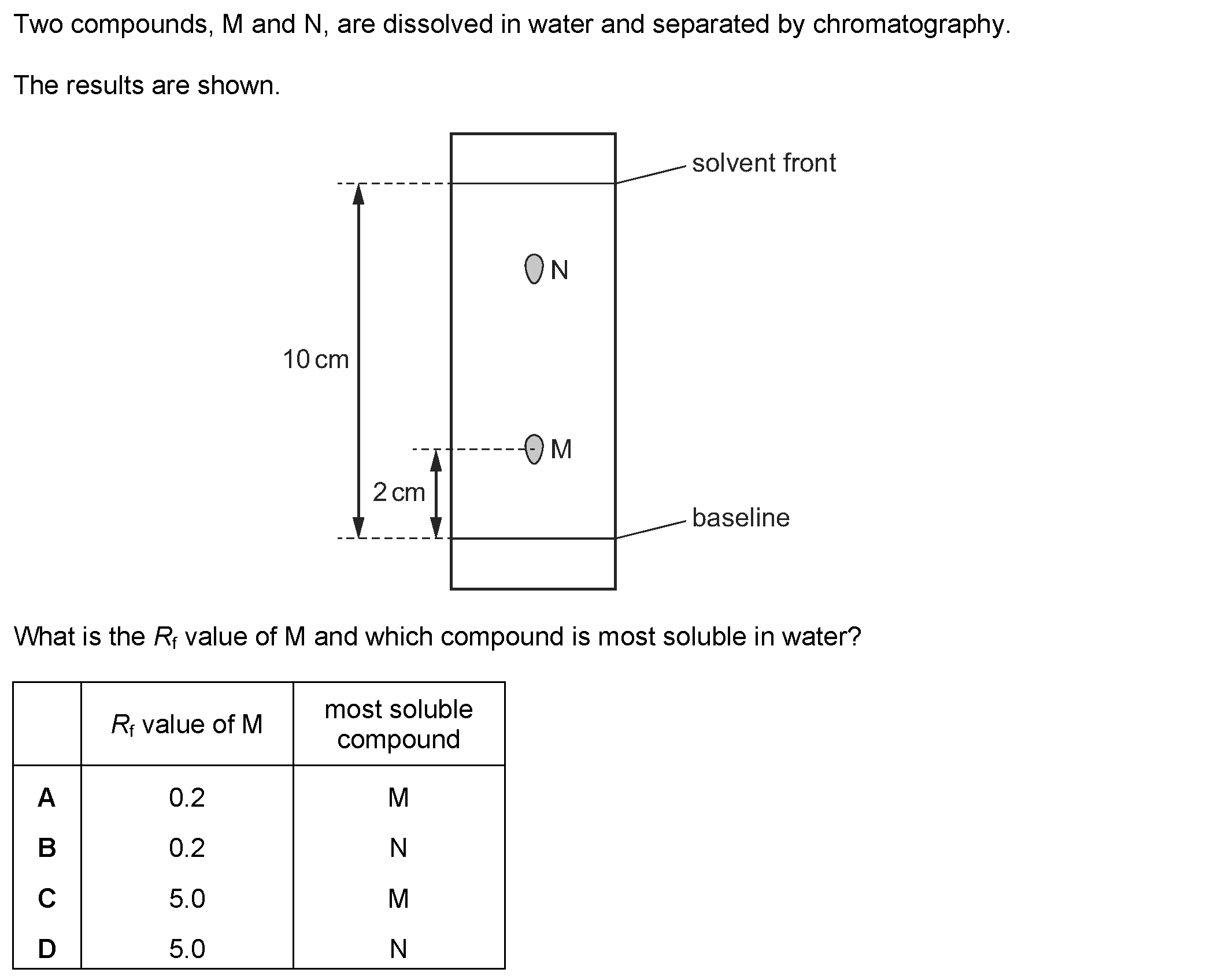
Two compounds, M and N, are dissolved in water and separated by chromatography.
The results are shown.
solvent front
10cm
baseline
What is the R; value of M and which compound is most soluble in water?
a R; value of M most soluble
compound
A 0.2 M
The results are shown.
solvent front
10cm
baseline
What is the R; value of M and which compound is most soluble in water?
a R; value of M most soluble
compound
A 0.2 M
Options:
A
B
C
D
Correct Key: B
A
B
C
D
Correct Key: B
Question 9
Paper Ref: 0620/12_Summer_2023_Q38
Paper Ref: 0620/12_Summer_2023_Q38
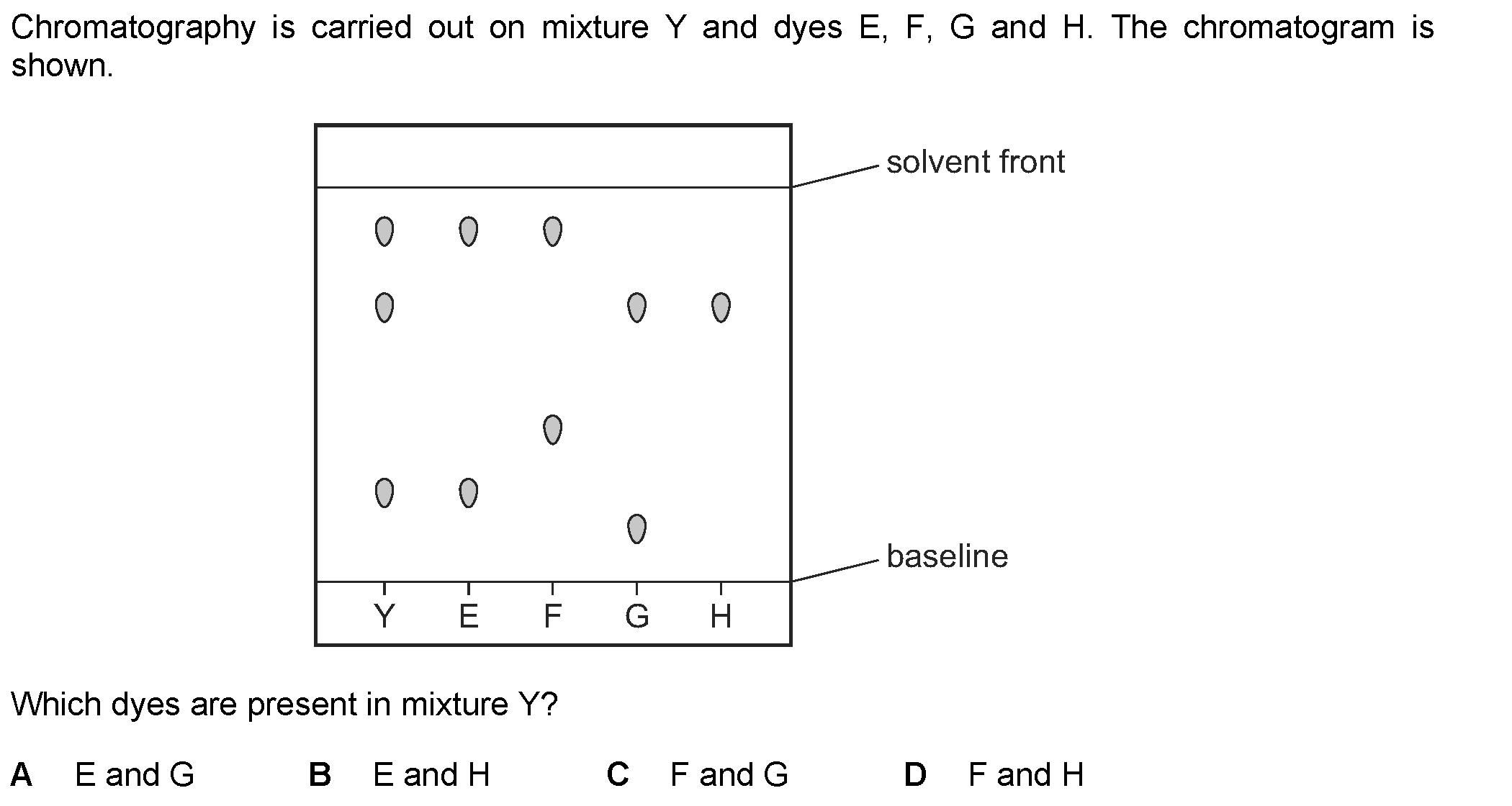
Chromatography is carried out on mixture Y and dyes E, F, G and H. The chromatogram is
shown.
solvent front
baseline
Which dyes are present in mixture Y?
A EandG B EandH C FandG D FandH
shown.
solvent front
baseline
Which dyes are present in mixture Y?
A EandG B EandH C FandG D FandH
Options:
A
B
C
D
Correct Key: B
A
B
C
D
Correct Key: B
Question 10
Paper Ref: 0620/11_Summer_2024_Q38
Paper Ref: 0620/11_Summer_2024_Q38
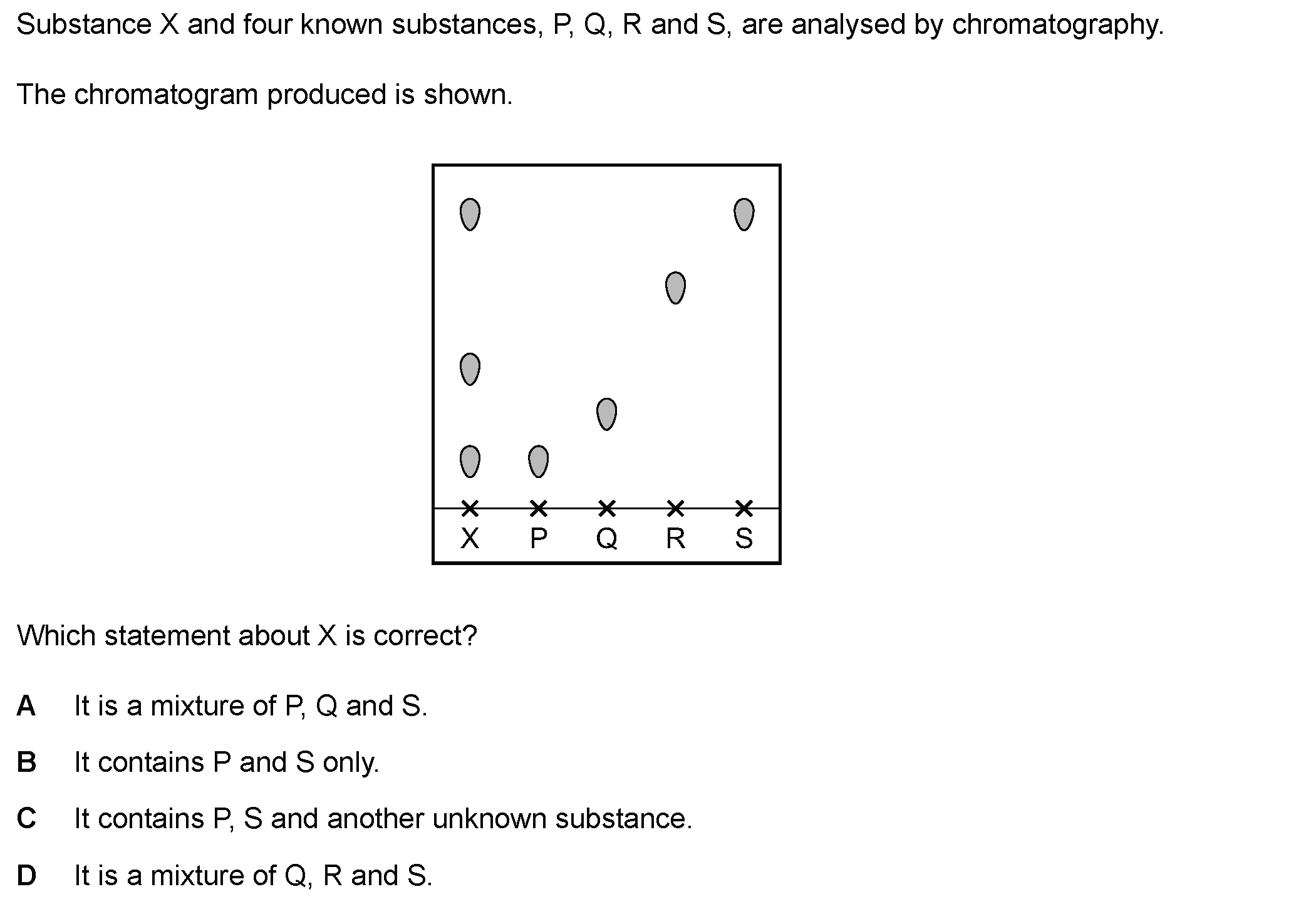
Substance X and four known substances, P, Q, R and §, are analysed by chromatography.
The chromatogram produced is shown.
Which statement about X is correct?
A Itis a mixture of P Q andS.
It contains P and S only.
It contains P, S and another unknown substance.
0 OO WW
It is a mixture of Q, R and S.
The chromatogram produced is shown.
Which statement about X is correct?
A Itis a mixture of P Q andS.
It contains P and S only.
It contains P, S and another unknown substance.
0 OO WW
It is a mixture of Q, R and S.
Options:
A
B
C
D
Correct Key: C
A
B
C
D
Correct Key: C
Question 11
Paper Ref: 0620/22_Summer_2025_Q39
Paper Ref: 0620/22_Summer_2025_Q39
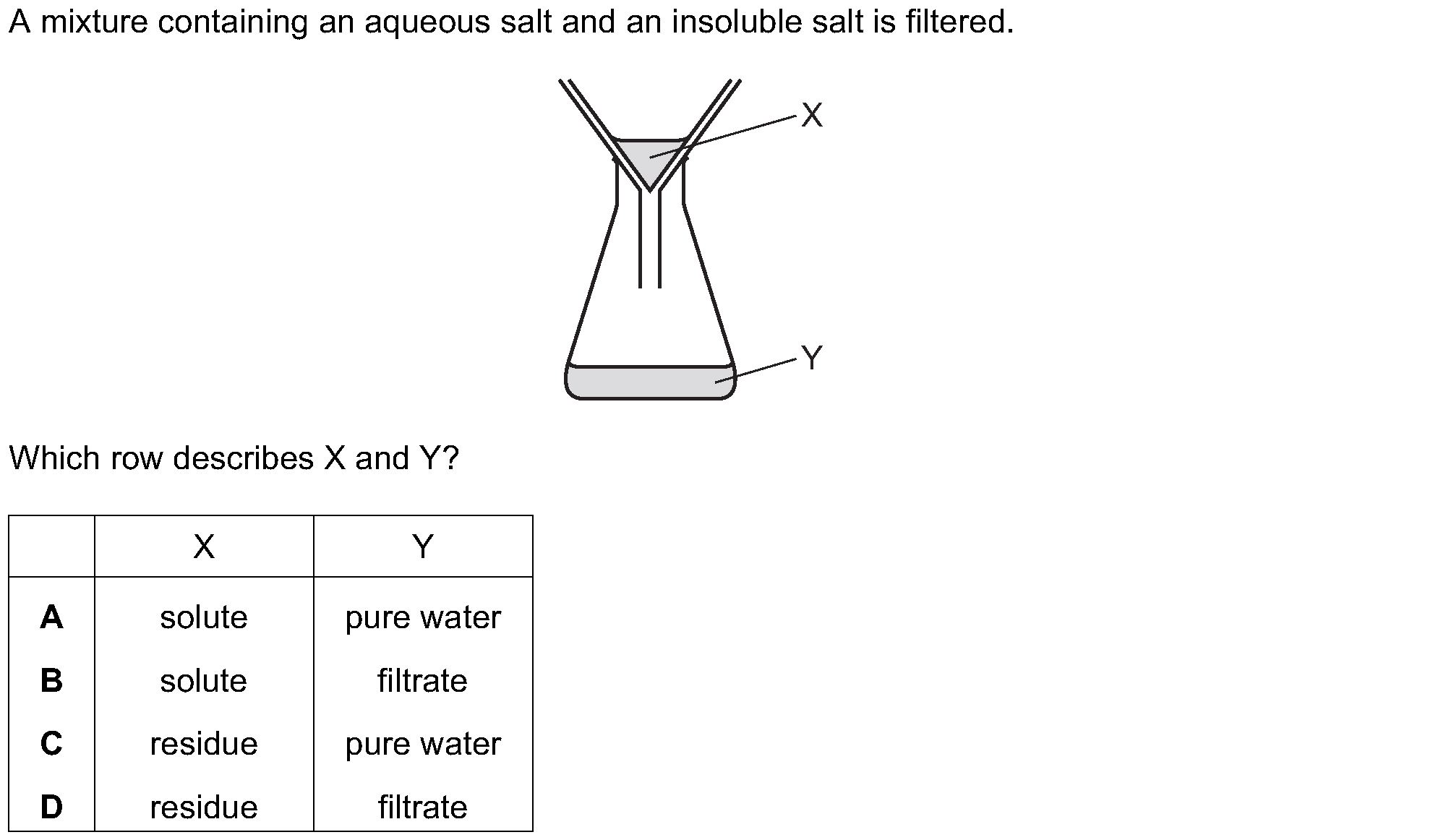
A mixture containing an aqueous salt and an insoluble salt is filtered.
X
Which row describes X and Y?
X Y
A solute pure water
B solute filtrate
Cc residue pure water
D residue filtrate
X
Which row describes X and Y?
X Y
A solute pure water
B solute filtrate
Cc residue pure water
D residue filtrate
Options:
A
B
C
D
Correct Key: D
A
B
C
D
Correct Key: D
Question 12
Paper Ref: 0620/22_Spring_2024_Q40
Paper Ref: 0620/22_Spring_2024_Q40
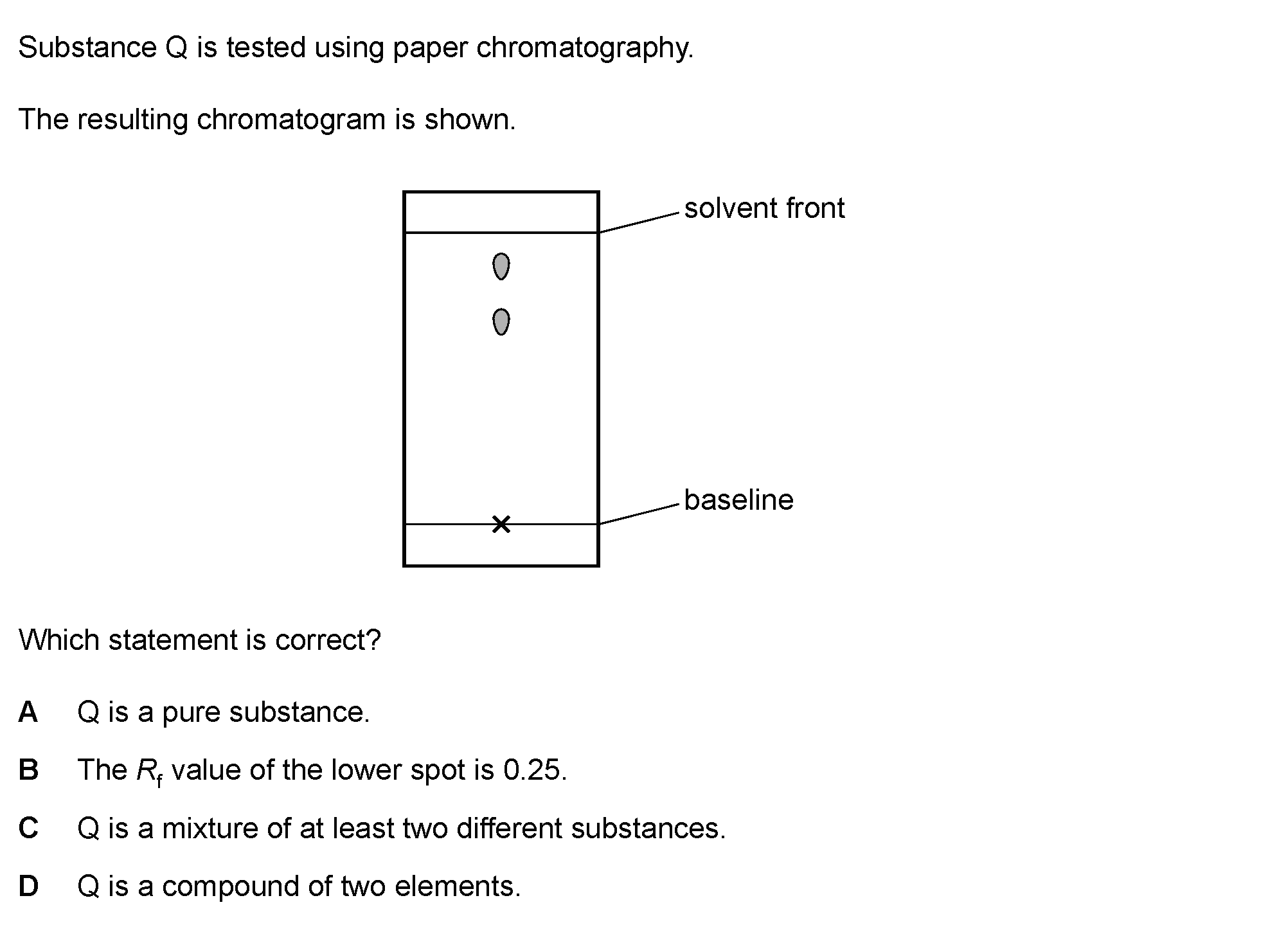
Substance Q is tested using paper chromatography.
The resulting chromatogram is shown.
PF solvent front
baseline
Which statement is correct?
A Qis apure substance.
The R;, value of the lower spot is 0.25.
Q is a mixture of at least two different substances.
0 O WW
Q is a compound of two elements.
The resulting chromatogram is shown.
PF solvent front
baseline
Which statement is correct?
A Qis apure substance.
The R;, value of the lower spot is 0.25.
Q is a mixture of at least two different substances.
0 O WW
Q is a compound of two elements.
Options:
A
B
C
D
Correct Key: C
A
B
C
D
Correct Key: C
Question 13
Paper Ref: 0620/12_Spring_2025_Q40
Paper Ref: 0620/12_Spring_2025_Q40
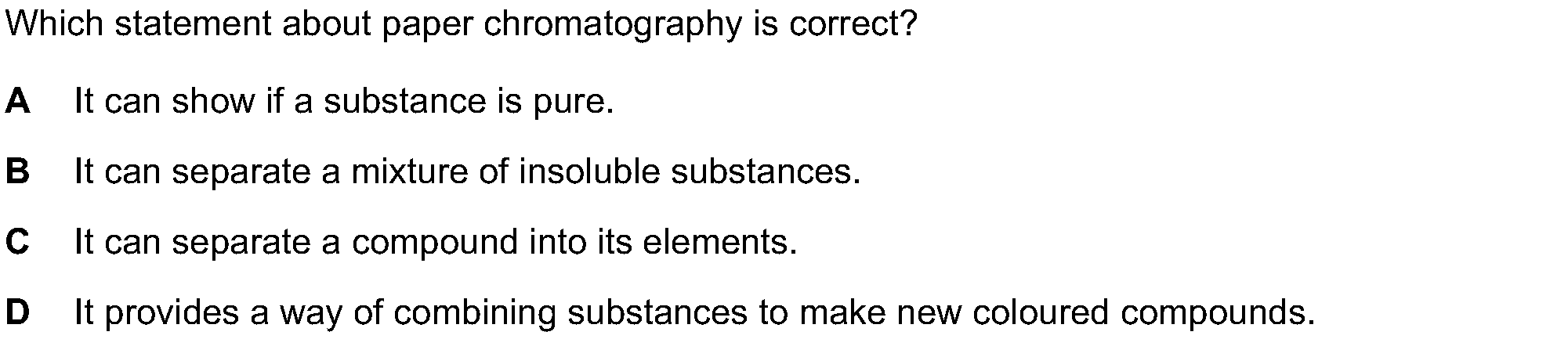
Which statement about paper chromatography is correct?
A
B
Cc
D
It can show if a substance is pure.
It can separate a mixture of insoluble substances.
It can separate a compound into its elements.
It provides a way of combining substances to make new coloured compounds.
A
B
Cc
D
It can show if a substance is pure.
It can separate a mixture of insoluble substances.
It can separate a compound into its elements.
It provides a way of combining substances to make new coloured compounds.
Options:
A
B
C
D
Correct Key: A
A
B
C
D
Correct Key: A
Structured Questions Mark Scheme & Answers
•1•.• • • •[•▍• •P•T• •S•8• •2•0•2•6• •P•2• • •·• • •Q•1•5• • •P•a•r•t• •(•a•)• • •·• • •2•0•2•6• • •·• • •L•o•w•e•r• •S•e•c• •0•8•9•3•]• • • • • • •b•l•u•e• •a•n•d• •r•e•d• •1• •2• •1• •p•e•n•c•i•l• •1• •D•o• •n•o•t• •a•c•c•e•p•t• •p•e•n• •I•g•n•o•r•e• •r•u•l•e•r•
•2•.• • • •[•▍• •P•T• •S•8• •2•0•2•6• •P•2• • •·• • •Q•1•5• • •P•a•r•t• •(•b•)• • •·• • •2•0•2•6• • •·• • •L•o•w•e•r• •S•e•c• •0•8•9•3•]• • • • • • •c•a•n•n•o•t• •s•e•e• •t•h•e• •‘•d•o•t•s•’• •o•n• •t•h•e• •c•h•r•o•m•a•t•o•g•r•a•p•h•y• •p•a•p•e•r• •1•
•3•.• • • •[•▍• •P•R•I• •2•0•1•6•B• •P•2• • •·• • •Q•1•2• • •P•a•r•t• •(•a•)• • •·• • •2•0•1•6• • •·• • •P•r•i•m•a•r•y• •0•8•4•6•]• • • • • • •(•n•o• •p•u•b•l•i•s•h•e•d• •m•a•r•k• •s•c•h•e•m•e• •f•o•r• •t•h•i•s• •p•a•p•e•r•)•
•4•.• • • •[•▍• •P•T• •S•8• •2•0•2•6• •P•1• • •·• • •Q•6• • •P•a•r•t• •(•a•)• • •·• • •2•0•2•6• • •·• • •L•o•w•e•r• •S•e•c• •0•8•9•3•]• • • • • • •2• •e•a•c•h• •c•o•r•r•e•c•t• •a•n•s•w•e•r• •=• •1• •m•a•r•k• •s•o•l•v•e•n•t• •l•i•n•e• •i•s• •a•b•o•v•e• •p•e•n•c•i•l• •s•t•a•r•t• •l•i•n•e• •/• •b•a•s•e•l•i•n•e• •o•r• •t•h•e• •••c•c•e•p•t• •o•r•a• •s•o•l•v•e•n•t• •l•i•n•e• •i•s• •a•b•o•v•e• •t•h•e• •s•a•m•p•l•e• •s•p•o•t• •(•i•d•e•a• •t•h•a•t•)• •t•h•e• •s•p•o•t• •w•i•l•l• •d•i•s•s•o•l•v•e• •i•n• •t•h•e• •s•o•l•v•e•n•t• •i•n• •t•h•e• •b•e•a•k•e•r• •a•n•d• •n•o•t• •m•o•v•e• •u•p• •t•h•e• •p•a•p•e•r•
•5•.• • • •[•▍• •P•T• •S•8• •2•0•2•6• •P•1• • •·• • •Q•6• • •P•a•r•t• •(•b•)• • •·• • •2•0•2•6• • •·• • •L•o•w•e•r• •S•e•c• •0•8•9•3•]• • • • • • •D• •1• •••c•c•e•p•t• •a•n•y• •i•n•d•i•c•a•t•i•o•n• •o•f• •t•h•e• •c•o•r•r•e•c•t• •a•n•s•w•e•r•,• •e•.•g•.• •D• •c•i•r•c•l•e•d• •o•n• •t•h•e• •d•i•a•g•r•a•m•,• •b•u•t• •a•n•s•w•e•r• •l•i•n•e• •t•a•k•e•s• •p•r•e•c•e•d•e•n•c•e• •©• •C•a•m•b•r•i•d•g•e• •U•n•i•v•e•r•s•i•t•y• •P•r•e•s•s• •&• •••s•s•e•s•s•m•e•n•t• •2•0•2•6• •P•a•g•e• •6• •o•f• •1•2• •3•1•4•5•/•0•1• •S•c•i•e•n•c•e• •S•t•a•g•e• •8• •P•a•p•e•r• •1• •M•a•r•k• •S•c•h•e•m•e• •2•0•2•6•
Last updated:
\n