Curriculum
Mathematics
Unit 1
0/12
1.1Key terms1.2Laws and key relationships1.3Rigorous Derivation of Reciprocal Trigonometric Functions1.4Logarithmic and General Exponential Differentiation Techniques1.5Parametric and Implicit Second-Order Derivatives1.6Worked examples1.7Exam tips1.8Real-world applications1.9Key Scientific Tables & Anatomical Diagrams Extracted from Official Curricula1.10📌 Comprehensive Scientific Terminology Dictionary:1.11🔍 In-Depth Explanations, Deductions & Multi-Book Insights:1.12Lesson summary
Unit 2
0/141.1The counting principle1.2Permutations (nPr)1.3Combinations (nCr)1.4Worked examples on counting, permutations and combinations1.5Recall: counting principle, permutations and combinations1.61-1 (a) Pascal's triangle and the binomial expansion1.71-1 (b) The general term1.81-1 (c) The middle term1.91-2 The term containing xk and the term free of x1.101-3 (a) The ratio between two consecutive terms1.111-3 (b) The greatest term1.12Key Scientific Tables & Anatomical Diagrams Extracted from Official Curricula1.13Lesson 1 - Counting Principle, Permutations and Combinations and the Binomial Theorem1.14Lesson summary
Unit 3
0/131.1Key terms1.2Laws and key relationships1.3Geometry of 3D Vectors and Scalar/Cross Product Physics1.4Equations of Straight Lines in Three Dimensions1.5Equations of Planes and Perpendicular Distance Formulas1.6Worked examples1.7Exam tips1.8Real-world applications1.9Key Scientific Tables & Anatomical Diagrams Extracted from Official Curricula1.10📌 Comprehensive Scientific Terminology Dictionary:1.11⚖️ Governing Physical Laws & Mathematical Relations:1.12🔍 In-Depth Explanations, Deductions & Multi-Book Insights:1.13Lesson summary
Unit 4
0/81.11 Smooth and rough surfaces1.22 Properties of the static friction force1.33 Kinetic friction force1.44 The resultant reaction R′1.55 The angle of friction1.66 Equilibrium of a body on a rough horizontal plane1.77 Equilibrium of a body on a rough inclined plane1.88 Conditions of equilibrium and rigid bodies with friction
Unit 5
0/121.13-1 (a) Indefinite integrals of exponential functions1.23-1 (b) Indefinite integrals of logarithmic functions1.33-2 (a) The differential and the standard integrals1.43-2 (b) Integration by substitution1.53-2 (c) Integration by parts1.63-2 (d) Applications of the indefinite integral1.73-3 (a) The definite integral and the fundamental theorem of calculus1.83-3 (b) Properties of the definite integral1.93-3 (c) Definite integral by substitution, odd and even functions1.103-4 (a) Area of a plane region1.113-4 (b) Volumes of solids of revolution1.12Key Scientific Tables & Anatomical Diagrams Extracted from Official Curricula
Unit 6
0/81.12-1 (a) Polar coordinates and the Argand plane1.22-1 (b) Modulus, amplitude and principal amplitude1.32-1 (c) The trigonometric (polar) form of a complex number1.42-1 (d) Product and quotient in trigonometric form1.52-1 (e) The exponential (Euler) form1.62-2 (a) De Moivre's theorem for a positive integer power1.72-2 (b) De Moivre's theorem for a rational power and the roots of a complex number1.82-3 The cube roots of unity
Unit 7
0/101.11 Momentum and its change1.22 Newton's first law, inertia and force1.33 Newton's second law, the equation of motion and variable mass1.44 Newton's third law, lifts and scales1.55 Bodies connected by a string over a smooth pulley1.66 Impulse1.77 Work1.88 Kinetic energy and the work-energy principle1.99 Potential energy and conservation of energy1.1010 Power
Text lesson
Lesson 2 – Rules of Differentiation, Chain Rule and Tangent Lines
Lesson 2 – Rules of Differentiation, Chain Rule and Tangent Lines
Overview
Overview
🎯 Learning outcomes
- Master the foundational differentiation rules power rule, constant multiple rule, sum/difference rule, product rule, and quotient rule.
- Apply the Chain Rule for composite functions and evaluate derivatives of nested powers: d/dx [f(x)]n = n [f(x)]n−1 f'(x).
- Perform implicit differentiation on algebraic relations F(x, y) = 0 and determine dy/dx.
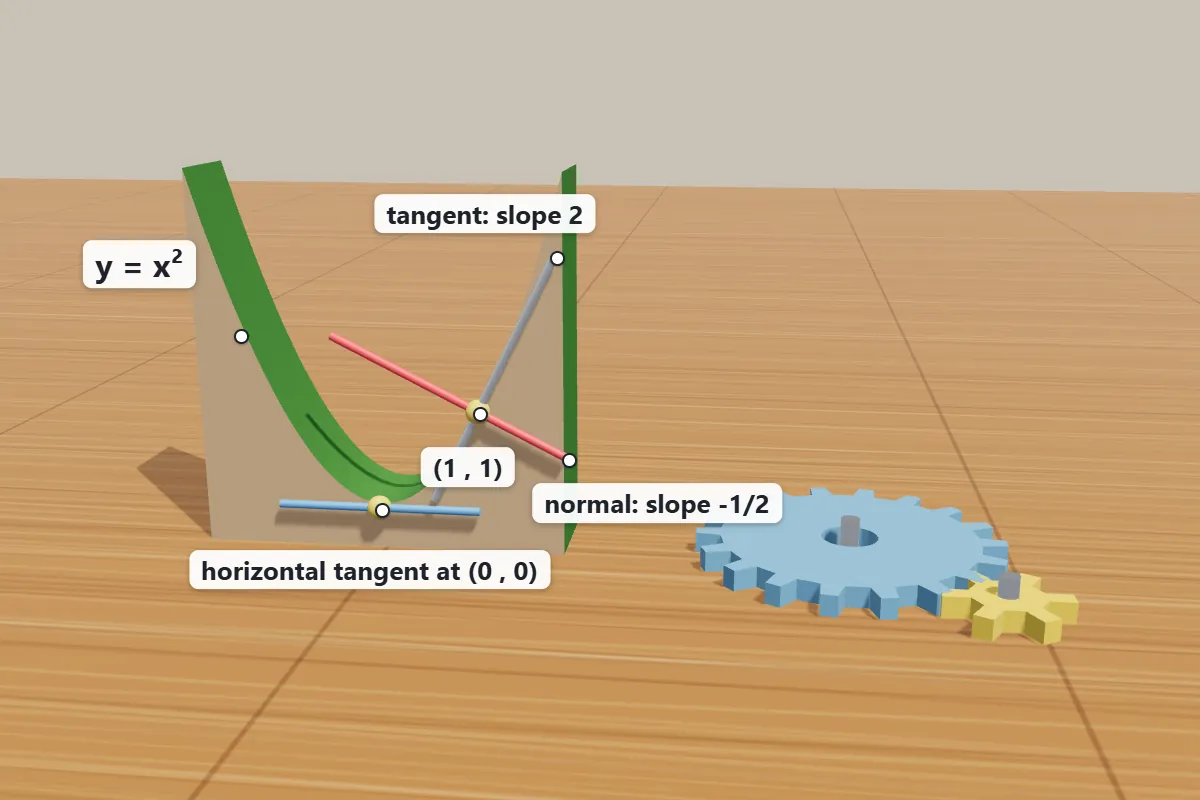
- Determine the geometric equations of tangent and normal lines to planar curves at specified points.
- Apply differentiation to real-world geometric and physical rates of change and optimization problems.
🌳 Concept tree
- Lesson 2 – Rules of Differentiation
- Chain Rule and Tangent Lines
├── Key terms
├── Laws and key relationships
| Comparison aspect | Main idea | Keywords |
|---|---|---|
| ├── Foundational Differentiation Rules |
| PowerProductQuotient |
| • | ├── The Chain Rule and Extended Power Rule for Composite Functions | ChainRuleExtendedPower |
| ├── Geometric Applications | Tangent and Normal Lines to Planar Curves | TangentNormalLinesPlanar |
├── Comparison
├── Worked examples
└── Exam tips
Lesson 2 – Rules of Differentiation, Chain Rule and Tangent Lines · 1 / 13
Key terms
Key terms
| Comparison aspect | Main idea | Keywords |
|---|---|---|
| Derivative (dy/dx or f'(x)) |
| instantaneousratechangefunction |
| Chain Rule |
| fundamentaltheoremdifferentiatingcomposite |
| Slope of Tangent Line |
| trigonometricangleinclinationcurve |
| Normal Line | The straight line perpendicular to the tangent line at the exact point of tangency (x1, y1), having a slope of mnormal = -1 / mtangent (provided mtangent ≠ 0). | straightperpendiculartangentexact |
| Product Rule |
| derivativedifferentiablefunctionsequals |
| Quotient Rule |
| derivativefunctionsequalsdenominator |
Lesson 2 – Rules of Differentiation, Chain Rule and Tangent Lines · 2 / 13
Laws and key relationships
Laws and key relationships
| Comparison aspect | Main idea | Keywords |
|---|---|---|
| Power Rule of Differentiation | [ Formula: d/dx [xn] = n × xn – 1 ] Valid for all real exponents n (positive, negative, and fractional). | FormulaValidrealexponents |
| Product and Quotient Rules | [ Formula: d/dx [u v] = u v’ + v u’ | d/dx [u / v] = (v u’ – u v’) / v2 ] Essential for differentiating complex rational and polynomial products | FormulaEssentialdifferentiatingcomplex |
| Equation of the Tangent Line |
| Formulaevaluatedpointcontact |
| Equation of the Normal Line | [ Formula: y – y1 = (-1 / m) × (x – x1) ] Perpendicular line to the tangent passing through the point of tangency | FormulaPerpendiculartangentpassing |
Lesson 2 – Rules of Differentiation, Chain Rule and Tangent Lines · 3 / 13
Foundational Differentiation Rules: Power, Product, and Quotient
Foundational Differentiation Rules: Power, Product, and Quotient
- Calculus represents the mathematical language of dynamic change.
- The first derivative of a function y = f(x) measures the sensitivity to change of the function value (y) with respect to a change in its argument (x).
| Comparison aspect | Main idea | Keywords |
|---|---|---|
| Power Rule |
| realnumberderivativecoupled |
| Product Rule |
| differentiatingfunctionsstudentsmust |
| Quotient Rule |
| rationalfunctionsminussign |
Lesson 2 – Rules of Differentiation, Chain Rule and Tangent Lines · 4 / 13
The Chain Rule and Extended Power Rule for Composite Functions
The Chain Rule and Extended Power Rule for Composite Functions
- In practical scientific and engineering formulations, functions are frequently nested as composites: y = f(g(x)).
- The Chain Rule dictates that the derivative of the composite function is the derivative of the outer function evaluated at the inner function, multiplied by the derivative of the inner function.
| Comparison aspect | Main idea | Example | Keywords |
|---|---|---|---|
| Extended Power Rule |
| — | differentiablefunctionthen |
| • | dy/dx = n × [u(x)]n – 1 × u'(x) | — | |
| Differentiating Radical Functions |
| — | squarerootsapplyingchain |
| Implicit Differentiation | For relations where y cannot be explicitly isolated as y = f(x) ( |
| relationscannotexplicitlyisolated |
Lesson 2 – Rules of Differentiation, Chain Rule and Tangent Lines · 5 / 13
Geometric Applications: Tangent and Normal Lines to Planar Curves
Geometric Applications: Tangent and Normal Lines to Planar Curves
| Comparison aspect | Main idea | Keywords |
|---|---|---|
| • |
| geometricinterpretationderivativegradient |
| • | Methodology for Determining Tangent and Normal Equations | MethodologyDeterminingTangentNormal |
| Step 1 |
| Verifydeterminepointcontact |
| Step 2 | Differentiate the function algebraically to obtain the general derivative expression dy/dx = f'(x) | Differentiatefunctionalgebraicallyobtain |
| Step 3 | Substitute the numerical coordinates of the point of contact into f'(x) to calculate the numerical slope of the tangent: m = f'(x1) | Substitutenumericalcoordinatespoint |
| Step 4 | Formulate the Tangent Line Equation: y – y1 = m (x – x1) | FormulateTangentLineEquation |
| Step 5 |
| FormulateNormalLineEquation |
- Special Geometric Orientations:
If m = 0Tangent is horizontal (parallel to x-axis), equation is y = y1, and normal is vertical x = x1.
If m = ∞ (undefined)Tangent is vertical (parallel to y-axis), equation is x = x1, and normal is horizontal y = y1.
Lesson 2 – Rules of Differentiation, Chain Rule and Tangent Lines · 6 / 13
Comparison
Comparison
Table→Summary Table of Calculus Differentiation Rules and Formulations
| Function Type | Mathematical Formula y = f(x) | First Derivative dy/dx | Practical Exemplary Application |
|---|---|---|---|
| Constant Function | y = c | 0 | d/dx [7] = 0 |
| Power Function | y = xn | n xn – 1 | d/dx [x5] = 5 x4 |
| Constant Multiple | y = c u(x) | c u'(x) | d/dx [4 x3] = 12 x2 |
| Product of Functions | y = u × v | u v’ + v u’ | d/dx [x2 (3x + 1)] = x2(3) + (3x + 1)(2x) |
| Quotient of Functions | y = u / v | (v u’ – u v’) / v2 | d/dx [(2x+1)/(x-3)] = [(x-3)(2) – (2x+1)(1)] / (x-3)2 |
| Extended Power Chain | y = [u(x)]n | n [u(x)]n−1 × u'(x) | d/dx [(x2 + 5)4] = 4(x2 + 5)3 × (2x) = 8x(x2 + 5)3 |
| Square Root Chain | y = √u(x) | u'(x) / (2 √u(x)) | d/dx [√(3x2 + 1)] = 6x / (2 √(3x2 + 1)) = 3x / √(3x2 + 1) |
Lesson 2 – Rules of Differentiation, Chain Rule and Tangent Lines · 7 / 13
Worked examples
Worked examples
- Determining Tangent and Normal Lines to an Algebraic CurveProblem Statement & Given Data: Find the equations of the tangent line and the normal line to the curve y = (2x – 1) / (x + 2) at the point where x = 1.Step-by-Step Mathematical & Chemical Solution: [1] Step 1: Determine the y-coordinate of the point of contact: Substitute x = 1 into the curve equation: [2] y1 = (2(1) – 1) / (1 + 2) = (2 – 1) / 3 = 1/3. [3] Point of tangency P is (1, 1/3). [4] Step 2: Differentiate y using the Quotient Rule: dy/dx = [(denominator)(derivative of numerator) – (numerator)(derivative of denominator)] / (denominator)2. [5] dy/dx = [(x + 2)(2) – (2x – 1)(1)] / (x + 2)2 = [2x + 4 – 2x + 1] / (x + 2)2 = 5 / (x + 2)2. [6] Step 3: Evaluate the slope m at x = 1: m = 5 / (1 + 2)2 = 5 / 32 = 5/9. [7] Step 4: Equation of the Tangent Line: y – y1 = m (x – x1) ==> y – 1/3 = 5/9 (x – 1). [8] Multiply both sides by 9: 9y – 3 = 5(x – 1) ==> 9y – 3 = 5x – 5. [9] Rearrange in standard form: 5x – 9y – 2 = 0. [10] Step 5: Equation of the Normal Line: Slope of normal mnorm = -1 / (5/9) = -9/5. [11] y – 1/3 = -9/5 (x – 1) ==> Multiply by 15: 15y – 5 = -27(x – 1) ==> 15y – 5 = -27x + 27. [12] Rearrange in standard form: 27x + 15y – 32 = 0.💡 High-Yield Exam Shortcut & Pitfall Alert: Exam Tip: Always double-check your tangent and normal slopes by verifying that mtangent × mnormal = (5/9) × (-9/5) = -1!
Lesson 2 – Rules of Differentiation, Chain Rule and Tangent Lines · 8 / 13
Exam tips
Exam tips
- The derivative of a square root is the derivative of the inside divided by twice the root: d/dx [√u] = u’ / (2√u).
- The product rule is u v’ + v u’, never simply u’ v’.
- The slope of the normal line is the negative reciprocal of the slope of the tangent line: mnorm = -1 / mtang.
- A horizontal tangent has dy/dx = 0; a vertical tangent has dy/dx = undefined (denominator of derivative equals zero).
- In implicit differentiation, remember to append (dy/dx) whenever differentiating any term containing y.
- .egp-ex{margin:18px 0;border:1px solid rgba(79,63,224,.2);border-radius:16px;overflow:hidden;background:#fff}.egp-ex-h{padding:10px 16px;font-weight:800;background:linear-gradient(90deg,#4f3fe0,#22c1c3);color:#fff}.egp-ex-tabs{display:flex;flex-wrap:wrap;gap:6px;padding:10px 12px;background:#f7f6ff}.egp-ex-b{border:1px solid rgba(79,63,224,.3);background:#fff;border-radius:20px;padding:5px 14px;font-weight:700;cursor:pointer}.egp-ex-b.on{background:#4f3fe0;color:#fff}.egp-ex-p{padding:12px 16px}
Lesson 2 – Rules of Differentiation, Chain Rule and Tangent Lines · 9 / 13
Key Scientific Tables & Anatomical Diagrams Extracted from Official Curricula
Key Scientific Tables & Anatomical Diagrams Extracted from Official Curricula
💡 Core Diagrams & Reference Data→All data, reference comparison tables, and anatomical figures have been accurately digitized from official curriculum textbooks.
🔬 Tangent_Normal_and_Derivative_Curve
- Scientific details and precise observational breakdown:
- Tangent & Normal Lines using First Derivative f (xo)
- Derivative Function f’(x) and Critical Points (f(x) = 0)
wes f(x) = X? — 3×7 +2×4+2
== Tangent at (2,2)y—2 =2(x—2)
se) Normal at (2,2)y—2=—3(x— 2)
F(x)
Lesson 2 – Rules of Differentiation, Chain Rule and Tangent Lines · 10 / 13
Part 11
Part 11
- 📖
Lesson 2 – Rules of Differentiation, Chain Rule and Tangent Lines · 11 / 13
🔍 In-Depth Explanations, Deductions & Multi-Book Insights:
🔍 In-Depth Explanations, Deductions & Multi-Book Insights:
- ★ Comprehensive Ministry-Approved Academic Textbook 2026 / 2027 ★
- Textbook Chapter Rules of Differentiation, Chain Rule and Tangent Lines
- Third Secondary / Grade 12 | Unit 2 – Calculus and Differentiation | Modern Egyptian Curriculum 2026/2027
- 🎯 Ministerial Learning Outcomes & Key Competencies 2026/2027:
- • Master the foundational differentiation rules power rule, constant multiple rule, sum/difference rule, product rule, and quotient rule.
- • Apply the Chain Rule for composite functions and evaluate derivatives of nested powers: d/dx [f(x)]n = n [f(x)]n−1 f'(x).
- • Perform implicit differentiation on algebraic relations F(x, y) = 0 and determine dy/dx.
- • Determine the geometric equations of tangent and normal lines to planar curves at specified points.
- • Apply differentiation to real-world geometric and physical rates of change and optimization problems.
- 📖 Core Scientific Terminology & Definitions:
- 🔹 Derivative (dy/dx or f'(x)) The instantaneous rate of change of a function with respect to its independent variable, defined as the limit of the difference quotient as Δx approaches zero: lim(h → 0) [f(x+h) – f(x)] / h.
- 🔹 Chain Rule A fundamental theorem for differentiating composite functions: if y = f(u) and u = g(x), then dy/dx = (dy/du) × (du/dx).
- 🔹 Slope of Tangent Line The trigonometric tangent of the angle of inclination of the tangent line to the curve at point (x1, y1), evaluated by calculating the first derivative m = f'(x1).
| Comparison aspect | Main idea | Keywords |
|---|---|---|
| 🔹 Normal Line |
| straightperpendiculartangentexact |
| 🔹 Product Rule |
| derivativedifferentiablefunctionsequals |
| 🔹 Quotient Rule |
| derivativefunctionsequalsdenominator |
| Comparison aspect | Main idea | Keywords |
|---|---|---|
| • | ⚖️ Governing Mathematical & Physical Laws and Principles | GoverningMathematicalPhysicalLaws |
| ★ Power Rule of Differentiation |
| FormulaValidrealexponents |
| ★ Product and Quotient Rules | [ Formula: d/dx [u v] = u v' + v u' | d/dx [u / v] = (v u' – u v') / v2 ] Essential for differentiating complex rational and polynomial products | FormulaEssentialdifferentiatingcomplex |
| ★ Equation of the Tangent Line |
| Formulaevaluatedpointcontact |
| ★ Equation of the Normal Line | [ Formula: y – y1 = (-1 / m) × (x – x1) ] Perpendicular line to the tangent passing through the point of tangency | FormulaPerpendiculartangentpassing |
- 📌 Exhaustive In-Depth Academic Explanation & Scientific Analysis:
1. Foundational Differentiation Rules: Power, Product, and Quotient
- Calculus represents the mathematical language of dynamic change.
- The first derivative of a function y = f(x) measures the sensitivity to change of the function value (y) with respect to a change in its argument (x).
2. The Chain Rule and Extended Power Rule for Composite Functions
- In practical scientific and engineering formulations, functions are frequently nested as composites: y = f(g(x)).
- The Chain Rule dictates that the derivative of the composite function is the derivative of the outer function evaluated at the inner function, multiplied by the derivative of the inner function.
- Extended Power Rule If y = [u(x)]n, where u(x) is a differentiable function of x, then:
| Comparison aspect | Main idea | Example | Keywords |
|---|---|---|---|
| • | dy/dx = n × [u(x)]n – 1 × u'(x) | — | |
| Differentiating Radical Functions |
| — | squarerootsapplyingchain |
| Implicit Differentiation | For relations where y cannot be explicitly isolated as y = f(x) ( |
| relationscannotexplicitlyisolated |
3. Geometric Applications: Tangent and Normal Lines to Planar Curves
| Comparison aspect | Main idea | Keywords |
|---|---|---|
| • |
| geometricinterpretationderivativegradient |
| • | Methodology for Determining Tangent and Normal Equations | MethodologyDeterminingTangentNormal |
| Step 1 |
| Verifydeterminepointcontact |
| Step 2 | Differentiate the function algebraically to obtain the general derivative expression dy/dx = f'(x) | Differentiatefunctionalgebraicallyobtain |
| Step 3 | Substitute the numerical coordinates of the point of contact into f'(x) to calculate the numerical slope of the tangent: m = f'(x1) | Substitutenumericalcoordinatespoint |
| Step 4 | Formulate the Tangent Line Equation: y – y1 = m (x – x1) | FormulateTangentLineEquation |
- Formulate the Normal Line Equation: Since the normal line is perpendicular to the tangent line at the exact point of tangency, its slope is mnorm = -1/m (provided m ≠ 0). The equation is: y – y1 = (-1/m) (x – x1).
- Special Geometric Orientations:
- Tangent is horizontal (parallel to x-axis), equation is y = y1, and normal is vertical x = x1.
- Tangent is vertical (parallel to y-axis), equation is x = x1, and normal is horizontal y = y1.
- 📊 Detailed Comparative Analysis & Data Classifications:
- Summary Table of Calculus Differentiation Rules and Formulations
- ✏️ Step-by-Step Fully Solved Exemplary Numerical Problems & Proofs:
| Comparison aspect | Main idea | Keywords |
|---|---|---|
| • | ★ Determining Tangent and Normal Lines to an Algebraic Curve | DeterminingTangentNormalLines |
| Problem Statement & Given Data | Find the equations of the tangent line and the normal line to the curve y = (2x – 1) / (x + 2) at the point where x = 1 | Findequationstangentline |
| • | Step-by-Step Mathematical & Chemical Solution | StepMathematicalChemicalSolution |
| [1] Step 1 | Determine the y-coordinate of the point of contact: Substitute x = 1 into the curve equation | Determinecoordinatepointcontact |
| • | [2] y1 = (2(1) – 1) / (1 + 2) = (2 – 1) / 3 = 1/3 | |
| • |
| Pointtangency |
| [4] Step 2 | Differentiate y using the Quotient Rule: dy/dx = [(denominator)(derivative of numerator) – (numerator)(derivative of denominator)] / (denominator)2 | DifferentiateusingQuotientRule |
| • | [5] dy/dx = [(x + 2)(2) – (2x – 1)(1)] / (x + 2)2 = [2x + 4 – 2x + 1] / (x + 2)2 = 5 / (x + 2)2 | |
| [6] Step 3 | Evaluate the slope m at x = 1: m = 5 / (1 + 2)2 = 5 / 32 = 5/9 | Evaluateslope |
| [7] Step 4 | Equation of the Tangent Line: y – y1 = m (x – x1) ==> y – 1/3 = 5/9 (x – 1) | EquationTangentLine |
| [8] Multiply both sides by 9 | 9y – 3 = 5(x – 1) ==> 9y – 3 = 5x – 5 | |
| [9] Rearrange in standard form | 5x – 9y – 2 = 0 | |
| [10] Step 5 | Equation of the Normal Line: Slope of normal mnorm = -1 / (5/9) = -9/5 | EquationNormalLineSlope |
| [11] y – 1/3 = -9/5 (x – 1) ==> Multiply by 15 | 15y – 5 = -27(x – 1) ==> 15y – 5 = -27x + 27 | |
| [12] Rearrange in standard form | 27x + 15y – 32 = 0 | |
| 💡 High-Yield Exam Shortcut & Pitfall Alert | Exam Tip: Always double-check your tangent and normal slopes by verifying that mtangent × mnormal = (5/9) × (-9/5) = -1! | Alwaysdoublecheckyour |
| Function Type | Mathematical Formula y = f(x) | First Derivative dy/dx | Practical Exemplary Application |
|---|---|---|---|
| Constant Function | y = c | 0 | d/dx [7] = 0 |
| Power Function | y = xn | n xn – 1 | d/dx [x5] = 5 x4 |
| Constant Multiple | y = c u(x) | c u'(x) | d/dx [4 x3] = 12 x2 |
| Product of Functions | y = u × v | u v' + v u' | d/dx [x2 (3x + 1)] = x2(3) + (3x + 1)(2x) |
| Quotient of Functions | y = u / v | (v u' – u v') / v2 | d/dx [(2x+1)/(x-3)] = [(x-3)(2) – (2x+1)(1)] / (x-3)2 |
| Extended Power Chain | y = [u(x)]n | n [u(x)]n−1 × u'(x) | d/dx [(x2 + 5)4] = 4(x2 + 5)3 × (2x) = 8x(x2 + 5)3 |
| Square Root Chain | y = √u(x) | u'(x) / (2 √u(x)) | d/dx [√(3x2 + 1)] = 6x / (2 √(3x2 + 1)) = 3x / √(3x2 + 1) |
💡 💡 Essential Exam Traps, Tips & High-Yield Insights:
- The derivative of a square root is the derivative of the inside divided by twice the root: d/dx [√u] = u' / (2√u).
- The product rule is u v' + v u', never simply u' v'.
- The slope of the normal line is the negative reciprocal of the slope of the tangent line: mnorm = -1 / mtang.
- A horizontal tangent has dy/dx = 0; a vertical tangent has dy/dx = undefined (denominator of derivative equals zero).
- In implicit differentiation, remember to append (dy/dx) whenever differentiating any term containing y.
Lesson 2 – Rules of Differentiation, Chain Rule and Tangent Lines · 12 / 13
Lesson summary
Lesson summary
- ★ High-Yield Summary, Mind Maps & Comparison Tables ★
- Calculus & Differentiation – Secondary Stage (Egyptian Curriculum 2026-2027) | 2026 / 2027 | 2026 / 2027 | Unit 2: Calculus and Differentiation
- 🗺️ Core Concept Map & Knowledge Architecture:
- ✔ Differentiability at x = a always implies continuity at x = a.
- ✔ Horizontal tangents occur where f'(x) = 0; vertical tangents occur where 1/f'(x) = 0.
- 📊 Classification & Comparative Summary Tables:
| Differentiation Rule | Function y = f(x) | First Derivative dy/dx |
|---|---|---|
| Power Rule | y = xn | dy/dx = n * xn−1 |
| Product Rule | y = u(x) * v(x) | u'(x)v(x) + u(x)v'(x) |
| Quotient Rule | y = u(x) / v(x) | [u'(x)v(x) – u(x)v'(x)] / [v(x)]2 |
| Chain Rule (Power) | y = [g(x)]n | n * [g(x)]n−1 * g'(x) |
| Trig Functions | sin(ax+b) / cos(ax+b) / tan(ax+b) | a cos(ax+b) / -a sin(ax+b) / a sec2(ax+b) |
- 💡 Exam Flashcard Capsules & High-Yield Secrets:
- ★ If m = f'(x_0) is the slope of the tangent at (x_0, y_0), then the slope of the perpendicular normal line is m_normal = -1 / m (provided m != 0).
- ★ Differentiability at x = a always implies continuity at x = a.
- ★ Horizontal tangents occur where f'(x) = 0
- vertical tangents occur where 1/f'(x) = 0.
Lesson 2 – Rules of Differentiation, Chain Rule and Tangent Lines · 13 / 13
Well done! You finished this lesson
What would you like to do next?