Curriculum
Mathematics
Unit 1
0/12
Unit 2
0/14Unit 3
0/13Unit 4
0/8Unit 5
0/12Unit 6
0/8Unit 7
0/10
Text lesson
Lesson 2 – Rules of Differentiation, Chain Rule and Tangent Lines
Lesson 2 – Rules of Differentiation, Chain Rule and Tangent Lines
🔍 In-Depth Explanations, Deductions & Multi-Book Insights:
🔍 In-Depth Explanations, Deductions & Multi-Book Insights:
- ★ Comprehensive Ministry-Approved Academic Textbook 2026 / 2027 ★
- Textbook Chapter Rules of Differentiation, Chain Rule and Tangent Lines
- Third Secondary / Grade 12 | Unit 2 – Calculus and Differentiation | Modern Egyptian Curriculum 2026/2027
- 🎯 Ministerial Learning Outcomes & Key Competencies 2026/2027:
- • Master the foundational differentiation rules power rule, constant multiple rule, sum/difference rule, product rule, and quotient rule.
- • Apply the Chain Rule for composite functions and evaluate derivatives of nested powers: d/dx [f(x)]n = n [f(x)]n−1 f'(x).
- • Perform implicit differentiation on algebraic relations F(x, y) = 0 and determine dy/dx.
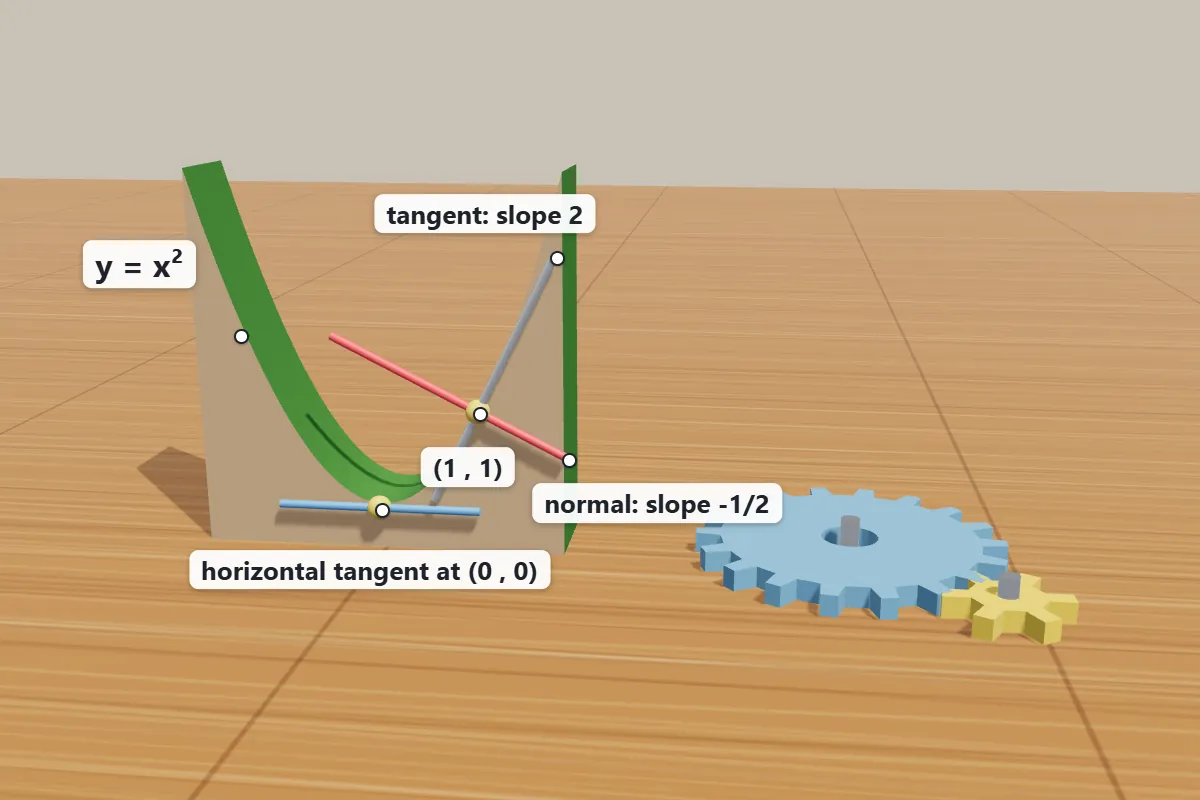
- • Determine the geometric equations of tangent and normal lines to planar curves at specified points.
- • Apply differentiation to real-world geometric and physical rates of change and optimization problems.
- 📖 Core Scientific Terminology & Definitions:
- 🔹 Derivative (dy/dx or f'(x)) The instantaneous rate of change of a function with respect to its independent variable, defined as the limit of the difference quotient as Δx approaches zero: lim(h → 0) [f(x+h) – f(x)] / h.
- 🔹 Chain Rule A fundamental theorem for differentiating composite functions: if y = f(u) and u = g(x), then dy/dx = (dy/du) × (du/dx).
- 🔹 Slope of Tangent Line The trigonometric tangent of the angle of inclination of the tangent line to the curve at point (x1, y1), evaluated by calculating the first derivative m = f'(x1).
| Comparison aspect | Main idea | Keywords |
|---|---|---|
| 🔹 Normal Line |
| straightperpendiculartangentexact |
| 🔹 Product Rule |
| derivativedifferentiablefunctionsequals |
| 🔹 Quotient Rule |
| derivativefunctionsequalsdenominator |
| Comparison aspect | Main idea | Keywords |
|---|---|---|
| • | ⚖️ Governing Mathematical & Physical Laws and Principles | GoverningMathematicalPhysicalLaws |
| ★ Power Rule of Differentiation |
| FormulaValidrealexponents |
| ★ Product and Quotient Rules | [ Formula: d/dx [u v] = u v' + v u' | d/dx [u / v] = (v u' – u v') / v2 ] Essential for differentiating complex rational and polynomial products | FormulaEssentialdifferentiatingcomplex |
| ★ Equation of the Tangent Line |
| Formulaevaluatedpointcontact |
| ★ Equation of the Normal Line | [ Formula: y – y1 = (-1 / m) × (x – x1) ] Perpendicular line to the tangent passing through the point of tangency | FormulaPerpendiculartangentpassing |
- 📌 Exhaustive In-Depth Academic Explanation & Scientific Analysis:
1. Foundational Differentiation Rules: Power, Product, and Quotient
- Calculus represents the mathematical language of dynamic change.
- The first derivative of a function y = f(x) measures the sensitivity to change of the function value (y) with respect to a change in its argument (x).
2. The Chain Rule and Extended Power Rule for Composite Functions
- In practical scientific and engineering formulations, functions are frequently nested as composites: y = f(g(x)).
- The Chain Rule dictates that the derivative of the composite function is the derivative of the outer function evaluated at the inner function, multiplied by the derivative of the inner function.
- Extended Power Rule If y = [u(x)]n, where u(x) is a differentiable function of x, then:
| Comparison aspect | Main idea | Example | Keywords |
|---|---|---|---|
| • | dy/dx = n × [u(x)]n – 1 × u'(x) | — | |
| Differentiating Radical Functions |
| — | squarerootsapplyingchain |
| Implicit Differentiation | For relations where y cannot be explicitly isolated as y = f(x) ( |
| relationscannotexplicitlyisolated |
3. Geometric Applications: Tangent and Normal Lines to Planar Curves
| Comparison aspect | Main idea | Keywords |
|---|---|---|
| • |
| geometricinterpretationderivativegradient |
| • | Methodology for Determining Tangent and Normal Equations | MethodologyDeterminingTangentNormal |
| Step 1 |
| Verifydeterminepointcontact |
| Step 2 | Differentiate the function algebraically to obtain the general derivative expression dy/dx = f'(x) | Differentiatefunctionalgebraicallyobtain |
| Step 3 | Substitute the numerical coordinates of the point of contact into f'(x) to calculate the numerical slope of the tangent: m = f'(x1) | Substitutenumericalcoordinatespoint |
| Step 4 | Formulate the Tangent Line Equation: y – y1 = m (x – x1) | FormulateTangentLineEquation |
- Formulate the Normal Line Equation: Since the normal line is perpendicular to the tangent line at the exact point of tangency, its slope is mnorm = -1/m (provided m ≠ 0). The equation is: y – y1 = (-1/m) (x – x1).
- Special Geometric Orientations:
- Tangent is horizontal (parallel to x-axis), equation is y = y1, and normal is vertical x = x1.
- Tangent is vertical (parallel to y-axis), equation is x = x1, and normal is horizontal y = y1.
- 📊 Detailed Comparative Analysis & Data Classifications:
- Summary Table of Calculus Differentiation Rules and Formulations
- ✏️ Step-by-Step Fully Solved Exemplary Numerical Problems & Proofs:
| Comparison aspect | Main idea | Keywords |
|---|---|---|
| • | ★ Determining Tangent and Normal Lines to an Algebraic Curve | DeterminingTangentNormalLines |
| Problem Statement & Given Data | Find the equations of the tangent line and the normal line to the curve y = (2x – 1) / (x + 2) at the point where x = 1 | Findequationstangentline |
| • | Step-by-Step Mathematical & Chemical Solution | StepMathematicalChemicalSolution |
| [1] Step 1 | Determine the y-coordinate of the point of contact: Substitute x = 1 into the curve equation | Determinecoordinatepointcontact |
| • | [2] y1 = (2(1) – 1) / (1 + 2) = (2 – 1) / 3 = 1/3 | |
| • |
| Pointtangency |
| [4] Step 2 | Differentiate y using the Quotient Rule: dy/dx = [(denominator)(derivative of numerator) – (numerator)(derivative of denominator)] / (denominator)2 | DifferentiateusingQuotientRule |
| • | [5] dy/dx = [(x + 2)(2) – (2x – 1)(1)] / (x + 2)2 = [2x + 4 – 2x + 1] / (x + 2)2 = 5 / (x + 2)2 | |
| [6] Step 3 | Evaluate the slope m at x = 1: m = 5 / (1 + 2)2 = 5 / 32 = 5/9 | Evaluateslope |
| [7] Step 4 | Equation of the Tangent Line: y – y1 = m (x – x1) ==> y – 1/3 = 5/9 (x – 1) | EquationTangentLine |
| [8] Multiply both sides by 9 | 9y – 3 = 5(x – 1) ==> 9y – 3 = 5x – 5 | |
| [9] Rearrange in standard form | 5x – 9y – 2 = 0 | |
| [10] Step 5 | Equation of the Normal Line: Slope of normal mnorm = -1 / (5/9) = -9/5 | EquationNormalLineSlope |
| [11] y – 1/3 = -9/5 (x – 1) ==> Multiply by 15 | 15y – 5 = -27(x – 1) ==> 15y – 5 = -27x + 27 | |
| [12] Rearrange in standard form | 27x + 15y – 32 = 0 | |
| 💡 High-Yield Exam Shortcut & Pitfall Alert | Exam Tip: Always double-check your tangent and normal slopes by verifying that mtangent × mnormal = (5/9) × (-9/5) = -1! | Alwaysdoublecheckyour |
| Function Type | Mathematical Formula y = f(x) | First Derivative dy/dx | Practical Exemplary Application |
|---|---|---|---|
| Constant Function | y = c | 0 | d/dx [7] = 0 |
| Power Function | y = xn | n xn – 1 | d/dx [x5] = 5 x4 |
| Constant Multiple | y = c u(x) | c u'(x) | d/dx [4 x3] = 12 x2 |
| Product of Functions | y = u × v | u v' + v u' | d/dx [x2 (3x + 1)] = x2(3) + (3x + 1)(2x) |
| Quotient of Functions | y = u / v | (v u' – u v') / v2 | d/dx [(2x+1)/(x-3)] = [(x-3)(2) – (2x+1)(1)] / (x-3)2 |
| Extended Power Chain | y = [u(x)]n | n [u(x)]n−1 × u'(x) | d/dx [(x2 + 5)4] = 4(x2 + 5)3 × (2x) = 8x(x2 + 5)3 |
| Square Root Chain | y = √u(x) | u'(x) / (2 √u(x)) | d/dx [√(3x2 + 1)] = 6x / (2 √(3x2 + 1)) = 3x / √(3x2 + 1) |
💡 💡 Essential Exam Traps, Tips & High-Yield Insights:
- The derivative of a square root is the derivative of the inside divided by twice the root: d/dx [√u] = u' / (2√u).
- The product rule is u v' + v u', never simply u' v'.
- The slope of the normal line is the negative reciprocal of the slope of the tangent line: mnorm = -1 / mtang.
- A horizontal tangent has dy/dx = 0; a vertical tangent has dy/dx = undefined (denominator of derivative equals zero).
- In implicit differentiation, remember to append (dy/dx) whenever differentiating any term containing y.
Lesson 2 – Rules of Differentiation, Chain Rule and Tangent Lines · 12 / 13
Well done! You finished this lesson
What would you like to do next?