Curriculum
Login

Curriculum

Mathematics

Text lesson

Lesson 1 Summary: Rate of Change and Differentiation Rules

Mathematics

Lesson 1 Summary: Rate of Change and Differentiation Rules

Key ideas at a glance

Key ideas at a glance

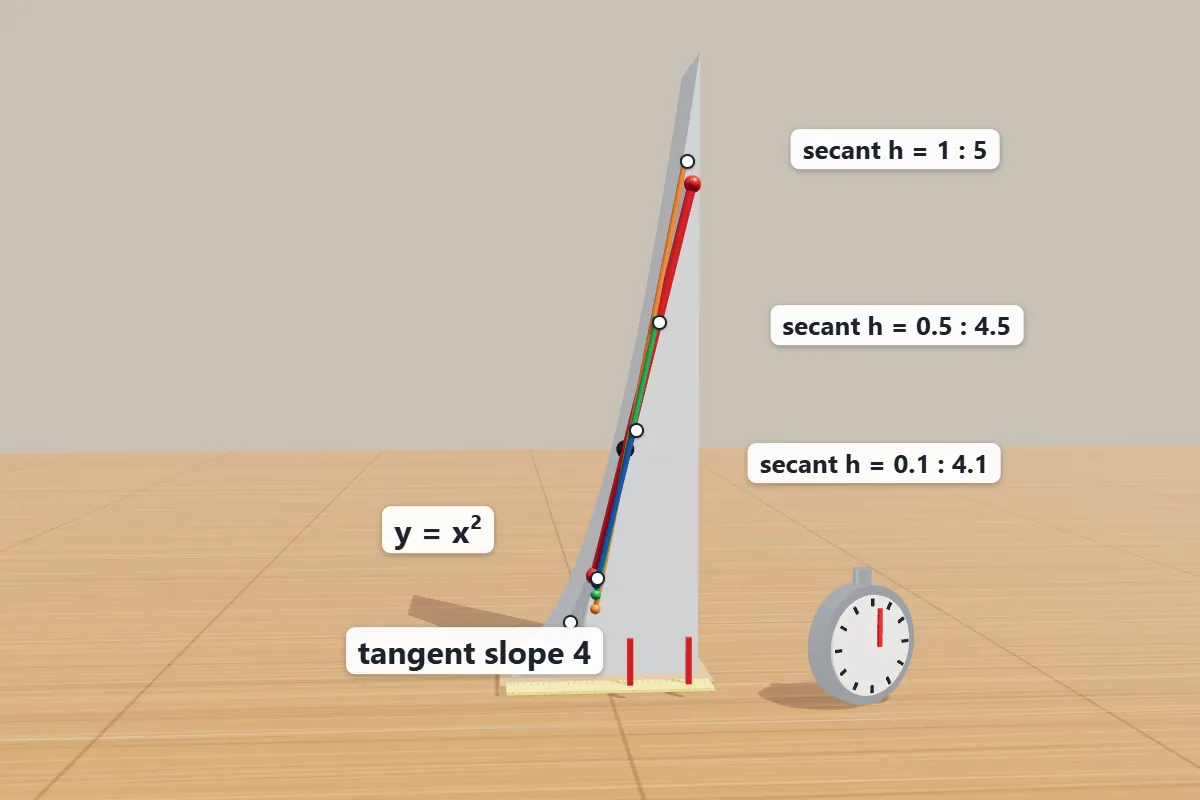
Rate of Change and Differentiation: a parabolic ramp with rods turning from secant to tangent shows rate of change and differentiation rules: slopes 5, 4.5, 4.1 approach 4.
  • Average rate of change of y = f(x) over an interval is (f(b) − f(a)) ÷ (b − a).
  • Instantaneous rate of change at x is the derivative f′(x), the limit of the average rate as the interval shrinks.
  • The derivative f′(x) is the slope of the tangent line to the graph at x.
  • If s(t) is a position, then v(t) = s′(t) is the velocity and a(t) = v′(t) is the acceleration.
Figure 1 – Geometric Tangent Slope and Rate of Change Secants
Figure 1 – Geometric Tangent Slope and Rate of Change Secants→Key ideas at a glance
Lesson 1 Summary: Rate of Change and Differentiation Rules · 1 / 5
Differentiation rules

Differentiation rules

Figure 2 – Product and Quotient Rules Differentiation Steps
Comparison aspectMain ideaKeywords
Power ruled/dx (xn) = n xn−1
Constant multipled/dx [c f(x)] = c f′(x)
Sum and differencethe derivative of a sum is the sum of the derivativesderivativederivatives
Product ruled/dx [u v] = u′v + uv′
Quotient rule
  • d/dx [u ÷ v] = (u′v − uv′) ÷ v2
  • for v ≠ 0
Chain ruled/dx [g(u(x))] = g′(u) × u′(x)
Lesson 1 Summary: Rate of Change and Differentiation Rules · 2 / 5
Rule comparison table

Rule comparison table

Rule Use it when Quick form
Power A single term xn Multiply by n, lower the power by 1
Product Two functions multiplied First × derivative of second + second × derivative of first
Quotient One function divided by another (bottom × derivative of top − top × derivative of bottom) ÷ bottom2
Chain A function inside another Outer derivative at the inner function × inner derivative
Lesson 1 Summary: Rate of Change and Differentiation Rules · 3 / 5
One short worked example for each rule

One short worked example for each rule

Tangent line.→The tangent to y = x2 at (3, 9) has slope 6, so its equation is y = 6x − 9.
Table 1 – Standard Derivative Formulas and Tangent Equations
Comparison aspectMain ideaKeywords
Power rule.d/dx (5x4) = 5 × 4x3 = 20x320x3
Sum rule.d/dx (3x2 − 4x + 7) = 6x − 4
Product rule.
  • For y = x2(x + 2)
  • write y = x3 + 2x2
  • so dy/dx = 3x2 + 4x. At x = 1
  • dy/dx = 7
write
Quotient rule.
  • For y = 2x ÷ (x + 1)
  • dy/dx = [2(x + 1) − 2x] ÷ (x + 1)2 = 2 ÷ (x + 1)2
Chain rule.
  • For y = (x2 + 1)3
  • dy/dx = 3(x2 + 1)2 × 2x = 6x(x2 + 1)2
Average rate.
  • For f(x) = x2 between x = 1 and x = 3
  • the average rate is (9 − 1) ÷ 2 = 4
between
Instantaneous rate.
  • The derivative of f(x) = x2 is 2x
  • so at x = 2 the rate is 4. This equals the average rate found above
  • because the two points are symmetric around x = 2
derivativeequalsaveragefound
Velocity.
  • If s(t) = t3 − 3t metres
  • then v(t) = 3t2 − 3. At t = 2 s
  • v = 9 m/s
metresthen
Lesson 1 Summary: Rate of Change and Differentiation Rules · 4 / 5
Lesson summary

Lesson summary

  • The derivative gives an instantaneous rate, and the average rate gives the rate over an interval.
  • Choose the rule that matches the shape of the expression before differentiating.
  • For a tangent line, find the point, then the slope f′(x), then use y − y₁ = m(x − x₁).
  • Derivatives of motion velocity is the derivative of position, and acceleration is the derivative of velocity.
Lesson 1 Summary: Rate of Change and Differentiation Rules · 5 / 5