| Power rule. | d/dx (5x4) = 5 × 4x3 = 20x3 | 20x3 |
| Sum rule. | d/dx (3x2 − 4x + 7) = 6x − 4 | |
| Product rule. | - For y = x2(x + 2)
- write y = x3 + 2x2
- so dy/dx = 3x2 + 4x. At x = 1
- dy/dx = 7
| write |
| Quotient rule. | - For y = 2x ÷ (x + 1)
- dy/dx = [2(x + 1) − 2x] ÷ (x + 1)2 = 2 ÷ (x + 1)2
| |
| Chain rule. | - For y = (x2 + 1)3
- dy/dx = 3(x2 + 1)2 × 2x = 6x(x2 + 1)2
| |
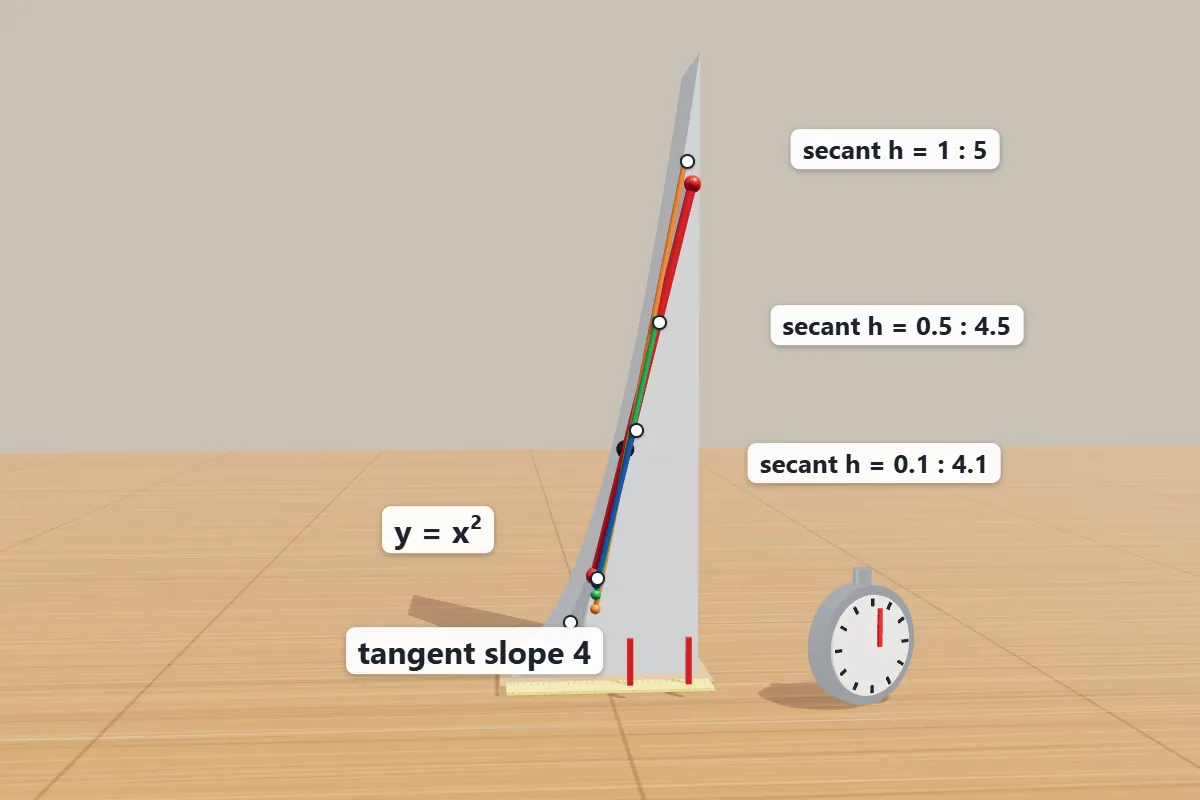
| Average rate. | - For f(x) = x2 between x = 1 and x = 3
- the average rate is (9 − 1) ÷ 2 = 4
| between |
| Instantaneous rate. | - The derivative of f(x) = x2 is 2x
- so at x = 2 the rate is 4. This equals the average rate found above
- because the two points are symmetric around x = 2
| derivativeequalsaveragefound |
| Velocity. | - If s(t) = t3 − 3t metres
- then v(t) = 3t2 − 3. At t = 2 s
- v = 9 m/s
| metresthen |