Curriculum
Mathematics
Unit 1
0/12
1.1Key terms1.2Laws and key relationships1.3Rigorous Derivation of Reciprocal Trigonometric Functions1.4Logarithmic and General Exponential Differentiation Techniques1.5Parametric and Implicit Second-Order Derivatives1.6Worked examples1.7Exam tips1.8Real-world applications1.9Key Scientific Tables & Anatomical Diagrams Extracted from Official Curricula1.10📌 Comprehensive Scientific Terminology Dictionary:1.11🔍 In-Depth Explanations, Deductions & Multi-Book Insights:1.12Lesson summary
Unit 2
0/141.1The counting principle1.2Permutations (nPr)1.3Combinations (nCr)1.4Worked examples on counting, permutations and combinations1.5Recall: counting principle, permutations and combinations1.61-1 (a) Pascal's triangle and the binomial expansion1.71-1 (b) The general term1.81-1 (c) The middle term1.91-2 The term containing xk and the term free of x1.101-3 (a) The ratio between two consecutive terms1.111-3 (b) The greatest term1.12Key Scientific Tables & Anatomical Diagrams Extracted from Official Curricula1.13Lesson 1 - Counting Principle, Permutations and Combinations and the Binomial Theorem1.14Lesson summary
Unit 3
0/131.1Key terms1.2Laws and key relationships1.3Geometry of 3D Vectors and Scalar/Cross Product Physics1.4Equations of Straight Lines in Three Dimensions1.5Equations of Planes and Perpendicular Distance Formulas1.6Worked examples1.7Exam tips1.8Real-world applications1.9Key Scientific Tables & Anatomical Diagrams Extracted from Official Curricula1.10📌 Comprehensive Scientific Terminology Dictionary:1.11⚖️ Governing Physical Laws & Mathematical Relations:1.12🔍 In-Depth Explanations, Deductions & Multi-Book Insights:1.13Lesson summary
Unit 4
0/81.11 Smooth and rough surfaces1.22 Properties of the static friction force1.33 Kinetic friction force1.44 The resultant reaction R′1.55 The angle of friction1.66 Equilibrium of a body on a rough horizontal plane1.77 Equilibrium of a body on a rough inclined plane1.88 Conditions of equilibrium and rigid bodies with friction
Unit 5
0/121.13-1 (a) Indefinite integrals of exponential functions1.23-1 (b) Indefinite integrals of logarithmic functions1.33-2 (a) The differential and the standard integrals1.43-2 (b) Integration by substitution1.53-2 (c) Integration by parts1.63-2 (d) Applications of the indefinite integral1.73-3 (a) The definite integral and the fundamental theorem of calculus1.83-3 (b) Properties of the definite integral1.93-3 (c) Definite integral by substitution, odd and even functions1.103-4 (a) Area of a plane region1.113-4 (b) Volumes of solids of revolution1.12Key Scientific Tables & Anatomical Diagrams Extracted from Official Curricula
Unit 6
0/81.12-1 (a) Polar coordinates and the Argand plane1.22-1 (b) Modulus, amplitude and principal amplitude1.32-1 (c) The trigonometric (polar) form of a complex number1.42-1 (d) Product and quotient in trigonometric form1.52-1 (e) The exponential (Euler) form1.62-2 (a) De Moivre's theorem for a positive integer power1.72-2 (b) De Moivre's theorem for a rational power and the roots of a complex number1.82-3 The cube roots of unity
Unit 7
0/101.11 Momentum and its change1.22 Newton's first law, inertia and force1.33 Newton's second law, the equation of motion and variable mass1.44 Newton's third law, lifts and scales1.55 Bodies connected by a string over a smooth pulley1.66 Impulse1.77 Work1.88 Kinetic energy and the work-energy principle1.99 Potential energy and conservation of energy1.1010 Power
Text lesson
Parallel Coplanar Forces: Resultant and Equilibrium
Parallel Coplanar Forces: Resultant and Equilibrium
Overview
Overview
- This lesson covers lessons 2-1 and 2-2 of the statics unit "Parallel Coplanar Forces". After it you should be able to:
- find the resultant of two like or two unlike parallel forces, and of a whole system of parallel forces;
- use the moment theorem to locate the line of action of the resultant;
- apply the conditions of equilibrium to rods, boards and ladders.
🌳 Concept tree
- Resultant and Equilibrium
- ├── 2-1 (a) Parallel forces acting on a rigid body
│ ├── Why a new idea is needed
│ └── A balancing experiment
- ├── 2-1 (b) The resultant of two like parallel forces
│ ├── Rule
│ └── Where the rule comes from
- ├── 2-1 (c) The resultant of two unlike parallel forces
│ └── Rule
├── 2-1 (d) Finding one force from the resultant
│ └── Method
├── 2-1 (e) The moment theorem (Varignon)
│ ├── Theorem
│ ├── Proof for two like forces
│ └── Consequence
- ├── 2-1 (f) The resultant of a system of parallel forces
│ ├── Procedure
│ └── Balance (centre of parallel weights)
├── 2-1 (g) Theoretical results
│ ├── Moving one of two like forces
│ └── Forces given as vectors
├── 2-2 (a) Conditions of equilibrium
│ ├── The two conditions
│ └── In components
├── 2-2 (b) Beams on supports
│ └── Procedure
├── 2-2 (c) Tilting and limiting positions
│ └── Idea
- ├── 2-2 (d) A rod on a rough surface and a smooth wedge
│ └── Method
├── 2-2 (e) A ladder against a smooth wall
│ └── Setting
└── 2-2 (f) Summary
├── Comparison
└── Checklist
Parallel Coplanar Forces: Resultant and Equilibrium · 1 / 14
2-1 (a) Parallel forces acting on a rigid body
2-1 (a) Parallel forces acting on a rigid body
Why a new idea is needed
- For forces acting on one particle the lines of action all pass through a single point, and their resultant passes through that same point.
- For forces acting on a rigid body the lines of action need not meet. Parallel forces never meet, so we must also find where the resultant acts.
- Like forces are parallel and in the same direction. Unlike forces are parallel and in opposite directions.
- A uniform ruler balances on a pivot at its centre.
- If two equal stones sit at the ends, the pivot stays at the centre. If one stone is doubled, the pivot must move towards the heavier end.
- The pivot is directly under the point where the resultant of the two weights acts.
Parallel Coplanar Forces: Resultant and Equilibrium · 2 / 14
2-1 (b) The resultant of two like parallel forces
2-1 (b) The resultant of two like parallel forces
Rule
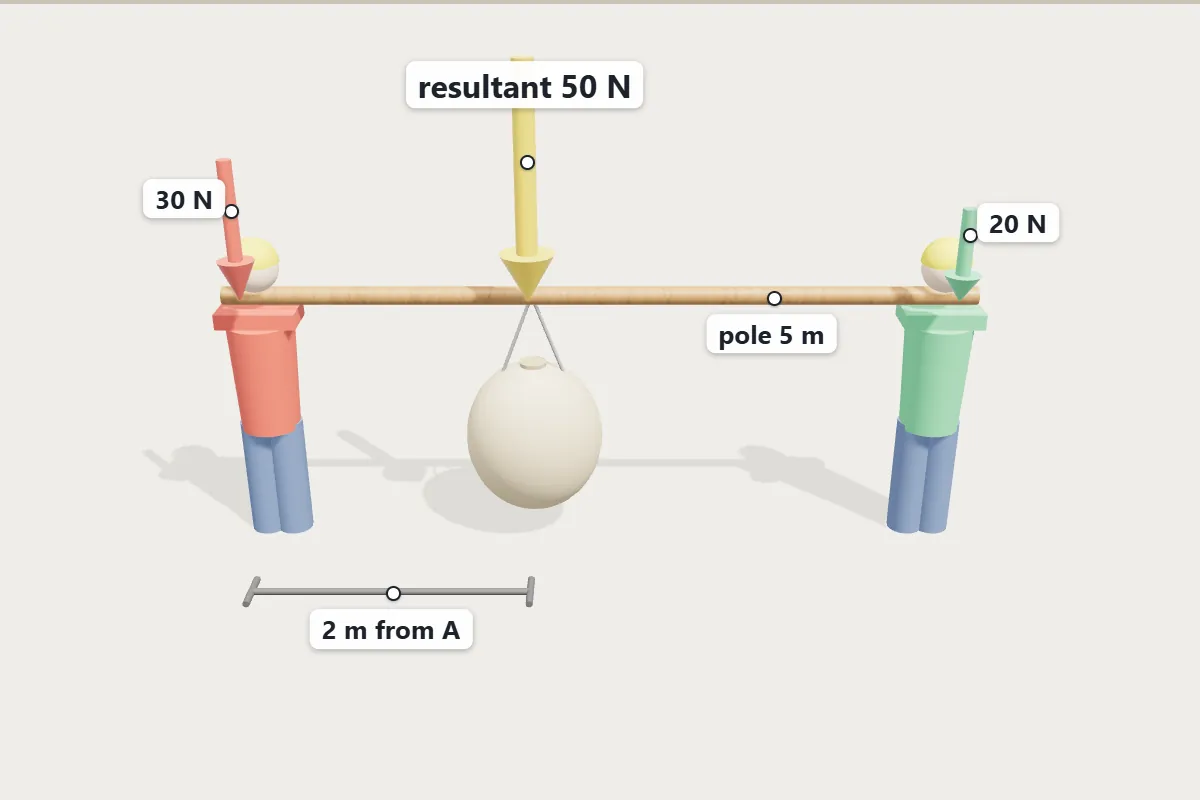
- Let and be like forces at points and of a rigid body.
- Their resultant is parallel to them, in the same direction, with magnitude
- Its line of action cuts the line at an inner point which divides internally in the inverse ratio of the forces:
- So is nearer to the larger force.
Where the rule comes from
- Add two equal and opposite forces along at and at ; they do not change the effect.
- Combine with the force at , and with the force at , by the parallelogram law. The two resultants meet at a point .
- Resolve them again at O the added horizontal forces cancel and F1, F2 act together along the line through O.
- Similar triangles then give and , so .
✍️ Worked examples
- Example 1 Two like forces of 5 N and 7 N act at and with cm. Find their resultant.
- Solution:
- N, in the direction of the two forces.
- with , so cm.
- The resultant acts 21 cm from (the end of the 5 N force) and 15 cm from .
- Example 2 Where does the resultant of two equal like forces act?
- Solution:
- With , , so the resultant acts at the midpoint of with magnitude .
Parallel Coplanar Forces: Resultant and Equilibrium · 3 / 14
2-1 (c) The resultant of two unlike parallel forces
2-1 (c) The resultant of two unlike parallel forces
Rule
- Let act in opposite directions at and .
- The resultant is parallel to them, in the direction of the larger force, with magnitude
- Its line of action cuts at a point outside the segment, on the side of the larger force, and
- Here is again nearer to the larger force .
- If F1=F2 there is no resultant force the pair is a couple (see the next lesson).
✍️ Worked examples
- Example 3 Unlike forces of 100 N (at ) and 40 N (at ) act at points 240 cm apart. Find the resultant.
- Solution:
- N in the direction of the 100 N force.
- lies on produced beyond , with .
- , so and cm.
- The resultant acts 160 cm from outside the segment .
Parallel Coplanar Forces: Resultant and Equilibrium · 4 / 14
2-1 (d) Finding one force from the resultant
2-1 (d) Finding one force from the resultant
Method
- Take the unit vector along the resultant and use with signs.
- Take moments about the point where the resultant acts; the sum of moments of the forces about that point is zero.
✍️ Worked examples
- Example 4:
- One of two parallel forces is 20 N.
- The resultant is 35 N, and its line of action is 15 cm from the 20 N force.
- Find the other force and its position in each case (a) the 20 N force and the resultant have the same direction, (b) opposite directions.
- Solution:
- (a) , so N, in the same direction.
- Moments about C (point of the resultant) 20×15=15×BC, so BC=20 cm. The 15 N force is on the other side of C, so AB=15+20=35 cm.
- (b) The resultant (35 N) is opposite to the 20 N force, so and N in the direction of the resultant.
- Moments about C 20×15=55×BC, so BC=6011 cm.
- Both and the 55 N force are on the same side of the 20 N force, so cm.
Parallel Coplanar Forces: Resultant and Equilibrium · 5 / 14
2-1 (e) The moment theorem (Varignon)
2-1 (e) The moment theorem (Varignon)
Theorem
- The algebraic sum of the moments of a system of parallel coplanar forces about any point in their plane equals the moment of their resultant about the same point.
- Write .
- Draw the common perpendicular through meeting the lines of action at , and (for ).
- Moment sum about O −F1⋅OA−F2⋅OB (with OA=OC−AC and OB=OC+CB in the appropriate arrangement).
- Using the sum becomes , which is the moment of .
- For unlike forces the same method gives .
- A system of many forces is handled by combining forces in pairs.
- If the resultant is zero, the sum of moments about any point is zero or constant (the system is either in equilibrium or equivalent to a couple).
- The theorem is the tool for locating the line of action of a resultant: take moments about a convenient point.
✍️ Worked examples
- Example 5:
- Parallel forces act perpendicular to a line at the points , , , , which are 0, 4, 9 and 16 cm from .
- The force at is 5 N, at it is 6 N, at it is 4 N in the opposite sense to the force at , and at it is 2 N in the same sense as the force at .
- Find the algebraic sum of the moments about (take the sense of the force at as positive).
- Solution:
- The 5 N force at has zero moment about .
- Moments about A 6×4−4×9+2×16=24−36+32=20 N·cm.
Parallel Coplanar Forces: Resultant and Equilibrium · 6 / 14
2-1 (f) The resultant of a system of parallel forces
2-1 (f) The resultant of a system of parallel forces
Procedure
- Choose a positive direction (a unit vector along the forces) and add the forces with signs: .
- If , take moments about a convenient point (often the first force):
where is the distance from to the line of action of , and the signed distance of each force. - State the magnitude, direction and position of the resultant (where it cuts the line through the points).
✍️ Worked examples
- Example 6 lie on a line with . Like forces of 30, 50, 20, 70, 40 N act at . Find the resultant.
- Solution:
- N, in the common direction.
- Let , so the distances from are .
- Moments about A R⋅AO=50(2x)+20(5x)+70(9x)+40(16x)=100x+100x+630x+640x=1470x.
- , so .
- The resultant divides AE internally in the ratio 7 16 from A.
- Example 7:
- Four forces act on points of a line with cm, cm, cm: 10 N down at , 25 N up at , 15 N down at , 20 N up at .
- Find the resultant.
- Solution:
- Take upward as positive R=−10+25−15+20=20 N upward.
- Distances from A 0,2,5,10 cm.
- Moments about A 25(2)−15(5)+20(10)=50−75+200=175 N·cm.
- , so cm from , on .
- Example 8:
- A light rod carries a downward force 8 N at , an upward 14 N at 3 m from , and a downward 4 N at (6 m from ).
- Find the resultant.
- Solution:
- Upward positive R=−8+14−4=2 N upward.
- Moments about A 14(3)−4(6)=42−24=18 N·m.
- m from along produced beyond (outside the rod).
Balance (centre of parallel weights)
- The weights of particles on a light rod have a resultant equal to the total weight, acting at the balance point.
- Example a light rod 1 m long carries 2 N at one end and 3 N at the other; the balance point is 25×100=40 cm from the 3 N end.
Parallel Coplanar Forces: Resultant and Equilibrium · 7 / 14
2-1 (g) Theoretical results
2-1 (g) Theoretical results
Moving one of two like forces
✍️ Worked examples
- Example 9:
- Like forces and act at and with resultant .
- If moves parallel to itself a distance along , prove that the resultant moves a distance in the same direction.
- Solution:
- Moments about A R⋅AC=F2⋅AB.
- After the move the point of action of is with , and the resultant acts at : .
- Subtract R (AC′−AC)=F2 x, so CC′=F2Rx=F2F1+F2x.
Forces given as vectors
✍️ Worked examples
- Example 10 acts at and acts at . Find the resultant and the point where its line of action meets .
- Solution:
- .
- , so the forces are parallel and in the same direction.
- ACCB=F2F1=21, so C divides AB in the ratio 2 1 from A.
- .
Parallel Coplanar Forces: Resultant and Equilibrium · 8 / 14
2-2 (a) Conditions of equilibrium
2-2 (a) Conditions of equilibrium
The two conditions
| Comparison aspect | Main idea | Keywords |
|---|---|---|
| • | A rigid body acted on by coplanar forces is in equilibrium if and only if | rigidbodyactedcoplanar |
| the resultant vector is zero | R⃗=0⃗ | |
| the sum of moments about any point is zero | ∑M=0 |
- Take and in the plane and perpendicular to it.
- and the moment is along , so the conditions become
- For parallel forces (say vertical), the first reduces to one equation: the forces up equal the forces down.
- The moment equation can be taken about any point; the best choice is a point where an unknown force acts, to eliminate it.
Parallel Coplanar Forces: Resultant and Equilibrium · 9 / 14
2-2 (b) Beams on supports
2-2 (b) Beams on supports
Procedure
- Draw all forces weights (a uniform rod’s weight acts at its midpoint), loads, reactions of supports, tensions.
- Write "vertical forces balance".
- Take moments about one support to find the other reaction directly.
✍️ Worked examples
- Example 11:
- A uniform wooden board, 6 m long, has mass 30 kg per metre.
- It rests horizontally on supports at its ends and and a box of 240 kg·wt is on the board 4 m from .
- Find the reaction at each support.
- Solution:
- Mass of board kg, so its weight is 180 kg·wt at the middle (3 m from each end).
- Vertical balance RA+RB=180+240=420.
- Moments about B RA×6=180×3+240×4=540+960=1500.
- kg·wt and kg·wt.
- As the box moves closer to , increases and decreases.
- Example 12:
- A uniform rod of length 90 cm and weight 60 N is hung horizontally by two vertical strings at its ends.
- Where must a 150 N weight be hung so that the tension at is twice the tension at ?
- Solution:
- Let the tension at be and at be .
- Vertical balance 2T+T=150+60, so T=70 N.
- Moments about A 150x+60(45)=T×90=6300.
- , so cm from .
- Example 13:
- A motorcycle of mass 200 kg has its weight acting midway between the wheels, 1.4 m apart.
- A rider of 84 kg·wt sits with the weight acting 1 m behind the front wheel.
- Find the ground reactions on each wheel (a) without the rider, (b) with the rider.
- Solution:
- (a) By symmetry each wheel carries kg·wt.
- (b) Moments about the front wheel Rrear×1.4=200×0.7+84×1=224, so Rrear=160 kg·wt.
- Vertical balance Rfront=284−160=124 kg·wt.
Parallel Coplanar Forces: Resultant and Equilibrium · 10 / 14
2-2 (c) Tilting and limiting positions
2-2 (c) Tilting and limiting positions
Idea
- A beam on two supports is about to tilt about one support when the reaction at the other support becomes zero.
- Take moments about the support that remains in contact.
✍️ Worked examples
- Example 14:
- A uniform beam of length 6 m and weight 40 kg·wt rests on supports at (1 m from ) and (1 m from ).
- A man of weight 100 kg·wt walks from the middle towards .
- How far from is he when the beam is about to tilt?
- Solution:
- At the limit the reaction at is zero, so take moments about (5 m from ).
- The beam’s weight is 2 m to the left of D anticlockwise moment 40×2=80.
- The man at distance x from A is (x−5) to the right of D clockwise moment 100(x−5).
- , so m from (0.2 m from the end ).
- Example 15 Two men carry a body of 90 kg hanging from a light rod 60 cm long, with the body 20 cm from man . Find the load each carries.
- Solution:
- Moments about A RB×60=90×20, so RB=30 kg·wt.
- RA=90−30=60 kg·wt the man nearer the load carries more.
Parallel Coplanar Forces: Resultant and Equilibrium · 11 / 14
2-2 (d) A rod on a rough surface and a smooth wedge
2-2 (d) A rod on a rough surface and a smooth wedge
Method
- Forces on the rod weight W, reaction of the wedge S (perpendicular to the rod, since the wedge is smooth), the ground reaction R and friction F at the lower end.
- Use , and moments about the foot of the rod.
- At the point of slipping, .
✍️ Worked examples
- Example 16:
- A uniform bar of weight 5 kg·wt and length 30 cm rests with on rough ground and touches a smooth wedge at , 12.5 cm above the ground, at to the horizontal.
- It is about to slip.
- Find the reaction of the wedge and the coefficient of friction.
- Solution:
- cm. The weight acts 15 cm from .
- Moments about A 5×15cos30∘=S×25, so S=3cos30∘=332≈2.60 kg·wt.
- The wedge reaction is perpendicular to the bar, so it makes with the vertical. Horizontal: .
- Vertical R+Scos30∘=5, so R=5−332⋅32=5−94=114.
- .
Parallel Coplanar Forces: Resultant and Equilibrium · 12 / 14
2-2 (e) A ladder against a smooth wall
2-2 (e) A ladder against a smooth wall
Setting
| Comparison aspect | Main idea | Keywords |
|---|---|---|
| • | A uniform ladder of weight and length rests with its foot on rough horizontal ground and its top against a smooth vertical wall. | uniformladderweightlength |
| Forces |
| weightmiddleverticalground |
| Conditions |
| momentsgive |
| Limiting equilibrium | F=μR |
✍️ Worked examples
- Example 17:
- A uniform ladder of weight makes an angle with the ground and is about to slip.
- The coefficient of friction at the ground is .
- Find .
- Solution:
- and .
- Moments about the foot S ℓsinθ=W ℓ2cosθ.
- , so .
- With the ladder is on the point of slipping at ; it is safe for larger angles.
- Example 18:
- A uniform ladder of weight 20 kg·wt rests at to the horizontal against a smooth wall on rough ground with .
- Show that a girl of weight 60 kg·wt can climb half the length of the ladder before it slips.
- Solution:
- Let the ladder have length and the girl be along it from the foot.
- Vertical R=20+60=80 kg·wt. Limiting friction: F=μR=8023=403, and S=F.
- Moments about the foot S ℓsin60∘=20⋅ℓ2cos60∘+60 xcos60∘.
- Left side 403⋅32ℓ=20ℓ. Right side: 5ℓ+30x.
- gives .
- Example 19:
- A uniform ladder of weight 30 kg·wt and length 4 m rests on a smooth floor against a smooth wall at , held by a horizontal rope at the foot.
- Show the tension grows as a man of weight 80 kg·wt climbs.
- Solution:
- Floor reaction ; the rope tension balances the wall reaction : .
- Moments about the foot with the man at distance along the ladder: , so .
- increases with .
- If the rope can bear at most 67 kg·wt, then gives m.
Parallel Coplanar Forces: Resultant and Equilibrium · 13 / 14
2-2 (f) Summary
2-2 (f) Summary
| Point of comparison | Like forces | Unlike forces |
|---|---|---|
| Direction of | same as the forces | that of the larger force |
| Magnitude of | ||
| Position of | between the forces | outside, beyond the larger force |
| Relation | ||
| Equal forces | resultant at the midpoint | no resultant (a couple) |
Checklist
- Choose a positive direction before adding forces.
- Take moments about a point where an unknown force acts.
- Check the signs of clockwise and anticlockwise moments.
- Check results the sum of moments about a second point must also be zero.
- .egp-ex{margin:18px 0;border:1px solid rgba(79,63,224,.2);border-radius:16px;overflow:hidden;background:#fff}.egp-ex-h{padding:10px 16px;font-weight:800;background:linear-gradient(90deg,#4f3fe0,#22c1c3);color:#fff}.egp-ex-tabs{display:flex;flex-wrap:wrap;gap:6px;padding:10px 12px;background:#f7f6ff}.egp-ex-b{border:1px solid rgba(79,63,224,.3);background:#fff;border-radius:20px;padding:5px 14px;font-weight:700;cursor:pointer}.egp-ex-b.on{background:#4f3fe0;color:#fff}.egp-ex-p{padding:12px 16px}
Parallel Coplanar Forces: Resultant and Equilibrium · 14 / 14
Well done! You finished this lesson
What would you like to do next?