Curriculum
Login

Curriculum

Mathematics

Text lesson

Trigonometry: Sine Rule, Cosine Rule and Triangle Area

Mathematics

Trigonometry: Sine Rule, Cosine Rule and Triangle Area

Overview

Overview

  • Apply the sine rule and the cosine rule to non-right-angled triangles.
  • Decide which rule the given information calls for.
  • Find the area of any triangle using two sides and the included angle.

🌳 Concept tree

  • Trigonometry of Any Triangle
  • ├── Sine rule
  • │ ├── a/sin A = b/sin B = c/sin C
  • │ └── The ambiguous case
  • ├── Cosine rule
  • │ ├── a2 = b2 + c2 − 2bc cos A
  • │ └── Finding an angle
  • ├── Area
  • │ └── Area = ½ ab sin C
  • └── Choosing the rule from the given data
Trigonometry: Sine Rule, Cosine Rule and Triangle Area · 1 / 6
The sine rule

The sine rule

Statement

  • a/sin A = b/sin B = c/sin C = 2R, where R is the circumradius of the triangle.
  • Use it when you know a matching pair a side and the angle opposite to it.
Given a = 7, A = 40°, B = 60°b = a·sin B / sin A = 7·sin 60° / sin 40° = 7(0.866)/0.643 ≈ 9.43.
Given b = 10, B = 50°, C = 70°c = 10·sin 70° / sin 50° = 10(0.940)/0.766 ≈ 12.27.
Finding a side with the circumradiusa = 2R sin A. If R = 6 and A = 30°, then a = 12 × 0.5 = 6.

The ambiguous case

  • When you are given two sides and a non-included angle (SSA), two different triangles may satisfy the data.
  • Because sin(180° − A) = sin A, both A and 180° − A are possible; check whether both angles leave a valid third angle.
  • Example a = 6, b = 8, A = 35° → sin B = 8 sin 35°/6 ≈ 0.765 → B ≈ 49.9° or B ≈ 130.1°. Both are valid because 49.9° + 35° < 180° and 130.1° + 35° < 180°.
Trigonometry: Sine Rule, Cosine Rule and Triangle Area · 2 / 6
The cosine rule

The cosine rule

Statement

  • a2 = b2 + c2 − 2bc cos A.
  • For an angle cos A = (b2 + c2 − a2) / (2bc).
  • Use it when you know two sides and the included angle (SAS) or all three sides (SSS).
Sides b = 5, c = 7, included angle A = 60°a2 = 25 + 49 − 2(5)(7)(0.5) = 74 − 35 = 39 → a = √39 ≈ 6.24.
Sides a = 8, b = 6, c = 5; find angle Acos A = (36 + 25 − 64)/(2·6·5) = −3/60 = −0.05 → A ≈ 92.9°.
A right angle checkif a2 = b2 + c2, then cos A = 0 and A = 90° — Pythagoras is the cosine rule with cos 90° = 0.
Given Use
Two angles and any side Sine rule
  • A side and its opposite angle
  • plus one more side or angle
Sine rule
Two sides and the included angle Cosine rule
Three sides Cosine rule (to find an angle)
Two sides and a non-included angle Sine rule, then check the ambiguous case
Trigonometry: Sine Rule, Cosine Rule and Triangle Area · 3 / 6
Area of a triangle

Area of a triangle

Comparison aspectMain ideaKeywords
•
  • Area = ½ ab sin C
  • where a and b are two sides and C is the angle between them
Areasidesanglebetween
Example
  • a = 5
  • b = 7
  • C = 60° → Area = ½(5)(7)(sin 60°) = 17.5 × 0.866 ≈ 15.16
Area
Example
  • b = 10
  • c = 12
  • A = 30° → Area = ½(10)(12)(0.5) = 30
Area
Heron's formula for three sides
  • Area = √(s(s − a)(s − b)(s − c))
  • where s = (a + b + c)/2
Area
Example
  • sides 5
  • 7 → s = 9 → Area = √(9·4·3·2) = √216 ≈ 14.70
sidesArea
  • The classic ½ × base × height is still valid; use the trigonometric form when the height is not given.
  • In an obtuse triangle, sin C stays positive, so the formula still gives a positive area.

The formula

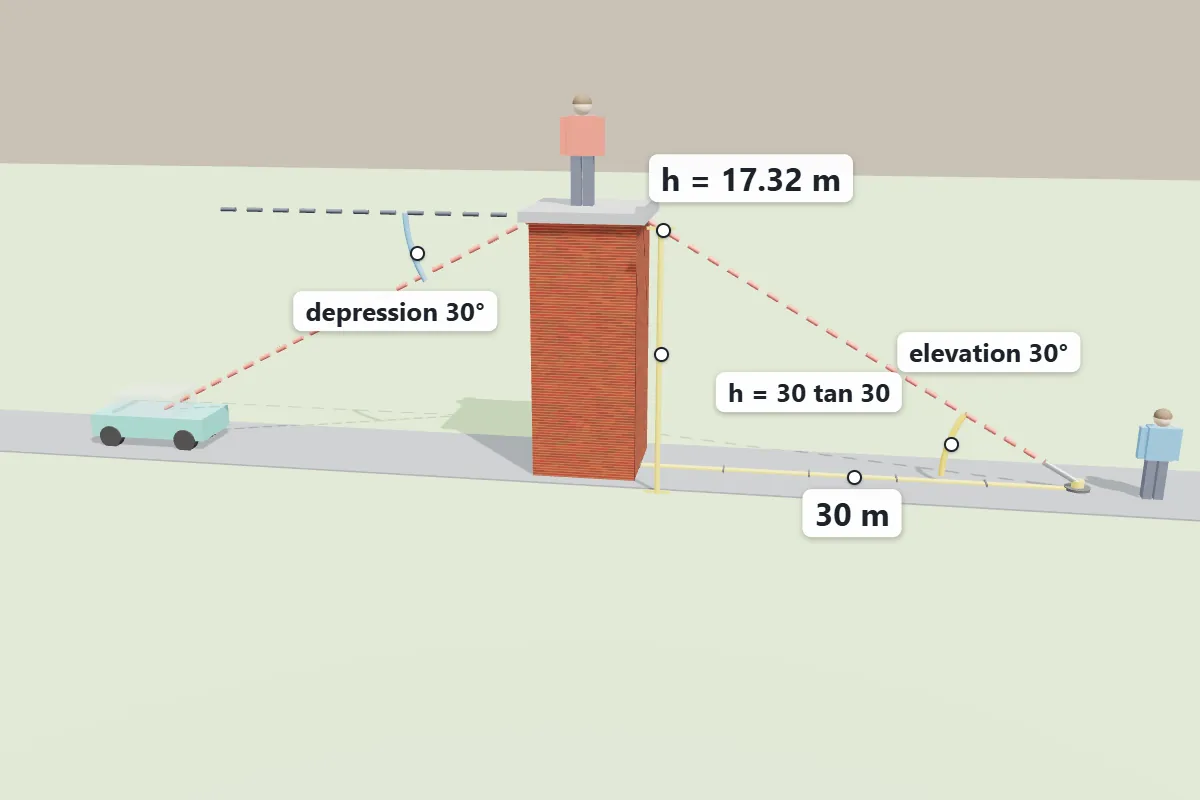
Trigonometry: a tower and a surveyor's theodolite show applications of trigonometry: elevation 30 degrees from 30 m gives a height of 17.32 m.
Trigonometry→a tower and a surveyor's theodolite show applications of trigonometry: elevation 30 degrees from 30 m gives a height of 17.32 m.: Area of a triangle
Trigonometry: Sine Rule, Cosine Rule and Triangle Area · 4 / 6
Practice with full answer key

Practice with full answer key

  1. a = 9, A = 45°, B = 30°; find b → b = 9 sin30/sin45 = 6.36
  2. b = 12, c = 15, A = 120°; find a → a2 = 144 + 225 − 360(−0.5) = 549 → a ≈ 23.43
  3. Sides 7, 8, 10; find the largest angle → cos C = (49 + 64 − 100)/(2·7·8) = 13/112 → C ≈ 83.3°
  4. Two sides 6 and 8 with included angle 45°; find the area → ½·6·8·sin45 = 16.97
  5. In a triangle, a = 4, b = 6, A = 30°; how many triangles are possible? → sin B = 6 sin30/4 = 0.75 → B ≈ 48.6° or 131.4°; only the first leaves C > 0 with the second? 30 + 131.4 < 180 as well — check both and state both; the safe answer is two possibilities
  6. A triangle has area 30 and sides 10 and 12; find the included angle → 30 = ½·10·12·sin C → sin C = 0.5 → C = 30° or 150°
Trigonometry: Sine Rule, Cosine Rule and Triangle Area · 5 / 6
Exam traps and key takeaways

Exam traps and key takeaways

💡 High-yield traps

  • In the cosine rule the minus sign is essential a2 = b2 + c2 − 2bc cos A. A plus sign is the most frequent error.
  • The angle in ½ab sin C must be the included angle; using any other angle gives a wrong area.
  • Calculator mode degrees unless the question says otherwise — radian answers lose all marks.
  • With the sine rule, always test whether the obtuse alternative is possible; the ambiguous case is a standard exam item.
  • For an obtuse angle cos A is negative, which makes a2 larger than b2 + c2; do not reject the negative value.
Trigonometry: Sine Rule, Cosine Rule and Triangle Area · 6 / 6