Trigonometry: Sine Rule, Cosine Rule and Triangle Area
Mathematics
Trigonometry: Sine Rule, Cosine Rule and Triangle Area
Overview
Overview
Apply the sine rule and the cosine rule to non-right-angled triangles.
Decide which rule the given information calls for.
Find the area of any triangle using two sides and the included angle.
🌳 Concept tree
Trigonometry of Any Triangle
├── Sine rule
│ ├── a/sin A = b/sin B = c/sin C
│ └── The ambiguous case
├── Cosine rule
│ ├── a2 = b2 + c2 − 2bc cos A
│ └── Finding an angle
├── Area
│ └── Area = ½ ab sin C
└── Choosing the rule from the given data
Trigonometry: Sine Rule, Cosine Rule and Triangle Area · 1 / 6
The sine rule
The sine rule
Statement
a/sin A = b/sin B = c/sin C = 2R, where R is the circumradius of the triangle.
Use it when you know a matching pair a side and the angle opposite to it.
Given a = 7, A = 40°, B = 60°b = a·sin B / sin A = 7·sin 60° / sin 40° = 7(0.866)/0.643 ≈ 9.43.
Given b = 10, B = 50°, C = 70°c = 10·sin 70° / sin 50° = 10(0.940)/0.766 ≈ 12.27.
Finding a side with the circumradiusa = 2R sin A. If R = 6 and A = 30°, then a = 12 × 0.5 = 6.
The ambiguous case
When you are given two sides and a non-included angle (SSA), two different triangles may satisfy the data.
Because sin(180° − A) = sin A, both A and 180° − A are possible; check whether both angles leave a valid third angle.
Example a = 6, b = 8, A = 35° → sin B = 8 sin 35°/6 ≈ 0.765 → B ≈ 49.9° or B ≈ 130.1°. Both are valid because 49.9° + 35° < 180° and 130.1° + 35° < 180°.
Trigonometry: Sine Rule, Cosine Rule and Triangle Area · 2 / 6
The cosine rule
The cosine rule
Statement
a2 = b2 + c2 − 2bc cos A.
For an angle cos A = (b2 + c2 − a2) / (2bc).
Use it when you know two sides and the included angle (SAS) or all three sides (SSS).
Sides b = 5, c = 7, included angle A = 60°a2 = 25 + 49 − 2(5)(7)(0.5) = 74 − 35 = 39 → a = √39 ≈ 6.24.
Sides a = 8, b = 6, c = 5; find angle Acos A = (36 + 25 − 64)/(2·6·5) = −3/60 = −0.05 → A ≈ 92.9°.
A right angle checkif a2 = b2 + c2, then cos A = 0 and A = 90° — Pythagoras is the cosine rule with cos 90° = 0.
Given
Use
Two angles and any side
Sine rule
A side and its opposite angle
plus one more side or angle
Sine rule
Two sides and the included angle
Cosine rule
Three sides
Cosine rule (to find an angle)
Two sides and a non-included angle
Sine rule, then check the ambiguous case
Trigonometry: Sine Rule, Cosine Rule and Triangle Area · 3 / 6
Area of a triangle
Area of a triangle
Comparison aspect
Main idea
Keywords
•
Area = ½ ab sin C
where a and b are two sides and C is the angle between them
Areasidesanglebetween
Example
a = 5
b = 7
C = 60° → Area = ½(5)(7)(sin 60°) = 17.5 × 0.866 ≈ 15.16
Area
Example
b = 10
c = 12
A = 30° → Area = ½(10)(12)(0.5) = 30
Area
Heron's formula for three sides
Area = √(s(s − a)(s − b)(s − c))
where s = (a + b + c)/2
Area
Example
sides 5
7 → s = 9 → Area = √(9·4·3·2) = √216 ≈ 14.70
sidesArea
The classic ½ × base × height is still valid; use the trigonometric form when the height is not given.
In an obtuse triangle, sin C stays positive, so the formula still gives a positive area.
The formula
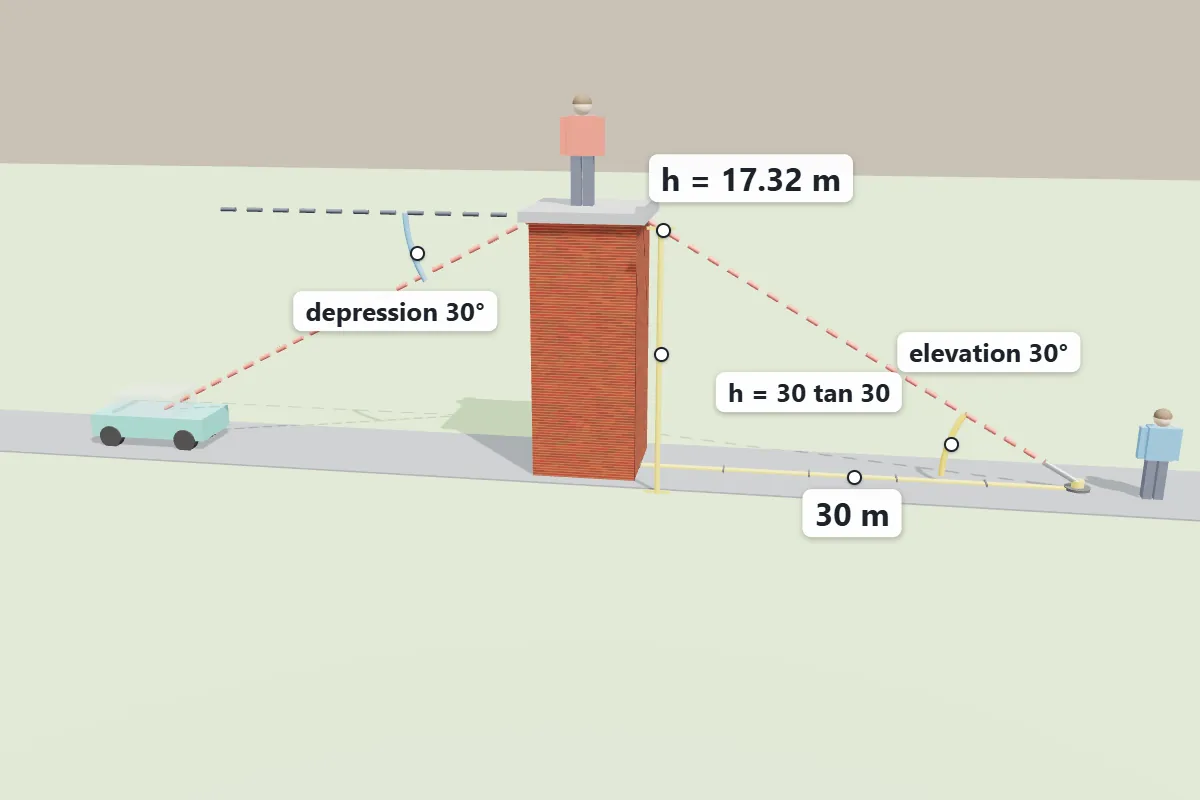
Trigonometry: a tower and a surveyor's theodolite show applications of trigonometry: elevation 30 degrees from 30 m gives a height of 17.32 m.
Trigonometry→a tower and a surveyor's theodolite show applications of trigonometry: elevation 30 degrees from 30 m gives a height of 17.32 m.: Area of a triangle
Trigonometry: Sine Rule, Cosine Rule and Triangle Area · 4 / 6
Practice with full answer key
a = 9, A = 45°, B = 30°; find b → b = 9 sin30/sin45 = 6.36
b = 12, c = 15, A = 120°; find a → a2 = 144 + 225 − 360(−0.5) = 549 → a ≈ 23.43
Sides 7, 8, 10; find the largest angle → cos C = (49 + 64 − 100)/(2·7·8) = 13/112 → C ≈ 83.3°
Two sides 6 and 8 with included angle 45°; find the area → ½·6·8·sin45 = 16.97
In a triangle, a = 4, b = 6, A = 30°; how many triangles are possible? → sin B = 6 sin30/4 = 0.75 → B ≈ 48.6° or 131.4°; only the first leaves C > 0 with the second? 30 + 131.4 < 180 as well — check both and state both; the safe answer is two possibilities
A triangle has area 30 and sides 10 and 12; find the included angle → 30 = ½·10·12·sin C → sin C = 0.5 → C = 30° or 150°
Trigonometry: Sine Rule, Cosine Rule and Triangle Area · 5 / 6
Exam traps and key takeaways
💡 High-yield traps
In the cosine rule the minus sign is essential a2 = b2 + c2 − 2bc cos A. A plus sign is the most frequent error.
The angle in ½ab sin C must be the included angle; using any other angle gives a wrong area.
Calculator mode degrees unless the question says otherwise — radian answers lose all marks.
With the sine rule, always test whether the obtuse alternative is possible; the ambiguous case is a standard exam item.
For an obtuse angle cos A is negative, which makes a2 larger than b2 + c2; do not reject the negative value.
Trigonometry: Sine Rule, Cosine Rule and Triangle Area · 6 / 6