Curriculum
Mathematics
Unit 1
0/12
Unit 2
0/14Unit 3
0/13Unit 4
0/8Unit 5
0/12Unit 6
0/8Unit 7
0/10
Text lesson
Statistics, Conditional Probability and Random Variables
Statistics, Conditional Probability and Random Variables
Worked examples
Worked examples
| Comparison aspect | Main idea | Keywords |
|---|---|---|
| Example 1 (basic probability). | A bag has 4 red and 6 blue balls. One ball is picked at random. Find P(red) | blueballsballpicked |
| Solution |
| Checkblue |
| Example 2 (complement and addition). |
| groupFind |
| Solution | P(A ∪ B) = 0.6 + 0.5 − 0.2 = 0.9. Also P(A′) = 1 − 0.6 = 0.4 | |
| Example 3 (conditional probability). |
| Amongstudentsplayfootball |
| Solution |
| conditionfootballplayersform |
| Comparison aspect | Main idea | Keywords |
|---|---|---|
| Example 4 (independence). |
| independent |
| Solution | P(A) × P(B) = 0.3 × 0.5 = 0.15 = P(A ∩ B). So A and B are independent | independent |
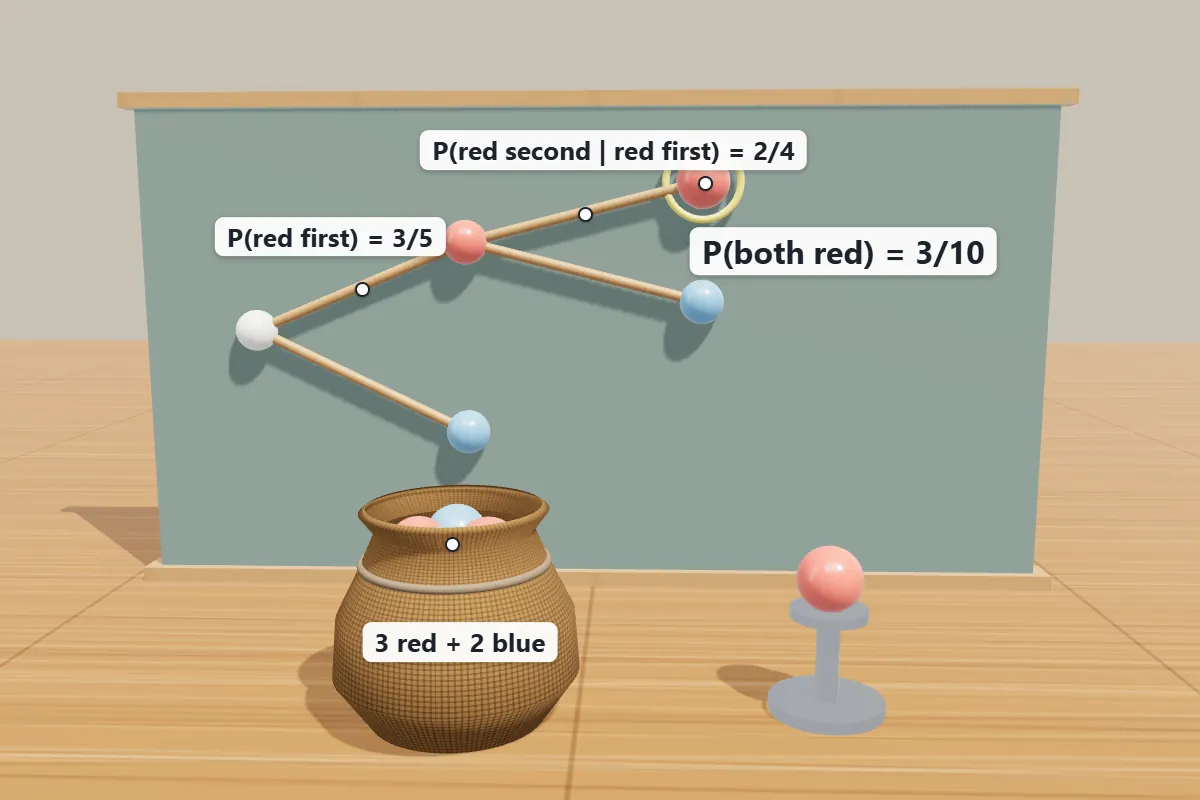
| Example 5 (two draws without replacement). | A box has 3 red and 2 blue balls. Two balls are drawn one after the other without replacement. Find the probability that both are red | blueballsdrawnafter |
| Solution |
| firstdrawgivesAfter |
| Example 6 (expected value and variance). |
| faircoinstossednumber |
| Comparison aspect | Main idea | Keywords |
|---|---|---|
| Solution | E(X) = 0 × 1/4 + 1 × 1/2 + 2 × 1/4 = 1. Then E(X2) = 0 × 1/4 + 1 × 1/2 + 4 × 1/4 = 3/2. So Var(X) = 3/2 − 12 = 1/2 | Then |
| Example 7 (binomial probability). |
| faircointossedtimes |
| Solution |
| meanvariance |
| Example 8 (harder discrete distribution). |
| randomvariabletakesvalues |
| Solution |
| probabilitiesThenNext |
| Comparison aspect | Main idea | Keywords |
|---|---|---|
| Example 9 (normal-type data). |
| heightsstudentsapproximatelymean |
| Solution |
| studentstandarddeviationsabove |
Statistics, Conditional Probability and Random Variables · 5 / 7
Well done! You finished this lesson
What would you like to do next?