Curriculum
Login

Curriculum

Physics

Chapter 4 - Alternating Current AC Circuits

0/30

Chapter 5 - Dual Nature of Wave and Particle

0/33

Chapter 6 - Atomic Spectra and X-Rays

0/28

Chapter 7 - Lasers and Principles

0/31

Chapter 8 - Modern Electronics and Semiconductors

0/31

More lessons

0/83
Text lesson

Lesson 2 Questions: Manometer, Barometer, Pascal Principle and Hydraulic Press

Physics

Lesson 2 Questions: Manometer, Barometer, Pascal Principle and Hydraulic Press

مقدمة الدرس

مقدمة الدرس

  • ★ Comprehensive Study & Detailed Pedagogical Guide ★
  • Comprehensive Explanation Density, Liquid Pressure at Depth and Pascal’s Principle
  • Physics (Secondary Stage – 2nd Secondary) | Grade 11 (2nd Secondary) | 2026 / 2027 Official Curriculum | Chapter 1: Fluid Mechanics & Pressure
  • • Define density and specific gravity (relative density) with standard SI dimensions and temperature dependence.
  • • Formulate the conservation of mass and volume in non-contracting liquid mixtures.
  • • Derive the fundamental hydrostatic equation for pressure at depth: P = Pa + ρgh.
  • • Analyze U-tube manometers, connecting vessels, and mercury Torricellian barometers.
Figure 1 – Liquid Pressure at a Point and Depth Dependence
  • • Measure arterial blood pressure (systolic vs. diastolic) and evaluate clinical anomalies.
  • • State Pascal’s Principle and deduce hydraulic press mechanical advantage, displacement ratios, and work efficiency.
Lesson 2 Questions: Manometer, Barometer, Pascal Principle and Hydraulic Press · 1 / 6
المفاهيم والمصطلحات الأساسية

المفاهيم والمصطلحات الأساسية

📖 📖 Core Terminology, Scientific Definitions & Glossaries:

Comparison aspectMain ideaKeywords
Density (ρ)The mass per unit volume of a homogeneous substance at a given temperature and pressuremassunitvolumehomogeneous
Relative Density (Specific Gravity)The dimensionless ratio of the density of a substance to the density of pure distilled water at 4°Cdimensionlessratiosubstancepure
Hydrostatic Liquid PressureThe perpendicular normal force exerted by a static liquid column on a unit horizontal surface area containing a specified point at depth hperpendicularnormalforceexerted
Gauge Pressure (Pgauge)The difference between absolute fluid pressure and ambient atmospheric pressuredifferencebetweenabsolutefluid
Pascal’s Principle
  • When external pressure is applied to an enclosed
  • incompressible static fluid
  • that pressure is transmitted undiminished throughout every portion of the fluid and perpendicularly to the walls of its containing vessel
externalpressureappliedenclosed
Lesson 2 Questions: Manometer, Barometer, Pascal Principle and Hydraulic Press · 2 / 6
الشرح والتفصيل العلمي الشامل

الشرح والتفصيل العلمي الشامل

Comparison aspectMain ideaKeywords
قانون وعلاقة حاكمة
  • ⚖️ Governing Scientific Laws
  • Theorems & Mathematical Models
GoverningScientificLawsTheorems
★ Hydrostatic Depth Pressure Law
  • [ Formula: P = Pa + ρgh ] Absolute pressure inside an open liquid container increases linearly with depth h
  • fluid density ρ
  • and gravitational acceleration g
FormulaAbsoluteinsideopen
★ Equilibrium of Immiscible Liquids in a U-Tube
  • [ Formula: ρ1 · h1 = ρ2 · h2 ] At static equilibrium
  • pressure at points on the same horizontal level inside the same continuous homogeneous fluid must be equal
Formulastaticpressurepoints
★ Hydraulic Press Mechanical Advantage (η)[ Formula: η = F / f = A / a = R2 / r2 = y1 / y2 = v1 / v2 ] Force amplification ratio equals the piston area ratio and the inverse ratio of piston displacements. Work input equals work output in an ideal 100% efficient pressFormulaForceamplificationratio
  • 📌 Exhaustive In-Depth Pedagogical Breakdown:
  • ◄ 1. Intensive Physics of Density and Non-Contracting Fluid Mixtures
  • Density (symbol ρ, Greek letter rho) is a fundamental intensive physical property of all states of matter, defined as the mass contained within a unit volume: ρ = m / V.
  • In the International System of Units (SI), density is expressed in kilograms per cubic meter (kg/m3), where 1 g/cm3 = 1,000 kg/m3.
  • Density depends strictly on two microscopic variables (1) The atomic or molecular mass of the constituent elements, and (2) The intermolecular spacing between molecules, which is directly governed by ambient temperature and pressure.
  • Relative Density (Specific Gravity) is a dimensionless quantity comparing the density of any substance to that of pure water at its maximum density temperature of 4°C (1,000 kg/m3): Relative Density = ρ_substance / 1,000.
  • Because it is a ratio of identical physical dimensions, it has no units.
  • Multiplying relative density by 1,000 instantly yields the absolute density in kg/m3.
Comparison aspectMain ideaKeywords
Fluid Mixtures
  • When two miscible liquids of volumes V1 and V2 and densities ρ1 and ρ2 are blended without chemical reaction or intermolecular contraction
  • total mass is conserved: mmix = m1 + m2
  • which yields: ρ_mix × Vmix = (ρ1 × V1) + (ρ2 × V2). If volume contraction occurs due to intermolecular dissolution (e.g
  • ethanol and water)
  • Vmix < V1 + V2
  • causing the mixture density to exceed the theoretical arithmetic weighted mean
miscibleliquidsvolumesdensities
Clinical & Industrial Diagnostics
  • (a) Medical diagnosis of anemia: Healthy adult blood density ranges strictly between 1
  • 040 and 1
  • 060 kg/m3
MedicaldiagnosisanemiaHealthy
  • A drop below 1,040 kg/m3 signifies anemia (deficiency of hemoglobin and erythrocytes).
  • (b) Urine density diagnostics Normal urine density is approximately 1,020 kg/m3; elevation above normal indicates hyper-concentration of excreted metabolic salts.
  • (c) Lead-acid automobile batteries A hydrometer measures the density of electrolyte sulfuric acid.
  • In a fully charged battery, sulfuric acid density is 1.28–1.30 g/cm3; discharge consumes acid into water and lead sulfate, dropping density below 1.20 g/cm3.
  • Figure (Figure 1 – Liquid Pressure at a Point and Depth Dependence.png): Hydrostatic pressure dependence on fluid column depth h and liquid density rho.
  • ◄ 2. Liquid Pressure at Depth and Manometric Measuring Instruments
  • Pressure at a point inside a static liquid is physically defined as the normal compressive weight of the liquid column resting above that point per unit cross-sectional area: P = F / A = (m × g) / A = (ρ × V × g) / A = (ρ × A × h × g) / A = ρgh.
Comparison aspectMain ideaKeywords
•When the liquid vessel is exposed to ambient atmospheric air, total absolute pressure is: P = Patm + ρgh.liquidvesselexposedambient
The gauge pressure is simplyPgauge = P – Patm = ρghPgaugePatm
Characteristics of Hydrostatic Pressure
  • (1) Liquid pressure at a given depth acts uniformly in all spatial directions (omnidirectional). (2) In connected vessels of varying geometric shapes
  • the liquid levels in all branches stabilize at the exact same horizontal height regardless of vessel geometry or cross-sectional area
  • because pressure depends solely on vertical depth h
  • not base surface area or liquid volume
Liquidgivendepthacts
The U-Tube Manometer
  • A U-shaped glass tube partially filled with liquid. When two immiscible liquids (e.g
  • water and oil) are poured into opposite arms
  • at equilibrium
  • the pressure at the separating interface level must balance: P1 = P2 -> Patm + ρ1·g·h1 = Patm + ρ2·g·h2 -> ρ1·h1 = ρ2·h2. The column heights above the common interface are inversely proportional to their respective densities
shapedglasspartiallyfilled
Torricellian Mercury Barometer→Evangelista Torricelli balanced atmospheric air weight against a dense mercury column.
  • At sea level and 0°C, atmospheric pressure balances exactly 76 cm of mercury (0.76 mHg).
  • The vacuum above the mercury column is known as Torricellian Vacuum, containing only trace mercury vapor.
  • Standard atmospheric pressure Patm = ρ_Hg × g × h = 13,600 kg/m3 × 9.8 m/s2 × 0.76 m = 1.013 × 10⁵ N/m2 (Pascals) = 1.013 bar = 760 Torr (mmHg).
  • Sphygmomanometer Blood Pressure Dynamics Arterial pressure cycles between Systolic Pressure (~120 mmHg, maximum pressure during left ventricular systole when aortic valves open) and Diastolic Pressure (~80 mmHg, minimum resting pressure during ventricular diastole).
  • Figure (Figure 2 – U-Tube Manometer and Barometer Setup.png): U-tube manometer with immiscible liquids at equilibrium and Torricellian mercury barometer column.

◄ 3. Pascal’s Principle and Hydraulic Systems

  • Pascal’s Principle applies strictly to incompressible fluids (liquids), stating that: Any pressure applied to an enclosed static fluid is transmitted without diminution to every portion of the fluid and to container walls.
  • Gases are highly compressible due to enormous intermolecular voids; hence, applied work compresses the gas volume rather than transmitting pressure instantaneously.
  • The Hydraulic Press Architecture Consists of two communicating cylinders fitted with leak-proof movable pistons of unequal areas: a small piston of cross-sectional area a (radius r) and a large piston of area A (radius R).
Comparison aspectMain ideaKeywords
•
  • When a small input force f is exerted downwards on the small piston
  • it creates pressure: P = f / a
smallinputforceexerted
•This pressure transmits across the fluid to act upwards beneath the large piston: P = F / Apressuretransmitsacrossfluid
Equating pressures yields
  • F / A = f / a
  • or: F = f × (A / a)
Mechanical Advantage (η)
  • Because A > a
  • the output force F is multiplied by the area ratio: η = F / f = A / a = R2 / r2 = D2 / d2 = y1 / y2 = v1 / v2
  • where y1 is the downward displacement of the small piston
  • y2 is the upward displacement of the large piston
  • v1 is the small piston velocity
  • and v2 is the large piston velocity
Becauseoutputforcemultiplied
Conservation of Energy & Efficiency
  • Force is multiplied
  • but work is NEVER created
ForcemultipliedworkNEVER
  • In an ideal press without friction Work Output = Work Input (F × y2 = f × y1).
  • In real-world hydraulic machinery, hydraulic fluid viscosity, fluid turbulence, and seal friction dissipate energy: Efficiency = (Work Output / Work Input) × 100% = [(F × y2) / (f × y1)] × 100% < 100%.
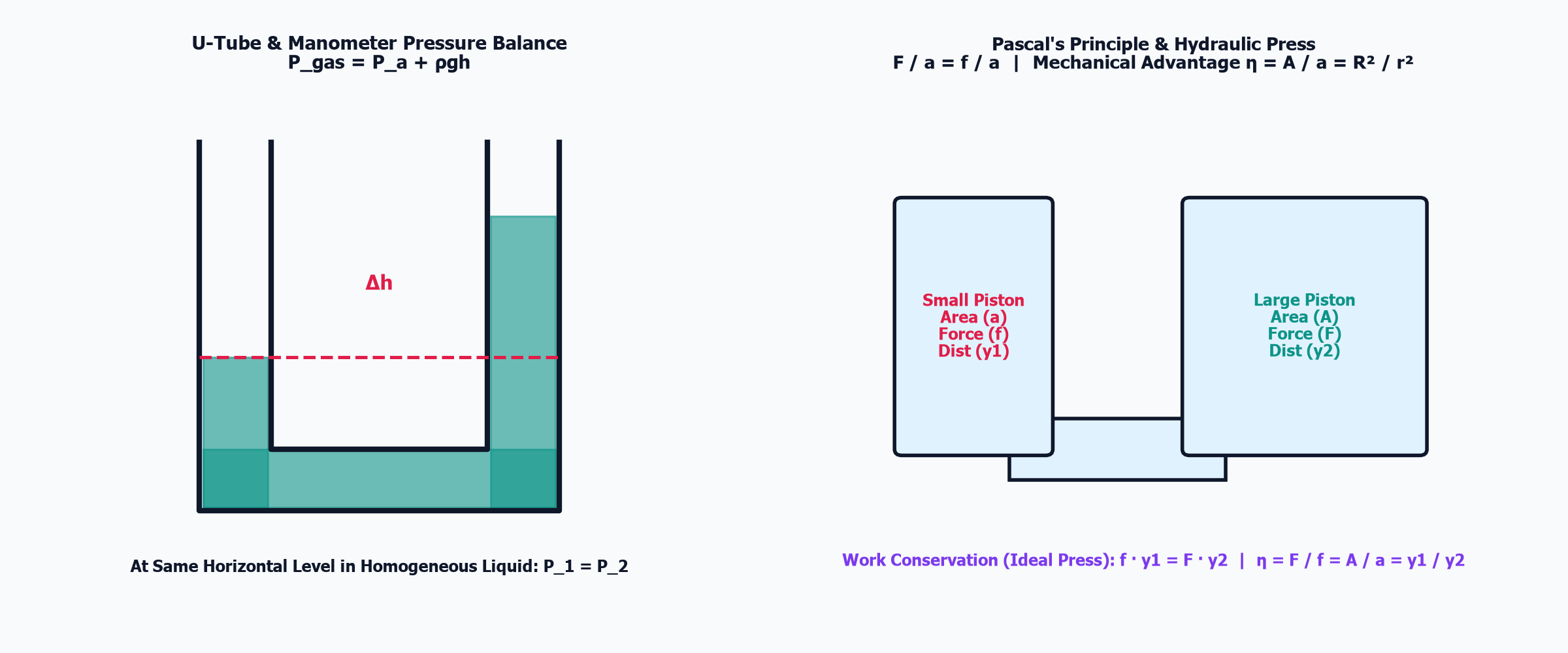
  • Figure (Table 1 – Pascal Principle and Hydraulic Press Mechanics.png): Mechanical advantage formulas, force amplification factors, and work conservation in hydraulic systems.
  • 🧮 Exemplary Step-by-Step Worked Problems & Applied Exercises:
  • Worked Example 1 Barometric Mountain Height Calculation
  • Problem Statement A Torricellian mercury barometer reads 76 cmHg at the base of a mountain and 70.8 cmHg at its summit. If the average density of atmospheric air over this altitude is 1.25 kg/m3 and the density of mercury is 13,600 kg/m3, calculate the absolute height of the mountain.
Detailed Solution & Derivation→Step 1: The drop in barometric pressure between ground and summit equals the weight of the air column spanning the mountain height: ΔP_Hg = ΔPair.
Comparison aspectMain ideaKeywords
Step 2ρ_Hg × g × (hground – hsummit) = ρ_air × g × HmountainhgroundhsummitHmountain
Step 3Cancel g from both sides: ρ_Hg × Δh_Hg = ρ_air × HmountainCancelbothsidesHmountain
Step 4Convert Δh to meters: Δh = 76 cm – 70.8 cm = 5.2 cm = 0.052 mConvertmeters
Step 5
  • Substitute numerical values: 13
  • 600 kg/m3 × 0.052 m = 1.25 kg/m3 × Hmountain. 707.2 = 1.25 × Hmountain -> Hmountain = 707.2 / 1.25 = 565.76 meters
SubstitutenumericalvaluesHmountain
Worked Example 2Hydraulic Press Force and Displacement DynamicsHydraulicPressForceDisplacement
Problem Statement
  • A hydraulic press has a small piston of radius 2 cm and a large piston of radius 20 cm. If an input force of 50 N is applied to the small piston: (1) Find the mechanical advantage of the press
  • (2) Determine the maximum load mass the large piston can lift (g = 10 m/s2)
  • (3) If the small piston moves downwards by 10 cm
  • how far does the large piston rise?
hydraulicpresssmallpiston
Detailed Solution & Derivation→Step 1: Mechanical Advantage η = A / a = R2 / r2 = (20 cm)2 / (2 cm)2 = 400 / 4 = 100. Step 2: Output force F = η × f = 100 × 50 N = 5,000 N.
Comparison aspectMain ideaKeywords
•
  • Maximum lifted mass M = F / g = 5
  • 000 N / 10 m/s2 = 500 kg
Maximumliftedmass
Step 3Displacement ratio: η = y1 / y2 -> 100 = 10 cm / y2 -> y2 = 10 cm / 100 = 0.1 cm (1 mm)Displacementratio
•💡 Master Teacher Insights & Critical Exam CautionsMasterTeacherInsightsCritical
★ Exam Trap
  • In a Torricellian barometer
  • tilting the tube changes the slanted length of the mercury thread
  • but the VERTICAL perpendicular height h remains strictly 76 cmHg at standard sea level atmospheric pressure
Torricellianbarometertiltingtube
★ Crucial Rule
  • When air bubbles enter a hydraulic press cylinder
  • the system efficiency crashes drastically because applied mechanical work is wasted on compressing the air bubbles rather than transmitting pressure to the large piston
bubblesenterhydraulicpress
  • ★ Pressure at the bottom of a container depends exclusively on vertical liquid height h, NOT on total liquid volume or the shape of the container walls.
  • 🌍 Practical Real-World, Industrial & Societal Connections:
  • ✔ Automotive Hydraulic Disc Brakes Stepping on the brake pedal exerts pressure on hydraulic master cylinders, transmitting equal fluid pressure instantly to all four caliper pistons to clamp rotating brake discs.
  • ✔ Deep-Sea Submersible Engineering Submarine hulls must be engineered with reinforced spherical titanium alloys to withstand extreme hydrostatic crushing pressures (P = ρgh exceeds 1,000 atmospheres in deep ocean trenches).
Figure 2 – U-Tube Manometer and Barometer Setup
✔ Aircraft Altimeters→Aneroid barometers calibrated to altitude indicate flight elevation based on the known exponential decay of atmospheric pressure with height.
Table 1 – Pascal Principle and Hydraulic Press Mechanics
  • Figure (Table 1 – Pascal Principle and Hydraulic Press Mechanics.png): Mechanical advantage formulas, force amplification factors, and work conservation in hydraulic systems.
  • • State Pascal’s Principle and deduce hydraulic press mechanical advantage, displacement ratios, and work efficiency.
  • ✔ Pascal’s Principle Hydraulic Press, Mechanical Advantage (A/a = F/f), Efficiency.
Fig 1 – U-Tube Manometer and Hydraulic Press Pascal Principle
Fig 1 – U-Tube Manometer and Hydraulic Press Pascal Principle→الشرح والتفصيل العلمي الشامل
Lesson 2 Questions: Manometer, Barometer, Pascal Principle and Hydraulic Press · 3 / 6
المقارنات وخريطة المفاهيم الجوهرية

المقارنات وخريطة المفاهيم الجوهرية

🗺️ ★ High-Yield Summary, Mind Maps & Comparison Tables ★

Comparison aspectMain ideaKeywords
Summary
  • Density
  • Liquid Pressure at Depth and Pascal’s Principle
DensityLiquidPressureDepth
•Physics (Secondary Stage – 2nd Secondary) | Grade 11 (2nd Secondary) | 2026 / 2027 Official Curriculum | Chapter 1: Fluid Mechanics & PressurePhysicsSecondaryStageGrade
•🗺️ Core Concept Map & Knowledge ArchitectureCoreConceptKnowledgeArchitecture
✔ Fluids at Rest
  • Density (Mass/Volume)
  • Specific Gravity
  • Fluid Mixtures
DensityMassVolumeSpecific
✔ Hydrostatic Pressure
  • P = ρgh
  • Absolute Pressure (P = Pa + ρgh)
  • Gauge Pressure
AbsoluteGauge
✔ Pressure Measurement
  • U-Tube Manometer
  • Mercury Barometer (76 cmHg = 1.013 bar)
  • Manometric Fluids
TubeManometerMercuryBarometer
✔ Pascal’s Principle
  • Hydraulic Press
  • Mechanical Advantage (A/a = F/f)
  • Efficiency
HydraulicPressMechanicalAdvantage
  • 📊 Classification & Comparative Summary Tables:
  • Table Pressure Conversion Factors and Barometric Units
  • 💡 Exam Flashcard Capsules & High-Yield Secrets:
  • ★ In a U-tube, points at the same horizontal level inside the SAME continuous, homogeneous static liquid have identical pressure.
  • ★ A hydraulic press multiplies FORCE, but it NEVER multiplies energy or power (Work output ≤ Work input due to conservation of energy).
  • ★ Relative density has NO units because it is a pure dimensionless ratio between two densities of identical dimensions.
Unit of Pressure Symbol Equivalence to Pascals (N/m2) Typical Application
Pascal Pa (N/m2) 1 Pa = 1 N/m2 SI Standard physics calculations
Bar bar 1 bar = 105 Pa Meteorological pressure and tire pressure
Centimeter of Mercury cmHg 76 cmHg = 1.013 × 10⁵ Pa Torricellian barometers
Torr (Millimeter Hg) Torr (mmHg) 1 Torr = 1 mmHg = 133.3 Pa Medical sphygmomanometers (blood pressure)
Standard Atmosphere atm 1 atm = 1.01325 × 10⁵ Pa Standard temperature and pressure (STP)
Lesson 2 Questions: Manometer, Barometer, Pascal Principle and Hydraulic Press · 4 / 6
أمثلة ومسائل محلولة بالخطوات

أمثلة ومسائل محلولة بالخطوات

  • مثال تطبيقي نموذجي:
  • مسألة شاملة على قوانين Lesson 1 – Density, Liquid Pressure and Pascal Principle مع بيان خطوات الحل والتعويض المباشر والوحدات الدولية.
Lesson 2 Questions: Manometer, Barometer, Pascal Principle and Hydraulic Press · 5 / 6
تريكات الامتحان وكبسولة التفوق الوزاري

تريكات الامتحان وكبسولة التفوق الوزاري

كبسولة التفوق لطلاب الثانوية والإعدادية→احرص على حفظ الوحدات بدقة، والانتباه للرسومات البيانية والمحاور والتحويلات، ومراجعة بنك الأسئلة أدناه.
Lesson 2 Questions: Manometer, Barometer, Pascal Principle and Hydraulic Press · 6 / 6