Curriculum
Mathematics — Third Preparatory
Unit 1
0/20
1.11-1 The base, the exponent, and the product and quotient of powers1.21-2 The zero exponent and the negative exponent1.31-3 Power of a power, of a product and of a quotient1.41-4 Sign of a power: even and odd exponents1.51-5 Powers, square roots and fractional exponents1.61-6 Simplifying expressions that combine several laws1.71-7 Exponential equations by equalising the base1.81-8 Equations with negative exponents and fractions1.91-9 Equations solved by taking out a common factor1.101-10 Equations in which the unknown is the base1.111-11 Real-life applications1.121-12 Summary of the laws of this unit1.13Exam traps and key takeaways
Unit 2
0/121.12-1 The quadratic function: definition, values and points1.22-2 The vertex form y = a(x − h)2 + k1.32-3 The vertex from the general form1.42-4 Sketching the parabola1.52-5 Maximum and minimum applications1.62-6 Polynomial functions and their degree1.72-7 Zeros of a polynomial function1.82-8 The rational algebraic function, its domain and simplifying1.92-9 Common domain of two functions and equality of functions1.102-10 Addition, subtraction, multiplication and division1.112-11 Additive and multiplicative inverses, and properties1.12Exam traps and key takeaways
Unit 3
0/121.13-1 The two conditions of similarity and the ratio of perimeters and areas1.23-2 Cases of similarity of triangles and the parallel line1.33-3 Real-life applications of similarity1.43-4 The dilation and its properties1.53-5 Dilation on the coordinate plane1.63-6 Sides relative to an angle, and the definitions of sin, cos and tan1.73-7 Finding side lengths and complementary angles1.83-8 Exact ratios of 30°, 45° and 60°1.93-9 Using the calculator and applications of trigonometry1.103-10 The slope of a line, parallel and perpendicular lines1.113-11 Equations of a line and the intercepts1.12Exam traps and key takeaways
Unit 4
0/131.14-1 Measures of central tendency: recap1.24-2 Why do we need measures of dispersion?1.34-3 The range1.44-4 The median recap, quartiles and the interquartile range1.54-5 The box plot (box-and-whisker)1.64-6 Deviation, variance and standard deviation of a set of values1.74-7 Standard deviation of a simple frequency distribution1.84-8 Standard deviation of a grouped (class) distribution1.94-9 Using the scientific calculator1.104-10 Comparing two data sets1.114-11 Effect of adding or multiplying every value1.124-12 Outliers and choosing the right measure1.13Exam traps and key takeaways
Text lesson
Unit 3: Similarity, Dilation, Trigonometric Ratios and the Straight Line
Unit 3: Similarity, Dilation, Trigonometric Ratios and the Straight Line
Overview
Overview
- Apply the two conditions of similarity and the three similarity cases of triangles, and use them in real-life measurement.
- Perform a dilation, state its properties and find image coordinates on the plane.
- Define sine, cosine and tangent in a right triangle, use complementary angles, and evaluate the ratios of 30°, 45° and 60°.
- Compute the slope of a line, test parallelism and perpendicularity, and write the equation of a line in its different forms.
Geometry and Measurement
├── 3-1 Similarity
│   ├── the two conditions for polygons
│   ├── ratio of perimeters = k, ratio of areas = k²
│   ├── the three cases for triangles
│   └── the line parallel to one side and its applications
├── 3-2 Dilation
│   ├── centre, scale factor, properties
│   └── dilation on the coordinate plane
├── 3-3 Trigonometric ratios in the right triangle
│   ├── opposite, adjacent, hypotenuse
│   ├── sin, cos, tan and complementary angles
│   ├── exact ratios of 30°, 45°, 60°
│   └── finding angles with the calculator
└── 3-4 The straight line
    ├── slope, parallel and perpendicular lines
    └── forms of the equation and the intercepts
Unit 3: Similarity, Dilation, Trigonometric Ratios and the Straight Line · 1 / 13
3-1 The two conditions of similarity and the ratio of perimeters and areas
3-1 The two conditions of similarity and the ratio of perimeters and areas
- Two polygons are similar when corresponding angles are equal and corresponding sides are proportional — both at once.
- The common ratio of corresponding sides is the scale factor k; k = 1 gives congruent figures.
- Ratio of perimeters = k; ratio of areas = k2. So from an area ratio take the square root to get k, and square k to get the area ratio.
- Any two regular polygons with the same number of sides are similar; any two circles are similar; two rectangles or two rhombi are not necessarily similar.
Unit 3: Similarity, Dilation, Trigonometric Ratios and the Straight Line · 2 / 13
3-2 Cases of similarity of triangles and the parallel line
3-2 Cases of similarity of triangles and the parallel line
| Comparison aspect | Main idea | Keywords |
|---|---|---|
| AA |
| equalanglesthirdfollows |
| SSS | the three pairs of corresponding sides proportional — order the sides from smallest to largest before comparing | threepairscorrespondingsides |
| SAS | two pairs of sides proportional and the included angles equal | pairssidesproportionalincluded |
| • | A line parallel to one side of a triangle divides the other two sides proportionally: DE ∥ BC gives AD/DB = AE/EC and AD/AB = AE/AC = DE/BC | lineparallelsidetriangle |
| The converse holds | proportional division proves parallelism | proportionaldivisionprovesparallelism |
| • |
| Correspondingaltitudesmediansangle |
Unit 3: Similarity, Dilation, Trigonometric Ratios and the Straight Line · 3 / 13
3-3 Real-life applications of similarity
3-3 Real-life applications of similarity
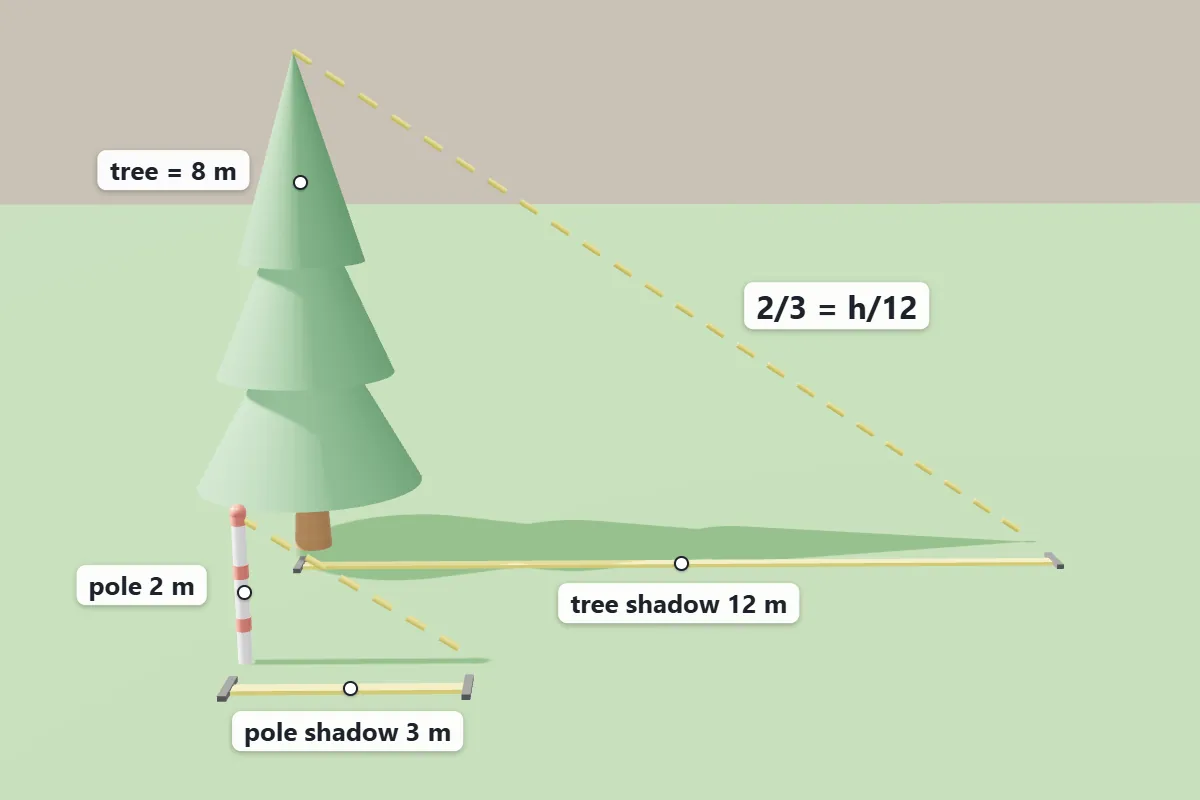
| Comparison aspect | Main idea | Keywords |
|---|---|---|
| Heights from shadows |
| parallelraysmakesimilar |
| Indirect measurement |
| riverwidthtreeheight |
| Maps, models and plans |
| scaleratiolengthsareas |
| • |
| Writeproportionmatchingvertices |
Unit 3: Similarity, Dilation, Trigonometric Ratios and the Straight Line · 4 / 13
3-4 The dilation and its properties
3-4 The dilation and its properties
- A dilation with centre O and scale factor k maps each point P to P′ on the line OP with OP′ = |k| × OP.
- k > 1 enlarges, 0 < k < 1 reduces; k > 0 keeps P′ on the same side of O, k < 0 puts it on the opposite side.
- The image is similar to the original angles are preserved, lengths multiply by |k|, areas multiply by k2.
- A line and its image are parallel (unless the line passes through the centre, in which case it maps onto itself).
- The centre, a point and its image are always collinear — that is how a missing centre or scale factor is recovered.
Unit 3: Similarity, Dilation, Trigonometric Ratios and the Straight Line · 5 / 13
3-5 Dilation on the coordinate plane
3-5 Dilation on the coordinate plane
| Comparison aspect | Main idea | Keywords |
|---|---|---|
| With centre at the origin |
| |
| Example |
| givesoppositesideorigin |
| With a centre C(a, b) not at the origin, translate first |
| |
| • | Check similarity by comparing side lengths and by verifying that the ratios OA′/OA all equal |k| | Checksimilaritycomparingside |
Unit 3: Similarity, Dilation, Trigonometric Ratios and the Straight Line · 6 / 13
3-6 Sides relative to an angle, and the definitions of sin, cos and tan
3-6 Sides relative to an angle, and the definitions of sin, cos and tan
- In a right triangle, for an acute angle θ the opposite side faces θ, the adjacent side touches it, and the hypotenuse lies opposite the right angle and is the longest side.
- sinθ = opposite/hypotenuse, cosθ = adjacent/hypotenuse, tanθ = opposite/adjacent (SOH-CAH-TOA).
- The ratios depend on the angle only, not on the size of the triangle — that is why similar triangles give the same values.
- Because the hypotenuse is longest, sinθ and cosθ are always between 0 and 1 for an acute angle, while tanθ can be any positive number.
- tanθ = sinθ/cosθ, and sin2θ + cos2θ = 1.
Unit 3: Similarity, Dilation, Trigonometric Ratios and the Straight Line · 7 / 13
3-7 Finding side lengths and complementary angles
3-7 Finding side lengths and complementary angles
- Choose the ratio that links the known side with the unknown one, substitute and solve; use Pythagoras when two sides are known.
- Example hypotenuse 10 and angle 30° → opposite = 10 sin 30° = 5, adjacent = 10 cos 30° = 5√3.
- Two acute angles in a right triangle are complementary (they sum to 90°), hence sinθ = cos(90 − θ), cosθ = sin(90 − θ) and tanθ = cot(90 − θ).
- So a ratio given for one angle can be read off for its complement — a standard one-mark conversion.
Unit 3: Similarity, Dilation, Trigonometric Ratios and the Straight Line · 8 / 13
3-8 Exact ratios of 30°, 45° and 60°
3-8 Exact ratios of 30°, 45° and 60°
| Comparison aspect | Main idea | Keywords |
|---|---|---|
| From an equilateral triangle of side 2 split by an altitude |
| sin30cos30tan30sin60 |
| From an isosceles right triangle of leg 1 |
| sin45cos45tan45 |
| Useful comparisons |
| growssinθtanθincrease |
| • |
| Keepsurdexactforms |
Unit 3: Similarity, Dilation, Trigonometric Ratios and the Straight Line · 9 / 13
3-9 Using the calculator and applications of trigonometry
3-9 Using the calculator and applications of trigonometry
| Comparison aspect | Main idea | Keywords |
|---|---|---|
| To find a side |
| evaluateratiomakesure |
| To find an angle |
| inversefunctionsratioresult |
| Applications |
| angleelevationlookingtower |
| • |
| Drawfiguremarkright |
Unit 3: Similarity, Dilation, Trigonometric Ratios and the Straight Line · 10 / 13
3-10 The slope of a line, parallel and perpendicular lines
3-10 The slope of a line, parallel and perpendicular lines
- Slope m = (y₂ − y₁)/(x₂ − x₁) = rise over run between any two points of the line; it is the same pair whichever two points are chosen.
- Positive slope rises to the right, negative falls, zero is a horizontal line, and the slope of a vertical line x = c is undefined.
- Two non-vertical lines are parallel ⟺ their slopes are equal.
- Two lines are perpendicular ⟺ the product of their slopes is −1, i.e. one slope is the negative reciprocal of the other.
- Slope as a gradient a road rising 3 m over 40 m has slope 3/40 = 0.075, often written as a percentage grade.
Unit 3: Similarity, Dilation, Trigonometric Ratios and the Straight Line · 11 / 13
3-11 Equations of a line and the intercepts
3-11 Equations of a line and the intercepts
| Comparison aspect | Main idea | Keywords |
|---|---|---|
| Through the origin with slope m | y = mx | |
| Slope–intercept form |
| point |
| Given the slope and one point (x₁, y₁) |
| substitutethenrearrange |
| Given two points |
| findslopeformulafirst |
| Standard form Ax + By = C |
| intercept |
| • |
| lineparallelgivenkeeps |
| • | Check the final equation by substituting the given point(s) before answering | Checkfinalequationsubstituting |
Unit 3: Similarity, Dilation, Trigonometric Ratios and the Straight Line · 12 / 13
Exam traps and key takeaways
Exam traps and key takeaways
💡 High-yield traps
- Similarity needs equal angles and proportional sides; one alone is not sufficient.
- Perimeters scale by k, areas by k2 — the question usually asks for the other one.
- In SAS similarity the equal angle must be the included angle.
- A dilation with negative k flips the figure through the centre; coordinates become kx, ky with the sign kept.
- Dilation keeps angles unchanged — a wrong option often claims the angle is multiplied too.
- sin, cos and tan are defined in a right triangle; identify the hypotenuse first, it is always opposite the right angle.
- sin30 = 1/2 and cos30 = √3/2; swapping them is the most common exact-value error.
- Complementary-angle questions test sinθ = cos(90 − θ) convert before looking for a triangle.
- Leaving the calculator in radian mode destroys every numerical trig answer.
- A vertical line has undefined slope, a horizontal line slope 0 — not the reverse.
- Perpendicular means negative reciprocal, not simply the opposite sign.
- In y = mx + b, b is the y-intercept; the x-intercept must be computed by setting y = 0.
Unit 3: Similarity, Dilation, Trigonometric Ratios and the Straight Line · 13 / 13
Well done! You finished this lesson
What would you like to do next?