Unit 1: Complex Numbers, the Quadratic Equation, Sign of a Function and Quadratic Inequalities
Mathematics — First Secondary
Unit 1: Complex Numbers, the Quadratic Equation, Sign of a Function and Quadratic Inequalities
Overview
Overview
Explain why the imaginary unit is needed and compute any integer power of i.
Operate on complex numbers equality, add, subtract, multiply, divide, conjugate.
Solve quadratic equations, classify the roots with the discriminant, and use the sum and product of roots.
Determine the sign of linear and quadratic functions and solve second-degree inequalities, including radical and verbal applications.
Algebra, Relations and Functions
├── 1-1 Complex numbers
│   ├── need for the imaginary number
│   ├── integer powers of i
│   ├── concept of a complex number, Re(z) and Im(z)
│   ├── equality, addition, subtraction, multiplication
│   └── conjugate and division
├── 1-2 The quadratic equation
│   ├── general formula
│   ├── the discriminant and the nature of the two roots
│   ├── rational and irrational roots
│   └── finding an unknown coefficient from the nature of the roots
├── 1-3 Roots of a quadratic
│   ├── sum and product of the roots
│   ├── symmetric expressions in the roots
│   ├── special relations between the roots
│   └── forming the equation from its roots
├── 1-4 Sign of a function
└── 1-5 Quadratic inequalities and their applications
Unit 1: Complex Numbers, the Quadratic Equation, Sign of a Function and Quadratic Inequalities · 1 / 13
1-1 The need for the imaginary number and the powers of i
1-1 The need for the imaginary number and the powers of i
Why number systems are extended
We studied the natural, then integer, then rational, then real numbers; each system was enlarged so that equations unsolvable in the previous one could be solved.
x2 + 1 = 0 has no real solution, because the square of any real number is non-negative. That forced the introduction of the imaginary unit.
Comparison aspect
Main idea
Keywords
i2 = −1
i = √(−1)
and √(−a) = i√a for a > 0
•
i1 = i
i2 = −1
i3 = −i
i4 = 1 — after i4 the values repeat
so i5 = i
i6 = −1
and so on
aftervaluesrepeat
Rule for any positive integer n
divide n by 4 and use the remainder: in = iremainder (i0 = 1 when the remainder is 0)
divideremainder
i27 = i24 · i3 = (i4)6 · (−i) = 1 · (−i) = −i.
i4 + i40 + i400 = 1 + 1 + 1 = 3.
Unit 1: Complex Numbers, the Quadratic Equation, Sign of a Function and Quadratic Inequalities · 2 / 13
1-2 The complex number: equality, addition and multiplication
1-2 The complex number: equality, addition and multiplication
Definition
A complex number is z = a + bi where a, b ∈ ℝ and i2 = −1.
a is the real part, written Re(z); b is the imaginary part, written Im(z). Both parts are real numbers.
If b = 0 the number is real; if a = 0 and b ≠ 0 it is purely imaginary.
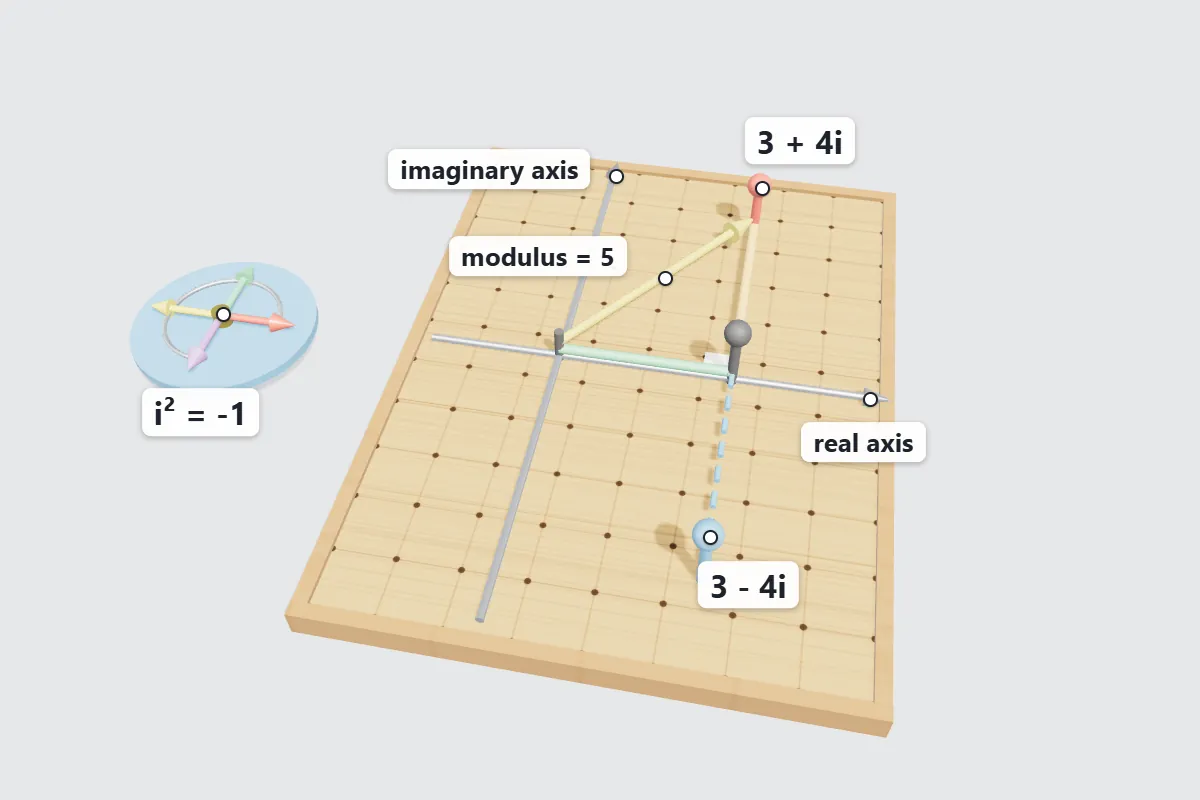
Complex Numbers, the Quadratic: a pegboard shows the Argand plane for complex numbers: 3 + 4i has modulus 5 and conjugate 3 – 4i.
Equality of two complex numbers
a + bi = c + di ⟺ a = c and b = d→equate real parts to real parts and imaginary to imaginary, then solve the two equations.
Addition and subtraction
(a + bi) + (c + di) = (a + c) + (b + d)i — add the real parts together and the imaginary parts together.
Multiplication
Multiply as two algebraic expressions, then replace i2 by −1.
Unit 1: Complex Numbers, the Quadratic Equation, Sign of a Function and Quadratic Inequalities · 4 / 13
1-4 Solving the quadratic equation with the general formula
1-4 Solving the quadratic equation with the general formula
For ax2 + bx + c = 0 with a ≠ 0 first identify a, b and c with their signs, put the equation in standard form, then apply x = (−b ± √(b2 − 4ac)) / (2a).
Δ = b2 − 4ac is called the discriminant.
If the equation lacks a term its coefficient is zero (no x means b = 0, no constant means c = 0).
x2 − 5x − 3 = 0→Δ = 25 + 24 = 49, √Δ = 7, so x = (5 ± 7)/4 → x = 3 or x = −1/2.
Unit 1: Complex Numbers, the Quadratic Equation, Sign of a Function and Quadratic Inequalities · 5 / 13
1-5 The discriminant and the nature of the two roots
1-5 The discriminant and the nature of the two roots
Comparison aspect
Main idea
Keywords
Δ > 0
two different real roots
differentrealroots
Δ = 0
two equal real roots
x = −b/(2a)
equalrealroots
Δ < 0
no real roots
the two roots are conjugate imaginary numbers
realrootsconjugateimaginary
If a, b, c are rational
Δ > 0 and Δ a perfect square → two different rational roots
Δ > 0 but not a perfect square → two different irrational roots
perfectsquaredifferentroots
Perfect squares to recognise at once
100
121
144 …
Unit 1: Complex Numbers, the Quadratic Equation, Sign of a Function and Quadratic Inequalities · 6 / 13
1-6 Finding an unknown coefficient from a condition on the roots
1-6 Finding an unknown coefficient from a condition on the roots
Two equal roots → put Δ = 0 and solve for the unknown.
Two different real roots → Δ > 0; no real roots → Δ < 0; two real roots (allowing equality) → Δ ≥ 0.
To prove that the roots are real for every value of the parameter, compute Δ and rewrite it as a square plus a positive term, e.g. Δ = (k − 3)2 + 4 ≥ 0 for all k — so the equation is never without real roots.
If one root r is given, substitute it ar2 + br + c = 0 gives the unknown coefficient directly.
Unit 1: Complex Numbers, the Quadratic Equation, Sign of a Function and Quadratic Inequalities · 7 / 13
1-7 Sum and product of the roots (Vieta)
1-7 Sum and product of the roots (Vieta)
The rules
α + β = −b/a and αβ = c/a.
Proof sketch from α = (−b + √Δ)/(2a) and β = (−b − √Δ)/(2a), adding cancels √Δ and multiplying gives (b2 − Δ)/(4a2) = 4ac/(4a2).
A symmetric expression does not change when α and β are interchanged, so it is always evaluated through α + β and αβ only.
One root twice the other roots α and 2α → α + β = 3α, αβ = 2α2; eliminate α.
Roots of opposite signs → αβ < 0; roots that are reciprocals → αβ = 1; roots that are negatives of each other → α + β = 0.
Unit 1: Complex Numbers, the Quadratic Equation, Sign of a Function and Quadratic Inequalities · 8 / 13
1-8 Forming the quadratic equation from its roots
1-8 Forming the quadratic equation from its roots
The equation whose roots are α, β is x2 − (α + β)x + αβ = 0.
Compute the sum, then the product, then write the rule; clear fractions by multiplying through by the L.C.M. if needed.
Comparison aspect
Main idea
Keywords
•
If the new roots are 2α and 2β
then the new sum is 2(α + β) and the new product is 4αβ
rootsthenproduct
If the new roots are α + 1 and β + 1
sum = (α + β) + 2
product = αβ + (α + β) + 1
product
Shortcut for a shift
in the original equation substitute x = y − 1 (for roots increased by 1) and expand
originalequationsubstituteroots
Unit 1: Complex Numbers, the Quadratic Equation, Sign of a Function and Quadratic Inequalities · 9 / 13
1-9 Sign of a function
1-9 Sign of a function
The concept
f is positive on a set of values of x when f(x) > 0, and negative when f(x) < 0; the zeros are the values that make f(x) = 0.
If a > 0 the function is negative to the left of its zero −b/a and positive to the right of it.
If a < 0 the signs are reversed positive on the left, negative on the right.
If a > 0positive outside the two zeros (x < α or x > β) and negative between them.
If a < 0negative outside and positive between.
Δ = 0ax2 + bx + c = a(x − r)2 with r = −b/(2a), so the sign is the sign of a for all x except the zero at r.
Δ < 0the expression never changes sign; it keeps the sign of a for every real x.
The x-intercepts of the curve are the zeros of the function
above the x-axis the function is positive
below it is negative.
Unit 1: Complex Numbers, the Quadratic Equation, Sign of a Function and Quadratic Inequalities · 10 / 13
1-10 Solving second-degree inequalities
1-10 Solving second-degree inequalities
The method
Step 1move all terms to one side and leave zero on the other.
Step 2solve the corresponding equation to get the zeros.
Step 3use the sign of the function to select the intervals, writing the solution set in interval or set notation.
Multiplying or dividing an inequality by a negative number reverses the sign.
Δ < 0 with a > 0 the quadratic is always positive, so “>” and “≥” give ℝ while “<” and “≤” give ∅.
Δ = 0 with a > 0 x2-type expression ≥ 0 on ℝ, but > 0 on ℝ − {r}.
A non-strict inequality includes the zeros; a strict one excludes them.
Unit 1: Complex Numbers, the Quadratic Equation, Sign of a Function and Quadratic Inequalities · 11 / 13
1-11 Applications: radicals and verbal problems
1-11 Applications: radicals and verbal problems
The domain of √f(x) is the solution set of f(x) ≥ 0.
The denominator √f(x) requires f(x) > 0 (strict, because the denominator may not vanish).
Verbal problems (area, consecutive numbers, projectile height): choose the unknown, express the quantities in terms of it, form the inequality or equation, solve, then reject any value that the situation forbids such as a negative length.
Unit 1: Complex Numbers, the Quadratic Equation, Sign of a Function and Quadratic Inequalities · 12 / 13
Exam traps and key takeaways
Exam traps and key takeaways
💡 High-yield traps
Im(z) is the real coefficient b, not “bi”; writing Im(z) = bi loses the mark.
in cycles with period 4 — reduce the exponent by the remainder of dividing by 4, never by taking the square root blindly.
z · z̄ = a2 + b2 is always real; z + z̄ = 2a. Swapping these two is the most common error.
Δ = 0 means two equal real roots, not “no roots”.
For “two real roots” use Δ ≥ 0 (not Δ > 0); for “two different real roots” use Δ > 0.
Rational roots additionally require Δ to be a perfect square; Δ > 0 alone is not enough.
Inequalities never divide by an expression containing x without discussing its sign.
With a < 0 the sign chart reverses — check the leading coefficient before choosing the interval.
The domain of √(quadratic) uses ≥ 0, but 1/√(quadratic) uses > 0.
Unit 1: Complex Numbers, the Quadratic Equation, Sign of a Function and Quadratic Inequalities · 13 / 13