Curriculum
Login

Curriculum

Mathematics — First Secondary

Text lesson

Unit 3: Parallel Lines, Proportional Segments and Angle Bisectors

Mathematics — First Secondary

Unit 3: Parallel Lines, Proportional Segments and Angle Bisectors

Overview

Overview

  • State and prove the theorem of the line parallel to one side of a triangle, and use its converse to establish parallelism.
  • Use Thales’ (intercept) theorem and its consequences in the triangle and the trapezoid.
  • Apply the internal and external bisector theorems, their converses, and the formulas for the lengths of the two bisectors.
Parallel Lines and Proportional Segments
├── 3-1 The line parallel to one side of a triangle
│   ├── the theorem and other ratios
│   ├── the converse
│   ├── the midline (joining two midpoints)
│   ├── Thales' general theorem (equal intercepts)
│   └── applications in the trapezoid
└── 3-2 The angle bisectors
    ├── internal bisector theorem and converse
    ├── external bisector theorem and converse
    ├── special case AB = AC
    ├── length of the internal and external bisectors
    └── mixed applications with areas
Unit 3: Parallel Lines, Proportional Segments and Angle Bisectors · 1 / 11
3-1 The line parallel to one side of a triangle

3-1 The line parallel to one side of a triangle

Comparison aspectMain ideaKeywords
Theorem
  • a straight line drawn parallel to one side of a triangle
  • cutting the other two sides
  • divides them in the same ratio: if DE ∥ BC with D on AB and E on AC
  • then AD/DB = AE/EC
straightlinedrawnparallel
Equivalent forms that follow from it
  • AD/AB = AE/AC = DE/BC —
  • is the same as the similarity △ADE ~ △ABC
samesimilarity
•
  • Use the first form when the question involves the two parts of a side
  • and the second when it involves a whole side or the parallel segment itself
firstformquestioninvolves
Unit 3: Parallel Lines, Proportional Segments and Angle Bisectors · 2 / 11
3-2 The converse

3-2 The converse

Comparison aspectMain ideaKeywords
Converse
  • if a point D on AB and a point E on AC divide those sides proportionally (AD/DB = AE/EC)
  • then DE ∥ BC
pointdividethosesides
Method
  • compute the two ratios separately
  • simplify
  • and compare. Equality proves parallelism
  • inequality refutes it
computeratiosseparatelysimplify
•Always check that D and E lie on the sides (or their extensions consistently) before applyingAlwayschecksidesextensions
Unit 3: Parallel Lines, Proportional Segments and Angle Bisectors · 3 / 11
3-3 Consequences: the midline

3-3 Consequences: the midline

  • Putting D and E as the midpoints of AB and AC gives AD/DB = 1 = AE/EC, so by the converse DE ∥ BC.
  • Moreover DE/BC = AD/AB = 1/2, so the segment joining the midpoints of two sides of a triangle is parallel to the third side and equal to half of it.
  • The three midpoints of a triangle divide it into four congruent triangles, each similar to the original with scale factor 1/2.
  • Corollary the line through the midpoint of one side of a triangle, drawn parallel to a second side, bisects the third side.
Unit 3: Parallel Lines, Proportional Segments and Angle Bisectors · 4 / 11
3-4 Thales’ general theorem (the intercept theorem)

3-4 Thales’ general theorem (the intercept theorem)

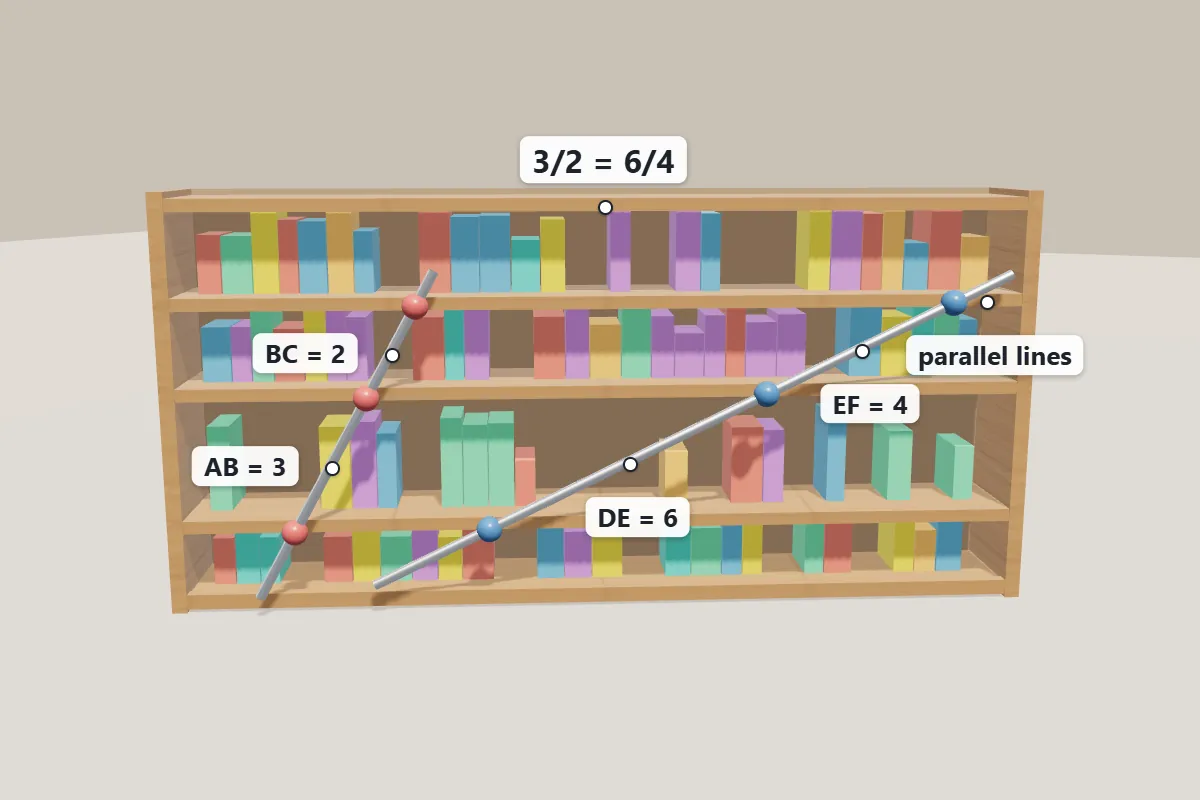
Parallel Lines, Proportional Segments: three parallel shelves cutting two leaning rods show parallel lines and proportional segments: 3/2 = 6/4.
  • A set of parallel lines cuts equal intercepts on any transversal, therefore it cuts equal intercepts on every other transversal.
  • General form if three parallel lines cut two transversals at A, B, C and at D, E, F respectively, then AB/BC = DE/EF, and likewise AB/DF = BC/EF … etc.
  • Construction aid to divide a segment into n equal parts, step off n equal units on an auxiliary ray and draw the parallel through the last point.
  • Equally spaced parallel lines preserve ratios of intercepted lengths, which is how a scaled ruler or a grid is divided proportionally.
Unit 3: Parallel Lines, Proportional Segments and Angle Bisectors · 5 / 11
3-5 Applications in the trapezoid

3-5 Applications in the trapezoid

  • In trapezoid ABCD with AB ∥ CD, a line XY parallel to the two bases with X on AD and Y on BC gives AX/XD = BY/YC.
  • The segment joining the midpoints of the two legs (the median) is parallel to the bases and equals half their sum: median = (AB + CD)/2.
  • The portion of such a parallel between the legs, when X divides AD in the ratio m : n, has length (m·CD + n·AB)/(m + n).
  • Lines through the intersection point of the diagonals give proportional segments on each diagonal, used to prove that the diagonal intersection divides them in the ratio of the bases.
Unit 3: Parallel Lines, Proportional Segments and Angle Bisectors · 6 / 11
3-6 The internal bisector theorem and its converse

3-6 The internal bisector theorem and its converse

Comparison aspectMain ideaKeywords
Theorem
  • if AD bisects angle BAC of triangle ABC and D lies on BC
  • then BD/DC = AB/AC — the bisector divides the opposite side in the ratio of the two sides forming the angle
bisectsangletrianglelies
Mnemonic
  • the ratio in
  • the bisector cuts the opposite side equals the ratio of the adjacent sides
ratiobisectorcutsopposite
Converse
  • if D on BC satisfies BD/DC = AB/AC
  • then AD bisects angle BAC
satisfiesthenbisectsangle
Rearrangements used in exams
  • BD = BC·AB/(AB + AC)
  • DC = BC·AC/(AB + AC)
  • and BD/BC = AB/(AB + AC)
Unit 3: Parallel Lines, Proportional Segments and Angle Bisectors · 7 / 11
3-7 The external bisector theorem

3-7 The external bisector theorem

  • The bisector of the exterior angle at A meets the extension of BC at a point E such that BE/EC = AB/AC, with E outside the segment BC, on the side of the shorter adjacent side.
  • If AB = AC the external bisector is parallel to BC, so it never meets the line BC and there is no external division point.
  • Converse verify that E lies on the extension of BC (outside the segment) and that BE/EC = AB/AC; then AE is the external bisector.
  • The internal and external bisectors at the same vertex are perpendicular to each other, so D and E subtend a right angle at A; B, D, C, E form a harmonic range with AB/AC.
Unit 3: Parallel Lines, Proportional Segments and Angle Bisectors · 8 / 11
3-8 Lengths of the internal and external bisectors

3-8 Lengths of the internal and external bisectors

InternalAD2 = AB × AC − BD × DC.
ExternalAE2 = BE × EC − AB × AC (E on the extension of BC).
  • Take AB = 3, AC = 4, BC = 5. The internal bisector gives BD = 15/7 and DC = 20/7, so AD2 = 12 − 300/49 = 288/49 → AD = 12√2/7.
  • The external bisector gives BE = 15, EC = 20, so AE2 = 300 − 12 = 288 → AE = 12√2 — note AE > AD, as it must be.
Unit 3: Parallel Lines, Proportional Segments and Angle Bisectors · 9 / 11
3-9 Mixed applications with areas

3-9 Mixed applications with areas

Comparison aspectMain ideaKeywords
•
  • Triangles ABD and ACD share the same altitude from A
  • so area(△ABD)/area(△ACD) = BD/DC
  • using the bisector theorem this ratio is also AB/AC
Trianglessharesamealtitude
Combining with similarity
  • a ratio of lengths gives a ratio of areas only when the triangles are similar or share an altitude — state
  • one you are using
ratiolengthsgivesareas
Perimeter problems
  • if a bisector or a parallel divides a side
  • first find the two parts with the ratio
  • then substitute into the length formulas
bisectorparalleldividesside
Coordinate setupsassign the base on the x-axis and use the section formula with the ratio from the bisector theorem to locate Dassignbaseaxissection
Unit 3: Parallel Lines, Proportional Segments and Angle Bisectors · 10 / 11
Exam traps and key takeaways

Exam traps and key takeaways

💡 High-yield traps

  • AD/DB = AE/EC uses the parts; AD/AB = AE/AC uses the whole sides. Mixing them is the standard lost mark.
  • The converse needs the equality of the two ratios before you may write “therefore parallel”.
  • The midline is half the third side — do not double it by accident when solving for the base.
  • The internal bisector ratio is AB/AC in the order of the sides: BD (adjacent to AB) corresponds to AB.
  • The external bisector divides the base externally; if you get a point inside the segment you have used the internal case.
  • When AB = AC there is no external division point because the external bisector is parallel to BC.
  • Subtract in the internal formula, subtract the other way in the external formula: AD2 = AB·AC − BD·DC; AE2 = BE·EC − AB·AC.
  • Area ratio = base ratio only when the two triangles share the same altitude.
Unit 3: Parallel Lines, Proportional Segments and Angle Bisectors · 11 / 11