Curriculum
Mathematics — First Secondary
Unit 1
0/12
1.11-1 The need for the imaginary number and the powers of i1.21-2 The complex number: equality, addition and multiplication1.31-3 The conjugate and the division of complex numbers1.41-4 Solving the quadratic equation with the general formula1.51-5 The discriminant and the nature of the two roots1.61-6 Finding an unknown coefficient from a condition on the roots1.71-7 Sum and product of the roots (Vieta)1.81-8 Forming the quadratic equation from its roots1.91-9 Sign of a function1.101-10 Solving second-degree inequalities1.111-11 Applications: radicals and verbal problems1.12Exam traps and key takeaways
Unit 2
0/111.12-1 Ratio and proportion (revision)1.22-2 Definition of the similarity of two polygons1.32-3 The scale factor, unknown lengths and map scale1.42-4 Cases of similarity of triangles1.52-5 Finding lengths and proving relations by similarity1.62-6 The right triangle and Euclid's theorems1.72-7 Pythagoras' theorem and its converse1.82-8 Areas, heights and the line parallel to one side1.92-9 Similarity inside the circle1.102-10 The converses: four concyclic points and proving a tangent1.11Exam traps and key takeaways
Unit 3
0/101.13-1 The line parallel to one side of a triangle1.23-2 The converse1.33-3 Consequences: the midline1.43-4 Thales' general theorem (the intercept theorem)1.53-5 Applications in the trapezoid1.63-6 The internal bisector theorem and its converse1.73-7 The external bisector theorem1.83-8 Lengths of the internal and external bisectors1.93-9 Mixed applications with areas1.10Exam traps and key takeaways
Unit 4
0/121.14-1 The directed angle and its standard position1.24-2 Sexagesimal and circular measure1.34-3 Arc length and sector area1.44-4 The trigonometric functions of any angle1.54-5 Fundamental identities and finding the rest from one function1.64-6 Related angles: reduction to the reference angle1.74-7 Simplifying expressions with related angles1.84-8 The graphs of sine, cosine and tangent1.94-9 Amplitude and period: y = a sin bx and y = a cos bx1.104-10 Finding an angle from a given ratio1.114-11 A point on the terminal side and radian answers1.12Exam traps and key takeaways
Text lesson
Unit 3: Parallel Lines, Proportional Segments and Angle Bisectors
Unit 3: Parallel Lines, Proportional Segments and Angle Bisectors
Overview
Overview
- State and prove the theorem of the line parallel to one side of a triangle, and use its converse to establish parallelism.
- Use Thales’ (intercept) theorem and its consequences in the triangle and the trapezoid.
- Apply the internal and external bisector theorems, their converses, and the formulas for the lengths of the two bisectors.
Parallel Lines and Proportional Segments
├── 3-1 The line parallel to one side of a triangle
│   ├── the theorem and other ratios
│   ├── the converse
│   ├── the midline (joining two midpoints)
│   ├── Thales' general theorem (equal intercepts)
│   └── applications in the trapezoid
└── 3-2 The angle bisectors
    ├── internal bisector theorem and converse
    ├── external bisector theorem and converse
    ├── special case AB = AC
    ├── length of the internal and external bisectors
    └── mixed applications with areas
Unit 3: Parallel Lines, Proportional Segments and Angle Bisectors · 1 / 11
3-1 The line parallel to one side of a triangle
3-1 The line parallel to one side of a triangle
| Comparison aspect | Main idea | Keywords |
|---|---|---|
| Theorem |
| straightlinedrawnparallel |
| Equivalent forms that follow from it |
| samesimilarity |
| • |
| firstformquestioninvolves |
Unit 3: Parallel Lines, Proportional Segments and Angle Bisectors · 2 / 11
3-2 The converse
3-2 The converse
| Comparison aspect | Main idea | Keywords |
|---|---|---|
| Converse |
| pointdividethosesides |
| Method |
| computeratiosseparatelysimplify |
| • | Always check that D and E lie on the sides (or their extensions consistently) before applying | Alwayschecksidesextensions |
Unit 3: Parallel Lines, Proportional Segments and Angle Bisectors · 3 / 11
3-3 Consequences: the midline
3-3 Consequences: the midline
- Putting D and E as the midpoints of AB and AC gives AD/DB = 1 = AE/EC, so by the converse DE ∥ BC.
- Moreover DE/BC = AD/AB = 1/2, so the segment joining the midpoints of two sides of a triangle is parallel to the third side and equal to half of it.
- The three midpoints of a triangle divide it into four congruent triangles, each similar to the original with scale factor 1/2.
- Corollary the line through the midpoint of one side of a triangle, drawn parallel to a second side, bisects the third side.
Unit 3: Parallel Lines, Proportional Segments and Angle Bisectors · 4 / 11
3-4 Thales’ general theorem (the intercept theorem)
3-4 Thales’ general theorem (the intercept theorem)
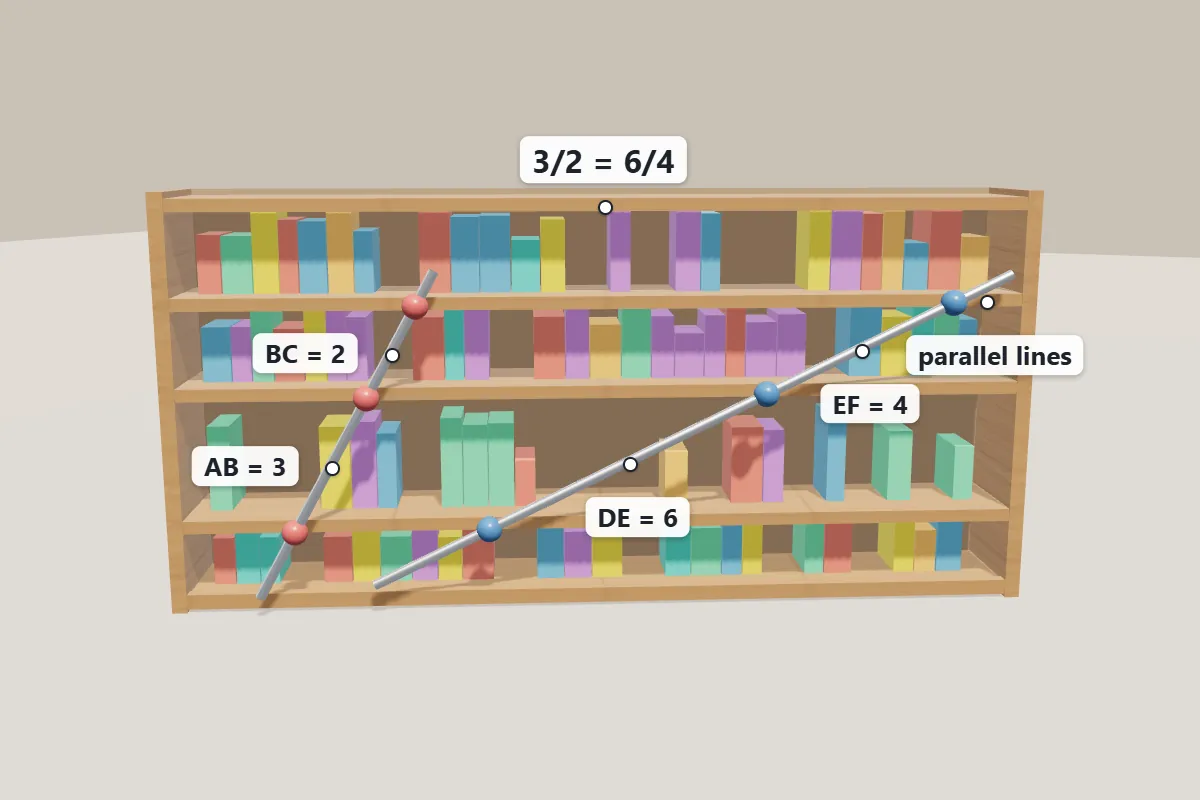
- A set of parallel lines cuts equal intercepts on any transversal, therefore it cuts equal intercepts on every other transversal.
- General form if three parallel lines cut two transversals at A, B, C and at D, E, F respectively, then AB/BC = DE/EF, and likewise AB/DF = BC/EF … etc.
- Construction aid to divide a segment into n equal parts, step off n equal units on an auxiliary ray and draw the parallel through the last point.
- Equally spaced parallel lines preserve ratios of intercepted lengths, which is how a scaled ruler or a grid is divided proportionally.
Unit 3: Parallel Lines, Proportional Segments and Angle Bisectors · 5 / 11
3-5 Applications in the trapezoid
3-5 Applications in the trapezoid
- In trapezoid ABCD with AB ∥ CD, a line XY parallel to the two bases with X on AD and Y on BC gives AX/XD = BY/YC.
- The segment joining the midpoints of the two legs (the median) is parallel to the bases and equals half their sum: median = (AB + CD)/2.
- The portion of such a parallel between the legs, when X divides AD in the ratio m : n, has length (m·CD + n·AB)/(m + n).
- Lines through the intersection point of the diagonals give proportional segments on each diagonal, used to prove that the diagonal intersection divides them in the ratio of the bases.
Unit 3: Parallel Lines, Proportional Segments and Angle Bisectors · 6 / 11
3-6 The internal bisector theorem and its converse
3-6 The internal bisector theorem and its converse
| Comparison aspect | Main idea | Keywords |
|---|---|---|
| Theorem |
| bisectsangletrianglelies |
| Mnemonic |
| ratiobisectorcutsopposite |
| Converse |
| satisfiesthenbisectsangle |
| Rearrangements used in exams |
|
Unit 3: Parallel Lines, Proportional Segments and Angle Bisectors · 7 / 11
3-7 The external bisector theorem
3-7 The external bisector theorem
- The bisector of the exterior angle at A meets the extension of BC at a point E such that BE/EC = AB/AC, with E outside the segment BC, on the side of the shorter adjacent side.
- If AB = AC the external bisector is parallel to BC, so it never meets the line BC and there is no external division point.
- Converse verify that E lies on the extension of BC (outside the segment) and that BE/EC = AB/AC; then AE is the external bisector.
- The internal and external bisectors at the same vertex are perpendicular to each other, so D and E subtend a right angle at A; B, D, C, E form a harmonic range with AB/AC.
Unit 3: Parallel Lines, Proportional Segments and Angle Bisectors · 8 / 11
3-8 Lengths of the internal and external bisectors
3-8 Lengths of the internal and external bisectors
InternalAD2 = AB × AC − BD × DC.
ExternalAE2 = BE × EC − AB × AC (E on the extension of BC).
- Take AB = 3, AC = 4, BC = 5. The internal bisector gives BD = 15/7 and DC = 20/7, so AD2 = 12 − 300/49 = 288/49 → AD = 12√2/7.
- The external bisector gives BE = 15, EC = 20, so AE2 = 300 − 12 = 288 → AE = 12√2 — note AE > AD, as it must be.
Unit 3: Parallel Lines, Proportional Segments and Angle Bisectors · 9 / 11
3-9 Mixed applications with areas
3-9 Mixed applications with areas
| Comparison aspect | Main idea | Keywords |
|---|---|---|
| • |
| Trianglessharesamealtitude |
| Combining with similarity |
| ratiolengthsgivesareas |
| Perimeter problems |
| bisectorparalleldividesside |
| Coordinate setups | assign the base on the x-axis and use the section formula with the ratio from the bisector theorem to locate D | assignbaseaxissection |
Unit 3: Parallel Lines, Proportional Segments and Angle Bisectors · 10 / 11
Exam traps and key takeaways
Exam traps and key takeaways
💡 High-yield traps
- AD/DB = AE/EC uses the parts; AD/AB = AE/AC uses the whole sides. Mixing them is the standard lost mark.
- The converse needs the equality of the two ratios before you may write “therefore parallel”.
- The midline is half the third side — do not double it by accident when solving for the base.
- The internal bisector ratio is AB/AC in the order of the sides: BD (adjacent to AB) corresponds to AB.
- The external bisector divides the base externally; if you get a point inside the segment you have used the internal case.
- When AB = AC there is no external division point because the external bisector is parallel to BC.
- Subtract in the internal formula, subtract the other way in the external formula: AD2 = AB·AC − BD·DC; AE2 = BE·EC − AB·AC.
- Area ratio = base ratio only when the two triangles share the same altitude.
Unit 3: Parallel Lines, Proportional Segments and Angle Bisectors · 11 / 11
Well done! You finished this lesson
What would you like to do next?