Curriculum
Login

Curriculum

Mathematics — First Secondary

Text lesson

Unit 2: Similarity of Polygons and Triangles, Areas and Circle Theorems

Mathematics — First Secondary

Unit 2: Similarity of Polygons and Triangles, Areas and Circle Theorems

Overview

Overview

  • Define the similarity of two polygons and find the unknown side from the scale factor.
  • Prove two triangles similar with AA, SSS or SAS and use the result to find lengths.
  • Apply Euclid’s theorems and Pythagoras’ theorem with its converse in the right triangle.
  • Relate the ratio of areas to the square of the scale factor, and use the chord, secant and tangent theorems in the circle.
Similarity
├── 2-1 Ratio, proportion and similar polygons
│   ├── ratio and proportion (revision)
│   ├── definition of similarity (two conditions)
│   ├── scale factor k and unknown lengths
│   ├── polygons always similar / never certainly similar
│   └── map scale and models
├── 2-2 Similar triangles
│   ├── AA, SSS, SAS
│   ├── finding lengths and proving relations
│   ├── the right triangle and Euclid's two theorems
│   ├── Pythagoras and its converse
│   └── real-life applications (shadows, heights)
├── 2-3 Areas of similar figures
│   ├── ratio of areas = k²
│   ├── heights and perimeters
│   └── the line parallel to one side of a triangle
└── 2-4 Similarity in the circle
    ├── two intersecting chords
    ├── two secants from an external point
    ├── tangent and secant from an external point
    └── converses: four concyclic points, proving a tangent
Unit 2: Similarity of Polygons and Triangles, Areas and Circle Theorems · 1 / 12
2-1 Ratio and proportion (revision)

2-1 Ratio and proportion (revision)

Comparison aspectMain ideaKeywords
•
  • The ratio between two quantities of the same kind is the result of dividing one by the other
  • written a : b or a/b
  • b ≠ 0
ratiobetweenquantitiessame
A proportion is the equality of two ratiosa/b = c/d ⟺ ad = bc (cross-multiplication)crossmultiplication
Ratio is an ordered relation, so a
  • b ≠ b : a unless a = b
  • and it has no unit because the two quantities are of the same kind
unlessunitbecausequantities
Unit 2: Similarity of Polygons and Triangles, Areas and Circle Theorems · 2 / 12
2-2 Definition of the similarity of two polygons

2-2 Definition of the similarity of two polygons

Comparison aspectMain ideaExampleKeywords
Two polygons are similar when both conditions hold
  • (1) corresponding angles are equal in measure
  • and (2) corresponding sides are proportional
—correspondinganglesequalmeasure
One condition alone is not enough
  • a rectangle and a square have equal angles but are not similar
  • a rhombus and a square have proportional sides but are not similar
—rectanglesquareequalangles
•
  • When the correspondence of vertices is written
  • name the polygons in matching order
  • ABCD ~ PQRS means A↔P
  • B↔Q …
correspondenceverticeswrittenname
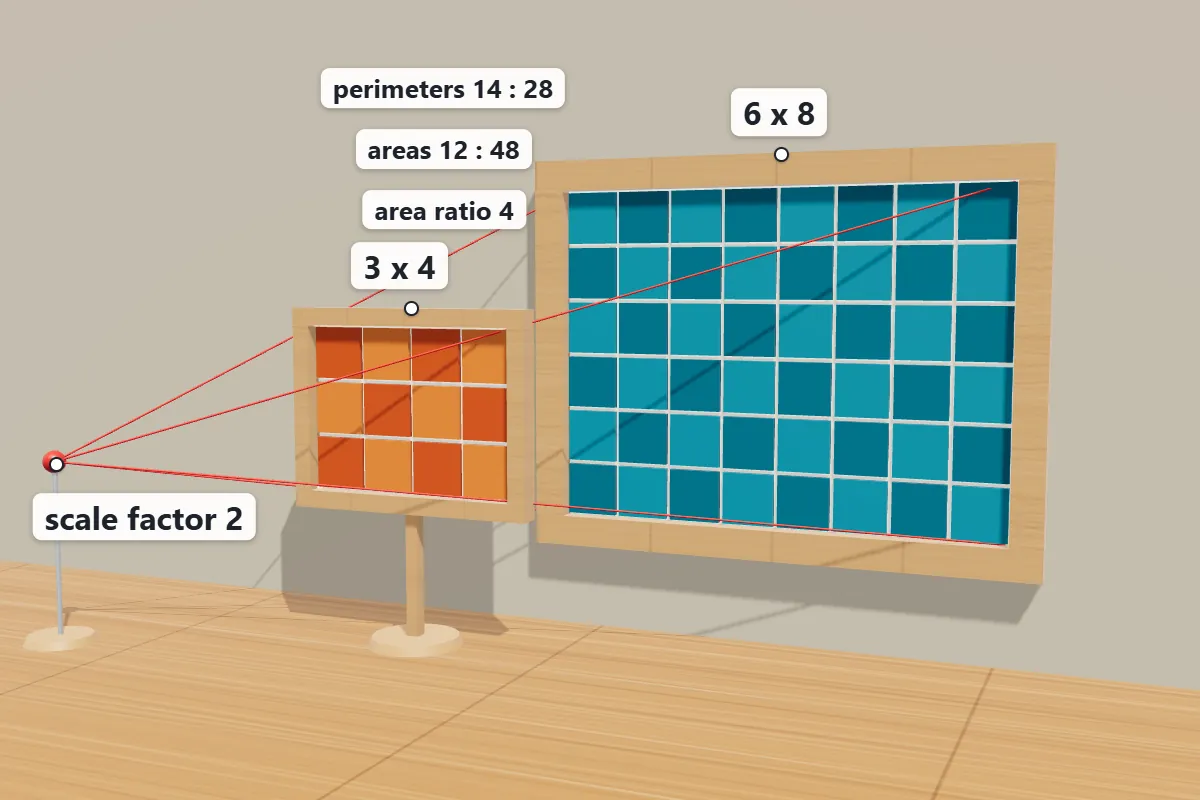
Similarity of Polygons: two wooden frames with scale factor 2 show similarity of polygons: perimeters 14 and 28, areas 12 and 48.

Polygons that are always similar

  • Any two regular polygons with the same number of sides are similar, because a regular polygon is equilateral and equiangular.
  • Any two circles are similar. Two rectangles or two rhombi are not necessarily similar.
Unit 2: Similarity of Polygons and Triangles, Areas and Circle Theorems · 3 / 12
2-3 The scale factor, unknown lengths and map scale

2-3 The scale factor, unknown lengths and map scale

  • The scale factor k is the ratio of a pair of corresponding sides; if k = 1 the two polygons are congruent.
  • To find an unknown length set the ratio of corresponding sides equal, then solve the proportion.
Comparison aspectMain ideaKeywords
A scale 150000 means 1 cm on the map represents 50000 cm = 500 m in reality50000meansrepresentsreality
•
  • Actual distance = map distance ÷ scale
  • always convert units before computing
Actualdistancescalealways
Areas scale with the square of the scalearea on the map = actual area × (scale)2actual
Unit 2: Similarity of Polygons and Triangles, Areas and Circle Theorems · 4 / 12
2-4 Cases of similarity of triangles

2-4 Cases of similarity of triangles

AA — two angles

  • If two angles of one triangle equal two angles of another, the triangles are similar. The third angle matches automatically because the angle sum of a triangle is 180°.
  1. Order the sides of each triangle from smallest to largest
  2. then compare the three ratios of corresponding sides
  3. equality of all three gives similarity.
  • The equal angle must be the one included between the two proportional sides; otherwise the case does not apply.
Unit 2: Similarity of Polygons and Triangles, Areas and Circle Theorems · 5 / 12
2-5 Finding lengths and proving relations by similarity

2-5 Finding lengths and proving relations by similarity

Comparison aspectMain ideaExampleKeywords
Step 1
  • look for equal angles (parallel lines
  • vertically opposite angles
  • angles on the same arc) or proportional sides
—lookequalanglesparallel
Step 2state the similarity with matching vertices in order—statesimilaritymatchingvertices
Step 3
  • write the ratio of corresponding sides and solve
  • equal ratios give the unknown length
  • and the product form gives relations
AB × DE = AC × DFwriteratiocorrespondingsides
•
  • Corresponding altitudes
  • medians and angle bisectors of similar triangles are in the same ratio k as the sides
—Correspondingaltitudesmediansangle
Unit 2: Similarity of Polygons and Triangles, Areas and Circle Theorems · 6 / 12
2-6 The right triangle and Euclid’s theorems

2-6 The right triangle and Euclid’s theorems

  1. In right triangle ABC
  2. right-angled at A
  3. with altitude AD drawn to the hypotenuse BC
  4. the two smaller triangles are similar to each other and to the whole triangle.
Leg theoremthe square of a leg equals the hypotenuse times the projection of that leg on the hypotenuse: AB2 = BD × BC and AC2 = CD × BC.
Altitude theoremthe square of the altitude to the hypotenuse equals the product of the two projections: AD2 = BD × DC.
  • AB/AC = √(BD/DC); sin and cos of the acute angles read directly from the projections.
  • BD + DC = BC, so the two projections add to the hypotenuse.
Unit 2: Similarity of Polygons and Triangles, Areas and Circle Theorems · 7 / 12
2-7 Pythagoras’ theorem and its converse

2-7 Pythagoras’ theorem and its converse

The theorem

  • In a right triangle, the square on the hypotenuse equals the sum of the squares on the two legs.
  • Proof from Euclid AB2 + AC2 = BD·BC + CD·BC = (BD + CD)·BC = BC2.
  • If the square of the longest side of a triangle equals the sum of the squares of the other two sides, then the triangle is right-angled, and the right angle lies opposite the longest side.
  • Compare instead of computing roots if c2 > a2 + b2 the angle opposite c is obtuse; if c2 < a2 + b2 it is acute.
  • Sun shadows light rays are parallel, so a person and his shadow form a triangle similar to that of a building and its shadow — heights are found from the ratio of shadows.
  • Ladders, diagonals of screens and fields, and the distance between two points on a grid.
Unit 2: Similarity of Polygons and Triangles, Areas and Circle Theorems · 8 / 12
2-8 Areas, heights and the line parallel to one side

2-8 Areas, heights and the line parallel to one side

  • The ratio of the areas of two similar polygons equals the square of the scale factor: A₁/A₂ = k2.
  • The ratio of perimeters equals k itself; so from an area ratio you get k by taking the square root, and from k you get an unknown height or perimeter.
  • If DE ∥ BC in triangle ABC, then △ADE ~ △ABC, and the trapezoid DBCE has area = area(△ABC) − area(△ADE).
  • Hence area(△ADE)/area(DBCE) = AD2 (AB2 − AD2) — a standard exam form that asks for a ratio to the trapezoid, not to the whole triangle.
Unit 2: Similarity of Polygons and Triangles, Areas and Circle Theorems · 9 / 12
2-9 Similarity inside the circle

2-9 Similarity inside the circle

Two intersecting chords

  • If chords AB and CD meet at an interior point E, then △AEC ~ △DEB (vertically opposite angles at E and angles in the same segment standing on arc CB), and EA × EB = EC × ED.
  • From a point M outside the circle, two secants cut the circle at A, B and C, D where A and C are the nearer points and B and D the farther ones: MA × MB = MC × MD.
  • When the second secant collapses onto the tangent (C = D = T) the result becomes MT2 = MA × MB — the square of the tangent equals the product of the segments of the secant.
Unit 2: Similarity of Polygons and Triangles, Areas and Circle Theorems · 10 / 12
2-10 The converses: four concyclic points and proving a tangent

2-10 The converses: four concyclic points and proving a tangent

  • If two points A and B lie on the same side of segment CD and subtend equal angles at it (∠CAD = ∠CBD), then the four points A, B, C, D lie on one circle.
  • If two chords AB and CD meet at E and EA × EB = EC × ED, then A, B, C, D are concyclic.
  • If from an external point M a line MT meets the circle at T and MT2 = MA × MB for a secant MAB, then MT is a tangent to the circle at T.
  • The converse of the intersecting-chords product is the usual route in “prove that the four points lie on a circle” items.
Unit 2: Similarity of Polygons and Triangles, Areas and Circle Theorems · 11 / 12
Exam traps and key takeaways

Exam traps and key takeaways

💡 High-yield traps

  • Similarity needs both conditions for polygons; equal angles alone or proportional sides alone are not enough (square vs rectangle, square vs rhombus).
  • In SAS similarity the angle must be included between the two proportional sides.
  • Ratio of areas is k2, ratio of lengths and perimeters is k — do not use one for the other.
  • The map scale is a ratio of lengths; areas need its square.
  • Write the similarity statement with corresponding vertices in the correct order, otherwise every later ratio is wrong.
  • Euclid’s theorems apply only after drawing the altitude to the hypotenuse of a right triangle.
  • In the secant theorem use the distance from the external point to each intersection, i.e. the whole secant times its external part.
  • MT2 = MA·MB is the tangent–secant case; the intersecting-chords product uses two interior segments through the crossing point.
  • For “four points on one circle”, check the two angles subtend the same segment and lie on the same side of it.
Unit 2: Similarity of Polygons and Triangles, Areas and Circle Theorems · 12 / 12