Unit 4: Trigonometry — Directed Angles, Functions, Related Angles and Graphs
Mathematics — First Secondary
Unit 4: Trigonometry — Directed Angles, Functions, Related Angles and Graphs
Overview
Overview
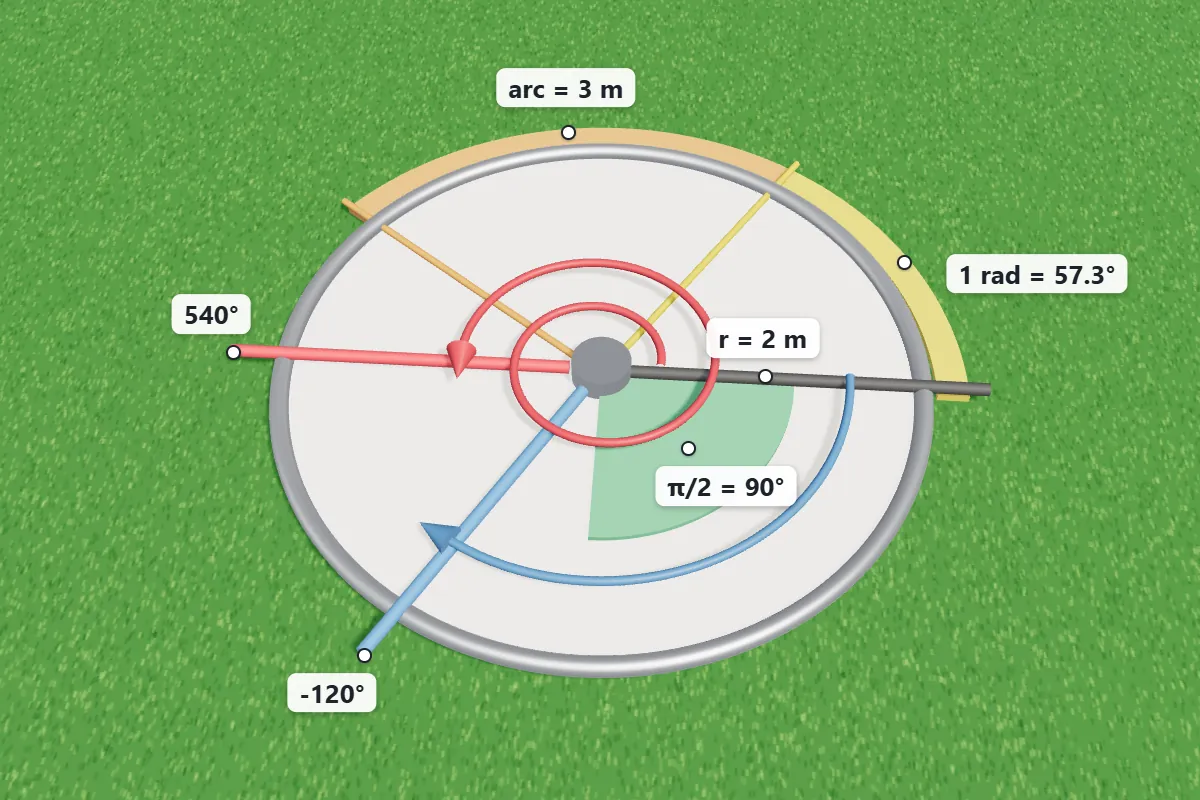
Trigonometry: a wheel of radius 2 m and a tape equal to the radius show circular measure and the directed angle: 1 radian is 57.3 degrees.
Define a directed angle, its standard position and coterminal angles, and find the measure of an angle from a figure or from revolutions.
Convert between sexagesimal and circular measure and use the arc and sector formulas.
Evaluate the six trigonometric functions of any angle, fix their signs by quadrant, and use the fundamental identities.
Reduce any angle to an acute reference angle, sketch the graphs of sine, cosine and tangent, and solve simple trigonometric equations on 0° ≤ θ < 360°.
Trigonometry
├── 4-1 Directed angles
│   ├── definition, initial and terminal side
│   ├── standard position and the four quadrants
│   ├── coterminal angles
│   └── reading the angle from a figure or from revolutions
├── 4-2 Measure
│   ├── sexagesimal: degrees, minutes, seconds
│   ├── circular: the radian
│   ├── conversion between the two
│   └── arc length and sector area
├── 4-3 Trigonometric functions
│   ├── definition for any angle
│   ├── signs in the quadrants
│   ├── quadrantal and special angles
│   ├── reciprocals and fundamental identities
│   └── finding the rest from one function
├── 4-4 Related angles (reduction to the acute angle)
├── 4-5 Graphs, amplitude and period
└── 4-6 Finding angles and solving simple equations
Unit 4: Trigonometry — Directed Angles, Functions, Related Angles and Graphs · 1 / 13
4-1 The directed angle and its standard position
4-1 The directed angle and its standard position
A directed angle is generated by a ray rotating about its endpoint from an initial side to a terminal side: counter-clockwise is positive, clockwise is negative.
The angle is in standard position when its vertex is at the origin and its initial side lies along the positive x-axis.
The quadrant of the angle is the quadrant in which its terminal side lies: 0–90° first, 90–180° second, 180–270° third, 270–360° fourth.
Angles whose sides are parallel to the axes (0°, 90°, 180°, 270°, 360°) are quadrantal and belong to no quadrant.
Coterminal angles share the initial and terminal sides and differ by a multiple of 360°: θ + 360°k, k ∈ ℤ.
Half a turn = 180°, one turn = 360°, two and a quarter turns = 810°; add 360° for every full turn.
To name the angle from a figure measure the rotation from the positive x-axis in the given direction, keeping the sign.
Unit 4: Trigonometry — Directed Angles, Functions, Related Angles and Graphs · 2 / 13
4-2 Sexagesimal and circular measure
4-2 Sexagesimal and circular measure
Comparison aspect
Main idea
Keywords
Degree
1/360 of one revolution
1° = 60′
1′ = 60″
so 1° = 3600″
revolution3600
Decimal degrees to DMS
keep the integer part as degrees
multiply the fraction by 60 for minutes
then again by 60 for seconds
keepintegerpartmultiply
•
The radian is the angle whose intercepted arc equals the radius
one revolution = 2π radians
hence π rad = 180° and 1 rad ≈ 57.3° ≈ 57°16′
radiananglewhoseintercepted
Comparison aspect
Main idea
Keywords
Degrees → radians
multiply by π/180. Radians → degrees: multiply by 180/π
multiply
Common values
30° = π/6
45° = π/4
60° = π/3
90° = π/2
120° = 2π/3
135° = 3π/4
150° = 5π/6
210° = 7π/6
270° = 3π/2
360° = 2π
•
Never mix units inside one expression — convert everything first
and leave the answer in the unit the question asks for
Neverunitsinsideexpression
Unit 4: Trigonometry — Directed Angles, Functions, Related Angles and Graphs · 3 / 13
4-3 Arc length and sector area
4-3 Arc length and sector area
l = rθ with θ in radians — for degrees use l = 2πr × (θ/360).
Sector area = ½ r2 θ (θ in radians), equivalently ½ × l × r.
Area of the corresponding triangle = ½ r2 sinθ, so the segment area = sector − triangle = ½ r2(θ − sinθ).
Gears, wheels and the movement of clock hands are applications: the linear speed of a point = r × (angular speed in rad/s).
Worked example
r = 10 cm, θ = 60° = π/3 rad→l = 10π/3 cm and sector = ½ × 100 × π/3 = 50π/3 cm2.
Unit 4: Trigonometry — Directed Angles, Functions, Related Angles and Graphs · 4 / 13
4-4 The trigonometric functions of any angle
4-4 The trigonometric functions of any angle
Take a point P(x, y) on the terminal side at distance r = √(x2 + y2) from the origin: sinθ = y/r, cosθ = x/r, tanθ = y/x (x ≠ 0).
Reciprocals cscθ = r/y, secθ = r/x, cotθ = x/y — csc is the reciprocal of sin, sec of cos, cot of tan.
tanθ = sinθ/cosθ and cotθ = cosθ/sinθ; cotθ is undefined when sinθ = 0, tanθ and secθ when cosθ = 0.
Firstall six positive. Second: only sin (and csc) positive. Third: only tan (and cot) positive. Fourth: only cos (and sec) positive.
MnemonicC AST — All, Sin, Tan, Cos going round the quadrants counter-clockwise.
0°→sin 0, cos 1, tan 0. 90°: sin 1, cos 0, tan undefined. 180°: sin 0, cos −1, tan 0. 270°: sin −1, cos 0, tan undefined. 360°: as 0°.
30°sin = 1/2, cos = √3/2, tan = 1/√3. 45°: sin = cos = √2/2, tan = 1. 60°: sin = √3/2, cos = 1/2, tan = √3.
The 3-4-5 approximations used in the syllabussin 37° ≈ 0.6, cos 37° ≈ 0.8, tan 37° ≈ 0.75; sin 53° ≈ 0.8, cos 53° ≈ 0.6, tan 53° ≈ 4/3.
Unit 4: Trigonometry — Directed Angles, Functions, Related Angles and Graphs · 5 / 13
4-5 Fundamental identities and finding the rest from one function
4-5 Fundamental identities and finding the rest from one function
The three Pythagorean identities
sin2θ + cos2θ = 1.
1 + tan2θ = sec2θ (divide the first by cos2θ).
1 + cot2θ = csc2θ (divide the first by sin2θ).
Determine the quadrant from the sign of the given function and the stated condition, so the signs of the rest are fixed.
Use sin2 + cos2 = 1 for the missing leg, then tan = sin/cos, and take reciprocals for csc, sec, cot.
Geometric alternative build a right triangle with the given ratio and place it in the correct quadrant to read the signs of x, y and r.
Remember r > 0 always, so sin and cos carry the sign of y and x respectively.
Unit 4: Trigonometry — Directed Angles, Functions, Related Angles and Graphs · 6 / 13
4-6 Related angles: reduction to the reference angle
4-6 Related angles: reduction to the reference angle
The reference angle is the acute angle between the terminal side and the x-axis; the value of the function is that of the reference angle with the sign fixed by the quadrant.
Comparison aspect
Main idea
Keywords
180° − θ
sin(180−θ) = sinθ
cos(180−θ) = −cosθ
tan(180−θ) = −tanθ
sinθcosθtanθ
180° + θ
sin = −sinθ
cos = −cosθ
tan = tanθ
sinθcosθtanθ
360° − θ
sin = −sinθ
cos = cosθ
tan = −tanθ
sinθcosθtanθ
−θ
sin = −sinθ
cos = cosθ
tan = −tanθ (cosine is even
sine and tangent odd)
sinθcosθtanθcosine
90° − θ (co-functions)
sin = cosθ
cos = sinθ
tan = cotθ
cosθsinθcotθ
90° + θ
sin = cosθ
cos = −sinθ
tan = −cotθ
cosθsinθcotθ
270° − θ
sin = −cosθ
cos = −sinθ
tan = cotθ
cosθsinθcotθ
270° + θ
sin = −cosθ
cos = sinθ
tan = −cotθ
cosθsinθcotθ
Rule of thumb
for 90° and 270° the function changes to its co-function
for 0°
180° and 360° it stays the same — the sign comes from the quadrant of the whole angle
functionchangesstayssame
Unit 4: Trigonometry — Directed Angles, Functions, Related Angles and Graphs · 7 / 13
4-7 Simplifying expressions with related angles
4-7 Simplifying expressions with related angles
Reduce every term to the same acute angle first, then collect like terms.
For proving identities, transform the harder side only, one valid step at a time, and never “assume the result then work backwards” without reversing the steps.
Powers are written sin2θ = (sinθ)2; note that sin2θ + sin2(90−θ) = sin2θ + cos2θ = 1 — a frequent one-mark item.
Unit 4: Trigonometry — Directed Angles, Functions, Related Angles and Graphs · 8 / 13
4-8 The graphs of sine, cosine and tangent
4-8 The graphs of sine, cosine and tangent
y = sin x and y = cos x
Both oscillate between −1 and +1 with period 360° (2π rad); the cosine curve is the sine curve shifted left by 90°.
Sine passes through (0, 0), peaks at 90°, returns to zero at 180°, minimum at 270°, and completes at 360°.
Key points to plot 0°, 90°, 180°, 270°, 360° — five points are enough for one cycle.
Period 180° (π rad), range all reals, with vertical asymptotes at x = 90° + 180°k where cosine vanishes; the curve crosses zero at 0°, 180°, 360°.
Between two asymptotes the tangent increases continuously from −∞ to +∞.
Solutions of an equation such as sin x = ½ on 0° ≤ x < 360° are the x-coordinates where the curve cuts the line y = ½ — here x = 30° and x = 150°.
Number of solutions equals the number of intersection points, so always state the interval.
Unit 4: Trigonometry — Directed Angles, Functions, Related Angles and Graphs · 9 / 13
4-9 Amplitude and period: y = a sin bx and y = a cos bx
4-9 Amplitude and period: y = a sin bx and y = a cos bx
Comparison aspect
Main idea
Keywords
Amplitude = |a|
the factor a stretches the curve vertically
so the range becomes [−|a|
|a|]
factorstretchescurvevertically
Period = 360°/|b|
in degrees
or 2π/|b| in radians: the factor b compresses or stretches the curve horizontally
degreesradiansfactorcompresses
Example
y = 3 sin 2x has amplitude 3 and period 180°
y = ½ cos 4x has amplitude ½ and period 90°
amplitudeperiod
•
A negative a reflects the curve in the x-axis without changing amplitude or period
a negative b does not change the period either
negativereflectscurveaxis
Real-life use
tides
alternating current
and the height of a point on a wheel — read the maximum
minimum and one complete cycle from the graph
tidesalternatingcurrentheight
Unit 4: Trigonometry — Directed Angles, Functions, Related Angles and Graphs · 10 / 13
4-10 Finding an angle from a given ratio
4-10 Finding an angle from a given ratio
Acute angle first
Ignore the sign
find the acute reference angle from the special values or the tables
then restore the quadrant.
Comparison aspect
Main idea
Keywords
•
Fix the two quadrants where the function has the given sign
then write θ = reference angle and θ = 180° ± reference or 360° − reference as appropriate
quadrantsfunctiongivensign
Example
cosθ = −½ with 0° ≤ θ < 360°: reference 60°
cosine negative in the second and third quadrants → θ = 120° or θ = 240°
cosθreferencecosinenegative
In radians the same idea gives, for sinθ = ½ on 0 ≤ θ < 2π
θ = π/6 or θ = 5π/6
Isolate the function first 2sinθ − 1 = 0 → sinθ = ½; never divide the whole equation by the function name.
For quadratic-type equations such as 2cos2θ − cosθ − 1 = 0, put u = cosθ, factor (2u + 1)(u − 1) = 0 and solve each branch with its own quadrants.
Reject any value outside the stated interval, and check that |sin|, |cos| ≤ 1 — a ratio like sinθ = 1.5 has no solution.
Unit 4: Trigonometry — Directed Angles, Functions, Related Angles and Graphs · 11 / 13
4-11 A point on the terminal side and radian answers
4-11 A point on the terminal side and radian answers
Given P(x, y) on the terminal side r = √(x2 + y2), then sinθ = y/r, cosθ = x/r, tanθ = y/x — signs come from the coordinates, not from a diagram assumption.
Example P(−3, 4) gives r = 5, so sinθ = 4/5, cosθ = −3/5, tanθ = −4/3 (second quadrant).
If the angle is asked in radians and the answer must be exact, keep π in the result: 150° = 5π/6.
For the general coterminal angle write θ + 360°k or θ + 2πk, and restrict k when the question limits the interval.
Unit 4: Trigonometry — Directed Angles, Functions, Related Angles and Graphs · 12 / 13
Exam traps and key takeaways
Exam traps and key takeaways
💡 High-yield traps
l = rθ and sector = ½r2θ work only with θ in radians — the most common numerical error.
The quadrant of an angle is that of its terminal side; 420° is a first-quadrant angle, not a fourth.
tanθ and secθ are undefined when cosθ = 0; sinθ undefined when csc is asked at 0° — check before substituting.
Signs csc follows sin, sec follows cos, cot follows tan — students often flip sec and csc.
For 90° and 270° you must switch to the co-function; for 180° and 360° you keep the same function.
sin(−θ) = −sinθ but cos(−θ) = cosθ cosine is even.
Always list both solutions on 0° ≤ θ < 360° unless the quadrant is fixed by the question.
Amplitude is |a| and period is 360/|b| — a coefficient of x is a horizontal compression, not a vertical one.
Identities 1 + tan2 = sec2 and 1 + cot2 = csc2; mixing these two is a favourite trap.
A stated interval in radians means the answer must stay in radians.
Unit 4: Trigonometry — Directed Angles, Functions, Related Angles and Graphs · 13 / 13