1.4Chapter 1: The Particle Model and States of Matter
Changes of state — Alhussan Chemistry - Stage 7 Revision Notes & Topical Questions
5 min read 9 parts Lesson 4 of 8 2 quizzes
1.4 Changes of state — Evaporating, Boiling, and Condensing — Alhussan International Academy — Chemistry (Stages 7–9) notes: Define and compare evaporation, boiling and condensation and explain them using the particle model.Six changes — melting (solid to liquid), freezing (liqui…
- Candle wax
- Particle explanation
- Higher temperature
- Larger surface area
- Moving air
- Low humidity
Part 1 of 7Changes of state
- Six changes melting, freezing (liquid to solid), evaporating and boiling (liquid to gas), condensing (gas to liquid) and the reverse of evaporating for gas to liquid.
- (solid to liquid)
- Most substances change state, not only water.
- Candle wax it shows several changes, since near a burning wick solid wax melts to liquid wax and some liquid wax evaporates to wax in the gas state,
- which is the part that burns.
- Particles when a substance changes state its particles stay the same and do not get bigger or smaller.
- What changes is how the particles are arranged, how they move and how far apart they are.
Part 2 of 7Evaporation
- Where it happens only at the surface of the liquid.
- Particle explanation in a liquid the particles touch and slide over each other, and some move faster than others.
- The faster particles near the surface have enough kinetic energy to overcome the attraction of their neighbours and leave the surface.
- They separate from each other and form gas.
- Cooling the fastest particles leave, so the average energy of those left falls and the liquid cools, which is why sweating cools the body.
Part 3 of 7Factors that speed up evaporation
- Higher temperature more particles have enough energy to escape.
- Larger surface area more particles are at the surface, so wet washing spread out dries faster than washing in a heap.
- Moving air wind carries escaped particles away so they cannot return to the liquid.
- Low humidity dry air can accept more vapour, so fewer particles return.
Part 4 of 7Boiling
- Bubbles bubbles of the substance in the gas state form everywhere in the liquid, rise to the surface and escape.
- In the liquid the particles touch, while inside the bubbles they are spread far apart.
- The bubbles are water vapour, which is an invisible gas, and visible steam is condensed droplets.
- Boiling point the temperature at which a substance boils, different for each substance.
- It is high if the particles hold together strongly and low if they hold together weakly.
- Constant temperature energy from a heater does not raise the temperature while boiling, because it is used to break the forces between particles.
- Pure water stays at 100 °C at normal pressure until all the liquid has become gas.
| Feature | Evaporation | Boiling |
|---|---|---|
| Temperature | Any temperature below boiling point | Only at the boiling point |
| Where it happens | Surface only | Throughout the liquid |
| Speed | Slow | Fast, with bubbles |
Part 5 of 7Making conclusions from boiling point data
- Gas at room temperature a substance with a boiling point below 20 °C, such as nitrogen at −196 °C, is a gas at room temperature.
- Strong attraction a substance with a very high boiling point, such as copper or diamond, has particles held together very strongly.
- Comparing ethanol boils at 78 °C, water at 100 °C and mercury at 357 °C.
Part 6 of 7Condensation
- Particle explanation when a gas is cooled its particles lose kinetic energy and slow down.
- They get closer until they touch, because the attractive forces can now hold them together.
- Energy is released to the surroundings.
- Everyday example warm, moist air touching a cold surface such as a bathroom mirror or cold glass of drink leaves droplets of water.
- The water condensed from vapour in the air and did not pass through the glass.
- Condenser a tube cooled by water cools vapour from a boiling liquid so it drips out as a liquid, which is the basis of distillation.
Part 7 of 7Physical change
- Reversible
- a change of state is a physical change that can be reversed, because only arrangement, spacing and movement change.
Key terms
| Term | Meaning |
|---|---|
| Evaporation | Liquid changing to gas at the surface at any temperature below boiling point. |
| Boiling | Liquid changing to gas throughout the liquid at the boiling point. |
| Condensation | Gas changing to liquid. |
| Boiling point | The temperature at which a liquid boils. |
| Kinetic energy | The energy of movement of particles. |
| Condenser | A cooled tube that turns vapour into liquid. |
Avoid these mistakes
Marked practiceQuizzes for this lesson
?What do you want to solve now?
✓Checkpoint Quiz
1 written questions from real exam papers on this lesson.
Written question 1 of 1 · part (a)(i) (1 / 4) 3:00
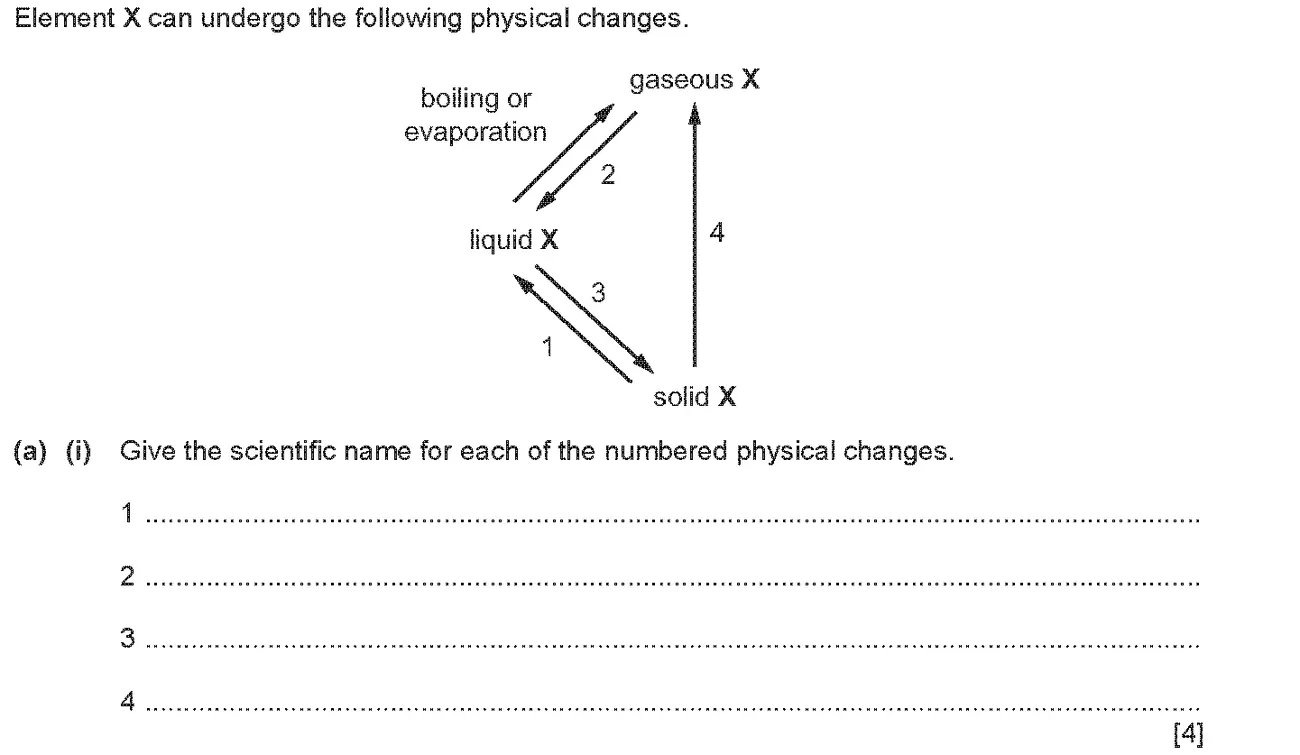
Show the answer
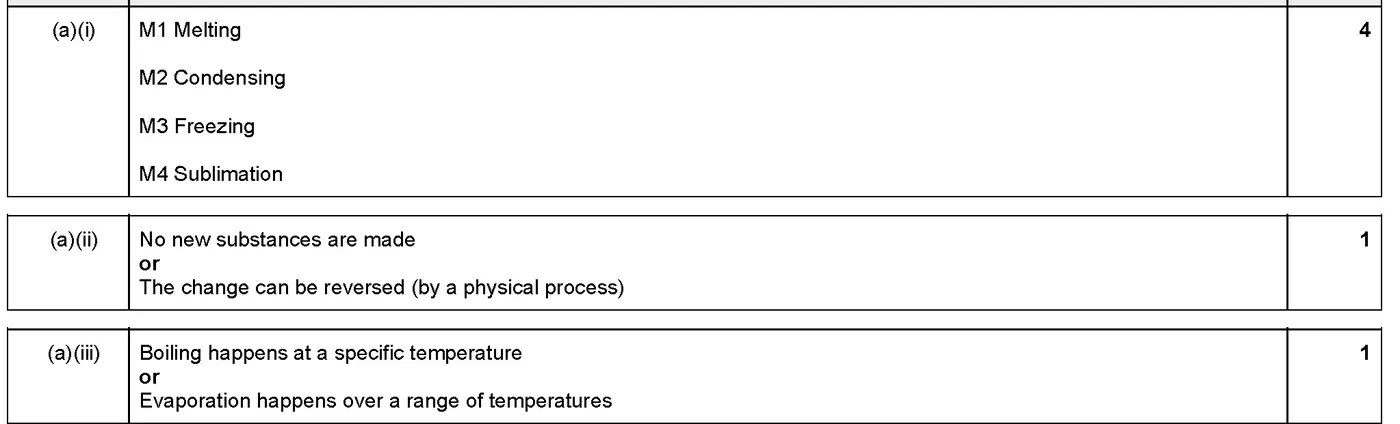
Written question 1 of 1 · part (a)(ii) (2 / 4) 3:00

Show the answer

Written question 1 of 1 · part (a)(iii) (3 / 4) 3:00

Show the answer

Written question 1 of 1 · part (c) (4 / 4) 3:00
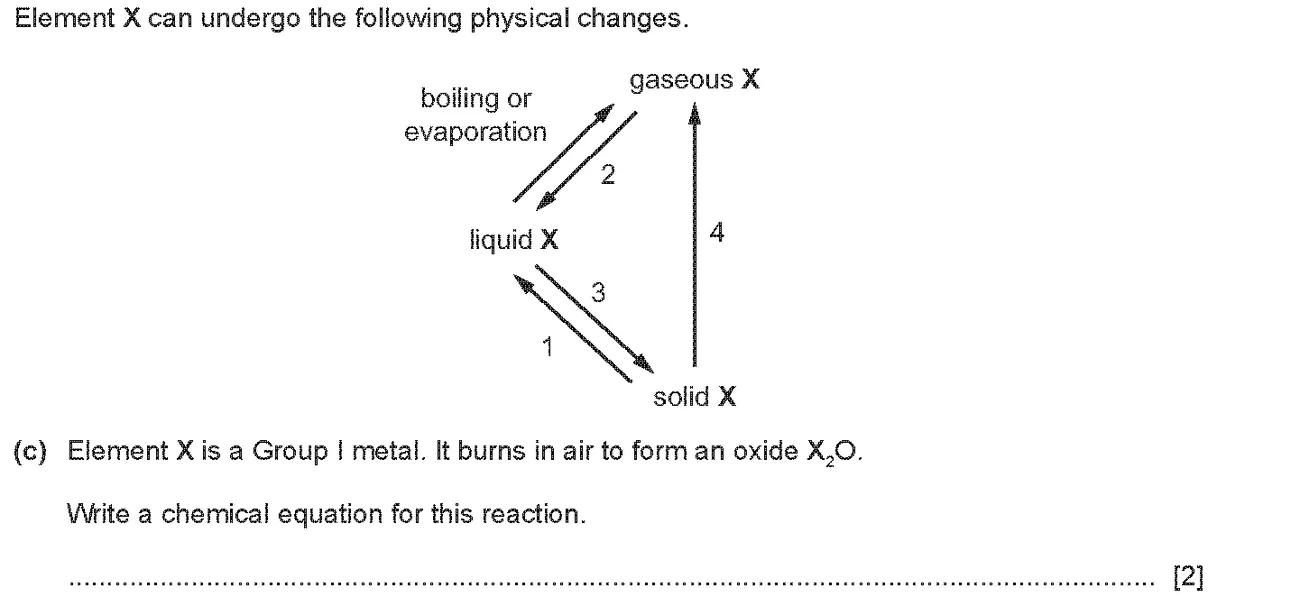
Show the answer

Each part of a written question is on its own screen. Write your answer first, then open "Show the answer" to check it against the mark scheme.
Last updated: