8.1Chapter 8: Pure Substances and Solutions
Pure substances — Alhussan Chemistry - Stage 8 Revision Notes & Topical Questions
5 min read 8 parts Lesson 1 of 10 1 quiz
8.1 Pure substances — Purity, Melting Points and Boiling Points — Alhussan International Academy — Chemistry (Stages 7–9) notes: Define pure substance and purity, and use melting and boiling points to judge whether a substance is pure.Pure substance = a single element or a single…
- Everyday meaning
- Why it matters
- Impure substance
- Everyday uses
- Pure result
- Pure sample
Part 1 of 6What pure means
- Pure silicon contains silicon atoms only and is used to make integrated circuits in phones.
- Pure water contains water molecules only.
- Everyday meaning in everyday life pure often means natural, unprocessed or with nothing added,
- such as pure orange juice,
- which differs from the scientific meaning.
- Mixtures tap water, sea water, mineral water, air, steel, milk and soil are mixtures.
- Tap water contains other substances such as chlorine and carbonates, so a vaccine company uses pure water instead.
Part 2 of 6Purity
- In 100 g of seawater there is 3.7 g of salt and 96.3 g of water, so the purity of the water is 96.3%.
- Ibuprofen powder with 98% purity contains 98 g or more of ibuprofen in 100 g of powder.
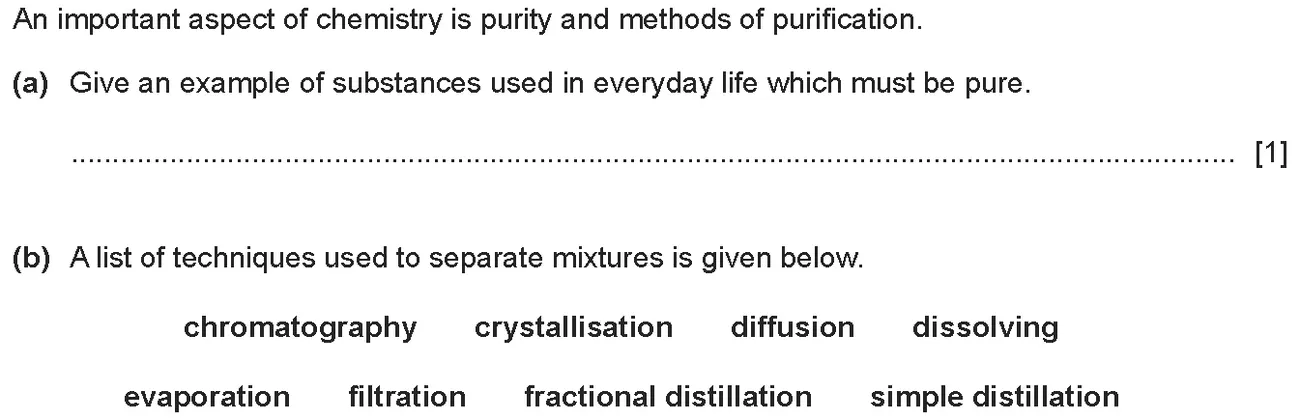
- Why it matters impurities can change properties and can be harmful,
- so medicines, food additives, electronic materials and fuels must meet purity standards.
Part 3 of 6Melting and boiling points as tests
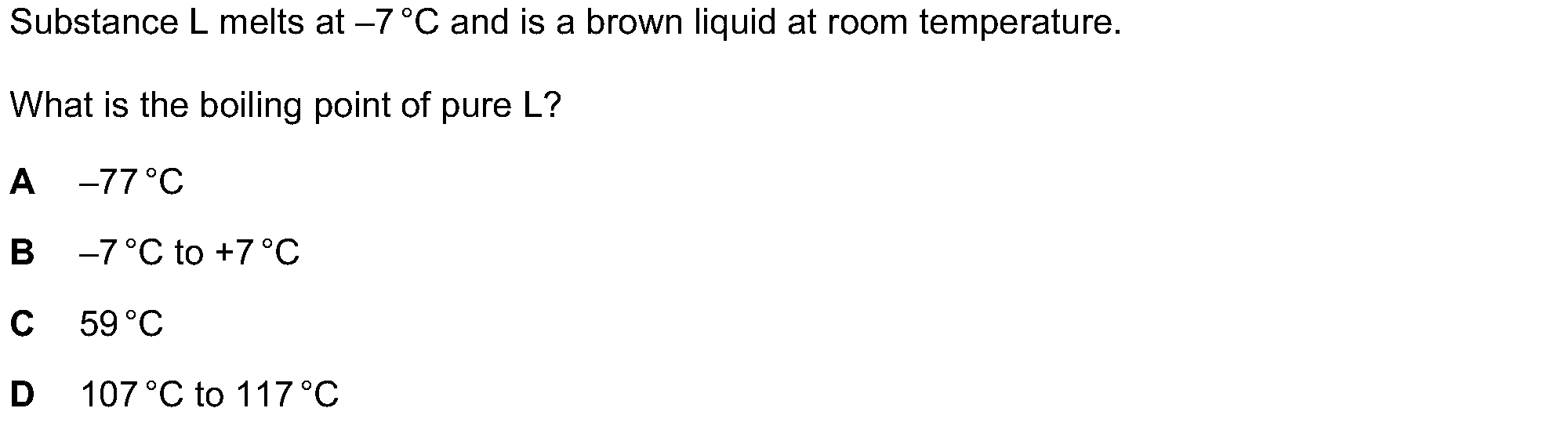
- Pure substance it melts and boils at definite, sharp temperatures that can be looked up in data tables.
- Pure water melts at 0 °C and boils at 100 °C at normal pressure.
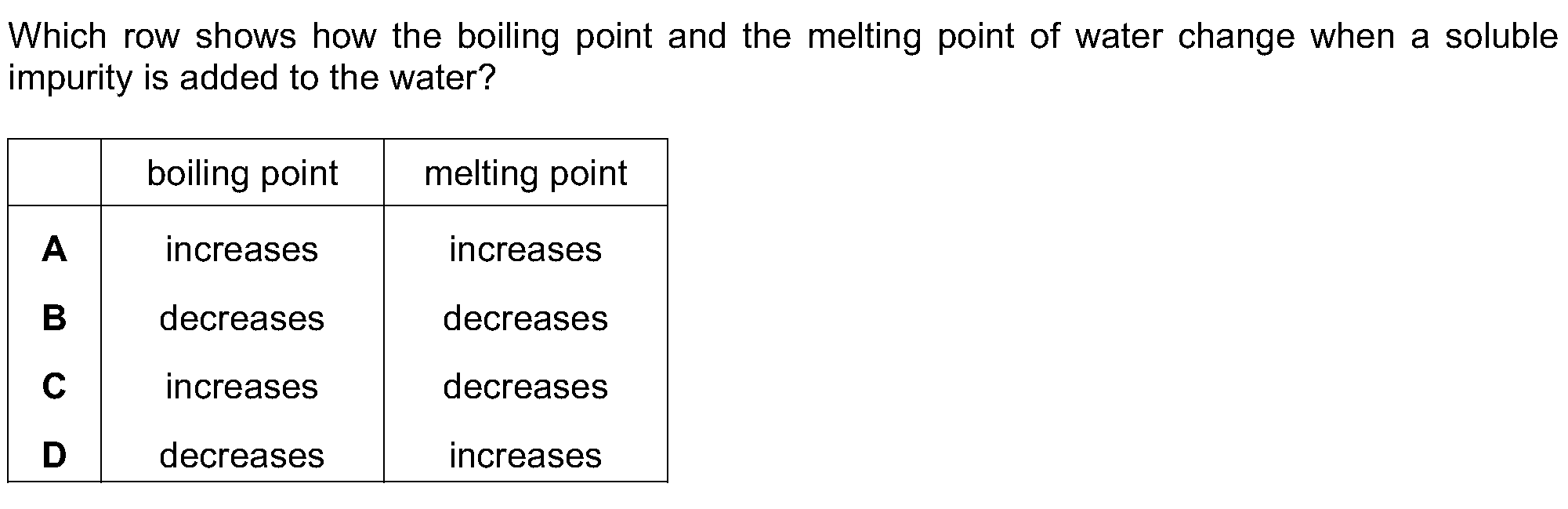
- Impure substance impurities change the melting and boiling behaviour.
- The melting point is lower than the pure value and the substance melts over a range of temperatures.
- The boiling point is higher than the pure value and it boils over a range.
- The more impurity, the greater the change.
| Sample | Melting behaviour | Conclusion |
|---|---|---|
| Melts sharply at 80 °C (data value 80 °C) | Single temperature | Pure |
| Melts from 72 to 78 °C | Range, lower | Impure |
- Everyday uses
- salt on icy roads works because salt water freezes below 0 °C,
- and antifreeze lowers the freezing point and raises the boiling point of car coolant.
Part 4 of 6Cooling curve of stearic acid
- Method hot liquid stearic acid is poured into a test tube and left to cool, with the temperature recorded every minute.
- Pure result the temperature stays constant (about 70 °C) while the stearic acid freezes, which shows it is pure.
- A graph of a pure substance has a flat section at its melting point.
- Impure result the temperature of an impure substance changes as it freezes, so there is no flat section.
- Formula stearic acid is C18H36O2, containing carbon, hydrogen and oxygen;
- ibuprofen, C13H18O2, contains the same three elements.
Part 5 of 6Measuring a melting point
- Pure sample a narrow range that matches the data value shows it is pure.
- (less than about 2 °C)
- Slow heating it is crucial for accuracy because the thermometer lags behind the sample if the temperature rises too fast.
Part 6 of 6Other tests and applications
- Chromatography a pure dye makes a single spot, whereas a mixture makes several.
- Industry purity is measured with more sophisticated instruments.
- Uses of pure substances pharmaceuticals, electronics and chemical experiments.
- (very pure silicon)
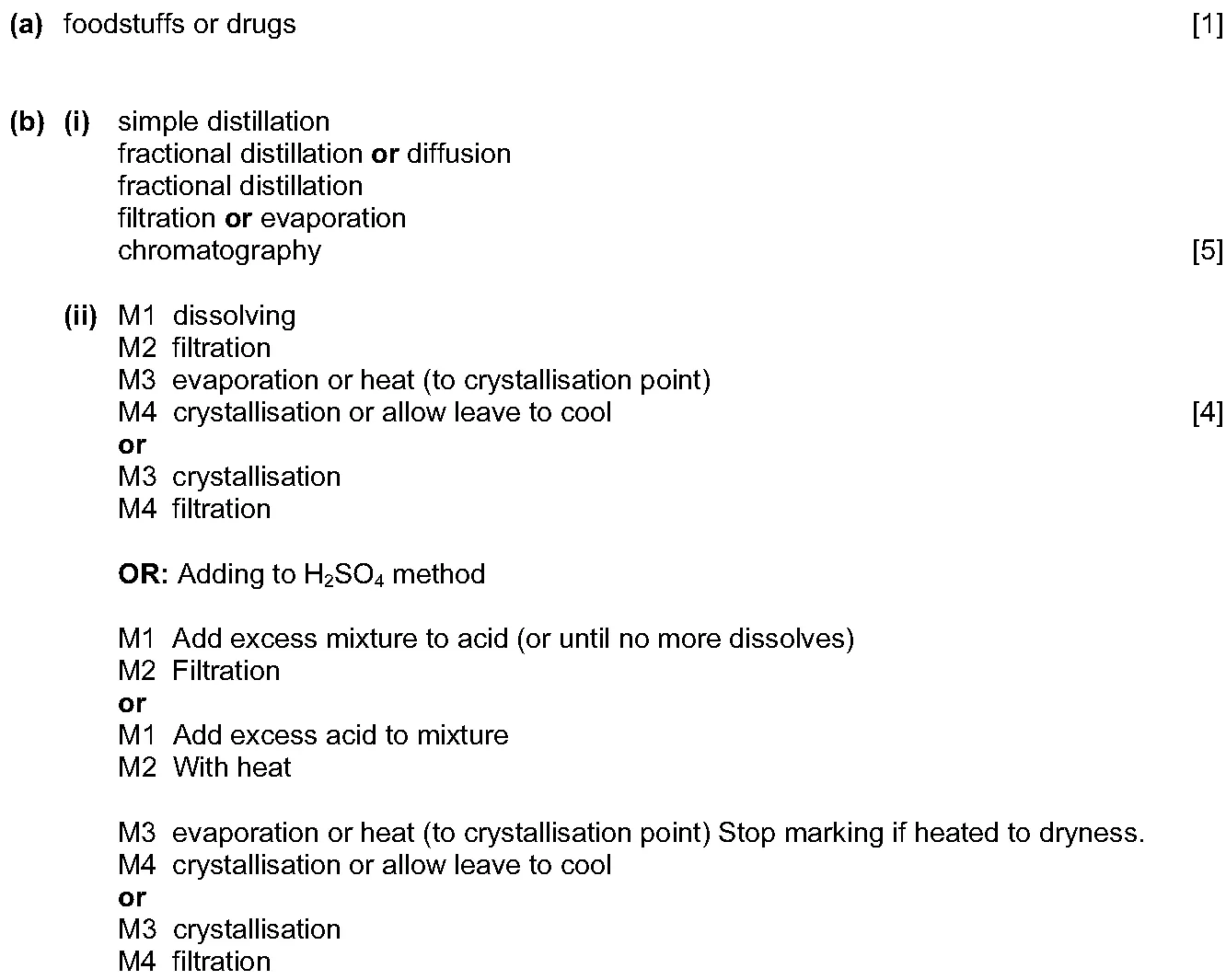
- Purifying crystallisation or distillation can purify a sample, and the melting point is then re-tested.
Key terms
| Term | Meaning |
|---|---|
| Pure substance | a single element or compound with nothing mixed in. |
| Purity | how much of a substance is in a mixture. |
| Impurity | an unwanted substance mixed in. |
| Melting point | the temperature at which a solid melts. |
| Boiling point | the temperature at which a liquid boils. |
| Capillary tube | a very thin glass tube. |
Avoid these mistakes
Topic quiz · 4 questionsQuiz for this lesson
?What do you want to solve now?
✓Checkpoint Quiz
4 multiple-choice + 1 written questions from real exam papers on this lesson.
Question 1 of 4 1:30

Question 2 of 4 1:30

Question 3 of 4 1:30
Question 4 of 4 1:30
Answer key
1 B2 C3 C4 C
Written question 1 of 1 · part (a) (1 / 3) 3:00
Show the answer

Written question 1 of 1 · part (b)(i) (2 / 3) 3:00

Show the answer
Written question 1 of 1 · part (b)(ii) (3 / 3) 3:00

Show the answer
Each part of a written question is on its own screen. Write your answer first, then open "Show the answer" to check it against the mark scheme.
Last updated: