8.3Chapter 8: Pure Substances and Solutions
Chromatography — Alhussan Chemistry - Stage 8 Revision Notes & Topical Questions
5 min read 7 parts Lesson 3 of 10 3 quizzes
8.3 Chromatography — Separating Dissolved Pigments and Chromatograms — Alhussan International Academy — Chemistry (Stages 7–9) notes: Describe how paper chromatography separates and identifies substances in a mixture and interpret a chromatogram.Chromatography = a method used to …
- Start line above the solvent
- Pure substance
- Same substance
- Green felt-tip ink
- Uses of paper chromatography
- Other types
Part 1 of 5What chromatography is
- It works if all the substances in the mixture dissolve in one solvent.
- Principle the solvent (mobile phase) moves through the paper and carries the substances at different speeds.
- (stationary phase)
- Substances that dissolve better in the solvent and stick less to the paper move further.
Part 2 of 5Method for paper chromatography
- Pencil pencil lead does not dissolve in the solvent, whereas ink would run.
- Start line above the solvent if the line is under the solvent, the spots would dissolve into it.
Part 3 of 5Reading a chromatogram
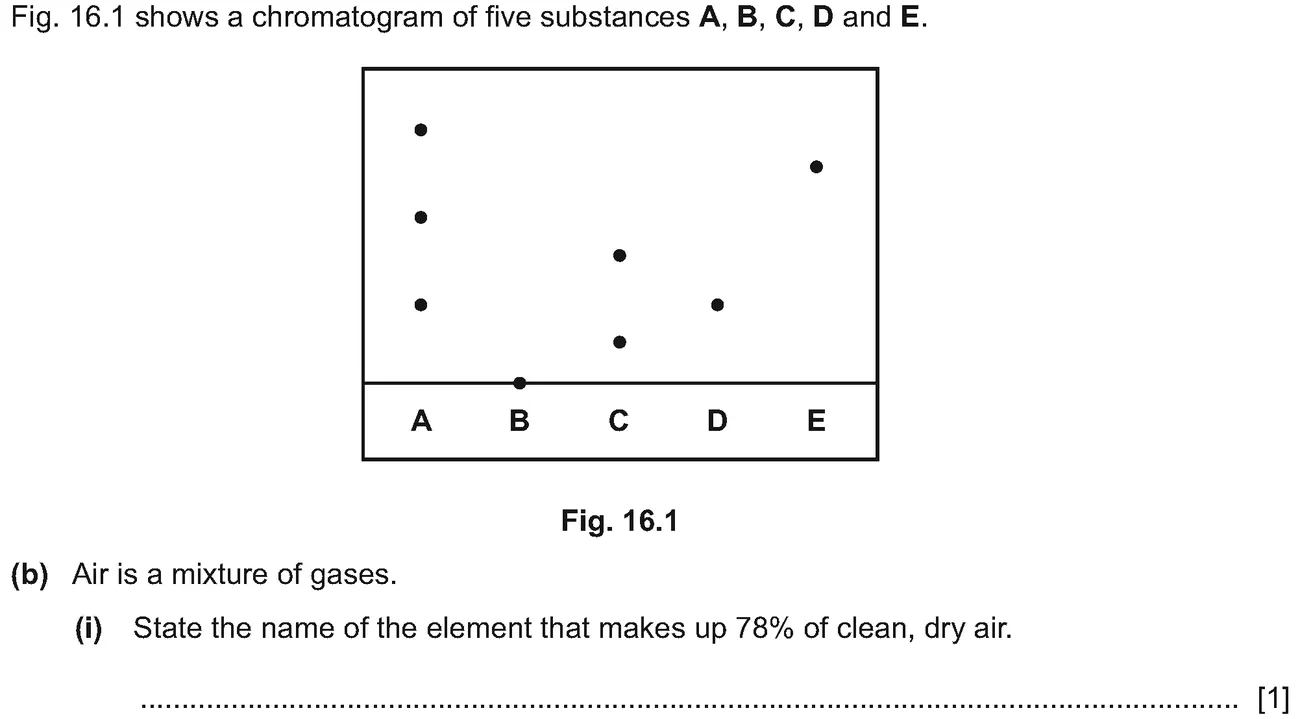
- Pure substance it gives one spot, whereas a mixture gives more than one.
- Same substance spots at the same height with the same colour are likely to be the same substance, so unknowns are compared with known substances.
- Green felt-tip ink it is a mixture of two dyes, yellow and blue, and the blue dye travels further.
- Sweets a chromatogram of five sweets showed the brown dye is a mixture of red, yellow and blue dyes, while the red dye makes one spot and is pure.
- Rf values are between 0 and 1 and are the same for a given substance in the same solvent and paper.
- A spot 3.0 cm from the start line with the solvent front at 6.0 cm has Rf = 0.50.
Part 4 of 5Uses and limitations
- Uses of paper chromatography separating substances in inks, plants and sweets.
- Other types they all separate mixtures and are used to identify substances, measure amounts and check purity.
- Scientists and pharmaceutical companies use chromatography in making some COVID-19 vaccines.
- Airport security officers use it to test clothes and luggage for explosives.
- Scientists use it to identify food nutrients.
- It is also used to analyse drugs in sport, identify pollutants in water and match inks in crime investigations.
- Insoluble substances they will not move, so another solvent such as ethanol may be needed.
- Fair testing use the same type of paper, the same solvent and similar spot sizes.
- Modern methods gas chromatography and mass spectrometry use the same basic principle.
Part 5 of 5Chromatography enquiry: vitamin A in cassava
- Problem in Africa and Asia up to half a million children go blind each year, and one cause is a lack of vitamin A.
- Steve Adewusi (Nigeria) and Howard Bradbury (Australia) asked how much vitamin A is in the roots and leaves of different types of cassava.
- Evidence they used chromatography to measure vitamin A in yellow and white cassava roots and in dark green and light green leaves.
- They also used secondary data on the vitamin A needed to be healthy from the World Health Organization (WHO),
- which they trusted because WHO is well respected.
- Conclusion dark green leaves have more vitamin A than light green leaves.
- Eating yellow cassava root and cassava leaves can provide enough vitamin A, but white roots alone cannot.
- Recommendation to prevent blindness, children should eat yellow cassava, not white, and also eat cassava leaves.
Key terms
| Term | Meaning |
|---|---|
| Chromatography | a method of separating soluble substances using a solvent moving through paper. |
| Chromatogram | the paper with the separated spots. |
| Solvent front | the furthest point reached by the solvent. |
| Rf value | distance moved by a substance divided by distance moved by the solvent. |
| Mobile phase | the moving solvent. |
| Secondary data | data collected by other people. |
Avoid these mistakes
Marked practiceQuizzes for this lesson
?What do you want to solve now?
✓Checkpoint Quiz
3 multiple-choice + 1 written questions from real exam papers on this lesson.
Question 1 of 3 1:30

Question 2 of 3 1:30
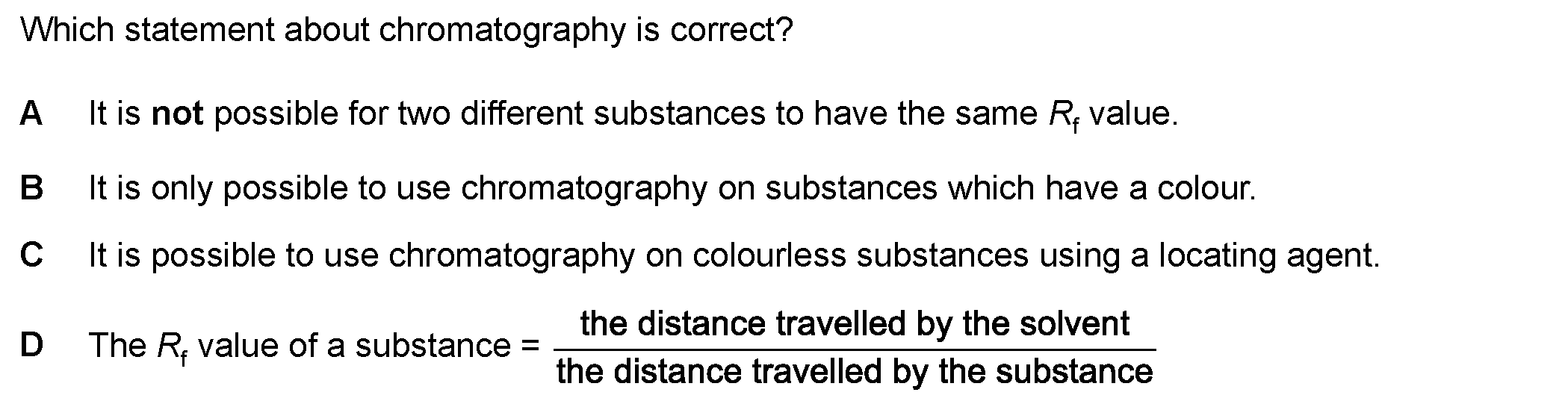
Question 3 of 3 1:30

Answer key
1 D2 C3 A
Written question 1 of 1 · part (a)(i) (1 / 5) 3:00

Show the answer

Written question 1 of 1 · part (a)(ii) (2 / 5) 3:00

Show the answer
Written question 1 of 1 · part (b)(i) (3 / 5) 3:00
Show the answer
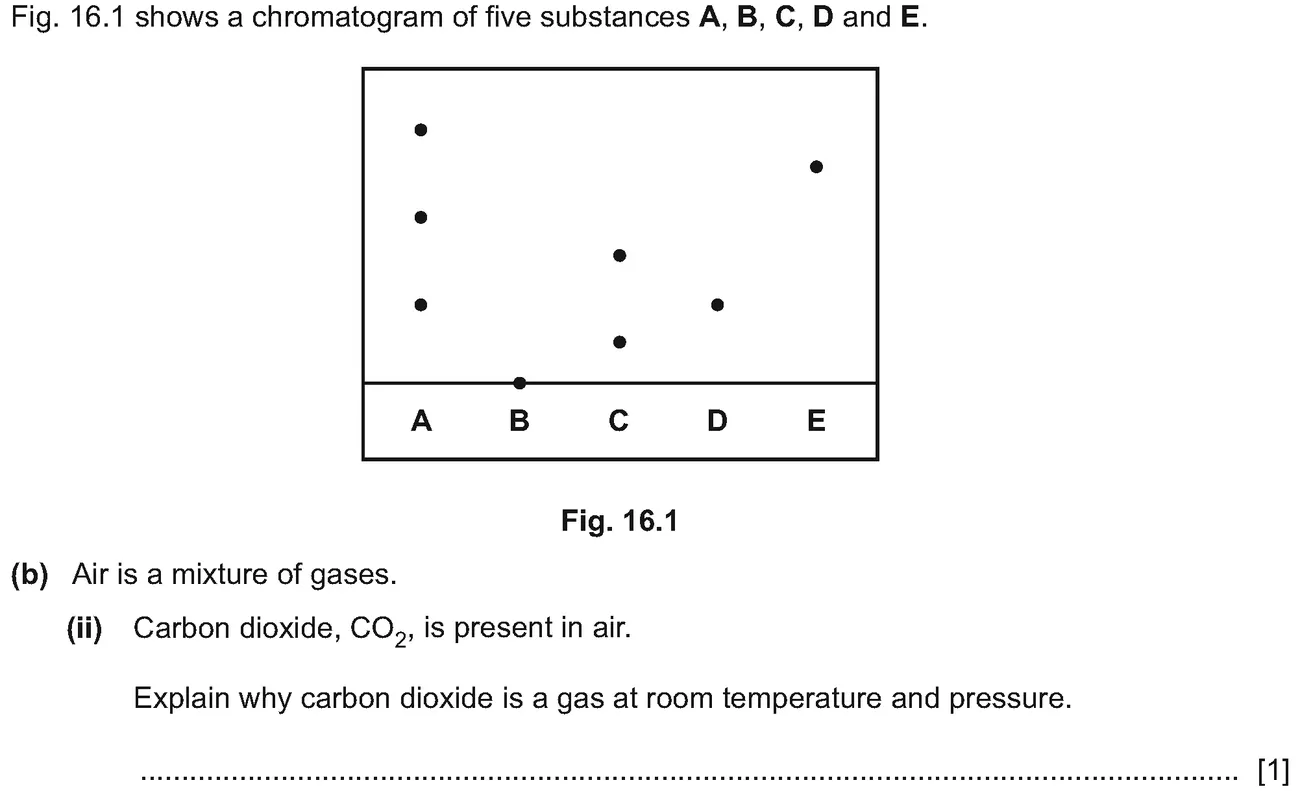
Written question 1 of 1 · part (b)(ii) (4 / 5) 3:00
Show the answer
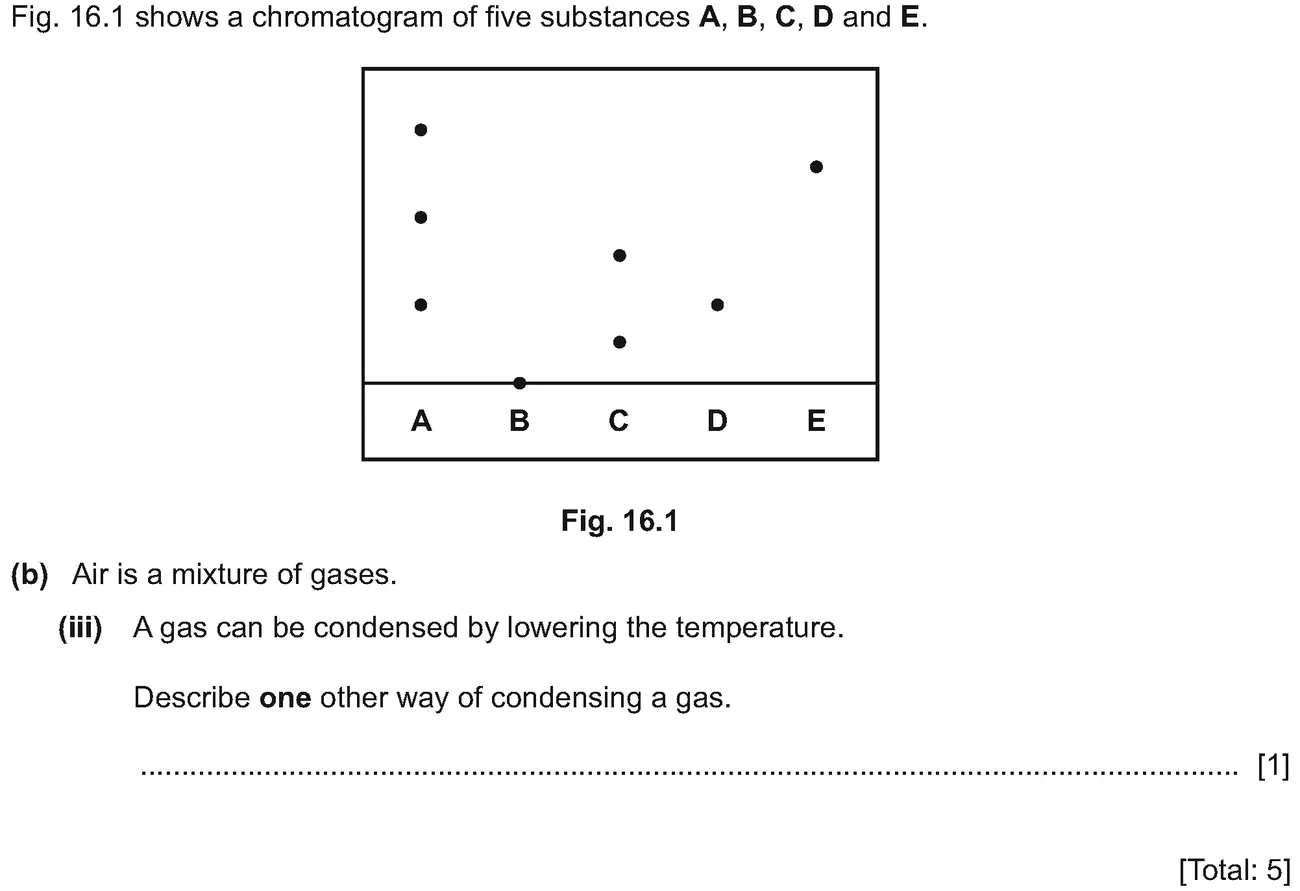
Written question 1 of 1 · part (b)(iii) (5 / 5) 3:00
Show the answer
Each part of a written question is on its own screen. Write your answer first, then open "Show the answer" to check it against the mark scheme.
Last updated: