17.0Interference and Diffraction
Overview: Interference and Diffraction of Light — American System Physics Revision Notes & Topical Questions
5 min read 7 parts Lesson 2 of 5 Unit quiz
Explain double-slit interference.Young's experiment demonstrated the wave nature of light.Longer wavelengths produce wider fringe spacing.Narrower slits produce more diffraction spreading.Larger telescope apertures resolve finer detail.Gratings give sharper, brighter lines than d…
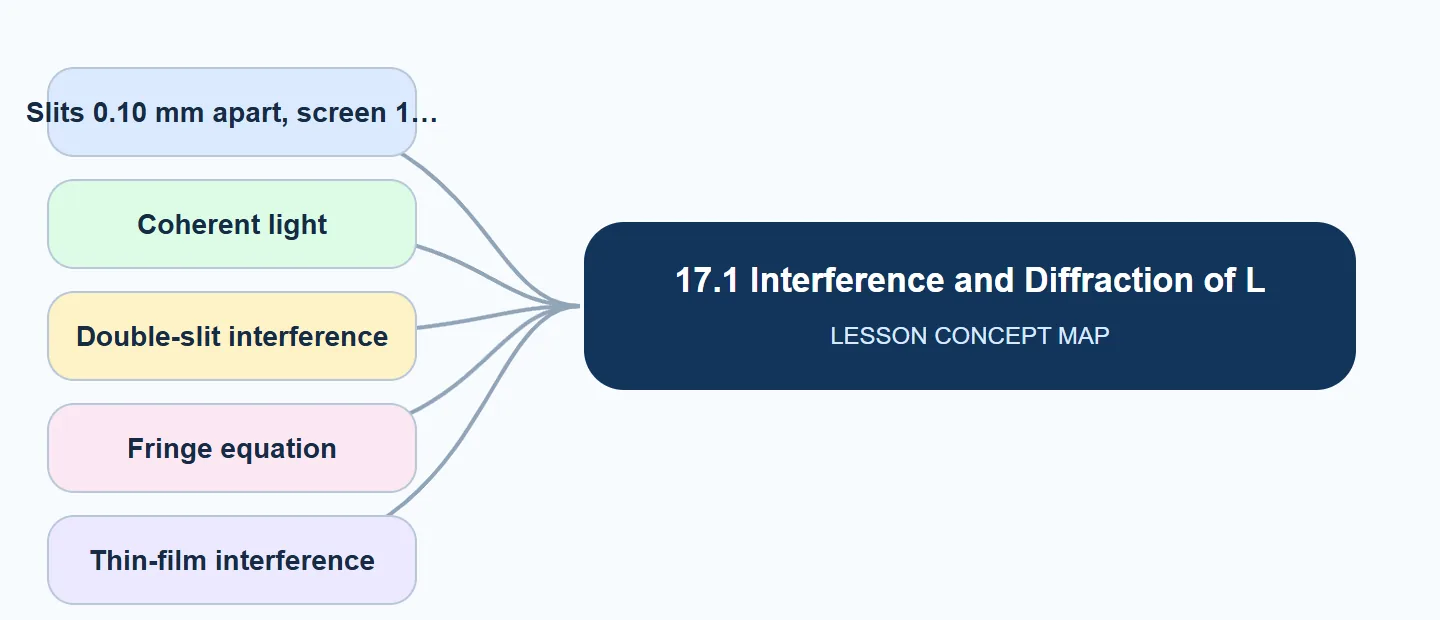
- Slits 0.10 mm apart, screen 1.0 m, fringe spacing 6.0 mm. Wavelength?
- Coherent light
- Fringe equation
- Thin-film interference
- Single-slit diffraction
- Diffraction grating
Part 1 of 7Key ideas
Part 2 of 7Learning objectives
Part 3 of 7Essential knowledge
Part 4 of 7Process & sequence
Double-slit patternwrite these steps in this order; each step is a marking point.
- Coherent source
- Two slits
- Waves overlap
- Path difference
- Bright/dark fringes
Part 5 of 7Worked examples
Slits 0.10 mm apart, screen 1.0 m, fringe spacing 6.0 mm. Wavelength?
- λ = (6.0 × 10−3 × 1.0 × 10−4)/1.0 = 600 nm.
Part 6 of 7Summary
- λ = xd/L.
- Grating: d sinθ = mλ.
- Diffraction shows light is a wave.
Part 7 of 7Compare: Compare
| Condition | Path difference | Result |
|---|---|---|
| Constructive | mλ | Bright fringe |
| Destructive | (m + ½)λ | Dark fringe |
| Phenomenon | Example |
|---|---|
| Thin-film interference | Soap bubbles, oil slicks, anti-reflection coatings |
| Diffraction grating | Spectroscopes, CD colours |
| Diffraction limit | Telescope resolution |
Key terms
Command terms
Exam technique
Keywords the mark scheme looks for in this lesson
How to get full marks (examiner guidance)
Instant feedbackCheck yourself
Q1. Bright fringes occur where path difference is
- A. (m + ½)λ
- B. mλ
- C. zero only
- D. 2λ only
Show answer
B. Constructive.
Q2. Using red instead of blue light, fringe spacing
- A. increases
- B. decreases
- C. same
- D. disappears
Show answer
A. Longer λ.
Q3. Soap bubble colours are due to
Show answer
B. Two reflections.
Q4. Narrowing a single slit makes the central band
- A. narrower
- B. wider
- C. disappear
- D. brighter only
Show answer
B. More diffraction.
Last updated:
\n