Skip to content
Dabour HubLEARN · PRACTICE · EXPLORESign inStudent

17.1Interference and Diffraction

Interference of Light — American System Physics Revision Notes & Topical Questions

10 min read 7 parts Lesson 3 of 5 1 quiz

🩺
100% Curriculum Specification Match Lesson Doctor Verified
The only platform with 100% curriculum specification match and verified interactive question banks.
0%read
Lesson summary

State the principle of superposition and describe constructive and destructive interference.Double-slit wavelengthwavelength = fringe spacing × slit separation ÷ slit-to-screen distance, λ = x d/L (all in m).Fringe spacingx = λL/d: wider fringes for longer λ, larger L, or smaller…

  • Bright fringe condition
  • Dark fringe condition
  • Wave speed
  • Visible wavelengths
  • Thin film (film index higher than surroundings)
  • Thin-film interference

Section 1 of 7Interference of Light
Essential knowledge
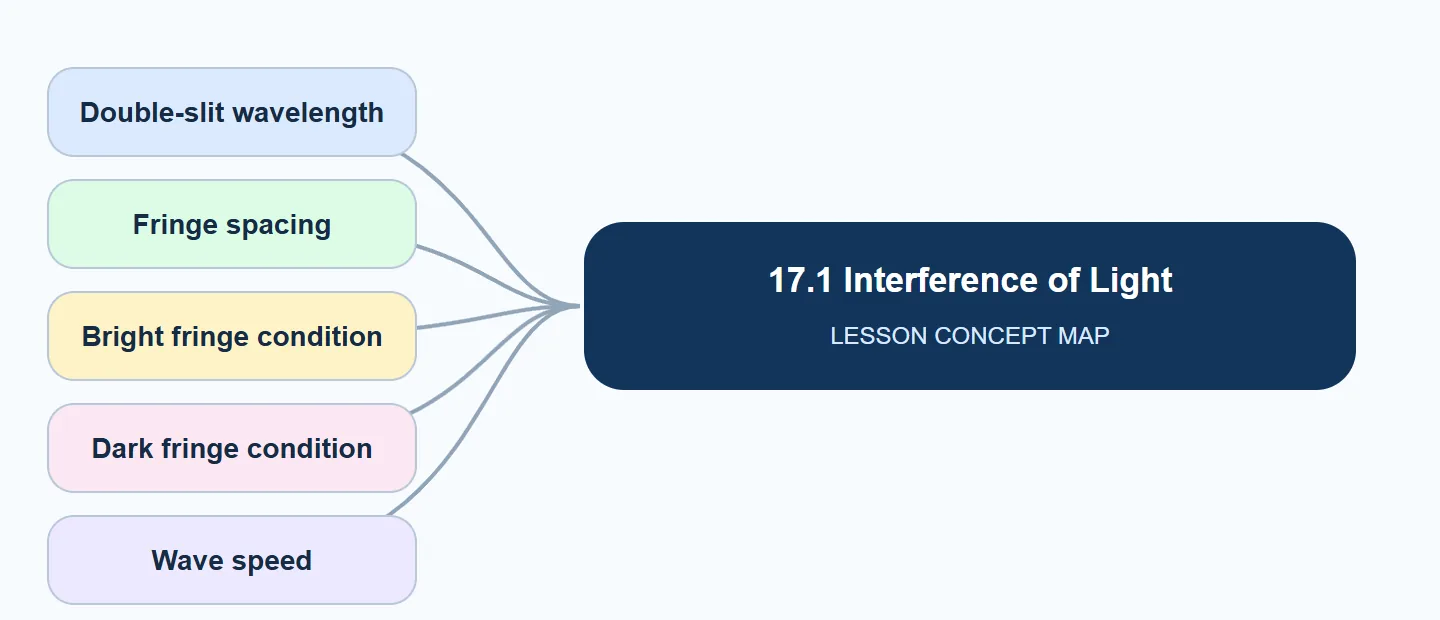
17.1 Interference of Light concept map: Double-slit wavelength, Fringe spacing, Bright fringe condition, Dark fringe condition, Wave speed
Visual guide to the key ideas explained in this lesson.
When two waves meet, they pass through each other; at each instant the displacement is the sum of the two. After meeting, each wave continues unchanged.
If two equal waves meet in phase the amplitude doubles (constructive); if they meet exactly out of phase they cancel (destructive). Energy is not destroyed, only redistributed to the bright regions.
Whether two waves arrive in or out of phase depends on the path difference. A path difference of a whole number of wavelengths gives constructive interference; an odd number of half-wavelengths gives destructive interference.
Ordinary lamps emit light in random short bursts, so two separate lamps are not coherent. Young solved this by passing light from one source through two slits, so both slits are fed by the same wavefront. Lasers are highly coherent.
In the double-slit pattern the central bright fringe (m = 0) is on the centre line where the path difference is zero; the next bright fringes (m = ±1) are where one path is one wavelength longer.
The formula λ = xd/L is valid when L is much larger than d (small angles).
With white light, the central fringe is white but other fringes are coloured, with blue closest to the centre, because shorter wavelengths give smaller spacing.
Thin-film interference
Thin-film interference part of the light reflects from the top surface of a film and part from the bottom surface.
  • The extra path (about 2t) and any phase change of half a cycle on reflection from a higher-index material determine whether each colour is reinforced or cancelled,
  • giving the rainbow colours of soap bubbles and oil slicks.
Anti-reflection coatings on lenses use a film about a quarter of a wavelength thick so reflected waves from its two surfaces cancel.
Interference also occurs for sound (loud and quiet spots between two speakers) and water waves (ripple tank with two dippers), confirming it is a general wave property.

Section 2 of 7Process & sequence

1
Place a laser (monochromatic, coherent) so its beam falls on a slide with two narrow slits a known distance d apart (e.g. 0.25 mm).
2
Set a white screen a measured distance L (a few metres) from the slits using a tape measure.
3
Darken the room and observe the row of equally spaced bright and dark fringes.
4
Measure across as many fringes as possible (e.g. 10 fringe spacings) with a ruler and divide to find the fringe spacing x,
  • reducing the percentage error.
5
Calculate the wavelength using λ = x d / L.
6
Repeat for different L; a graph of x against L gives a straight line with gradient λ/d. (Never look directly into the laser beam.)

How the double-slit pattern formswrite these steps in this order; each step is a marking point.

1
A single coherent source (laser) illuminates two narrow slits.
2
Each slit diffracts light, so two sets of waves spread out and overlap.
3
At each point on the screen the path lengths from the two slits differ.
4
Path difference mλ: waves in phase, bright fringe.
5
Path difference (m + ½)λ: waves in antiphase, dark fringe.

Section 3 of 7Compare

Constructive versus destructive interference
FeatureConstructiveDestructive
Phase relationIn phase (0°, 360°…)Antiphase (180°)
Path difference0, λ, 2λ … = mλ½λ, 1½λ … = (m + ½)λ
Resultant amplitudeSum of amplitudes (maximum)Difference (zero if equal)
Light patternBright fringeDark fringe
Sound patternLoudQuiet

Section 4 of 7Worked examples

Laser light passes through two slits 0.20 mm apart. Fringes on a screen 3.0 m away have spacing 9.5 mm. Calculate the wavelength.
  • λ = xd/L = (9.5 × 10−3 m × 0.20 × 10−3 m)/3.0 m = 1.9 × 10⁻⁶/3.0 = 6.3 × 10⁻⁷ m (633 nm, red).
Green light (λ = 5.4 × 10⁻⁷ m) passes through slits 0.30 mm apart. Find the fringe spacing on a screen 2.5 m away.
  • x = λL/d = (5.4 × 10−7 × 2.5)/(0.30 × 10−3) = 1.35 × 10⁻⁶/3.0 × 10−4 = 4.5 × 10⁻³ m (4.5 mm).
Quiet
Two coherent speakers emit sound of wavelength 0.68 m. At point P the path difference is 1.02 m. Is P loud or quiet?
  • Path difference ÷ λ = 1.02/0.68 = 1.5, i.e. 1½ wavelengths, an odd number of half-wavelengths, so destructive interference: P is quiet.

Section 5 of 7Key terms

Section 6 of 7Command terms

Command terms
Identify / Describe (FRQ)
A short, specific statement; describing requires relevant characteristics, not a single word.
Explain / Justify (FRQ)
Give the cause-and-effect reasoning or evidence; a restated fact does not score.
Calculate
Show setup, substitution and the answer with units.
Predict
State the expected outcome; add a reason only if asked to justify.
MCQ technique
Read every option; eliminate distractors that are true statements but do not answer the question; watch for NOT/EXCEPT.

Section 7 of 7Exam technique

Keywords the mark scheme looks for in this lesson

Keywords the mark scheme looks for in this lesson
Superposition · Interference · Constructive interference · Destructive interference · Coherent sources · Phase difference · Path difference · Fringe · Fringe spacing (x or Δy) · Double-slit (Young's) experiment · Thin-film interference · Monochromatic light
Learn each definition in the Key words tab exactly; a missing keyword in a definition usually loses the mark.

How to get full marks (examiner guidance)

1
Answer exactly what is asked; extra correct material does not earn credit, and contradictory statements can cancel credit (AP FRQ).
2
Use precise vocabulary, never “it/stuff/things”.
3
Show units and working in calculations.
4
In MCQs, predict the answer before reading the options, then eliminate.

Words to avoid

1
the waves cancel and the energy is destroyedenergy is redistributed from dark regions to bright regions.
2
coherent means the same amplitudecoherent means the same frequency and a constant phase difference.
3
dark fringes occur at a path difference of λdark fringes occur at a path difference of half a wavelength (or any odd number of half-wavelengths).
4
the waves add together (for constructive)the waves arrive in phase, so their displacements add to give a larger amplitude.
5
λ = xL/dλ = xd/L, with x the fringe spacing, d the slit separation and L the slit-to-screen distance.

Last updated: