Skip to content
Dabour HubLEARN · PRACTICE · EXPLORESign inStudent

13.1Vibrations and Waves

Periodic Motion — American System Physics Revision Notes & Topical Questions

10 min read 7 parts Lesson 3 of 5 1 quiz

🩺
100% Curriculum Specification Match Lesson Doctor Verified
The only platform with 100% curriculum specification match and verified interactive question banks.
0%read
Lesson summary

Define period, frequency and amplitude and use f = 1/T.Period and frequencyfrequency = 1 / period, f = 1/T (f in Hz, T in s).Hooke's lawforce = spring constant × extension, F = kx (F in N, k in N/m, x in m); as a restoring force F = −kx.Elastic potential energy stored in a spring…

  • Period of a mass on a spring
  • Period of a simple pendulum
  • Real oscillators are damped
  • A pendulum completes 30 oscillations in 42.0 s. Find its period and frequency
  • What length of simple pendulum has a period of 2.00 s on Earth (g = 9.80 m/s²)?
  • Periodic motion

Section 1 of 7Periodic Motion
1
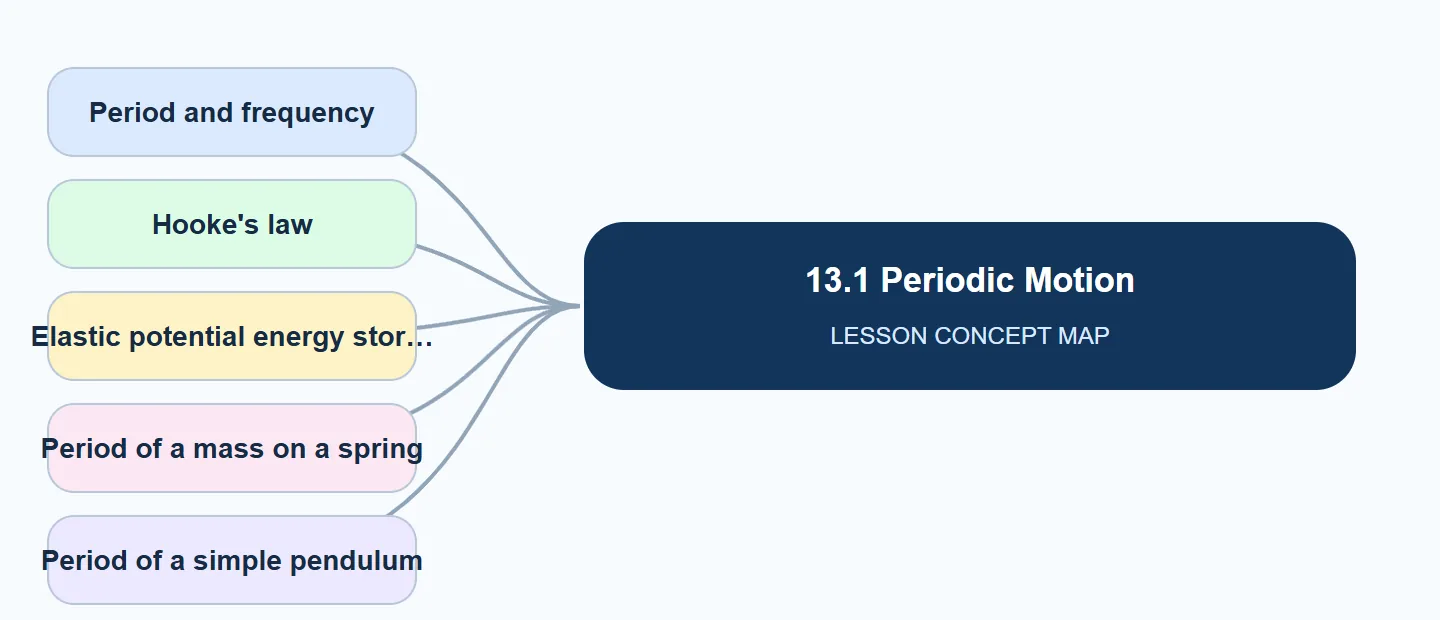
13.1 Periodic Motion concept map: Period and frequency, Hooke's law, Elastic potential energy stor, Period of a mass on a spring, Period of a simple pendulum
Visual guide to the key ideas explained in this lesson.
2
Any motion that repeats at regular intervals is periodic. The key quantities are period T (seconds per cycle) and frequency f (cycles per second); they are reciprocals, so doubling the frequency halves the period.
3
Amplitude is measured from the equilibrium position to the maximum displacement, not from one extreme to the other. The distance from one extreme to the other is twice the amplitude.
4
Simple harmonic motion occurs whenever the restoring force is proportional to displacement and points back towards equilibrium. A mass on a spring obeys this because the spring follows Hooke's law, F = −kx; the negative sign shows the force opposes displacement.
5
Hooke's law holds only up to the limit of proportionality. Beyond it the force–extension graph curves and the spring may be permanently stretched (past the elastic limit).
6
The area under a force–extension graph equals the work done stretching the spring, which is stored as elastic potential energy, ½kx² for a Hookean spring.
7
In an oscillating spring or pendulum, energy continually transfers between potential energy (elastic or gravitational) and kinetic energy. At the extremes the object is momentarily at rest (all PE); at equilibrium it moves fastest (maximum KE).
8
The period of a simple pendulum for small angles is T = 2π√(l/g). It does not depend on the mass of the bob, because both the restoring force and the inertia are proportional to mass. A pendulum can therefore be used to measure g.
9
The period of a mass–spring system is T = 2π√(m/k). A heavier mass accelerates less for the same force, so it oscillates more slowly; a stiffer spring gives a larger force and faster oscillation.
10Real oscillators are damped
Real oscillators are damped friction and air resistance transfer energy to the surroundings, so the amplitude gradually decreases while the period stays almost unchanged. Car shock absorbers deliberately damp oscillations.
11
Every object has a natural frequency. If a periodic driving force matches it, energy is transferred efficiently every cycle and the amplitude builds up greatly – resonance. Examples: pushing a swing at the right moments, a wine glass shattered by a sung note, bridges swaying in wind.
12
Resonance can be useful (tuning radios, musical instruments, MRI) or harmful (collapsing structures), so engineers add damping to reduce unwanted resonant amplitude.

Section 2 of 7Process & sequence

1
Set up a pendulum with a measured length l (from the pivot to the centre of the bob) using a metre rule.
2
Pull the bob aside through a small angle (less than about 10–15°) and release it without pushing.
3
Use a fiducial marker at the equilibrium position and start the stopwatch as the bob passes it.
4
Time 20 complete oscillations; repeat and take a mean to reduce the effect of human reaction time.
5
Divide the mean total time by 20 to find the period T; calculate f = 1/T.
6
Repeat for several lengths and plot T² against l; the straight line through the origin has gradient 4π²/g, so g = 4π²/gradient.

Energy changes in one swing of a pendulumwrite these steps in this order; each step is a marking point.

1
Bob held at maximum displacement: at rest, maximum gravitational PE, zero KE.
2
Bob released: restoring force accelerates it towards equilibrium; PE converts to KE.
3
Bob at equilibrium: lowest point, maximum speed, maximum KE, zero net restoring force.
4
Bob continues past equilibrium: slows down as KE converts back to PE.
5
Bob reaches opposite extreme: momentarily at rest, maximum PE; cycle repeats (slowly damped).

Section 3 of 7Compare

Mass on a spring vs simple pendulum
FeatureMass on a springSimple pendulum
Period equationT = 2π√(m/k)T = 2π√(l/g)
Depends on mass?Yes – larger m, longer TNo (for small swings)
Depends on amplitude?No (within Hooke's law)No for small angles (< about 15°)
Depends on g?NoYes – smaller g, longer T
Restoring forceSpring force −kxComponent of weight along the arc
Energy changesElastic PE ↔ KEGravitational PE ↔ KE

In both, the object moves fastest at equilibrium and momentarily stops at maximum displacement.

Section 4 of 7Worked examples

Worked examples
A pendulum completes 30 oscillations in 42.0 s. Find its period and frequency.
  • T = total time ÷ number of oscillations = 42.0 s ÷ 30 = 1.40 s. f = 1/T = 1/1.40 s = 0.714 Hz.
    What the symbols mean: T = period, the time for one complete wave (s) · f = frequency (Hz)
0.25 s
A spring of spring constant 250 N/m has a 0.40 kg mass attached. Find the period of oscillation.
  • T = 2π√(m/k) = 2π√(0.40 kg ÷ 250 N/m) = 2π√(0.0016 s²) = 2π × 0.040 s = 0.25 s (2 s.f.).
    What the symbols mean: T = period (s) · m = mass on the spring (kg) · k = spring constant (N m−1)
What length of simple pendulum has a period of 2.00 s on Earth (g = 9.80 m/s²)?
  • Rearrange T = 2π√(l/g): l = gT²/(4π²) = 9.80 × (2.00)² ÷ (4π²) = 39.2 ÷ 39.48 = 0.993 m (3 s.f.).

Section 5 of 7Key terms

Section 6 of 7Command terms

Command terms
Identify / Describe (FRQ)
A short, specific statement; describing requires relevant characteristics, not a single word.
Explain / Justify (FRQ)
Give the cause-and-effect reasoning or evidence; a restated fact does not score.
Calculate
Show setup, substitution and the answer with units.
Predict
State the expected outcome; add a reason only if asked to justify.
MCQ technique
Read every option; eliminate distractors that are true statements but do not answer the question; watch for NOT/EXCEPT.

Section 7 of 7Exam technique

Keywords the mark scheme looks for in this lesson

Keywords the mark scheme looks for in this lesson
Periodic motion · Equilibrium position · Oscillation (vibration) · Period (T) · Frequency (f) · Amplitude (A) · Displacement (in oscillation) · Simple harmonic motion (SHM) · Restoring force · Hooke's law · Spring constant (k) · Simple pendulum · Resonance · Damping
Learn each definition in the Key words tab exactly; a missing keyword in a definition usually loses the mark.

How to get full marks (examiner guidance)

1
Answer exactly what is asked; extra correct material does not earn credit, and contradictory statements can cancel credit (AP FRQ).
2
Use precise vocabulary, never “it/stuff/things”.
3
Show units and working in calculations.
4
In MCQs, predict the answer before reading the options, then eliminate.

Words to avoid

1
amplitude is the distance from one side to the otheramplitude is the maximum displacement from the equilibrium position.
2
a heavier bob swings more slowlythe period of a simple pendulum does not depend on the mass of the bob.
3
frequency is how fast it movesfrequency is the number of complete oscillations per second.
4
resonance is when it vibrates a lotresonance is a large increase in amplitude when the driving frequency equals the natural frequency.
5
timed one swing with a stopwatchtimed 20 oscillations and divided by 20 to reduce the effect of reaction time.

Last updated: