Skip to content
Dabour HubLEARN · PRACTICE · EXPLORESign inStudent

13.3Vibrations and Waves

Wave Behavior — American System Physics Revision Notes & Topical Questions

10 min read 7 parts Lesson 5 of 5 1 quiz

🩺
100% Curriculum Specification Match Lesson Doctor Verified
The only platform with 100% curriculum specification match and verified interactive question banks.
0%read
Lesson summary

Describe reflection, refraction and diffraction of waves and what changes in each.Law of reflectionangle of incidence = angle of reflection (both measured from the normal).Refractionfrequency is constant, so λ ∝ v: λ2/λ1 = v2/v1.Wave equation still applies in each mediumv = fλ.Di…

  • Superposition
  • Standing wave on a string fixed at both ends
  • Interference
  • Standing (stationary) wave
  • Incident wave
  • Coherent sources

Part 1 of 7Key ideas

1Law of reflection
Law of reflection angle of incidence = angle of reflection (both measured from the normal).
2Refraction
Refraction frequency is constant, so λ ∝ v: λ2/λ1 = v2/v1.
3Wave equation still applies in each medium
Wave equation still applies in each medium v = fλ.
4Gap width ≈ wavelength
Diffraction is significant when gap width ≈ wavelength; wavelength is unchanged by diffraction.
5Superposition
Superposition resultant displacement = sum of individual displacements, y = y1 + y2.
6Standing wave on a string fixed at both ends
L = nλ/2 (n = 1, 2, 3...), so fn = nv/(2L).
7Λ/2
Adjacent nodes (or antinodes) are λ/2 apart; node to adjacent antinode is λ/4.
8
Path difference of a whole number of wavelengths (nλ) → constructive; odd number of half wavelengths ((n+½)λ) → destructive.

Part 2 of 7Learning objectives

1
Describe reflection, refraction and diffraction of waves and what changes in each.
2
Explain superposition, constructive and destructive interference.
3
Describe how standing waves form and locate nodes and antinodes.
4
Use a ripple tank to demonstrate wave behaviour.

Part 3 of 7Essential knowledge

1
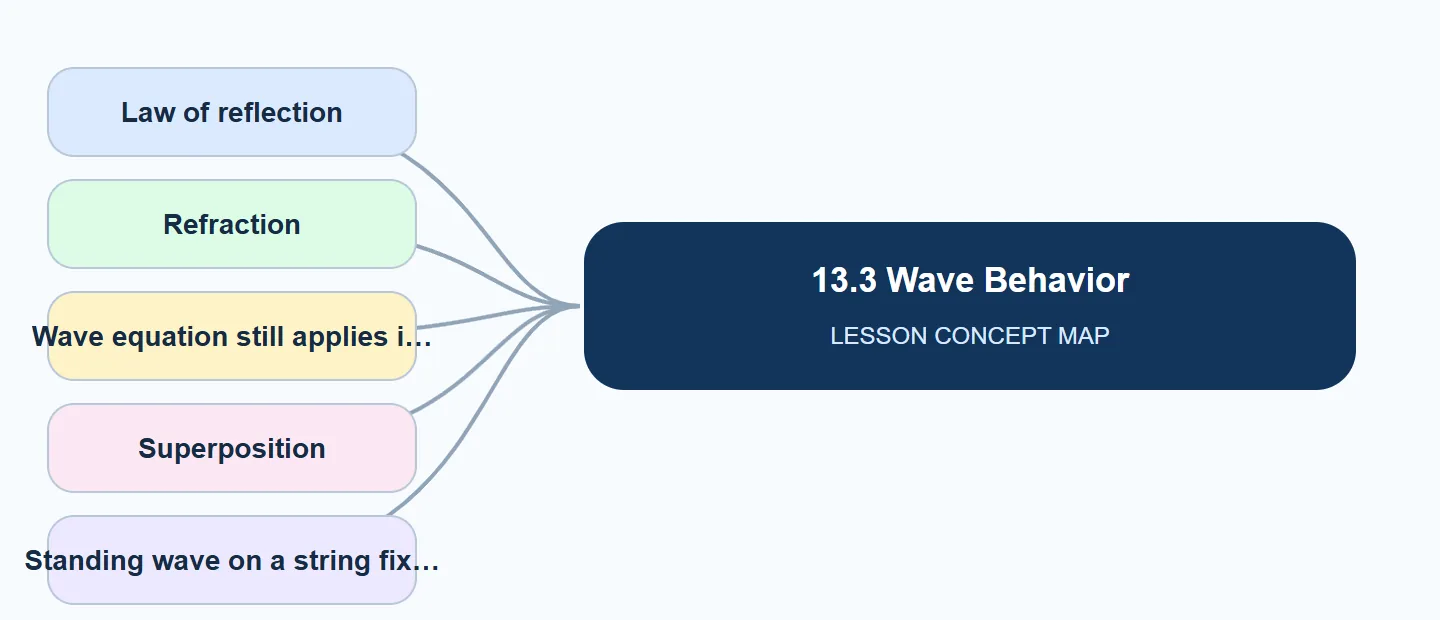
13.3 Wave Behavior concept map: Law of reflection, Refraction, Wave equation still applies i, Superposition, Standing wave on a string fix
Visual guide to the key ideas explained in this lesson.
2
At a boundary a wave may be reflected, transmitted (and refracted) or absorbed; usually a mixture. When a pulse reaches a fixed end, it is reflected inverted; at a free end it is reflected upright.
3
In reflection the wave stays in the same medium, so speed, frequency and wavelength are all unchanged. Only the direction changes, with the angle of incidence equal to the angle of reflection.
4
Refraction happens because the wave changes speed when it enters a new medium at an angle.
  • The part of the wavefront that enters first changes speed first, so the wavefront turns.
  • Slower medium → bends towards the normal; faster → away from the normal.
  • If the wave meets the boundary along the normal (at 90°), it changes speed but not direction.
5
In a ripple tank, water waves travel slower in shallow water, so wavefronts crowd together (shorter wavelength) and bend towards the normal over a shallow region.
6
Diffraction is the spreading of waves through a gap or around an edge. A narrow gap (about one wavelength) gives strong spreading into near-circular wavefronts; a wide gap gives only slight spreading at the edges. Wavelength, frequency and speed are unchanged.
7
Diffraction explains why you can hear sound around corners (long wavelengths, similar to doorway size) but not see around them (light wavelengths are far smaller than doorways). Long-wave radio diffracts around hills; high-frequency signals need line of sight.
8The superposition principle
The superposition principle when waves overlap, displacements add algebraically. After passing through each other, waves continue unchanged.
9
Constructive interference occurs when waves arrive in phase (path difference 0, λ, 2λ...), giving a bigger amplitude. Destructive interference occurs in antiphase (path difference λ/2, 3λ/2...), giving a smaller or zero amplitude.
10
A standing wave forms when a wave reflects and superposes with itself travelling the opposite way. Nodes (no motion) and antinodes (maximum motion) are fixed in position. Only certain frequencies (harmonics) fit a string fixed at both ends: L = nλ/2.
11
Unlike travelling waves, a standing wave does not transfer energy along its length; energy is stored in the vibration between nodes.
12
Stable interference patterns need coherent sources – same frequency, constant phase difference – e.g. two dippers driven by one motor, or two loudspeakers from one signal generator.

Part 4 of 7Process & sequence

1
Set up a ripple tank producing straight wavefronts from a vibrating bar.
2
Place a straight barrier at an angle: observe reflected wavefronts and check angle of incidence = angle of reflection.
3
Place a glass plate to create a shallow region at an angle: observe wavefronts slow down, get closer together and change direction (refraction).
4
Place two barriers to form a gap; vary the gap width and observe that spreading is greatest when gap ≈ wavelength (diffraction).
5
Replace the bar with two point dippers attached to the same motor (coherent sources) and observe the interference pattern of calm and rough lines.
6
Record observations as sketches of wavefronts described in words (spacing = wavelength).

Formation of a standing wave on a stringwrite these steps in this order; each step is a marking point.

1
Vibrator sends a travelling wave along the string towards the fixed end.
2
Wave reflects (inverted) at the fixed end and travels back.
3
Incident and reflected waves of equal frequency superpose.
4
At certain points they always cancel – nodes; midway they reinforce – antinodes.
5
Only frequencies where a whole number of half-wavelengths fit the length give a steady pattern.

Part 5 of 7Worked examples

6.0 Hz
A wave of wavelength 3.0 cm travelling at 18 cm/s enters shallower water where its speed becomes 12 cm/s. Find its frequency and new wavelength.
  • f = v/λ = 18 ÷ 3.0 = 6.0 Hz (unchanged). New λ = v/f = 12 cm/s ÷ 6.0 Hz = 2.0 cm.
0.80 m
A string 1.2 m long, fixed at both ends, vibrates with 3 loops (3rd harmonic). Wave speed on the string is 60 m/s. Find the wavelength and frequency.
  • For n = 3: L = 3λ/2, so λ = 2L/3 = 2 × 1.2 ÷ 3 = 0.80 m. f = v/λ = 60 ÷ 0.80 = 75 Hz.
5.0 cm
Two waves of amplitude 2.0 cm and 3.0 cm meet. State the resultant amplitudes for constructive and destructive interference.
  • Constructive
    • 3.0 + 2.0 = 5.0 cm.
    • Destructive: 3.0 − 2.0 = 1.0 cm.

Part 6 of 7Summary

1
Reflection obeys angle i = angle r, measured from the normal.
2
Refraction is caused by a change in speed; frequency never changes.
3
Diffraction is greatest when the gap is about one wavelength wide.
4
Superposing waves add their displacements: in phase → constructive, antiphase → destructive.
5
Standing waves have nodes and antinodes spaced λ/2 apart.

Part 7 of 7Compare: Compare

Behaviour of a wave at a boundary or gap
EffectSpeedFrequencyWavelengthDirection
ReflectionSameSameSameChanges (i = r)
Refraction (into slower medium)DecreasesSameDecreasesBends towards normal
Refraction (into faster medium)IncreasesSameIncreasesBends away from normal
DiffractionSameSameSameSpreads out
Reflection of a pulse on a rope
End conditionReflected pulse
Fixed (rigid) endInverted (phase change of half a cycle)
Free endUpright (no inversion)
Into denser ropePartly reflected inverted, partly transmitted upright
Into lighter ropePartly reflected upright, partly transmitted upright

Key terms

Command terms

Command terms
Identify / Describe (FRQ)
A short, specific statement; describing requires relevant characteristics, not a single word.
Explain / Justify (FRQ)
Give the cause-and-effect reasoning or evidence; a restated fact does not score.
Calculate
Show setup, substitution and the answer with units.
Predict
State the expected outcome; add a reason only if asked to justify.
MCQ technique
Read every option; eliminate distractors that are true statements but do not answer the question; watch for NOT/EXCEPT.

Exam technique

Keywords the mark scheme looks for in this lesson

Keywords the mark scheme looks for in this lesson
Reflection · Refraction · Diffraction · Superposition principle · Interference · Constructive interference · Destructive interference · Standing (stationary) wave · Node · Antinode · Normal · Incident wave · Coherent sources
Learn each definition in the Key words tab exactly; a missing keyword in a definition usually loses the mark.

How to get full marks (examiner guidance)

1
Answer exactly what is asked; extra correct material does not earn credit, and contradictory statements can cancel credit (AP FRQ).
2
Use precise vocabulary, never “it/stuff/things”.
3
Show units and working in calculations.
4
In MCQs, predict the answer before reading the options, then eliminate.

Words to avoid

1
refraction is when the wave bendsrefraction is a change of direction caused by a change in wave speed.
2
diffraction changes the wavelengthdiffraction spreads the wave; wavelength stays the same.
3
waves cancel out and the energy is lostdestructive interference redistributes energy to regions of constructive interference.
4
angle measured from the surfaceangle measured from the normal.
5
the gap should be smalldiffraction is greatest when the gap width is about the same as the wavelength.

Last updated: