8.3Unit 8: Energy changes and reactions of metals
Metals and their reactions with oxygen — Question Bank (Cambridge) — HIA International - Grade 7 Revision Notes & Topical Questions
10 min read Lesson 6 of 12 3 quizzes
Cambridge Past Paper Bank
8.3 Metals and their reactions with oxygen
8 Multiple-Choice Questions with Official Mark Schemes
Question 1
0620/12_Summer_2025_Q28

Question 2
0620/22_Spring_2021_Q27

Question 3
0620/22_Winter_2009_Q31
Question 4
0620/23_Summer_2022_Q26

Question 5
5129/11_Summer_2024_Q21
Question 6
0620/11_Summer_2024_Q25
Question 7
5129/12_Winter_2021_Q21
Question 8
0620/21_Winter_2020_Q32
Cambridge Lower Secondary Stage 8
8.3 Metals and their reactions with oxygen – Complete Question Bank & Mark Scheme
Total Questions8 Questions with Verified Solutions & Past Paper Mark Schemes
Multiple Choice Questions (Exam Practice)
Question 1
Paper Ref: 0620/12_Summer_2025_Q28
Paper Ref: 0620/12_Summer_2025_Q28
The diagram shows iron nails which are left for one week in separate test-tubes with the
conditions shown.
rubber stopper
oil
iron nail iron nail iron nail
water clean, dry air boiled water
1 2 3
Which test-tubes show evidence of rusting after one week?
A 1and3 B 1 only C 2and3 D 2only
conditions shown.
rubber stopper
oil
iron nail iron nail iron nail
water clean, dry air boiled water
1 2 3
Which test-tubes show evidence of rusting after one week?
A 1and3 B 1 only C 2and3 D 2only
Options:
A
B
C
D
Correct Key: B
A
B
C
D
Correct Key: B
Question 2
Paper Ref: 0620/22_Spring_2021_Q27
Paper Ref: 0620/22_Spring_2021_Q27
Which row describes the reactions of magnesium hydroxide and magnesium oxide?
— effect of heat on hydroxide effect of heating oxide with carbon
forms magnesium oxide magnesium and carbon dioxide formed
forms magnesium oxide no reaction
no reaction magnesium and carbon dioxide formed
no reaction no reaction
— effect of heat on hydroxide effect of heating oxide with carbon
forms magnesium oxide magnesium and carbon dioxide formed
forms magnesium oxide no reaction
no reaction magnesium and carbon dioxide formed
no reaction no reaction
Options:
A
B
C
D
Correct Key: B
A
B
C
D
Correct Key: B
Question 3
Paper Ref: 0620/22_Winter_2009_Q31
Paper Ref: 0620/22_Winter_2009_Q31
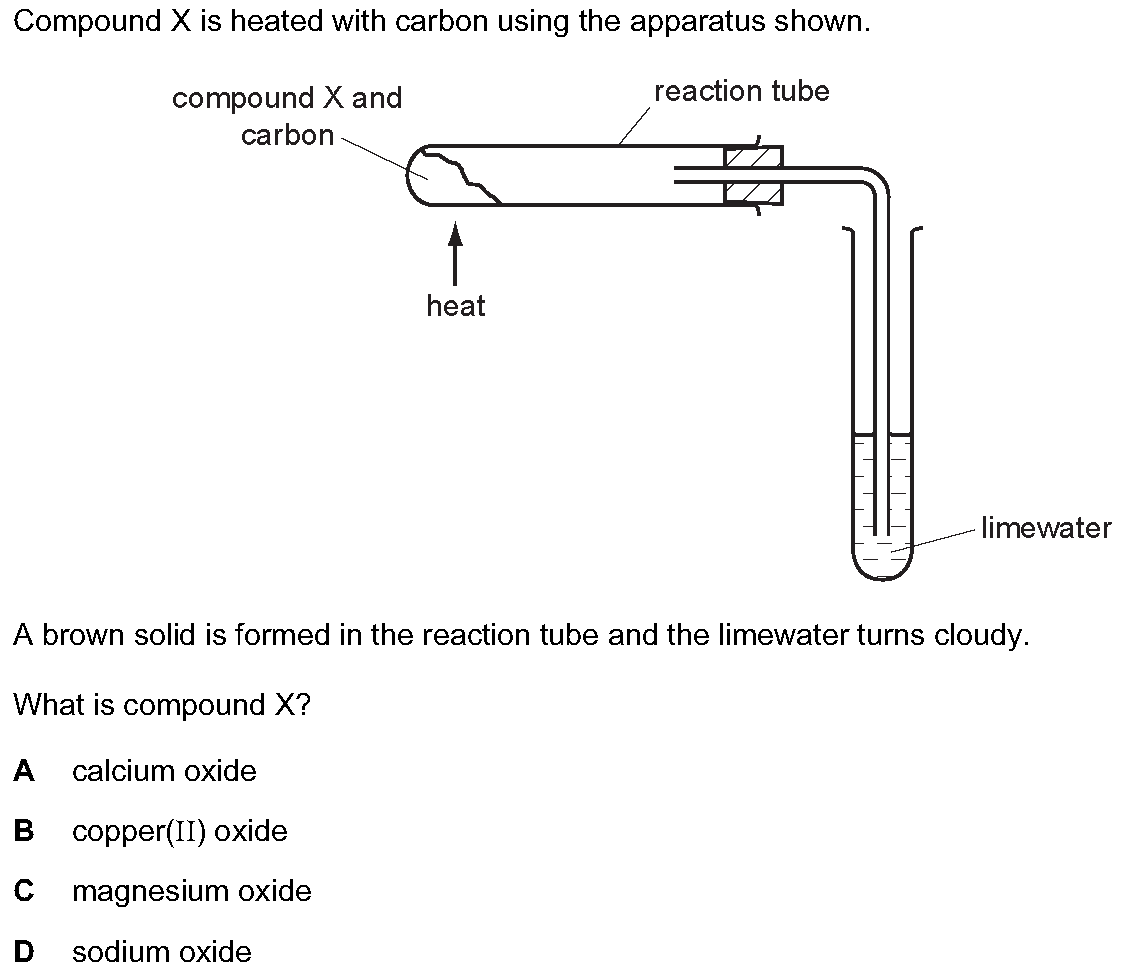
Compound X is heated with carbon using the apparatus shown.
compound X and reaction tube
carbon
limewater
A brown solid is formed in the reaction tube and the limewater turns cloudy.
What is compound X?
A calcium oxide
B copper(II) oxide
C magnesium oxide
D
sodium oxide
compound X and reaction tube
carbon
limewater
A brown solid is formed in the reaction tube and the limewater turns cloudy.
What is compound X?
A calcium oxide
B copper(II) oxide
C magnesium oxide
D
sodium oxide
Options:
A
B
C
D
Correct Key: B
A
B
C
D
Correct Key: B
Question 4
Paper Ref: 0620/23_Summer_2022_Q26
Paper Ref: 0620/23_Summer_2022_Q26
Some properties of four elements, P, Q, R and S, are shown.
Solid P reacts with dilute hydrochloric acid to give hydrogen.
Solid Q does not conduct electricity.
Solid R is used to make saucepans because it is a good conductor of heat.
Solid S reacts with oxygen to form a compound where atoms of S share electrons with
atoms of oxygen.
Which elements are metals?
A PandR B PandS C QandR D QandS
Options:
A
B
C
D
Correct Key: A
A
B
C
D
Correct Key: A
Question 5
Paper Ref: 5129/11_Summer_2024_Q21
Paper Ref: 5129/11_Summer_2024_Q21
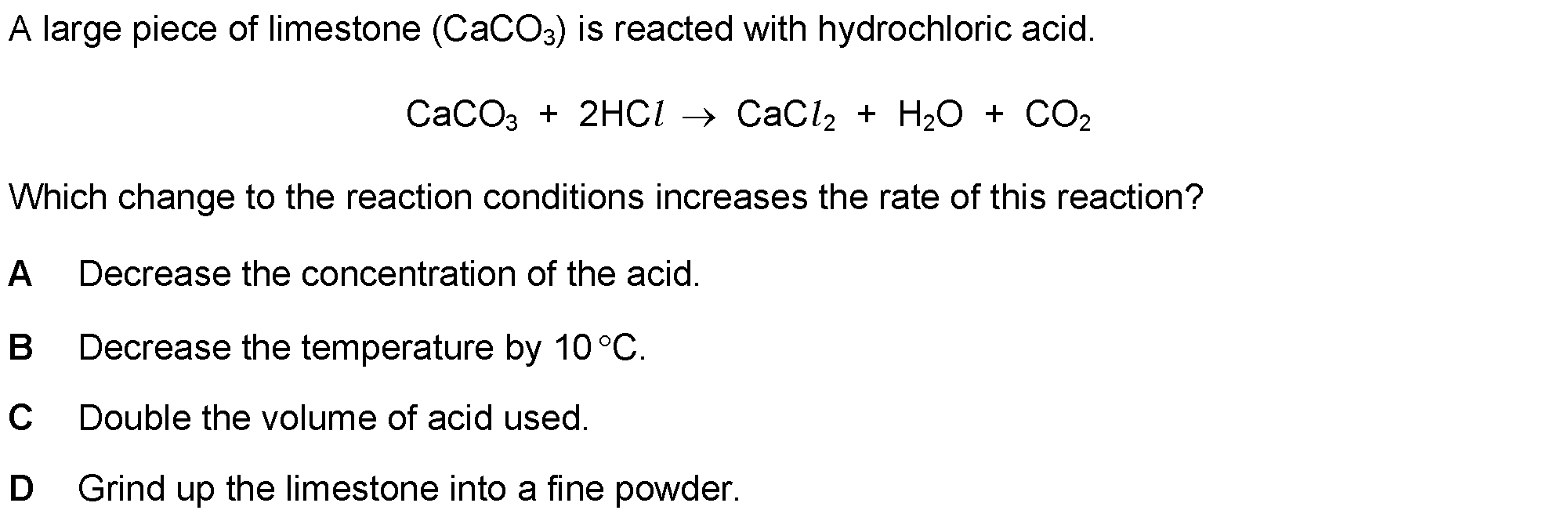
A large piece of limestone (CaCQs) is reacted with hydrochloric acid.
Which change to the reaction conditions increases the rate of this reaction?
A
B
Cc
D
Decrease the concentration of the acid.
Decrease the temperature by 10°C.
Double the volume of acid used.
Grind up the limestone into a fine powder.
Which change to the reaction conditions increases the rate of this reaction?
A
B
Cc
D
Decrease the concentration of the acid.
Decrease the temperature by 10°C.
Double the volume of acid used.
Grind up the limestone into a fine powder.
Options:
A
B
C
D
Correct Key: D
A
B
C
D
Correct Key: D
Question 6
Paper Ref: 0620/11_Summer_2024_Q25
Paper Ref: 0620/11_Summer_2024_Q25
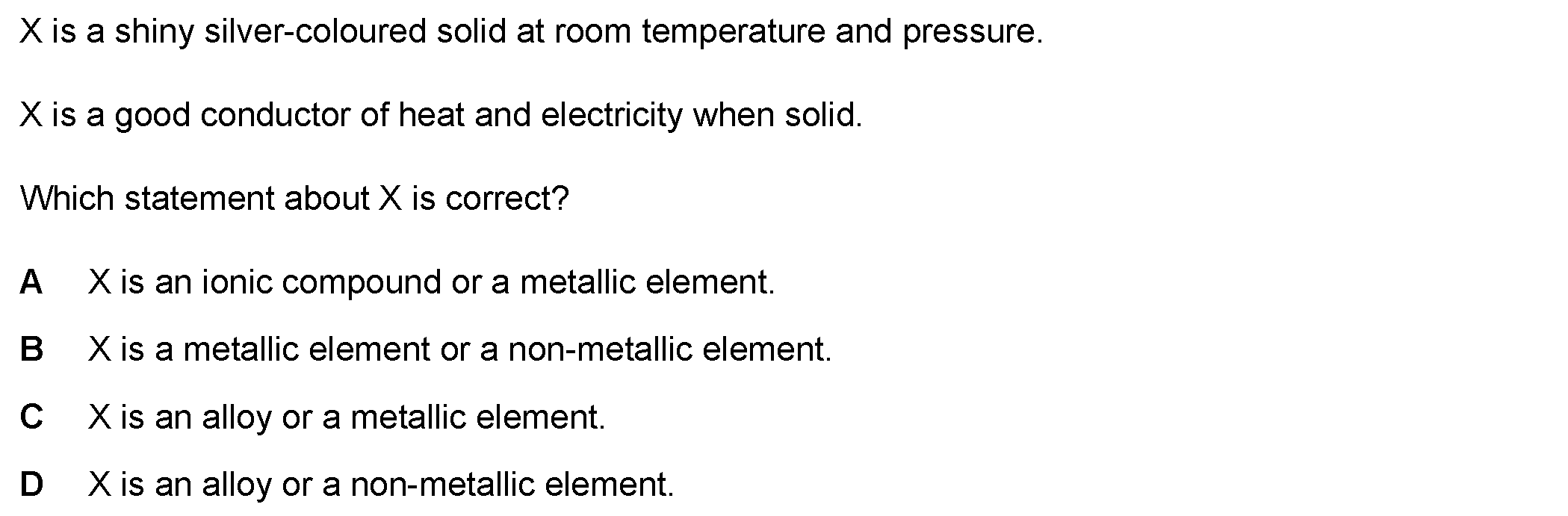
X is a shiny silver-coloured solid at room temperature and pressure.
X is a good conductor of heat and electricity when solid.
Which statement about X is correct?
A
B
Cc
D
X is an ionic compound or a metallic element.
X is a metallic element or a non-metallic element.
X is an alloy or a metallic element.
X is an alloy or a non-metallic element.
X is a good conductor of heat and electricity when solid.
Which statement about X is correct?
A
B
Cc
D
X is an ionic compound or a metallic element.
X is a metallic element or a non-metallic element.
X is an alloy or a metallic element.
X is an alloy or a non-metallic element.
Options:
A
B
C
D
Correct Key: C
A
B
C
D
Correct Key: C
Question 7
Paper Ref: 5129/12_Winter_2021_Q21
Paper Ref: 5129/12_Winter_2021_Q21
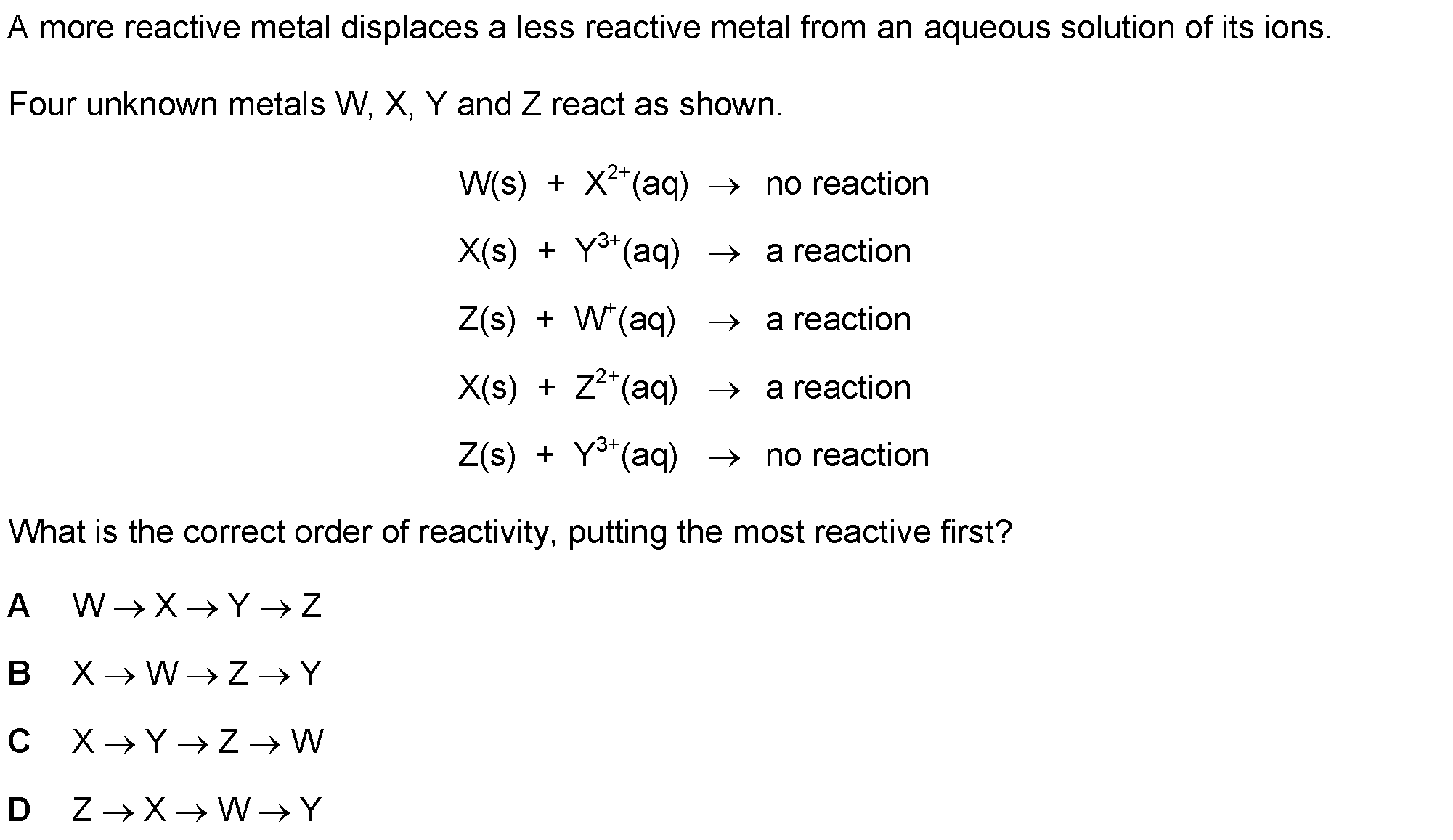
A more reactive metal displaces a less reactive metal from an aqueous solution of its ions.
Four unknown metals W, X, Y and Z react as shown.
W(s) + X?*(aq) no reaction
X(s) + Y**(aq) a reaction
a reaction
+5
+5
Z(s) + W'(aq) —> areaction
X(s) + Z°*(aq) >
+5
Z(s) + Y**(aq) no reaction
What is the correct order of reactivity, putting the most reactive first?
WoK3Y>Zz
Xe>W>2Z>5Y
X>YOZ5W
0 0O WwW F
Zo KOWRO>Y
Options:
A
B
C
D
Correct Key: C
A
B
C
D
Correct Key: C
Question 8
Paper Ref: 0620/21_Winter_2020_Q32
Paper Ref: 0620/21_Winter_2020_Q32
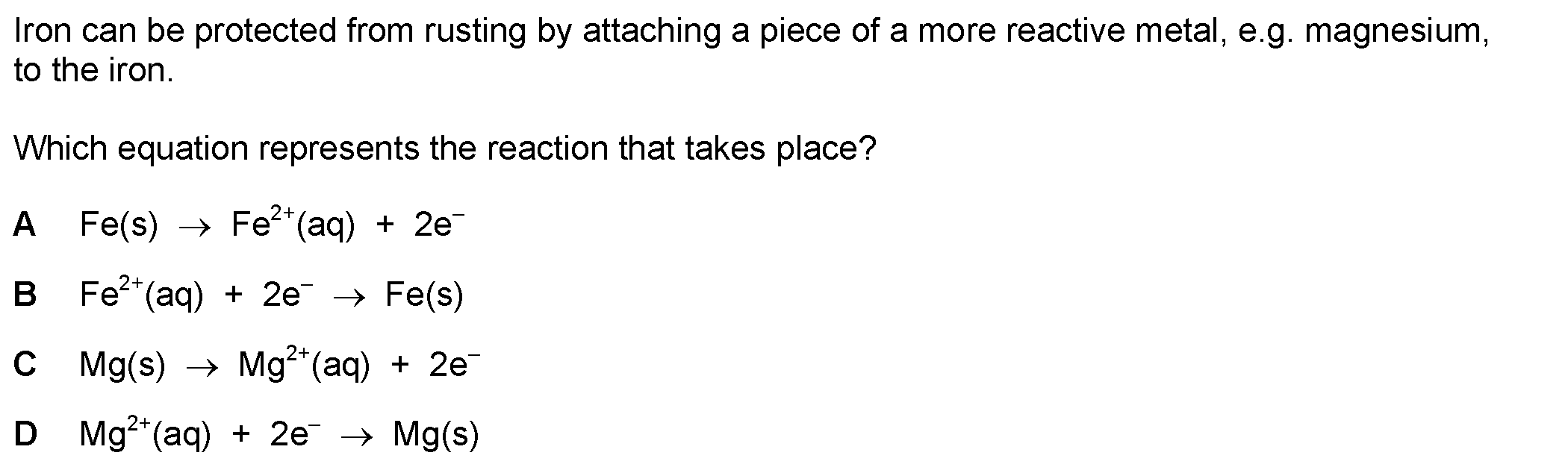
Iron can be protected from rusting by attaching a piece of a more reactive metal, e.g. magnesium,
to the iron.
Which equation represents the reaction that takes place?
A Fe(s) — Fe?*(aq) + 2e
B Fe*'(aq) + 2e > Fe(s)
C Mg(s) > Mg**(aq) + 2e
D Mg*(aq) + 2e —> Mg(s)
to the iron.
Which equation represents the reaction that takes place?
A Fe(s) — Fe?*(aq) + 2e
B Fe*'(aq) + 2e > Fe(s)
C Mg(s) > Mg**(aq) + 2e
D Mg*(aq) + 2e —> Mg(s)
Options:
A
B
C
D
Correct Key: C
A
B
C
D
Correct Key: C
Structured Questions Mark Scheme & Answers
•1•.• • • •[•▍• •S•P• •S•8• •P•2• • •·• • •Q•8• • •P•a•r•t• •(•c•)• • •·• • •S•p•e•c•i•m•e•n• • •·• • •L•o•w•e•r• •S•e•c• •0•8•9•3•]• • • • • • •c•a•l•c•i•u•m• •h•y•d•r•o•x•i•d•e• •2• •••c•c•e•p•t• •C•a•(•O•H•)•2• •b•u•t• •n•a•m•e• •t•a•k•e•s• •p•r•e•c•e•d•e•n•c•e• •h•y•d•r•o•g•e•n• •••c•c•e•p•t• •H•2• •/• •H• •b•u•t• •n•a•m•e• •t•a•k•e•s• •p•r•e•c•e•d•e•n•c•e• •©• •U•C•L•E•S• •2•0•2•0• •P•a•g•e• •7• •o•f• •1•0• •S•8•/•0•2• •S•c•i•e•n•c•e• •S•t•a•g•e• •8• •P•a•p•e•r• •2• •M•a•r•k• •S•c•h•e•m•e• •F•r•o•m• •2•0•2•0•
•2•.• • • •[•▍• •S•P• •S•8• •P•2• • •·• • •Q•1•1• • •P•a•r•t• •(•a•)• • •·• • •S•p•e•c•i•m•e•n• • •·• • •L•o•w•e•r• •S•e•c• •0•8•9•3•]• • • • • • •t•o• •m•a•k•e• •i•t• •a• •f•a•i•r• •t•e•s•t• •/• •t•o• •c•o•n•t•r•o•l• •t•h•e• •v•a•r•i•a•b•l•e•s• •1• •I•g•n•o•r•e• •r•e•f•e•r•e•n•c•e•s• •t•o• •r•e•l•i•a•b•i•l•i•t•y• •o•r• •a•c•c•u•r•a•c•y•
•3•.• • • •[•▍• •S•P• •S•8• •P•2• • •·• • •Q•1•1• • •P•a•r•t• •(•b•)• • •·• • •S•p•e•c•i•m•e•n• • •·• • •L•o•w•e•r• •S•e•c• •0•8•9•3•]• • • • • • •m•e•a•s•u•r•e• •t•h•e• •t•e•m•p•e•r•a•t•u•r•e• •(•o•f• •t•h•e• •a•c•i•d•)• •b•e•f•o•r•e• •a•d•d•i•n•g• •m•e•t•a•l• •2• •m•e•a•s•u•r•e• •t•e•m•p•e•r•a•t•u•r•e• •a•t• •s•t•a•r•t• •a•n•d• •e•n•d• •/• •m•e•a•s•u•r•e• •t•h•e• •t•e•m•p•e•r•a•t•u•r•e• •c•h•a•n•g•e• •=• •2• •m•a•r•k•s• •m•e•a•s•u•r•e• •t•h•e• •t•e•m•p•e•r•a•t•u•r•e• •o•f• •t•h•e• •r•e•a•c•t•i•o•n• •m•i•x•t•u•r•e• •a•t• •t•h•e• •e•n•d• •o•f• •t•h•e• •r•e•a•c•t•i•o•n• •••c•c•e•p•t• •m•e•a•s•u•r•e• •t•h•e• •t•e•m•p•e•r•a•t•u•r•e• •=• •1• •m•a•r•k• •i•f• •n•o• •o•t•h•e•r• •m•a•r•k• •a•w•a•r•d•e•d• •I•g•n•o•r•e• •o•t•h•e•r• •m•e•a•s•u•r•e•m•e•n•t•s•
•4•.• • • •[•▍• •P•T• •S•8• •2•0•2•5• •P•1• • •·• • •Q•1•4• • •·• • •2•0•2•5• • •·• • •L•o•w•e•r• •S•e•c• •0•8•9•3•]• • • • • • •n•o• •t•i•c•k•e•d• •(•n•o• •m•a•r•k•)• •3• •e•a•c•h• •c•o•r•r•e•c•t• •a•n•s•w•e•r• •=• •1• •m•a•r•k• •a•n•y• •t•h•r•e•e• •f•r•o•m• •N•o•t•e• •f•o•r• •3• •m•a•r•k•s• •a•n•s•w•e•r•s• •m•u•s•t• •q•u•o•t•e• •i•n•f•o•r•m•a•t•i•o•n• •f•r•o•m• •t•h•e• •t•a•b•l•e• •m•o•s•t• •r•e•a•c•t•i•v•e• •i•s• •c•a•l•c•i•u•m• •a•s• •i•t• •h•a•s• •t•h•e• •l•o•w•e•s•t• •t•i•m•e• •m•a•g•n•e•s•i•u•m• •h•a•s• •t•h•e• •s•e•c•o•n•d• •l•o•w•e•s•t• •t•i•m•e• •a•n•d• •i•s• •t•h•e• •n•e•x•t• •m•o•s•t• •r•e•a•c•t•i•v•e• •z•i•n•c• •h•a•s• •t•h•e• •t•h•i•r•d• •l•o•w•e•s•t• •t•i•m•e• •a•n•d• •i•s• •t•h•i•r•d• •i•n• •t•h•e• •l•i•s•t• •o•f• •r•e•a•c•t•i•v•i•t•i•e•s• •c•o•p•p•e•r• •d•o•e•s• •n•o•t• •r•e•a•c•t• •a•n•d• •i•s• •t•h•e•r•e•f•o•r•e• •t•h•e• •l•e•a•s•t• •r•e•a•c•t•i•v•e• •••c•c•e•p•t• •o•r•d•e•r• •o•f• •r•e•a•c•t•i•v•i•t•y• •s•h•o•u•l•d• •b•e• •c•a•l•c•i•u•m•,• •m•a•g•n•e•s•i•u•m•,• •z•i•n•c•,• •c•o•p•p•e•r• •=• •2• •m•a•r•k•s• •©• •U•C•L•E•S• •2•0•2•5• •P•a•g•e• •1•3• •o•f• •1•4• •S•8•/•0•1• •S•c•i•e•n•c•e• •S•t•a•g•e• •8• •P•a•p•e•r• •1• •M•a•r•k• •S•c•h•e•m•e• •2•0•2•5•
Last updated: